Chi Phí Tuyển Dụng Mass tại Việt Nam | 2027

Trong các chiến dịch mass hiring quy mô lớn, ngân sách thực tế hiếm khi dừng lại ở phí đăng tin hay hoa hồng agency. Bài toán chiến lược của lãnh đạo nhân sự là nhận diện đúng các chi phí ẩn: tổn thất từ vị trí bỏ trống, tuyển sai người và tỷ lệ tiêu hao nhân sự (turnover rate) giai đoạn đầu.

Bài viết sau từ ManNet bóc tách toàn bộ cấu trúc chi phí tuyển dụng số lượng lớn tại Việt Nam: từ công thức tính cost-per-hire (CPH), khung benchmark theo từng cấp độ vị trí, đến chiến lược tối ưu ngân sách mà không đánh đổi chất lượng ứng viên đầu vào.

Tóm Tắt Nhanh

  • Phương pháp tính cost-per-hire: Công thức bao gồm tổng chi phí tuyển dụng nội bộ và bên ngoài chia cho tổng số nhân sự tuyển được trong cùng kỳ. Đối với các chiến dịch mass hiring, doanh nghiệp nên phân tích CPH riêng theo từng nhóm vị trí để tránh sai lệch khi đánh giá.
  • Khung benchmark tại Việt Nam: Chi phí dao động từ 1-5 triệu đồng/nhân sự đối với lao động phổ thông đến 80-300 triệu đồng đối với cấp quản lý, biến thiên tùy theo đặc thù ngành và mô hình vận hành.
  • Nhận diện các khoản chi phí ẩn: Thời gian đầu tư của bộ phận tuyển dụng nội bộ và quản lý trực tiếp, tỷ lệ ứng viên không nhận việc, chi phí tái tuyển dụng cùng sự gián đoạn năng suất khi vị trí bị bỏ trống kéo dài là những yếu tố đẩy tổng chi phí thực tế lên rất cao.
  • So sánh chi phí nội bộ và thuê ngoài: Các giải pháp tuyển dụng hàng loạt hoặc khoán quy trình tuyển dụng (RPO) có thể áp dụng linh hoạt phí theo đầu người, gói dự án hoặc phí quản lý định kỳ. Bộ phận nhân sự cần đánh giá toàn diện phạm vi dịch vụ, cam kết triển khai và tổng chi phí sở hữu để lựa chọn mô hình phù hợp nhất với mục tiêu kinh doanh.
  • Đòn bẩy tối ưu ngân sách: Phát triển thương hiệu nhà tuyển dụng, chuẩn hóa quy trình sàng lọc tiền khả thi và liên tục đo lường tỷ lệ chuyển đổi theo từng kênh là những chìa khóa cốt lõi giúp giảm thiểu chi phí tuyển dụng, đồng thời đảm bảo chất lượng ứng viên và tiến độ cam kết.

Cấu Trúc Chi Phí Tuyển Dụng Số Lượng Lớn

Để đánh giá đúng ngân sách mass hiring, doanh nghiệp cần tính đến toàn bộ nguồn lực sử dụng trong quá trình tuyển dụng, thay vì chỉ nhìn vào các khoản chi phí thể hiện trên hóa đơn hoặc hợp đồng dịch vụ.

Theo chuẩn ANSI/SHRM 06001.2012, cost per hire (CPH) là chi phí tuyển dụng bình quân trên mỗi nhân sự được tuyển trong một kỳ xác định, bao gồm cả chi phí nội bộ và chi phí bên ngoài. (ANSI/SHRM Cost-per-Hire Standard)

Công thức tính:

Cost per hire (CPH) = (Tổng chi phí tuyển dụng nội bộ + Tổng chi phí tuyển dụng bên ngoài) / Tổng số nhân sự được tuyển trong kỳ

Trong đó:

  • Chi phí nội bộ: Lương và phúc lợi của đội ngũ TA/HR phân bổ theo thời gian dành cho tuyển dụng, thời gian tham gia tuyển chọn của quản lý tuyển dụng, chi phí hệ thống ATS và các nguồn lực nội bộ liên quan.
  • Chi phí bên ngoài: Phí đăng tin tuyển dụng, quảng cáo, dịch vụ headhunting hoặc RPO, tổ chức ngày hội tuyển dụng, kiểm tra và đánh giá ứng viên, cùng các chi phí bên ngoài khác phục vụ hoạt động tuyển dụng.

Với mass hiring, doanh nghiệp nên tính CPH riêng cho từng nhóm vị trí hoặc chiến dịch khi cần đánh giá hiệu quả cụ thể. Nếu gộp lao động phổ thông, nhân sự kỹ thuật và vị trí quản lý vào cùng một chỉ số, kết quả bình quân có thể che khuất sự khác biệt về chi phí giữa các nhóm.

Ví dụ minh họa

Một doanh nghiệp tuyển 20 nhân viên vận hành và 1 quản lý trong cùng quý, với tổng chi phí tuyển dụng nội bộ là 90 triệu đồng và chi phí bên ngoài là 150 triệu đồng.

  • Tổng chi phí tuyển dụng: 240 triệu đồng.
  • Tổng số nhân sự được tuyển: 21 người.
  • CPH gộp: 240 triệu / 21 ≈ 11,43 triệu đồng/người.

Đây là mức chi phí bình quân của toàn bộ chiến dịch. Chỉ số này chưa cho biết riêng việc tuyển nhân viên vận hành hay tuyển quản lý tốn kém hơn; để phân tích sâu hơn, doanh nghiệp cần phân bổ chi phí theo nhóm vị trí hoặc theo hoạt động tuyển dụng tương ứng.

Phân định ba nhóm chi phí cốt lõi trong tuyển dụng

Để quản trị tài chính hiệu quả trong các chiến dịch tuyển dụng quy mô lớn, doanh nghiệp cần phân tách rõ ràng cấu trúc chi phí thành ba nhóm độc lập:

Nhóm chi phí Thành phần chính Ví dụ trong thực tế
Chi phí tuyển dụng nội bộ Thời gian của bộ phận tuyển dụng và quản lý trực tiếp; tỷ lệ lương thưởng phân bổ; chi phí duy trì hệ thống ATS và hạ tầng hỗ trợ. Thời gian sàng lọc hồ sơ, hội đồng phỏng vấn, điều phối lịch trình và đàm phán thư mời nhận việc.
Chi phí tuyển dụng bên ngoài Phí đăng tin, ngân sách quảng cáo, hoa hồng dịch vụ đối tác, chi phí tổ chức sự kiện và công cụ đánh giá năng lực. Gói đăng tin trên các nền tảng việc làm, phí dịch vụ tuyển dụng trọn gói.
Chi phí đào tạo và hội nhập Chi phí đào tạo ban đầu, tài liệu hướng dẫn công việc, thời gian kèm cặp và các nguồn lực hỗ trợ nhân sự mới. Đào tạo an toàn lao động, hướng dẫn quy trình vận hành nhà máy và chuyển giao kỹ thuật thiết bị.

Lưu ý: Hai nhóm chi phí đầu thuộc phạm vi tính toán chỉ số cost-per-hire (CPH) theo tiêu chuẩn chuẩn hóa quốc tế (ANSI/SHRM). Chi phí đào tạo và hội nhập nên được theo dõi độc lập hoặc tích hợp vào một chỉ số chi phí mở rộng tùy thuộc vào mục tiêu phân tích chiến lược của doanh nghiệp. Việc phân loại rõ ràng này giúp tránh cộng dồn các khoản chi phí khác bản chất vào cùng một chỉ số.

Đối với các chiến dịch mass hiring, việc phân định từng nhóm chi phí chính là cơ sở để ban lãnh đạo kiểm soát chính xác dòng tiền và so sánh hiệu quả giữa các chiến dịch. Từ đó, bộ phận nhân sự có thể phân tích sâu hơn các biến số tác động đến chi phí và xác định chính xác các điểm cần ưu tiên trong kế hoạch phân bổ ngân sách.

Các Yếu Tố Quyết Định Ngân Sách Tuyển Dụng Quy Mô Lớn Tại Việt Nam

Chi phí tuyển dụng số lượng lớn tại thị trường Việt Nam phụ thuộc vào chuỗi biến số đa dạng: từ đặc thù vị trí, quy mô chiến dịch, nguồn cung lao động theo khu vực địa lý cho đến năng lực tối ưu quy trình của doanh nghiệp.

Đối với các dự án cần huy động hàng chục đến hàng trăm nhân sự trong khoảng thời gian ngắn, việc chỉ nhìn vào ngân sách đăng tin hay phí dịch vụ ban đầu sẽ khiến nhà quản trị nhân sự đánh giá thấp tổng chi phí sở hữu. Chi phí thực tế còn bao gồm tài nguyên vận hành dành cho việc xử lý hồ sơ, thời gian phỏng vấn của cấp quản lý, tỷ lệ từ chối thư mời nhận việc, tình trạng bỏ việc ngay trước ngày nhận việc và nhu cầu tuyển bù sau giai đoạn hội nhập.

Để kiểm soát dòng tiền hiệu quả, bộ phận nhân sự cần nhận diện chính xác các yếu tố tác động trực tiếp đến ngân sách, đồng thời đo lường hiệu quả tuyển dụng dựa trên số lượng nhân sự thực tế đi vào vận hành và tỷ lệ giữ chân theo mốc mục tiêu.
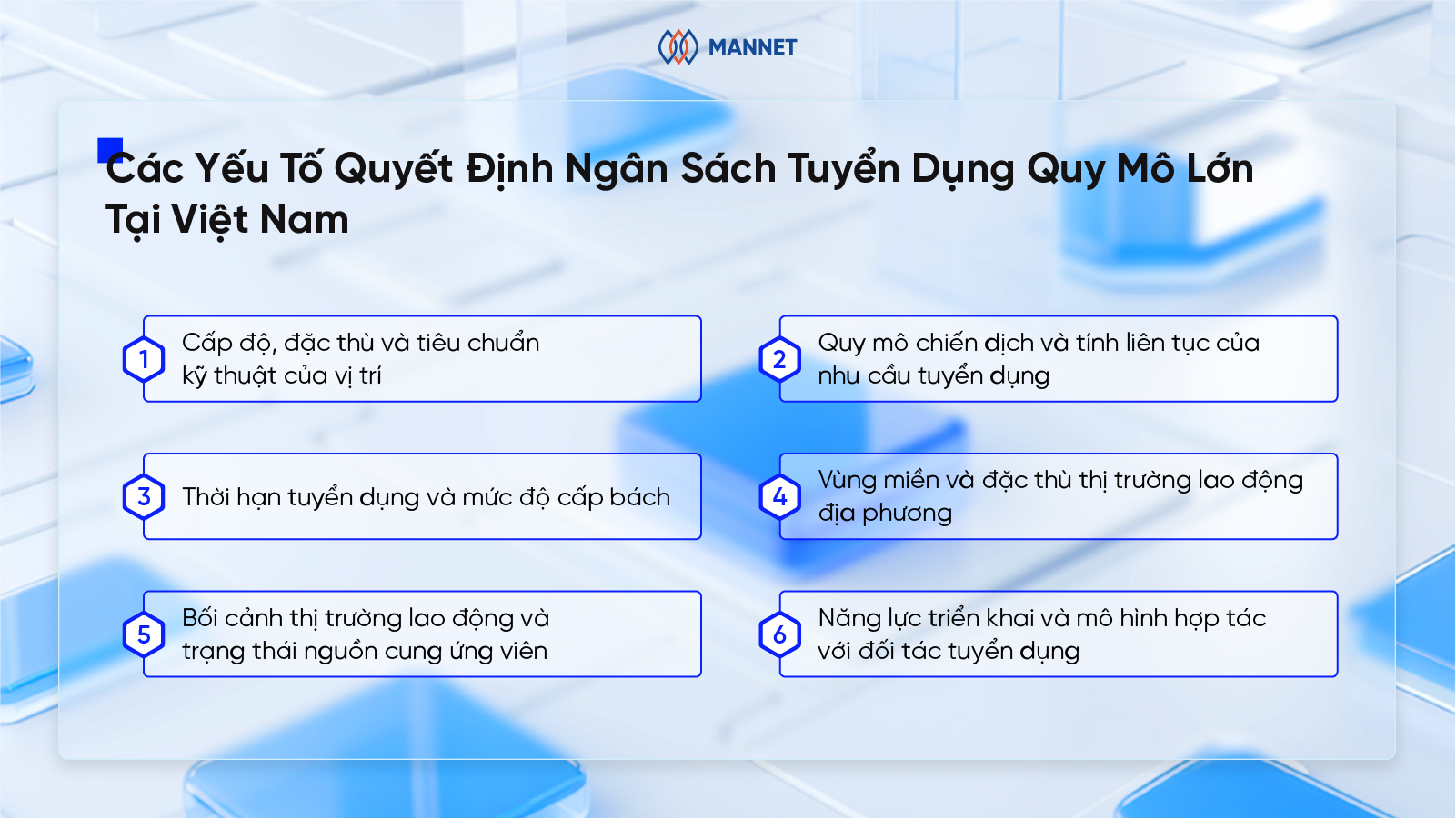
Các Yếu Tố Quyết Định Ngân Sách Tuyển Dụng Quy Mô Lớn Tại Việt Nam

1. Cấp độ, đặc thù và tiêu chuẩn kỹ thuật của vị trí

Độ phức tạp của chân dung ứng viên quyết định trực tiếp đến quy mô nguồn lực cần thiết cho khâu tìm kiếm, đánh giá và thu hút. Các vị trí phổ thông với nguồn ứng viên dồi dào có cấu trúc chi phí khác hoàn toàn so với các vị trí đòi hỏi kỹ năng chuyên sâu, năng lực quản lý hoặc chứng chỉ đặc thù.

  • Nhóm vị trí phổ thông (sản xuất, kho vận, dịch vụ khách hàng): Chiến dịch tập trung tối đa vào bán kính tiếp cận ứng viên, tốc độ sàng lọc quy mô lớn và tỷ lệ nhận việc thực tế.
  • Nhóm vị trí kỹ thuật & quản lý (kỹ sư vận hành CNC, kỹ sư tự động hóa, quản lý sản xuất): Quy trình đòi hỏi bổ sung các bước kiểm tra năng lực thực hành, đánh giá kinh nghiệm thực chiến và xác minh lịch sử làm việc.

Đối với các giải pháp tuyển dụng chuyên nghiệp, cấu trúc chi phí sẽ thay đổi tùy theo mô hình hợp tác. Dịch vụ headhunting cho vị trí chuyên môn cao thường tính phí theo tỷ lệ phần trăm tổng thu nhập năm; trong khi các mô hình mass recruitment, RPO (Recruitment Process Outsourcing) hay cung ứng nhân lực lại áp dụng đơn giá theo đầu người (cost-per-head), phí trọn gói dự án hoặc cấu trúc phí hỗn hợp. Do đó, doanh nghiệp không nên áp dụng một định mức chi phí cào bằng cho toàn bộ danh mục tuyển dụng.

Khuyến nghị cho nhà quản trị nhân sự:

  • Phân nhóm nhu cầu trước khi lập ngân sách: Phân loại nhân sự thành các nhóm: lao động phổ thông, nghiệp vụ, kỹ thuật chuyên sâu và quản lý để đánh giá đúng mức độ thách thức của từng phân khúc.
  • Tối ưu hóa bộ tiêu chí tuyển chọn (scorecard): Phân định rõ ràng giữa tiêu chuẩn bắt buộc và các kỹ năng có thể đào tạo sau khi nhận việc. Cách tiếp cận này giúp mở rộng phễu ứng viên tiềm năng và tránh loại bỏ nhân sự phù hợp vì những yêu cầu không thiết yếu.
  • Chuẩn hóa khung thỏa thuận với đối tác: Rõ ràng hóa đơn giá, phạm vi công việc, cam kết mốc thời gian (SLA), chính sách bảo hành/tái tuyển dụng và các điều khoản chi phí phát sinh trước khi kích hoạt chiến dịch.

2. Quy mô chiến dịch và tính liên tục của nhu cầu tuyển dụng

Quy mô tuyển dụng tác động đồng thời đến chi phí trên từng nhân sự (cost-per-head) và tổng ngân sách của toàn bộ chiến dịch.

Một chiến dịch thu hút hàng trăm nhân sự cùng lúc đòi hỏi hạ tầng vận hành phải có khả năng chịu tải cao: từ kênh thu hút ứng viên, công cụ sàng lọc tự động, năng lực phỏng vấn của hội đồng cho đến quy trình đào tạo hội nhập. Trái lại, nếu doanh nghiệp duy trì nhu cầu tuyển dụng ổn định theo kế hoạch, bộ phận nhân sự có thể chủ động tích lũy nguồn ứng viên dự phòng, phân bổ nguồn lực đều đặn và tránh việc phải thiết lập lại quy trình từ đầu cho mỗi đợt phát sinh.

Chiêu mộ nhân sự quy mô lớn giúp doanh nghiệp tối ưu đơn giá nhờ lợi thế quy mô. Tuy nhiên, nếu nhu cầu biến động đột ngột hoặc vượt quá năng lực xử lý của hệ thống, tổng chi phí thực tế sẽ tăng nhanh do xuất hiện các điểm nghẽn trong phễu tuyển dụng (chẳng hạn như quá tải ở khâu sàng lọc hồ sơ, dồn ứ lịch phỏng vấn với quản lý hoặc nghẽn thủ tục tiếp nhận nhân sự mới).

Khuyến nghị cho nhà quản trị nhân sự:

  • Chia nhỏ kế hoạch tuyển dụng theo phân kỳ: Chia tổng nhu cầu thành các đợt tuyển theo tuần hoặc theo lịch hội nhập, bám sát tiến độ vận hành thực tế thay vì tuyển ồ ạt cùng lúc.
  • Chủ động quản trị nguồn ứng viên dự phòng: Lưu trữ và phân loại danh sách ứng viên tiềm năng đã qua sàng lọc để sẵn sàng kết nối ngay khi phát sinh nhu cầu tuyển bù.
  • Đàm phán thương mại dựa trên quy mô tổng thể: Cung cấp dự báo nhu cầu tuyển dụng theo quý hoặc năm cho đối tác làm cơ sở áp dụng chính sách ưu đãi theo quy mô hoặc triển khai mô hình khoán quy trình (RPO).
  • Kiểm soát năng lực xử lý tại từng công đoạn: Theo dõi số lượng CV được lọc, số lượt phỏng vấn và số nhân sự nhận việc mỗi ngày. Việc nhận diện chính xác công đoạn đang bị quá tải sẽ giúp doanh nghiệp điều chỉnh đúng điểm nghẽn, tránh lãng phí ngân sách vào việc gia tăng quảng cáo không cần thiết.

3. Thời hạn tuyển dụng và mức độ cấp bách

Thời gian cho phép càng ngắn so với khối lượng nhân sự cần tuyển, áp lực đè nặng lên ngân sách và hạ tầng vận hành càng lớn.

Khi buộc phải huy động gấp hàng trăm nhân sự trong thời gian ngắn, doanh nghiệp thường phải chịu các khoản chi phí phát sinh: mở rộng dồn dập các kênh đăng tuyển trả phí, gia tăng nhân sự hỗ trợ sàng lọc, tổ chức hội đồng phỏng vấn tăng ca, hoặc nâng cao mức lương và phụ cấp để tạo lợi thế cạnh tranh trước các đối thủ trên thị trường.

Đối với các khối sản xuất, kho vận hay dịch vụ, tiến độ tuyển dụng còn phụ thuộc chặt chẽ vào các thủ tục tiền hội nhập: từ lịch trình đào tạo, khám sức khỏe định kỳ, hoàn thiện hồ sơ lao động cho đến khả năng sắp xếp ca làm việc. Một chiến dịch dù thu hút thành công lượng lớn hồ sơ nhưng không chuyển đổi được thành nhân sự thực tế bắt đầu làm việc đúng hạn vẫn sẽ đẩy doanh nghiệp vào tình thế tốn kém chi phí tuyển bù.

Khuyến nghị cho nhà quản trị nhân sự:

  • Thiết lập khung thời gian theo từng phân kỳ: Thay vì chỉ ấn định một deadline chung cho toàn bộ chiến dịch, hãy chia nhỏ các mốc thời gian rõ ràng cho từng giai đoạn: tiếp cận, sàng lọc, phỏng vấn, phát hành thư mời nhận việc và chính thức hội nhập.
  • Chiến lược phân bổ nguồn lực theo trọng số vận hành: Ưu tiên ngân sách và lực lượng triển khai cho các vị trí tác động trực tiếp đến dây chuyền vận hành cốt lõi, tránh tình trạng dàn trải nguồn lực trên toàn bộ danh mục tuyển dụng.
  • Kiểm định sức hút của gói đãi ngộ: Thường xuyên đối chiếu mức lương, phụ cấp, chính sách ca làm việc và điều kiện hỗ trợ đi lại với mặt bằng chung tại khu vực địa lý để đảm bảo tính cạnh tranh.
  • Dự báo dòng chuyển đổi dựa trên dữ liệu lịch sử: Tính toán ngược số lượng thư mời cần phát hành dựa trên tỷ lệ chấp nhận offer và tỷ lệ nhân sự thực sự đến nhận việc từ dữ liệu thực tế của các chiến dịch trước.

Chẳng hạn, để có 200 nhân sự đi làm ổn định, bộ phận nhân sự cần căn cứ vào các tỷ lệ chuyển đổi này để xác định chính xác số lượng hồ sơ cần tiếp cận ban đầu, thay vì chỉ đặt mục tiêu dựa trên con số thiếu hụt thuần túy.

4. Vùng miền và đặc thù thị trường lao động địa phương

Địa điểm làm việc tác động trực tiếp đến bán kính tiếp cận ứng viên, cường độ cạnh tranh giữa các nhà tuyển dụng và chi phí thu hút nhân sự thực tế.

Tại các trung tâm kinh tế lớn như Hà Nội và TP.HCM, doanh nghiệp có lợi thế tiếp cận nguồn lao động đa dạng nhưng phải đối mặt với áp lực cạnh tranh gay gắt từ nhiều ngành nghề. Trái lại, tại các tỉnh thành sở hữu khu công nghiệp tập trung lớn, nhu cầu tuyển dụng dồn dập từ nhiều nhà máy trong cùng một địa bàn có thể gây ra hiện tượng khan hiếm lao động cục bộ tại một số thời điểm cao điểm.

Bên cạnh đó, các yếu tố hạ tầng và chính sách hỗ trợ, như khoảng cách di chuyển, tuyến xe đưa đón, chi phí thuê trọ, phụ cấp chuyên cần và cơ cấu ca làm việc, đóng vai trò quyết định đối với tâm lý ứng tuyển và tỷ lệ gắn bó lâu dài. Nghiên cứu của OECD về thị trường lao động Việt Nam cũng chỉ ra sự phân hóa rõ rệt giữa các vùng kinh tế về phân bố việc làm, mặt bằng thu nhập và mức độ sẵn có của lực lượng lao động có kỹ năng.

Do đó, bộ phận quản trị không nên mặc định chi phí tuyển dụng tại các đô thị lớn luôn cao hơn ở các tỉnh theo một tỷ lệ cố định. Mức chênh lệch thực tế phụ thuộc vào tính chất vị trí, đặc thù ngành, gói tổng thu nhập và trạng thái cung – cầu lao động tại thời điểm triển khai.

Khuyến nghị cho nhà quản trị nhân sự:

  • Đánh giá nguồn cung theo bán kính di chuyển: Phân tích mật độ dân cư, các địa bàn lân cận và khả năng bố trí tuyến xe đưa đón để chủ động mở rộng phạm vi thu hút ứng viên.
  • Đánh giá năng lực cạnh tranh tổng thể: Đối chiếu tổng thu nhập, chế độ phụ cấp, lịch ca làm và điều kiện hỗ trợ đi lại với các doanh nghiệp cùng khu vực, thay vì chỉ so sánh mức lương cơ bản thuần túy.
  • Đa dạng hóa kênh thu hút theo đặc thù địa bàn: Kết hợp linh hoạt giữa nền tảng trực tuyến với mạng lưới giới thiệu nội bộ, kênh truyền thông cộng đồng địa phương, trung tâm giới thiệu việc làm và các cơ sở đào tạo nghề phù hợp với từng nhóm vị trí.
  • Đo lường tỷ lệ nhận việc và biến động nhân sự theo địa điểm: Liên tục theo dõi tỷ lệ nhận việc và tỷ lệ nghỉ việc sớm phân theo từng khu vực. Nếu một địa bàn liên tục ghi nhận chỉ số chuyển đổi thấp, doanh nghiệp cần rà soát lại nguyên nhân gốc rễ trước khi quyết định tiếp tục đổ thêm ngân sách quảng cáo.

5. Bối cảnh thị trường lao động và trạng thái nguồn cung ứng viên

Chi phí tuyển dụng quy mô lớn chịu sự tác động đa chiều từ động thái kinh tế vĩ mô, làn sóng mở rộng sản xuất của các doanh nghiệp, cường độ cạnh tranh trên thị trường và mức độ sẵn sàng về kỹ năng của lực lượng lao động.

Theo dữ liệu từ Cục Thống kê, vốn đầu tư trực tiếp nước ngoài (FDI) thực hiện tại Việt Nam đạt khoảng 27,62 tỷ USD, tăng 9% so với năm trước và ghi nhận mức cao nhất trong giai đoạn 5 năm. Cùng thời điểm, tỷ lệ lao động qua đào tạo có bằng, chứng chỉ đạt 29,2%.

Những chỉ số vĩ mô này phản ánh quy mô mở rộng đầu tư và bức tranh chất lượng nguồn nhân lực, nhưng không đồng nghĩa với việc mọi ngành nghề đều rơi vào trạng thái thiếu hụt nhân sự hay chịu đà tăng chi phí cào bằng. Tác động thực tế sẽ phân hóa mạnh mẽ theo từng vùng kinh tế, đặc thù ngành và tiêu chuẩn kỹ thuật của từng nhóm vị trí.

  • Đối với khối sản xuất & kỹ thuật: Thách thức cốt lõi thường tập trung ở khâu thu hút ứng viên đáp ứng đúng tiêu chuẩn vận hành, trình độ ngoại ngữ hoặc chứng chỉ nghề đặc thù.
  • Đối với khối lao động phổ thông: Bài toán quản trị lại nằm ở khả năng phủ rộng điểm tiếp cận ứng viên, năng lực cạnh tranh về tổng thu nhập và tỷ lệ duy trì nhân sự sau giai đoạn hội nhập.

Khuyến nghị cho nhà quản trị nhân sự:

  • Cập nhật dữ liệu thị trường theo thời gian thực: Thường xuyên rà soát mặt bằng lương tuyển dụng, mật độ đối thủ cạnh tranh trên cùng địa bàn, thời gian lấp đầy trung bình và dung lượng nguồn cung tại địa phương trước khi kích hoạt chiến dịch.
  • Cấu trúc hóa nguồn dự phòng theo nhóm năng lực: Phân loại dữ liệu ứng viên theo kinh nghiệm thực chiến, chứng chỉ, trình độ ngoại ngữ và khả năng đáp ứng ca làm việc để sẵn sàng rút ngắn chu kỳ tìm kiếm khi phát sinh nhu cầu khẩn cấp.
  • Mở rộng phễu tuyển chọn có kiểm soát: Đối với các kỹ năng có khả năng chuyển giao ngắn hạn, doanh nghiệp nên xem xét tiếp nhận ứng viên từ các ngành nghề lân cận có nền tảng phù hợp, kết hợp xây dựng chương trình đào tạo gia tốc sau khi tiếp nhận.
  • Thiết lập kịch bản ngân sách linh hoạt: Đóng gói phương án ngân sách cơ sở đi kèm các kịch bản dự phòng, trong đó định sẵn hạn mức điều chỉnh ngân sách khi tỷ lệ chuyển đổi sụt giảm hoặc thời gian lấp đầy vị trí bị kéo dài vượt dự kiến.

6. Năng lực triển khai và mô hình hợp tác với đối tác tuyển dụng

Năng lực của đối tác tuyển dụng đóng vai trò quyết định đối với tổng chi phí sở hữu (total cost of acquisition) của một chiến dịch mass hiring, đặc biệt khi doanh nghiệp đối mặt với bài toán tuyển gấp, tuyển liên tục hoặc triển khai trên nhiều địa bàn cùng lúc.

Một đối tác đưa ra đơn giá ban đầu thấp nhưng thiếu hụt nguồn ứng viên mục tiêu, quy trình sàng lọc lỏng lẻo hoặc khả năng điều phối hạn chế sẽ tạo ra hiệu ứng ngược: bộ phận nhân sự nội bộ phải tốn thời gian xử lý lượng lớn hồ sơ không đạt, tổ chức nhiều vòng phỏng vấn lãng phí và liên tục phải tuyển bù cho các trường hợp không đến nhận việc.

Ngược lại, một đối tác sở hữu quy trình vận hành chuẩn hóa, cơ sở dữ liệu minh bạch và năng lực phối hợp hệ thống sẽ giúp rút ngắn chu kỳ xử lý, nâng cao tỷ lệ chuyển đổi ở từng công đoạn và kiểm soát tối ưu chi phí trên mỗi nhân sự thực tế bắt đầu làm việc.

Điểm cốt lõi trong quản trị là nhà lãnh đạo cần phân tách rõ ràng giữa phí dịch vụ thuần túy (service fee) và tổng chi phí để đạt mục tiêu (total cost to outcome). Hai đối tác với cấu trúc phí khác nhau có thể tạo ra hiệu quả kinh tế hoàn toàn trái ngược, phụ thuộc vào phạm vi cam kết, chất lượng ứng viên đầu vào và các điều khoản bảo hành hợp tác.

Khuyến nghị cho nhà quản trị nhân sự:

  • Đánh giá đối tác bằng hệ thống KPI chuẩn hóa: Liên tục theo dõi các chỉ số định lượng: thời gian cung cấp danh sách ứng viên đạt chuẩn (shortlist lead-time), tỷ lệ ứng viên đạt yêu cầu phỏng vấn, tỷ lệ chấp nhận thư mời nhận việc (offer acceptance rate), tỷ lệ thực tế đi làm (show-up rate) và tỷ lệ duy trì sau 30/60 ngày (early retention rate).
  • Minh bạch hóa phạm vi dịch vụ và cấu trúc chi phí: Làm rõ các hạng mục trọn gói, các khoản chi phí phát sinh riêng biệt, trách nhiệm phối hợp giữa hai bên và điều khoản tái tuyển dụng/bảo hành nhân sự.
  • Yêu cầu báo cáo tiến độ theo thời gian thực: Đối chiếu dữ liệu ứng viên qua từng công đoạn để nhận diện chính xác điểm nghẽn xuất phát từ nguồn cung, bộ tiêu chí tuyển chọn, mức độ hấp dẫn của gói đãi ngộ hay quy trình hội nhập.
  • Triển khai thử nghiệm trước khi mở rộng quy mô: Với các chiến dịch quy mô lớn hoặc đa địa bàn, doanh nghiệp nên bắt đầu bằng một dự án mẫu tại một nhóm vị trí hoặc khu vực trọng điểm để kiểm định năng lực vận hành thực tế của đối tác trước khi chính thức ký kết hợp tác toàn diện.

Khung quản trị giúp nhà lãnh đạo nhân sự kiểm soát tổng chi phí mass hiring

Sáu yếu tố trên cho thấy ngân sách mass hiring cần được đánh giá dựa trên cả đầu vào, hiệu suất quy trình và kết quả nhân sự. Thay vì chỉ theo dõi tổng số tiền đã chi, bộ phận nhân sự nên kết hợp ba nhóm chỉ số sau:

Nhóm chỉ số Chỉ số cần theo dõi Ý nghĩa quản trị
Chi phí Cost per hire; chi phí theo kênh tuyển dụng Xác định ngân sách thực tế và kênh mang lại ứng viên hiệu quả
Hiệu suất Time-to-fill; tỷ lệ chuyển đổi qua từng giai đoạn; tỷ lệ chấp nhận offer Phát hiện điểm nghẽn làm tăng chi phí hoặc kéo dài tiến độ
Chất lượng Tỷ lệ đến nhận việc; tỷ lệ duy trì sau 30/60/90 ngày; tỷ lệ tuyển thay thế Đánh giá số nhân sự thực sự đáp ứng mục tiêu tuyển dụng

Đặc biệt, doanh nghiệp nên thống nhất cách tính chi phí trên mỗi nhân sự thực sự nhận việc. Một công thức quản trị có thể áp dụng là:

Chi phí trên mỗi nhân sự nhận việc = Tổng chi phí tuyển dụng trong chiến dịch / Số nhân sự thực sự bắt đầu làm việc

Tổng chi phí cần được xác định nhất quán, bao gồm những khoản doanh nghiệp muốn đưa vào phạm vi đo lường như phí đối tác, quảng cáo, nhân sự tuyển dụng nội bộ, đánh giá ứng viên và hoạt động tuyển bù. Với các chiến dịch cần đánh giá hiệu quả dài hạn, doanh nghiệp có thể bổ sung chi phí onboarding và dữ liệu duy trì nhân sự.

Khi đã có dữ liệu theo từng vị trí, địa điểm và kênh tuyển dụng, nhà quản trị nhân sự có thể xác định khoản chi nào đang tạo ra kết quả, khoản chi nào cần điều chỉnh và mức ngân sách hợp lý cho các chiến dịch tiếp theo.

Tóm lại: Kiểm soát chi phí mass hiring không chỉ là đàm phán mức phí thấp hơn. Đó là quá trình lập kế hoạch sát với nhu cầu thực tế, lựa chọn nguồn ứng viên phù hợp, quản lý hiệu suất tuyển dụng và đánh giá chất lượng nhân sự sau khi nhận việc. Khi các chỉ số được theo dõi nhất quán, bộ phận nhân sự có cơ sở dữ liệu rõ ràng hơn để phân bổ ngân sách, đánh giá đối tác và chứng minh hiệu quả tuyển dụng với ban lãnh đạo.

So Sánh Chi Phí Giữa Các Mô Hình Tuyển Dụng Số Lượng Lớn

Mỗi mô hình tuyển dụng có cách tính phí, yêu cầu nguồn lực và lợi thế riêng. Để xác định phương án phù hợp, bộ phận nhân sự cần xem xét không chỉ mức phí dịch vụ mà còn cả chi phí vận hành nội bộ, khả năng đáp ứng tiến độ và quy mô tuyển dụng thực tế.

Tại Việt Nam, doanh nghiệp có thể cân nhắc bốn mô hình phổ biến sau:

Mô hình Cách tính chi phí Phù hợp nhất với
Tuyển dụng nội bộ (In-house) Lương và phúc lợi của đội ngũ nhân sự/tuyển dụng, chi phí đăng tin, công cụ sourcing và hệ thống tuyển dụng Doanh nghiệp có nhu cầu tuyển dụng ổn định, đội ngũ nhân sự đủ năng lực và hạ tầng sẵn có
Headhunter / contingency Phí theo kết quả tuyển dụng, thường tính theo tỷ lệ phần trăm lương năm của ứng viên được tuyển Vị trí chuyên môn cao, quản lý hoặc nhu cầu tuyển số lượng ít
Nền tảng tuyển dụng (Job platforms) Phí theo tin đăng, gói dịch vụ hoặc thời hạn sử dụng; không nhất thiết phụ thuộc vào kết quả tuyển dụng Vị trí phổ biến, nguồn ứng viên dễ tiếp cận và thời hạn tuyển dụng linh hoạt
Mass recruitment / RPO thuê ngoài Phí theo đầu người, gói dự án, phí quản lý theo tháng hoặc cấu trúc thỏa thuận theo phạm vi dịch vụ Chiến dịch tuyển số lượng lớn, nhu cầu tuyển liên tục hoặc doanh nghiệp cần bổ sung năng lực tuyển dụng

Lưu ý: Đây là các cách tính phí phổ biến, không phải biểu phí cố định cho toàn thị trường. Một nhà cung cấp có thể áp dụng nhiều mô hình tùy theo số lượng tuyển, loại vị trí, thời hạn triển khai và phạm vi công việc.

Khi nào thuê ngoài tuyển dụng có thể tiết kiệm hơn tự tuyển?

Phí dịch vụ cao hơn không đồng nghĩa với tổng chi phí tuyển dụng cao hơn. Với một chiến dịch cần tuyển hàng trăm nhân sự trong thời gian ngắn, doanh nghiệp có thể phải tăng nhân lực tuyển dụng nội bộ, mở rộng kênh tìm kiếm và dành thêm thời gian cho sàng lọc, điều phối phỏng vấn và xử lý các trường hợp không đến nhận việc.

Trong trường hợp này, mass recruitment hoặc RPO có thể là phương án hiệu quả về chi phí nếu đối tác giúp giảm khối lượng công việc nội bộ, duy trì nguồn ứng viên phù hợp và đáp ứng tiến độ đã thống nhất. Ngược lại, nếu doanh nghiệp đã có đội ngũ tuyển dụng đủ mạnh và nhu cầu phát sinh không lớn, tự tuyển có thể phù hợp hơn.

Để so sánh công bằng, bộ phận nhân sự nên đánh giá ba yếu tố:

  • Tổng chi phí thực tế: Bao gồm phí dịch vụ, nguồn lực nội bộ và những khoản phát sinh trong quá trình tuyển dụng.
  • Hiệu suất triển khai: Số ứng viên đạt yêu cầu, thời gian cung cấp shortlist, tỷ lệ nhận việc và khả năng đáp ứng số lượng mục tiêu.
  • Chất lượng sau tuyển dụng: Tỷ lệ duy trì nhân sự, nhu cầu tuyển thay thế và mức độ đáp ứng yêu cầu công việc.

Chọn mô hình phù hợp với nhu cầu tuyển dụng

Với doanh nghiệp cần mở rộng đội ngũ vận hành nhanh nhưng đồng thời tuyển các vị trí kỹ thuật chuyên biệt, kết hợp nhiều mô hình có thể giúp phân bổ nguồn lực hợp lý hơn.

Chẳng hạn, doanh nghiệp có thể sử dụng dịch vụ mass recruitment của ManNet cho các chiến dịch tuyển dụng số lượng lớn, đồng thời cân nhắc RPO khi cần bổ sung năng lực tuyển dụng liên tục hoặc IT recruitment cho các vị trí công nghệ chuyên biệt.

ManNet cung cấp các phương án tuyển dụng với phạm vi và điều khoản được xác định theo nhu cầu thực tế. Doanh nghiệp nên yêu cầu báo giá chi tiết, thống nhất KPI và điều kiện thay thế trước khi quyết định mô hình hợp tác.

Điểm mấu chốt: Mô hình phù hợp nhất không nhất thiết là mô hình có mức phí thấp nhất, mà là mô hình đáp ứng được mục tiêu tuyển dụng với tổng chi phí, tiến độ và chất lượng nhân sự phù hợp với doanh nghiệp.

Chi Phí Ẩn: Những Khoản Ngân Sách Dễ Bị Bỏ Sót Trong Tuyển Dụng Quy Mô Lớn

Khi quy mô tuyển dụng mở rộng lên hàng trăm nhân sự, tổng chi phí sở hữu (total cost of acquisition) không chỉ dừng lại ở ngân sách đăng tin hay phí dịch vụ trả cho đối tác. Những khoản chi phí phát sinh từ vị trí bỏ trống, tuyển sai nhân sự, biến động lao động giai đoạn đầu và độ trễ thời gian đạt năng suất sẽ tích lũy theo cấp số nhân, tác động trực tiếp đến hiệu quả tài chính và năng lực vận hành của doanh nghiệp.
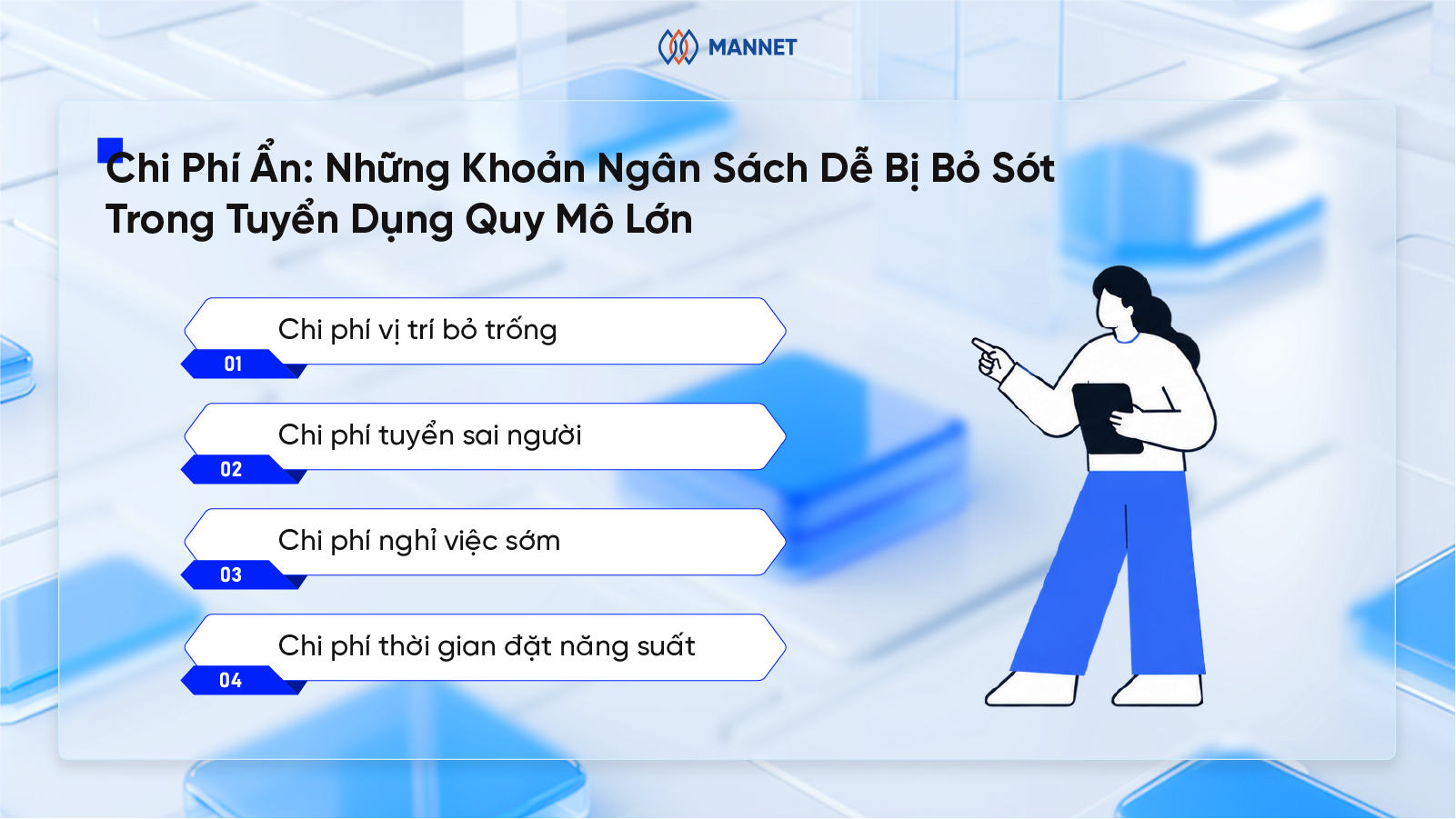
Chi Phí Ẩn: Những Khoản Ngân Sách Dễ Bị Bỏ Sót Trong Tuyển Dụng Quy Mô Lớn

1. Chi phí vị trí bỏ trống

Một vị trí chưa được lấp đầy phản ánh tổn thất trực tiếp về chi phí cơ hội. Doanh nghiệp buộc phải tái phân bổ khối lượng công việc, gia tăng chi phí tăng ca (overtime expense) hoặc chấp nhận chậm tiến độ vận hành.

Trong các chiến dịch mass hiring tại nhà máy, trung tâm dịch vụ khách hàng hay hệ thống vận hành theo ca, tác động này tạo ra hiệu ứng dây chuyền (compound effect). Việc thiếu hụt nhân sự trên diện rộng làm suy giảm trực tiếp các chỉ số cam kết chất lượng dịch vụ (SLA) và năng lực sản xuất tổng thể.

  • Chỉ số đo lường (KPIs): Tỷ lệ vị trí trống (vacancy rate), thời gian lấp đầy (time-to-fill) và chi phí nhân lực thay thế/tăng ca (overtime cost).
  • Khuyến nghị cho nhà quản trị: Tiến hành phân tích dòng thời gian phễu tuyển dụng (time-to-hire analysis) qua từng giai đoạn để nhận diện chính xác các điểm nghẽn vận hành. Trên cơ sở đó, bộ phận nhân sự cần tập trung ưu tiên nguồn lực để lấp đầy các vị trí có mức độ tác động cao nhất đến chuỗi vận hành cốt lõi.

2. Chi phí tuyển sai người

Một quyết định tuyển dụng không phù hợp ở quy mô lớn sẽ tạo ra chuỗi tổn thất cộng hưởng: ngân sách đào tạo lại bị lãng phí, thời gian quản lý tiêu tốn để can thiệp điều chỉnh, sự sụt giảm năng suất chung của tập thể và gia tăng chi phí tuyển mới thay thế.

Theo nghiên cứu của Robert Half, cấp quản lý mất trung bình 11 tuần để xử lý trường hợp nhân sự không đáp ứng yêu cầu công việc và mất thêm 8 tuần để tái tuyển dụng – tương đương một đợt gián đoạn vận hành kéo dài gần 5 tháng.

Nếu tiêu chuẩn đánh giá thiếu tính đồng nhất hoặc quy trình lọc hồ sơ không bám sát mô tả công việc, rủi ro tuyển sai sẽ nhân rộng trên toàn hệ thống, tạo áp lực tài chính nặng nề lên ngân sách tuyển dụng của doanh nghiệp.

  • Chỉ số đo lường cốt lõi (KPIs): Tỷ lệ không đạt thử việc (probation failure rate), Tỷ lệ tuyển thay thế (replacement rate) và Chi phí tái tuyển dụng (cost per re-hire).
  • Khuyến nghị cho nhà quản trị: Đo lường chất lượng nguồn tuyển (quality of hire by source) để xác định nguyên nhân gốc rễ; đồng thời chuẩn hóa bộ tiêu chí đánh giá (assessment scorecard) và thống nhất khung năng lực với quản lý chuyên môn (hiring manager) ngay từ khâu thiết lập yêu cầu đầu vào.

3. Chi phí nghỉ việc sớm

Sự sụt giảm nhân sự ngay trong những tháng đầu vận hành làm lãng phí toàn bộ ngân sách đã đầu tư cho khâu thu hút, sàng lọc và đào tạo hội nhập. Rủi ro này đặc biệt nghiêm trọng ở các khối sản xuất, kho vận và dịch vụ khách hàng, nơi tính ổn định của lực lượng lao động quyết định trực tiếp đến tiến độ và kế hoạch vận hành.

Báo cáo của SHRM về lực lượng lao động tuyến đầu chỉ ra: 56% chuyên gia nhân sự gặp thách thức lớn trong việc giữ chân lực lượng lao động không làm việc tại bàn (deskless workers), và 53% khẳng định năm đầu tiên là giai đoạn ghi nhận tỷ lệ biến động nhân sự cao nhất.

Dữ liệu trên phản ánh một thực tế quản trị: Tỷ lệ chấp nhận thư mời nhận việc (offer acceptance rate) chưa đủ để phản ánh hiệu quả tài chính của chiến dịch. Nếu tỷ lệ giữ chân giai đoạn đầu thấp, chi phí thực tế trên mỗi nhân sự đáp ứng yêu cầu sẽ vượt xa định mức ngân sách dự toán ban đầu.

  • Chỉ số đo lường cốt lõi (KPIs): Tỷ lệ giữ chân nhân sự theo các mốc 30/60/90 ngày (retention rate by milestones) và báo cáo phân tích nguyên nhân nghỉ việc (exit analytics).
  • Khuyến nghị cho nhà quản trị: Phân đoạn dữ liệu nghỉ việc (attrition segmentation) theo địa điểm, ca làm việc, nhóm vị trí và kênh thu hút ứng viên. Việc đối chiếu đa chiều này giúp bộ phận nhân sự nhận diện chính xác các điểm gãy trong trải nghiệm nhân sự, từ đó kịp thời điều chỉnh thông điệp tuyển dụng và nâng cao chất lượng chương trình đào tạo hội nhập.

4. Chi phí thời gian đạt năng suất

Mọi nhân sự mới đều cần một khoảng thời gian thích ứng (ramp-up period) để làm quen với hệ thống, thiết bị và quy trình vận hành trước khi đạt 100% hiệu suất kỳ vọng. Trong giai đoạn này, doanh nghiệp vẫn phải chi trả đầy đủ chi phí nhân sự và nguồn lực hỗ trợ, trong khi sản lượng đầu ra thực tế chưa chạm mức tối ưu.

Độ dài của giai đoạn thích ứng phụ thuộc trực tiếp vào độ phức tạp của vị trí công việc và chất lượng của chương trình đào tạo ban đầu. Việc áp dụng một tỷ lệ năng suất cào bằng cho toàn bộ các nhóm vị trí trong một chiến dịch tuyển dụng quy mô lớn sẽ dẫn đến những sai lệch đáng kể trong dự báo ngân sách và hiệu quả tài chính.

  • Chỉ số đo lường cốt lõi (KPIs): Thời gian đạt năng suất chuẩn (time-to-productivity), Tỷ lệ hoàn thành đào tạo (training completion rate) và Tỷ lệ đạt KPI sau giai đoạn thử việc.
  • Khuyến nghị cho nhà quản trị: Bộ phận nhân sự cần phối hợp chặt chẽ với bộ phận vận hành (operations) để thiết lập các mốc năng suất định lượng chi tiết theo từng tuần/tháng. Đồng thời, doanh nghiệp cần chuẩn hóa lộ trình đào tạo thực chiến nhằm rút ngắn tối đa thời gian để nhân sự mới chạm mốc năng suất mục tiêu.

Khung Tham Chiếu Chi Phí Tuyển Dụng (Cost-per-Hire Benchmark) Theo Phân Khúc Vị Trí Tại Việt Nam

Sau khi phân tách rõ ràng chỉ số cost-per-hire (CPH) của chiến dịch tuyển dụng quy mô lớn (mass hiring) khỏi quy trình tuyển dụng nhân sự cấp cao, doanh nghiệp cần một khung tham chiếu chuẩn hóa (market benchmark) để đánh giá và định vị tính hợp lý của mức chi phí thực tế.

Dưới đây là khung CPH ước tính dựa trên dữ liệu tổng hợp từ thị trường lao động và tuyển dụng tại Việt Nam:

Phân khúc vị trí Mức CPH ước tính (VND) Phương thức đo lường chính
Lao động phổ thông (Sản xuất, vận hành) 1 – 5 triệu / nhân sự Chi phí thu hút, sàng lọc quy mô lớn
Nhân viên sơ cấp (Entry-level) 5 – 12 triệu / nhân sự Phí kênh tuyển dụng & Thời gian tuyển chọn
Chuyên viên / Kỹ thuật viên cấp trung 15 – 40 triệu / nhân sự Phí nền tảng & Chi phí đánh giá chuyên môn
Nhân sự cao cấp / Team lead 30 – 80 triệu / nhân sự Phí dịch vụ đối tác & Chi phí cơ hội
Cấp Quản lý / Giám đốc 80 – 300 triệu / nhân sự Headhunter fee (15% – 25% tổng thu nhập năm)
Cấp Điều hành (C-level / VP) 200 triệu – 2 tỷ / nhân sự Retainer fee (25% – 35% tổng thu nhập năm)

(Nguồn: Tổng hợp và phân tích dữ liệu thị trường Việt Nam)

Hai biến số chiến lược cần lưu ý trong dự báo ngân sách mass hiring

Khi áp dụng bảng benchmark này vào bài toán tuyển dụng quy mô lớn, doanh nghiệp cần đưa hai yếu tố biến thiên sau vào mô hình tài chính:

  • Tác động của đặc thù ngành hình thành hai mô hình chi phí trái ngược: Các ngành công nghệ thông tin, tài chính – ngân hàng, FMCG và dược phẩm thường nằm ở ngưỡng trên của khung chi phí do mức độ cạnh tranh nhân tài khốc liệt. Trái lại, khối sản xuất và bán lẻ ghi nhận CPH trên từng lượt tuyển ở mức thấp hơn, nhưng tỷ lệ tiêu hao nhân sự (turnover rate) cao lại tạo nên tổng chi phí tuyển dụng cả năm (annual total cost) tương đương, do doanh nghiệp phải tái tuyển dụng liên tục.
  • Xu hướng tăng trưởng chi phí theo năm: Dữ liệu thị trường cho thấy CPH cho các vị trí chuyên môn đã ghi nhận mức tăng trung bình 8% – 12%/năm, phản ánh áp lực gia tăng từ thị trường lao động và chi phí thu hút ứng viên ngày càng cao.

Giải pháp tối ưu mô hình ngân sách từ ManNet

Để khắc phục rủi ro biến động ngân sách khi áp dụng CPH đơn lẻ, các mô hình hợp tác hiện đại hướng tới việc cố định chi phí theo hiệu quả chiến dịch.

ManNet cung cấp giải pháp tuyển dụng mass hiring với cấu trúc chi phí theo đầu người (cost-per-head) đi kèm cam kết mốc thời gian hoàn thành (service level agreement – SLA). Mô hình này giúp bộ phận TA chuyển đổi chi phí biến đổi thành chi phí cố định có thể dự báo, tối ưu hóa ngân sách theo chiến dịch thay vì chịu rủi ro phát sinh theo từng vị trí riêng lẻ.

Quy Trình Xây Dựng Ngân Sách Cho Chiến Dịch Tuyển Dụng Quy Mô Lớn

Sau khi nắm rõ cấu trúc chi phí, các yếu tố tác động và khung tham chiếu, bước tiếp theo của nhà quản trị là quy đổi toàn bộ các biến số thành một kế hoạch ngân sách cụ thể cho từng chiến dịch:
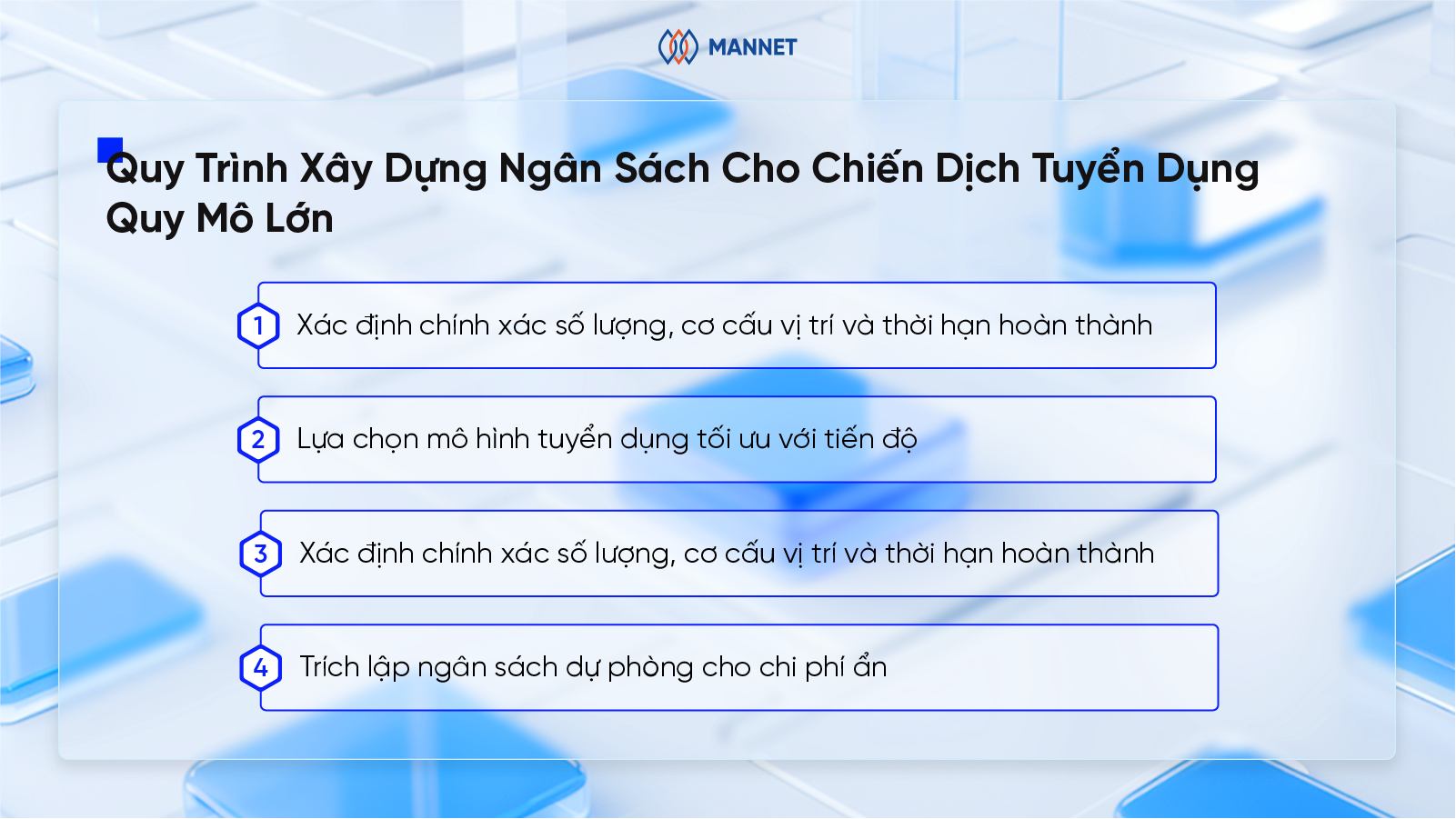
Quy Trình Xây Dựng Ngân Sách Cho Chiến Dịch Tuyển Dụng Quy Mô Lớn

1. Xác định chính xác số lượng, cơ cấu vị trí và thời hạn hoàn thành

Liệt kê rõ ràng số lượng vị trí vận hành, vị trí kỹ thuật và mốc thời gian nhân sự chính thức đi làm. Một kế hoạch thiếu tính chi tiết là nguyên nhân hàng đầu khiến chi phí thực tế vượt xa dự toán.

2. Lựa chọn mô hình tuyển dụng tối ưu với tiến độ

Đánh giá và quyết định giữa các phương án tự tuyển, headhunter hay thuê ngoài các dịch vụ mass recruitment/RPO. Mỗi mô hình sẽ kéo theo một cơ cấu phân bổ ngân sách khác nhau giữa chi phí vận hành nội bộ và chi phí dịch vụ bên ngoài.

3. Ước tính chi phí dựa trên khung tham chiếu và điều chỉnh theo bối cảnh

Sử dụng bảng benchmark CPH làm mốc khởi điểm, sau đó thực hiện điều chỉnh tăng/giảm dựa trên mức độ cạnh tranh của ngành (như IT, tài chính) hoặc đặc thù khan hiếm lao động tại địa bàn triển khai.

4. Trích lập ngân sách dự phòng cho chi phí ẩn

Với các chiến dịch có mức độ cấp bách cao hoặc vị trí trọng yếu, doanh nghiệp nên chủ động phân bổ từ 10% – 20% ngân sách trực tiếp để quản trị rủi ro từ vị trí bỏ trống kéo dài và chi phí tuyển sai người, thay vì để phát sinh bị động trong quá trình triển khai.

Ví dụ ngân sách minh họa:

Bối cảnh: Doanh nghiệp FDI mở rộng quy mô nhà máy, cần tuyển 200 vị trí vận hành và 10 vị trí kỹ thuật trong thời hạn 8 tuần.

Hạng mục Số lượng CPH ước tính Thành tiền
Vị trí vận hành 200 ~3.000.000 VND 600.000.000 VND
Vị trí kỹ thuật 10 ~25.000.000 VND 250.000.000 VND
Tổng chi phí trực tiếp 850.000.000 VND
Dự phòng chi phí ẩn (15%) ~127.500.000 VND
TỔNG NGÂN SÁCH DỰ KIẾN ~977.500.000 VND

Lưu ý: Đây là kịch bản minh họa dựa trên chỉ số CPH trung bình theo thị trường. Chi phí thực tế sẽ được điều chỉnh linh hoạt tùy thuộc vào đặc thù ngành, khu vực địa lý và mô hình đối tác triển khai.

Chiến Lược Tối Ưu Chi Phí Tuyển Dụng Quy Mô Lớn Nhưng Vẫn Đảm Bảo Chất Lượng

Cắt giảm chi phí tuyển dụng không đồng nghĩa với việc hạ thấp tiêu chuẩn sàng lọc hay triệt hạ ngân sách vận hành. Ngược lại, đòn bẩy tối ưu chi phí bền vững nhất luôn nằm ở chiến lược cắt giảm chi phí ẩn, thay vì nỗ lực ép giá phí dịch vụ đơn thuần:
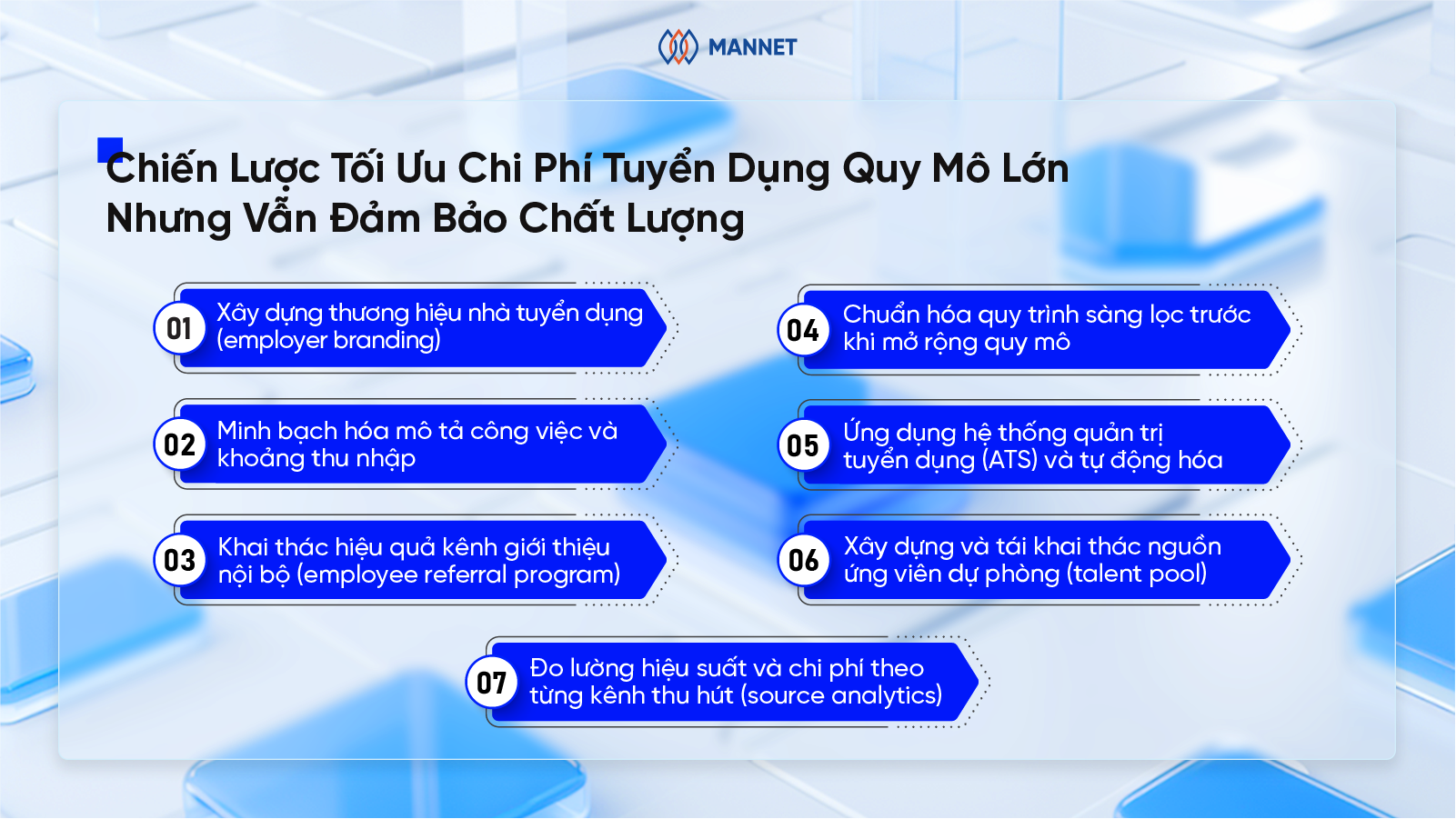
Chiến Lược Tối Ưu Chi Phí Tuyển Dụng Quy Mô Lớn Nhưng Vẫn Đảm Bảo Chất Lượng

1. Xây dựng thương hiệu nhà tuyển dụng (employer branding)

Đây là đòn bẩy có tác động chiến lược lớn nhất. Một thương hiệu tuyển dụng uy tín giúp giảm đến 43% chi phí trên mỗi ứng viên (cost-per-candidate). Các doanh nghiệp thuộc danh sách “Nơi làm việc tốt nhất” do Anphabe công bố cũng ghi nhận mức cắt giảm 30% – 40% tổng chi phí tuyển dụng thực tế.

Khuyến nghị hành động:

  • Số hóa trải nghiệm ứng viên (candidate experience): Xây dựng một trang tuyển dụng (career page) chuyên biệt, tối ưu trên thiết bị di động với quy trình ứng tuyển ngắn gọn (dưới 3 phút).
  • Khai thác nội dung thực tế (employee-generated content): Sản xuất các video/bài viết ngắn phản ánh môi trường làm việc thực tế, chế độ đãi ngộ và lộ trình phát triển từ chính nhân viên hiện tại để đăng tải lên mạng xã hội (LinkedIn, Facebook, TikTok).

2. Minh bạch hóa mô tả công việc và khoảng thu nhập

Việc biên soạn tin tuyển dụng chi tiết, nêu rõ quyền lợi và yêu cầu giúp loại bỏ ngay 30% – 40% hồ sơ không phù hợp từ đầu phễu. Đồng thời, công khai khoảng lương (salary range) giúp giảm 30% – 60% số lượng các buổi phỏng vấn bị sai lệch về kỳ vọng đãi ngộ.

Khuyến nghị hành động:

  • Chuẩn hóa JD theo dạng checklist: Thay thế các mô tả mơ hồ bằng danh mục 3-5 nhiệm vụ cốt lõi và 3 tiêu chuẩn “bắt buộc phải có” (must-have requirements).
  • Công khai cấu trúc total rewards: Nêu rõ các khoản phụ cấp (ăn trưa, đi lại, chuyên cần), thưởng năng suất và điều kiện ca làm việc ngay trong tin tuyển dụng để sàng lọc độ sẵn sàng của ứng viên trước vòng phỏng vấn.

3. Khai thác hiệu quả kênh giới thiệu nội bộ (employee referral program)

Chi phí thưởng giới thiệu nhân sự nội bộ thông thường chỉ bằng khoảng 1/3 so với phí dịch vụ săn tin (headhunter), trong khi tỷ lệ chấp nhận offer và độ gắn bó của ứng viên luôn vượt trội so với các kênh quảng cáo truyền thông.

Khuyến nghị hành động:

  • Thiết lập cơ chế thưởng phân kỳ: Chi trả tiền thưởng giới thiệu thành 2 đợt (50% khi ứng viên nhận việc, 50% sau khi vượt qua thử việc hoặc chạm mốc 90 ngày) để gắn trách nhiệm của người giới thiệu với chất lượng ứng viên.
  • Game hóa (gamify) chương trình: Đẩy mạnh truyền thông nội bộ theo từng chiến dịch, vinh danh các nhân viên giới thiệu thành công nhiều nhân sự trên các kênh tin tức nội bộ.

4. Chuẩn hóa quy trình sàng lọc trước khi mở rộng quy mô

Sử dụng các bài kiểm tra năng lực chuẩn hóa và bộ câu hỏi phỏng vấn theo khung năng lực ngay từ 20-30 hồ sơ đầu tiên. Việc thử nghiệm này giúp hoàn thiện phễu đánh giá trước khi áp dụng đại trà cho hàng trăm ứng viên, ngăn ngừa rủi ro tuyển sai hệ thống.

Khuyến nghị hành động:

  • Thiết lập bộ phiếu đánh giá (scorecard): Thống nhất với quản lý chuyên môn (hiring manager) bộ tiêu chí chấm điểm cố định (thang điểm 1-5 cho từng năng lực) để loại bỏ cảm tính cá nhân trong khi phỏng vấn.
  • Đưa bài test nhanh vào đầu phễu: Áp dụng bài kiểm tra thao tác/tư duy ngắn (10-15 phút) tự động ngay sau bước nộp hồ sơ để chỉ chuyển tiếp những ứng viên đạt chuẩn vào vòng phỏng vấn trực tiếp.

5. Ứng dụng hệ thống quản trị tuyển dụng (ATS) và tự động hóa

Tự động hóa các tác vụ lặp đi lặp lại như đăng tin, sàng lọc hồ sơ ban đầu và đặt lịch phỏng vấn giúp đội ngũ nhân sự tuyển dụng xử lý khối lượng vị trí lớn mà không cần gia tăng tương ứng định biên nhân lực nội bộ.

Khuyến nghị hành động:

  • Triển khai auto-responder & scheduling: Cấu hình hệ thống ATS tự động gửi xác nhận hồ sơ và tự động gửi link cho ứng viên chủ động chọn lịch phỏng vấn trống phù hợp.
  • Tích hợp chatbot sàng lọc ban đầu: Sử dụng chatbot trên Zalo/messenger/website để tự động hỏi các câu hỏi điều kiện (như độ tuổi, bằng cấp, ca làm việc) và loại các hồ sơ không đáp ứng điều kiện tiên quyết trước khi nhân sự phải thao tác thủ công.

6. Xây dựng và tái khai thác nguồn ứng viên dự phòng (talent pool)

Số hóa và lưu trữ cấu trúc hồ sơ ứng viên tiềm năng từ các chiến dịch trước. Việc chủ động tái kết nối với nguồn dữ liệu sẵn có sẽ giúp doanh nghiệp rút ngắn đáng kể thời gian lấp đầy vị trí (time-to-fill) và tiết kiệm chi phí tìm kiếm mới (sourcing cost).

Khuyến nghị hành động:

  • Gắn thẻ (tagging) dữ liệu ứng viên: Phân loại hồ sơ trong hệ thống ATS theo kỹ năng, khu vực sinh sống, nhóm vị trí và lý do chưa tuyển dụng trước đây (ví dụ: “Đạt phỏng vấn nhưng từ chối offer đợt 1”).
  • Vận hành chiến dịch chăm sóc nguồn (nurturing campaigns): Định kỳ gửi bản tin tuyển dụng hoặc cập nhật công việc mới cho danh sách talent pool qua Email/Zalo ZNS để giữ ấm kết nối.

7. Đo lường hiệu suất và chi phí theo từng kênh thu hút (source analytics)

Liên tục theo dõi chỉ số CPH và chất lượng ứng viên phân theo từng kênh tuyển dụng. Dữ liệu này là cơ sở để bộ phận nhân sự kiên quyết loại bỏ các kênh kém hiệu quả và tập trung nguồn lực tài chính vào các kênh có tỷ lệ chuyển đổi cao nhất.

Khuyến nghị hành động:

  • Gắn mã định danh UTM/source code: Đảm bảo mọi đường link đăng tin trên từng kênh (Facebook Ads, LinkedIn, TopCV, Zalo, mã QR poster) đều có mã tracking riêng biệt để đo chính xác số lượng và chất lượng hồ sơ về từ từng nguồn.
  • Đánh giá ROI kênh theo quý: Xây dựng báo cáo ma trận so sánh giữa chi phí đầu tư kênh và tỷ lệ nhân sự thử việc thành công. Ngắt ngân sách ngay đối với các kênh có chi phí đầu vào thấp nhưng tỷ lệ nghỉ việc sớm (early attrition) cao.

Cả 7 chiến lược trên đều đòi hỏi doanh nghiệp phải đầu tư hạ tầng công nghệ, hệ thống dữ liệu và thời gian tích lũy. Đây cũng chính là lý do khiến nhiều doanh nghiệp lựa chọn hợp tác cùng các đối tác tuyển dụng chuyên nghiệp, đơn vị đã sở hữu sẵn hạ tầng vận hành chuẩn hóa, thay vì tự xây dựng lại từ đầu cho mỗi chiến dịch.

Vai trò của đối tác mass recruitment trong tối ưu tổng chi phí sở hữu

Việc xây dựng và vận hành 7 chiến lược tối ưu hóa đòi hỏi nguồn lực đầu tư lớn về hạ tầng công nghệ, hệ thống dữ liệu và thời gian tích lũy. Đây là lý do các giải pháp tuyển dụng chuyên biệt từ ManNet thường được các doanh nghiệp FDI lựa chọn gắn trực tiếp với bài toán tài chính chiến lược:

  • Chuyển hóa chi phí ẩn thành chi phí dự báo được: Cam kết rõ ràng về thời gian cung cấp hồ sơ và chính sách bảo hành thông qua hệ thống SLA minh bạch cho từng nhóm vị trí, giúp doanh nghiệp chủ động hoạch định ngân sách từ đầu và triệt tiêu rủi ro vị trí trống kéo dài.
  • Giảm thiểu triệt để rủi ro tuyển sai: Kế thừa mạng lưới nguồn ứng viên đã được xác thực qua hàng trăm dự án thực tế, từ lao động vận hành/sản xuất đến nhân sự văn phòng và vận hành số (digital operations), giúp rút ngắn đáng kể vòng sàng lọc mà không cần hạ thấp tiêu chuẩn đầu vào.
  • Tích hợp đa dịch vụ trong cùng một đầu mối quản lý: Đối với các dự án mở rộng nhà máy đòi hỏi đồng thời hàng trăm vị trí vận hành và các vị trí kỹ thuật/IT chuyên sâu, mô hình tích hợp giữa mass recruitment, IT recruitment, IT staff augmentation và RPO của ManNet giúp doanh nghiệp loại bỏ các lớp phí quản lý trung gian và tối ưu thời gian điều phối.
  • Linh hoạt cấu trúc vận hành cho doanh nghiệp giai đoạn đầu: Đối với các doanh nghiệp chưa hoàn thiện pháp nhân tại Việt Nam (quy mô dưới 15-20 nhân sự), việc kết hợp mass recruitment với dịch vụ EOR hoặc HR consultation & set-up giúp loại bỏ hoàn toàn chi phí thành lập pháp nhân, kế toán và kiểm toán độc lập.
  • Minh bạch hóa dòng tiền lao động: Tích hợp dịch vụ bảng lương (payroll) giúp đội ngũ tài chính và nhân sự dự toán chính xác tổng chi phí nhân sự toàn diện (total labor cost bao gồm lương, bảo hiểm bắt buộc và phí quản lý) thay vì chỉ dừng lại ở chi phí tuyển dụng thuần túy.

Tóm lại, giá trị cốt lõi của một đối tác chiến lược như ManNet không nằm ở việc đưa ra mức phí dịch vụ thấp nhất, mà nằm ở năng lực thực thi giúp kéo tổng chi phí sở hữu (total cost of acquisition, bao gồm cả các chi phí ẩn) xuống mức thấp nhất so với việc doanh nghiệp tự triển khai tuyển dụng số lượng lớn mà chưa sở hữu sẵn hạ tầng chuẩn hóa.

Câu Hỏi Thường Gặp Về Chi Phí Tuyển Dụng Số Lượng Lớn Tại Việt Nam

Chi phí tuyển dụng số lượng lớn trung bình bao nhiêu mỗi người?

Theo cấp độ vị trí, dao động từ 1-5 triệu đồng/người với lao động phổ thông đến 15-40 triệu đồng/người với vị trí kỹ thuật cấp trung, chưa tính chi phí ẩn như vị trí trống hay tuyển sai.

Vì sao không nên gộp CPH của mass hiring và tuyển cấp cao?

Vì hai nhóm có chi phí dịch vụ chênh nhau hàng chục lần. Gộp chung sẽ làm sai lệch con số trung bình, khiến TA khó đánh giá đúng hiệu quả chi phí của từng chiến dịch.

Thuê ngoài mass recruitment có rẻ hơn tự tuyển không?

Không luôn đúng nếu chỉ so phí dịch vụ. Nhưng khi quy đổi theo tổng chi phí, gồm chi phí xây hạ tầng sàng lọc nội bộ, vị trí trống và tuyển sai, thuê ngoài cho quy mô lớn thường tối ưu hơn, đặc biệt khi doanh nghiệp chỉ tuyển hàng loạt theo chu kỳ, không liên tục cả năm.

Chi phí ẩn nào dễ bị bỏ sót nhất?

Chi phí năng suất chờ đạt (ramp-up) trong 3-6 tháng đầu, vì khoản này không xuất hiện trên bất kỳ hóa đơn nào, nhưng ảnh hưởng trực tiếp đến doanh thu hay sản lượng thực tế.

Làm sao giảm chi phí mà không giảm chất lượng ứng viên?

Đầu tư vào employer branding, chuẩn hóa sàng lọc và công khai thông tin tuyển dụng rõ ràng ngay từ đầu, đây là những đòn bẩy giảm chi phí mà không đánh đổi tỷ lệ chuyển đổi, thay vì chỉ ép giá đối tác.

Khi nào nên kết hợp Mass Recruitment với EOR?

Khi doanh nghiệp chưa có pháp nhân đầy đủ tại Việt Nam hoặc đội ngũ dưới 15-20 người, lúc này, kết hợp hai dịch vụ thường hiệu quả về chi phí hơn so với việc tự thành lập công ty con để tuyển dụng trực tiếp.

Kết Luận: Quản Trị Chi Phí Tuyển Dụng Quy Mô Lớn Như Một Hệ Thống Chiến Lược

Chi phí tuyển dụng số lượng lớn tại thị trường Việt Nam không bao giờ gói gọn trong một dòng phí dịch vụ đơn lẻ. Đó là tổng hòa của chi phí vận hành nội bộ, chi phí dịch vụ bên ngoài và, quan trọng nhất, những khoản chi phí ẩn phát sinh từ vị trí bỏ trống, quyết định tuyển sai và tình trạng biến động nhân sự sớm.

Nhà quản trị nhân sự nào kiểm soát và tối ưu toàn diện được toàn bộ hệ thống này, thay vì sa đà vào việc đàm phán ép giá phí dịch vụ bề nổi, sẽ là người thực sự làm chủ ngân sách nhân sự của cả năm tài chính, thay vì chỉ giải quyết bài toán cho một chiến dịch đơn lẻ.

Nếu doanh nghiệp của bạn đang tìm kiếm một đối tác chiến lược đã sở hữu sẵn hạ tầng sàng lọc chuẩn hóa, mạng lưới nguồn ứng viên xác thực và hệ thống cam kết chất lượng (SLA) rõ ràng để chuyển hóa toàn bộ chi phí ẩn thành số liệu dự báo được, hãy kết nối cùng đội ngũ chuyên gia của ManNet để khám phá giải pháp mass recruitment tối ưu hoặc truy cập cổng thông tin blog của ManNet nhằm đón đọc các phân tích quản trị chuyên sâu tiếp theo.

Hy vọng những chia sẻ trên đã mang đến cho Quý doanh nghiệp góc nhìn tổng quan để lựa chọn đối tác nhân sự phù hợp. Nếu doanh nghiệp đang tìm kiếm giải pháp tuyển dụng chuyên nghiệp và hiệu quả, hãy liên hệ ngay với ManNet để được tư vấn chi tiết!

chi phí tuyển dụng quy mô lớn mass

Common AI Outsourcing Mistakes & How to Avoid Them

AI outsourcing can accelerate access to specialized talent and technical capabilities, but the wrong outsourcing model can turn a promising initiative into a costly stalled project. Vague requirements, unvalidated data, rigid contracts, and unclear ownership can create problems long before development begins.

Research from RAND, MIT, and Gartner highlights the broader challenge: many enterprise AI initiatives struggle to move from experimentation to measurable business value. For organizations outsourcing AI development, the risks extend beyond technical performance to governance, data, integration, cost, and long-term ownership.

This guide explores the most common AI outsourcing mistakes and how to avoid them, from treating AI like conventional software development to choosing a partner without assessing its delivery and governance capabilities. It also provides practical measures for structuring the engagement, managing risk, and evaluating potential AI outsourcing partners before signing a contract.

Let’s dive in!

In brief

  • AI outsourcing mistakes often start before development begins: Unclear business objectives, poorly defined scope, unrealistic timelines, and unvalidated data can create delivery problems that technical expertise alone cannot resolve.
  • The most common AI outsourcing mistakes fall into five areas: Unclear requirements and success metrics; weak data readiness and governance; insufficient protection of intellectual property and security; poor integration with existing systems and workflows; and unclear ownership after deployment.
  • AI projects require a different outsourcing approach from conventional software development. AI performance can depend on data quality, model selection, evaluation criteria, infrastructure, ongoing monitoring, and iterative development. Contracts and delivery plans need to account for these variables.
  • Outsourcing execution does not mean outsourcing strategic ownership. Organizations should retain control over business objectives, critical data decisions, governance, risk thresholds, and success criteria while the outsourcing partner contributes specialized technical capabilities.
  • A strong AI outsourcing partner is evaluated beyond technical skills. Relevant criteria include AI delivery experience, data and security practices, integration capabilities, documentation, knowledge transfer, communication, scalability, and post-deployment support.
  • Avoiding AI outsourcing mistakes requires risk management throughout the engagement. From partner selection and contract design to development, testing, deployment, and handover, each stage should have defined responsibilities, measurable outcomes, and clear ownership.
  • This guide covers 10 common AI outsourcing mistakes and practical ways to avoid them, with examples, industry data, and a framework for evaluating AI outsourcing partners before entering an engagement.

Common AI Outsourcing Models and Where They Can Go Wrong

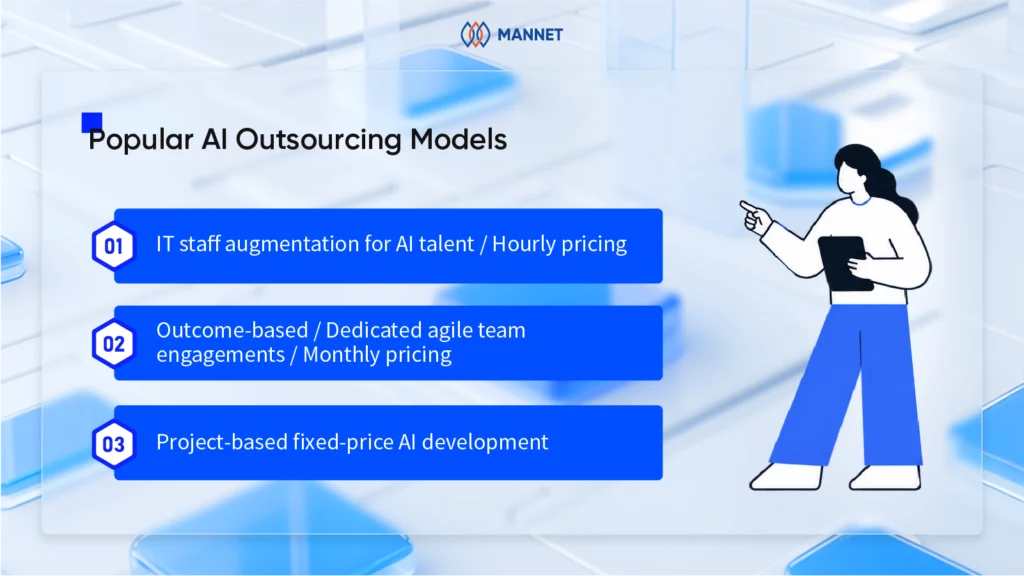
AI outsourcing can take several forms depending on an organization’s technical requirements, internal capabilities, project scope, and long-term business objectives. Each engagement model offers a different level of delivery ownership, team integration, and operational flexibility. However, choosing a model that does not align with these factors can create challenges throughout the engagement.

In practice, most AI outsourcing engagements fall into four broad models:

Model How it works Best suited to Where it can go wrong
Project-based An external provider delivers a defined solution against an agreed scope and timeline. Validating or delivering a clearly bounded AI use case. A rigid scope can limit flexibility when requirements evolve during AI development, potentially leading to additional costs or delivery delays.
Dedicated team An external team works exclusively on the organization’s AI roadmap. Longer-term initiatives with evolving requirements and multiple development phases. Without clear internal oversight and shared priorities, the external team may lose alignment with business objectives or become disconnected from internal stakeholders.
Staff augmentation External specialists integrate directly into the organization’s existing team and workflows. Filling specific AI skill or capacity gaps while retaining internal technical control. Poor onboarding, unclear responsibilities, or limited integration with internal systems and workflows can reduce team productivity.
Hybrid External delivery capacity is combined with internal hiring and capability development. Building long-term internal AI capabilities while maintaining external delivery capacity. Without a structured knowledge transfer plan and clear ownership boundaries, organizations may struggle to retain expertise or manage the transition to internal teams.

These models are not mutually exclusive. Organizations can combine them as their AI strategies evolve. For example, a business may start with project-based delivery to validate an initial use case, bring in specialized AI engineers through staff augmentation as the initiative scales, and gradually build permanent internal capabilities.

The right engagement model should reflect more than immediate resource requirements. Organizations also need to consider who owns delivery, who controls technical decisions, how quickly the team can scale, and how knowledge and responsibilities will be managed over time. Addressing these considerations early can help prevent common outsourcing pitfalls before they affect project outcomes.

ManNet provides AI talent and outsourcing solutions across flexible engagement models, including AI staff augmentation, IT recruitment, and EOR. Through access to specialized AI and engineering talent, ManNet helps organizations build teams that align with their technical requirements, delivery priorities, and long-term workforce strategies.

Explore ManNet AI Outsourcing Solutions

Top 10 AI Outsourcing Mistakes and How to Avoid Them

1. Treating AI like a standard software project

One of the most common AI outsourcing mistakes is applying fixed-scope, deterministic software contracts to work that is inherently experimental, data-dependent, and subject to performance changes over time. AI development relies on probabilistic outcomes rather than a fully predictable specification, which can create friction when conventional software delivery models are applied without adjustment. (Saigon Technology, 2026)

In traditional software outsourcing, the process is relatively straightforward: the organization defines a feature, the development team builds it, and the result is tested against the agreed specification. AI introduces three additional variables.

First, the same code can produce different results as the underlying data changes. Second, a model may achieve 85% accuracy when the business requires 95%, and that outcome cannot be reliably determined before the model has been tested against representative data. Third, performance can decline after deployment as data drift and concept drift affect the relationship between inputs and expected outcomes. In other words, delivery does not necessarily end when the initial model goes live.

Example

A retail company signs a fixed-price, fixed-scope contract for a demand-forecasting model, with a single milestone: “deliver a model with 90% forecast accuracy.”

Three months into the project, the vendor discovers that two years of historical sales data are missing promotional flags. Without this information, the model cannot reliably distinguish a genuine demand spike from one driven by a discount campaign.

Because the contract is built around a single performance milestone, the project now has limited room to accommodate the discovery. The vendor may deliver a weaker model that technically satisfies the agreed requirement, or the client may need to approve additional change orders to address the data issue.

Neither outcome addresses the underlying problem: the original contract treated an uncertain AI development process as though its requirements and inputs were fully known from the start.

How to avoid it

common ai outsourcing mistakes & how to avoid them

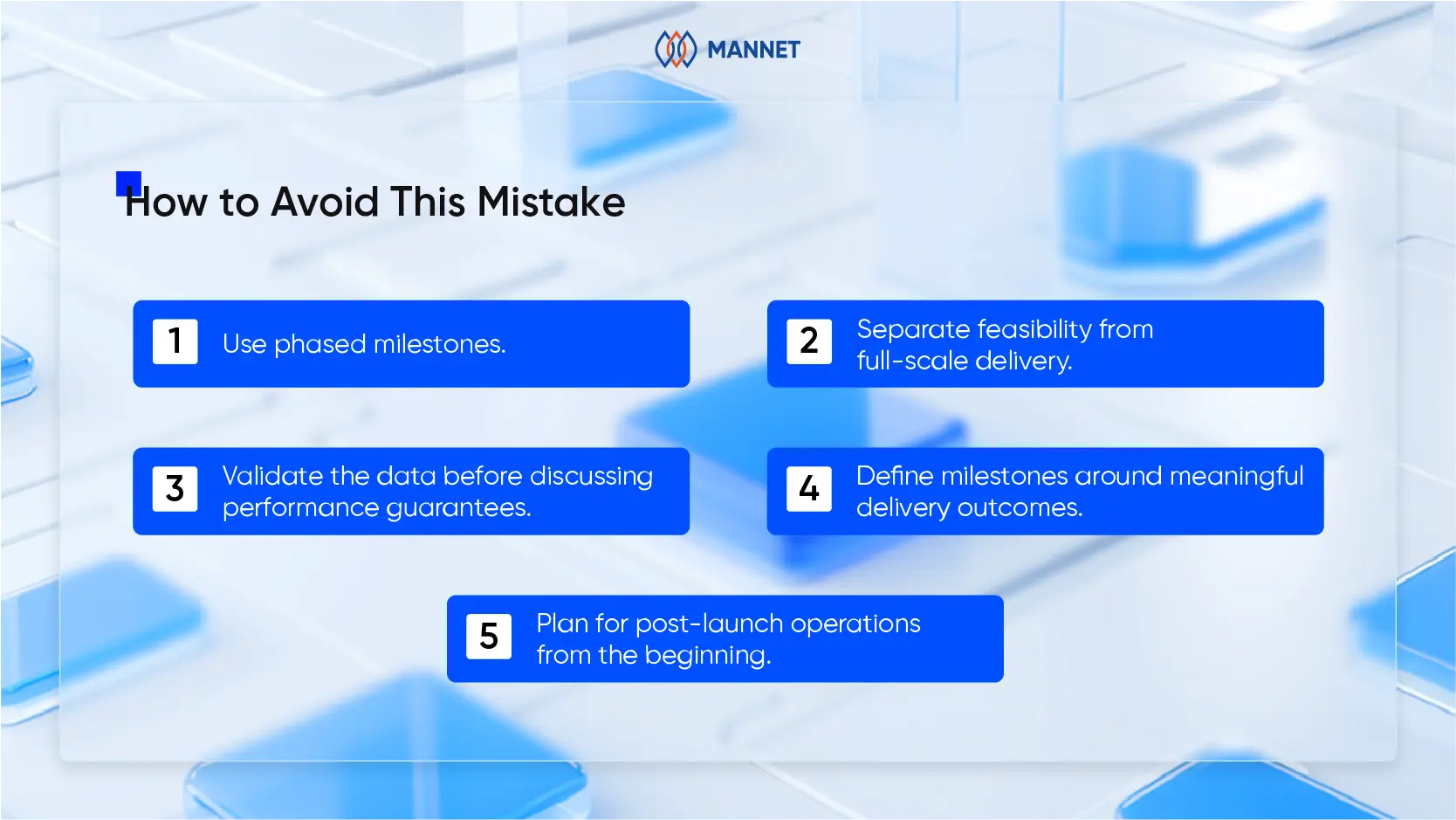
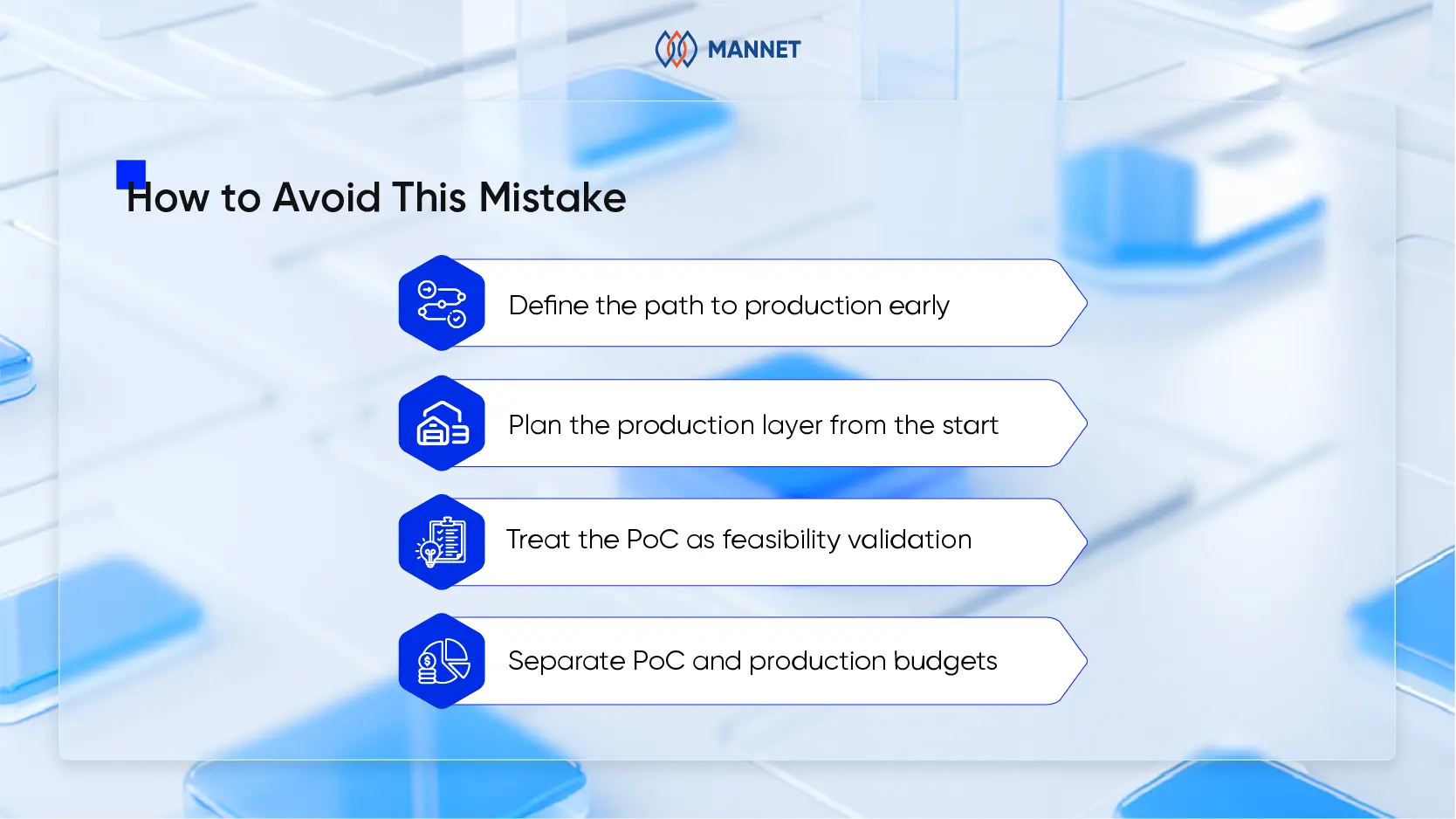
  • Use phased milestones. Structure the engagement around stages such as data assessment and pipeline development, model development, and proof of concept, with a defined budget and go/no-go decision at each stage. (Saigon Technology, 2026)
  • Separate feasibility from full-scale delivery. Run initial discovery and proof-of-concept work on a time-and-materials basis where appropriate. Once feasibility, data readiness, and technical requirements are better understood, transition to milestone-based or dedicated-team delivery.
  • Validate the data before discussing performance guarantees. A vendor should inspect the organization’s actual or representative data before committing to a specific model-performance target. (Saigon Technology, 2026) An accuracy target agreed without sufficient data validation can create unrealistic expectations for both sides.
  • Define milestones around meaningful delivery outcomes. Instead of making a single accuracy number the only acceptance criterion, consider measurable outcomes such as a pipeline operating successfully on production-representative data, a model meeting agreed evaluation criteria, or a proof of concept demonstrating the required business workflow.
  • Plan for post-launch operations from the beginning. Monitoring, retraining, model evaluation, infrastructure, and ongoing maintenance should be considered part of the AI delivery lifecycle and reflected in the initial scope and budget.

2. Losing control of data and IP ownership

A common AI outsourcing mistake is assuming that paying for an AI project automatically gives the client ownership of the model, source code, training outputs, and fine-tuned weights. That assumption can be wrong, depending on the contract, the underlying technology, and the third-party components used to build the solution. Some vendors may retain rights to parts of the trained model or reserve rights to use certain client data to improve their services or models. (AIVision, 2026)

This can become one of the most consequential contractual blind spots in AI outsourcing because ownership and usage rights may remain unclear until the relationship changes or the project is transferred to another provider. An AI system can depend on proprietary client data, third-party datasets, open-source components, commercial foundation models, vendor-developed preprocessing logic, and custom model weights. A general “client owns the deliverables” clause may not clearly define the rights attached to each of these assets.

Example

A manufacturer outsources a defect-detection model built using years of proprietary inspection images, making the underlying dataset a potentially valuable business asset. The vendor’s standard contract includes a broad clause permitting the “use of data to improve service quality.”

Eighteen months later, the manufacturer sees a competitor’s product demonstration featuring a similar defect-detection capability. The manufacturer becomes concerned that patterns derived from its proprietary defect library may have contributed to a model or service subsequently offered to other organizations in the same industry.

The situation may be difficult to resolve if the original agreement did not clearly distinguish between client-owned data, model outputs, trained weights, derived insights, and vendor rights to reuse data. The contractual ambiguity can become as significant as the technical issue itself.

How to avoid it

common ai outsourcing mistakes & how to avoid them

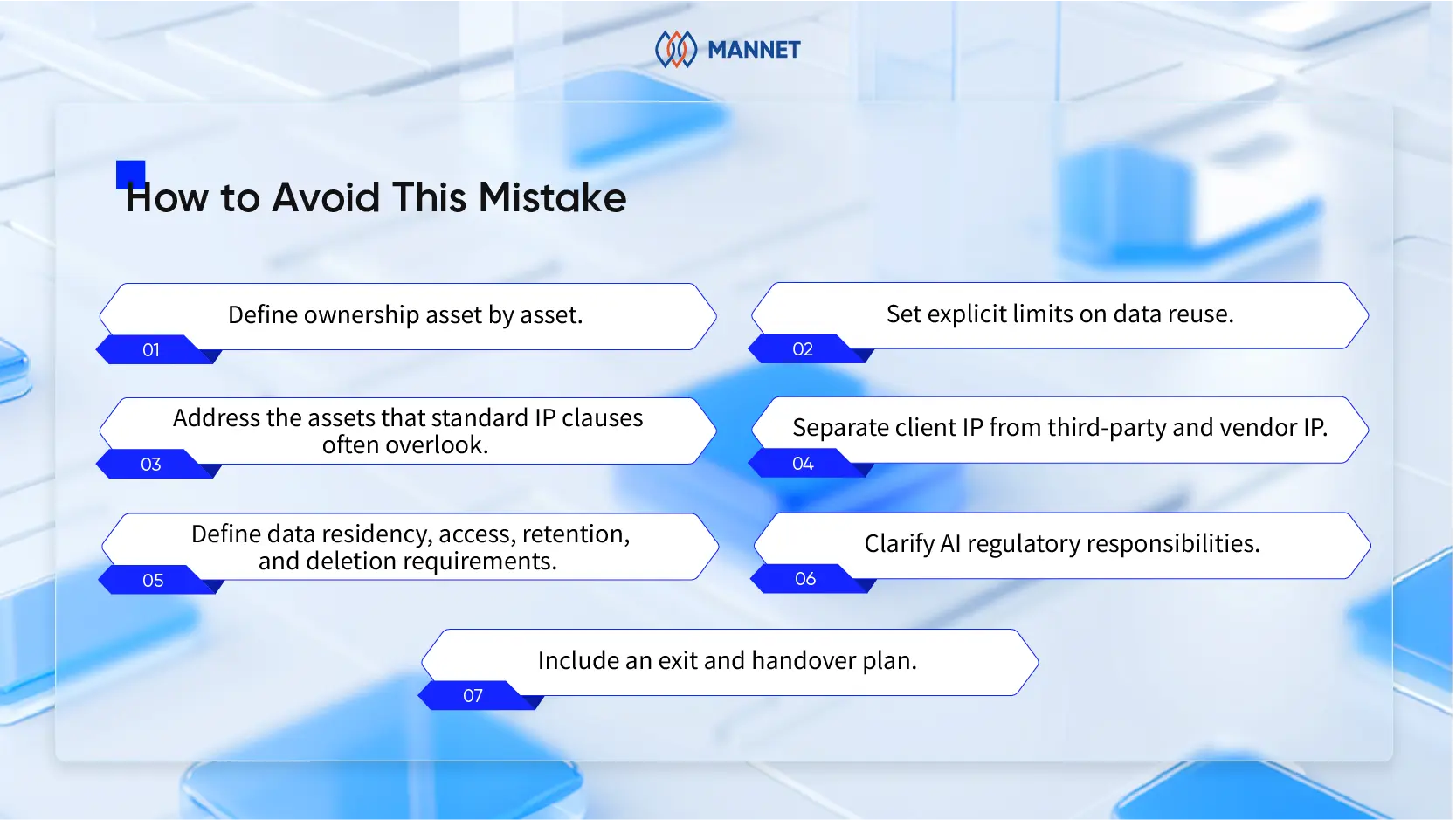
  • Define ownership asset by asset. Clearly specify who owns the input data, output data, source code, custom-trained models, fine-tuned weights, documentation, and other project-specific deliverables. Where ownership cannot be transferred, define the scope, duration, and exclusivity of the license granted to the client. (AIVision, 2026)
  • Set explicit limits on data reuse. Prohibit the use of production or proprietary client data for training general-purpose or third-party models unless the client has provided specific, written consent for that use. (AIVision, 2026)
  • Address the assets that standard IP clauses often overlook. Fine-tuned weights, prompts, feature-engineering logic, preprocessing pipelines, evaluation datasets, embeddings, and other derived assets can each raise separate ownership or usage questions.
  • Separate client IP from third-party and vendor IP. Identify which components come from the client, the outsourcing provider, open-source projects, or commercial model providers. Document the applicable licenses and any restrictions on modification, redistribution, or commercial use.
  • Define data residency, access, retention, and deletion requirements. Specify where data can be stored and processed, who can access it, how long it may be retained, and how it must be returned or deleted when the engagement ends. Align these requirements with GDPR and other applicable data-protection obligations.
  • Clarify AI regulatory responsibilities. For systems placed on the EU market or otherwise subject to the EU AI Act, define the relevant roles and responsibilities of the provider, deployer, and other parties involved in the AI system. The Act’s obligations apply progressively, with several provisions becoming applicable from 2 August 2026. EU AI Act — Regulation (EU) 2024/1689
  • Include an exit and handover plan. Before development begins, define what happens to the data, models, weights, code, documentation, credentials, and other project assets when the engagement ends or moves to another provider. A clean exit should be part of the original contract, not negotiated after the relationship has broken down.

3. Skipping data readiness and scope assessment before hiring a vendor

One of the most avoidable AI outsourcing mistakes is hiring a vendor before confirming that the required data exists, can be accessed, and reflects real production conditions. Gartner reported that 63% of organizations either lacked the right data management practices for AI or were unsure whether they had them, highlighting how data readiness can become a major constraint before development even begins. (Gartner, 2025)

“Build us an AI chatbot” or “use AI to improve operations” describes an ambition, not a sufficiently defined project scope. Without a precise problem definition, an outsourcing partner cannot make informed technical trade-offs around data, architecture, model selection, evaluation, or deployment. Without usable data, even a highly capable team may spend the early stages of the engagement on data discovery, cleaning, integration, and access requests instead of model development.

Example

A logistics company hires a vendor to build a route-optimization model, expecting delivery within ten weeks. During the first month, the vendor discovers that driver GPS logs are stored in three incompatible formats across regional systems, with no unified timestamp standard.

The project was originally scoped as a model-development engagement. In practice, it has become a data-unification project that requires additional engineering work, internal coordination, and security reviews. The client had not budgeted for this work, and the original delivery timeline quickly becomes unrealistic.

The problem was not necessarily the vendor’s development capability. The project entered technical delivery before the organization had established whether the underlying data environment was ready for it.

How to avoid it

common ai outsourcing mistakes & how to avoid them

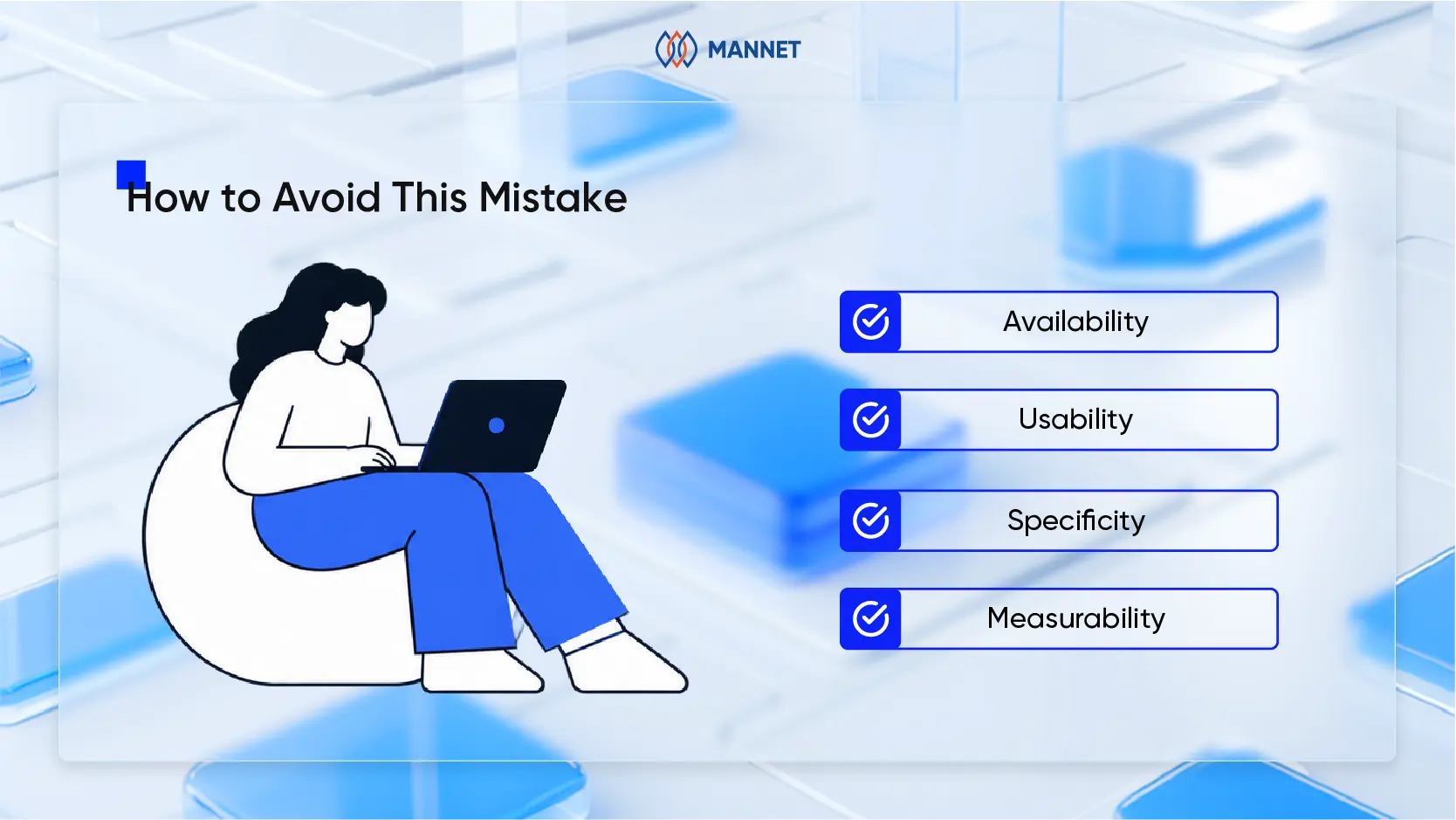
Run a focused AI readiness and scope assessment before committing to a large outsourcing engagement. At minimum, answer four questions:

  • Availability: Where does the required data actually reside? Map the relevant systems, databases, files, APIs, third-party sources, and data owners.
  • Usability: Is the data sufficiently complete, consistent, labeled, and representative of real production conditions? A curated sample can create a very different picture from the data the system will encounter after deployment.
  • Specificity: Has the initial business ambition been translated into a defined workflow, user group, decision, and use case? “Improve operations with AI” needs to become a concrete problem that can be evaluated.
  • Measurability: Do technical evaluation metrics connect to a business outcome? Depending on the use case, this could include hours saved, error rates reduced, forecast accuracy, processing time, conversion, or other operational measures.

If the data is not ready, make the first paid phase a data readiness or data strategy engagement instead of committing immediately to full model development. This gives both parties an opportunity to identify data gaps, integration requirements, security constraints, and realistic project parameters before larger delivery commitments are made.

Organizations should also resolve internal dependencies early. In outsourced AI projects, delays can arise from the client side when data access, security approvals, system credentials, procurement processes, or stakeholder decisions take weeks to complete. A capable vendor cannot progress against dependencies that remain unresolved internally.

The practical rule is simple: validate the data and define the decision before defining the model.

4. Choosing a vendor on price or a polished demo alone

A polished AI demo or a low price can create a misleading picture of a vendor’s actual delivery capability. AIVision’s review of AI partnerships across Vietnam and Southeast Asia found that roughly one-third of AI outsourcing projects in the region fail because of partner selection, rather than technology limitations. (AIVision, 2026)

A controlled demo built on clean, curated data says little about how a solution will perform against real production conditions. Two vendors may both claim AI expertise while having very different capabilities: one may have extensive experience operating models in production and managing MLOps, while another may primarily integrate third-party APIs into compelling prototypes. The difference may only become visible when the project encounters messy data, changing requirements, integration constraints, or post-launch maintenance.

Example

A food manufacturer selects a vendor after seeing a packaging-inspection demo achieving 99% accuracy on clean, well-lit sample images. Once deployed on the production line, dusty cameras, inconsistent lighting, and partial product occlusions reduce real-world accuracy to the low 80s.

Addressing these edge cases requires additional data preparation, model development, and infrastructure work that was not included in the original estimate. The project stalls at the pilot stage as the cost and scope expand. (AIVision, 2026)

How to avoid it

common ai outsourcing mistakes & how to avoid them

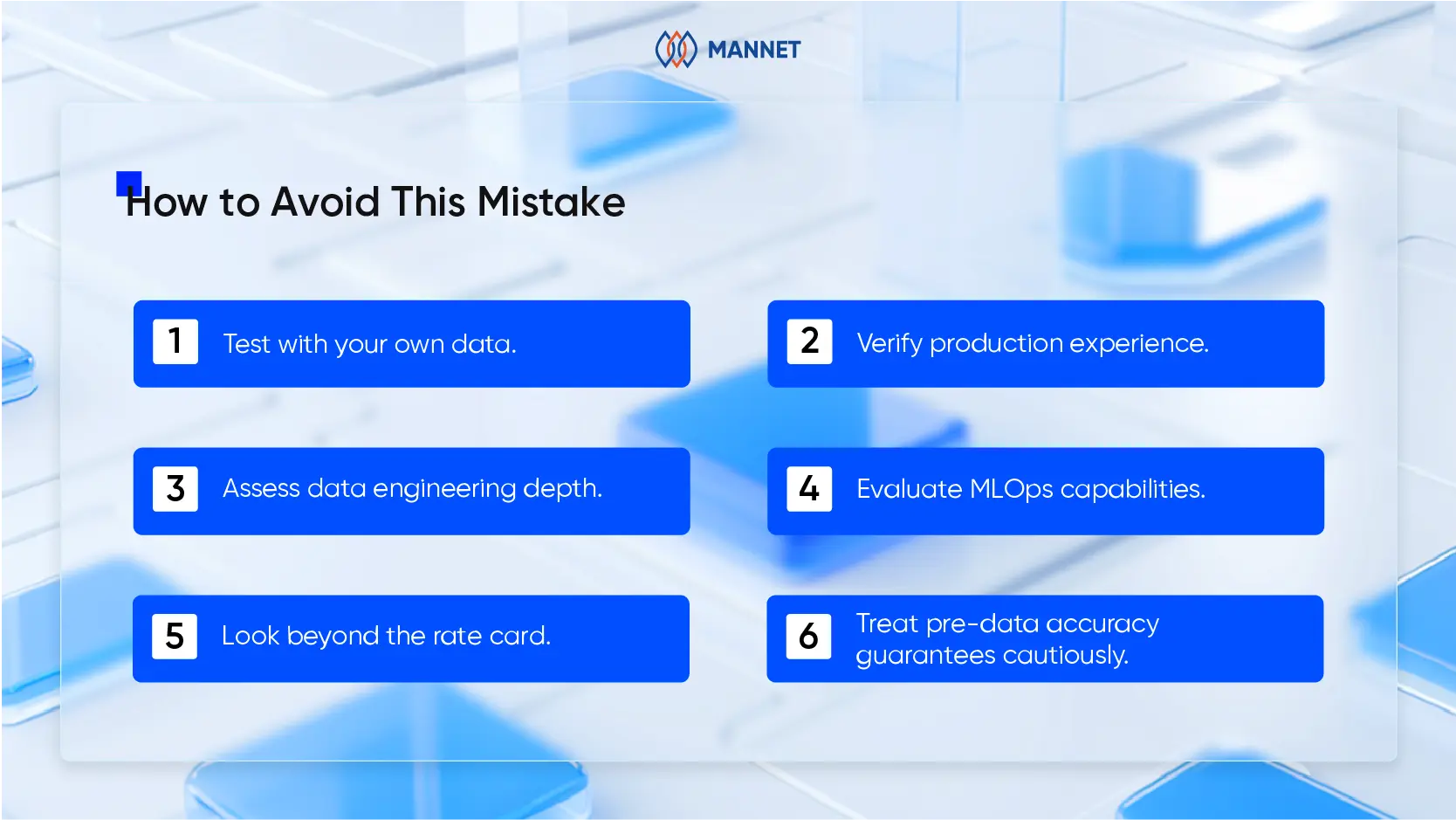
  • Test with your own data. Before signing a large engagement, assess how the vendor handles imperfect inputs, missing fields, inconsistent formats, or other production-specific conditions. (AIVision, 2026)
  • Verify production experience. Ask for relevant AI systems the team currently operates and how they monitor, maintain, and improve them.
  • Assess data engineering depth. Explore how the team manages data pipelines, upstream changes, quality issues, and integration with existing systems.
  • Evaluate MLOps capabilities. Review deployment, model versioning, monitoring, rollback, retraining, and post-launch support processes.
  • Look beyond the rate card. Compare the delivery model, technical scope, operational support, and likely rework required alongside the initial project cost.
  • Treat pre-data accuracy guarantees cautiously. Performance targets should be based on testing against representative data and agreed evaluation criteria, not a generic benchmark from a controlled demo.

5. Overlooking undocumented process knowledge

AI systems depend on the process knowledge behind the data, and much of that knowledge may exist only in employees’ experience rather than formal documentation. Every business has exceptions, judgment calls, and escalation rules that a standard process map rarely captures. When these details are missed, an AI system can reproduce the documented workflow while still making the wrong business decision.

Example

A company outsources a customer-support triage model to automatically route incoming tickets. Straightforward cases such as “billing question” or “password reset” are easy to document, and the model handles them well.

The problem is an exception known only to experienced support staff: when a ticket mentions a specific enterprise account together with the word “escalate,” it must bypass the standard queue entirely. Because this rule was never formally documented, it is absent from the training and evaluation process.

The model routes the ticket through the normal workflow, leaving a genuine enterprise issue unresolved for two days.

How to avoid it

common ai outsourcing mistakes & how to avoid them

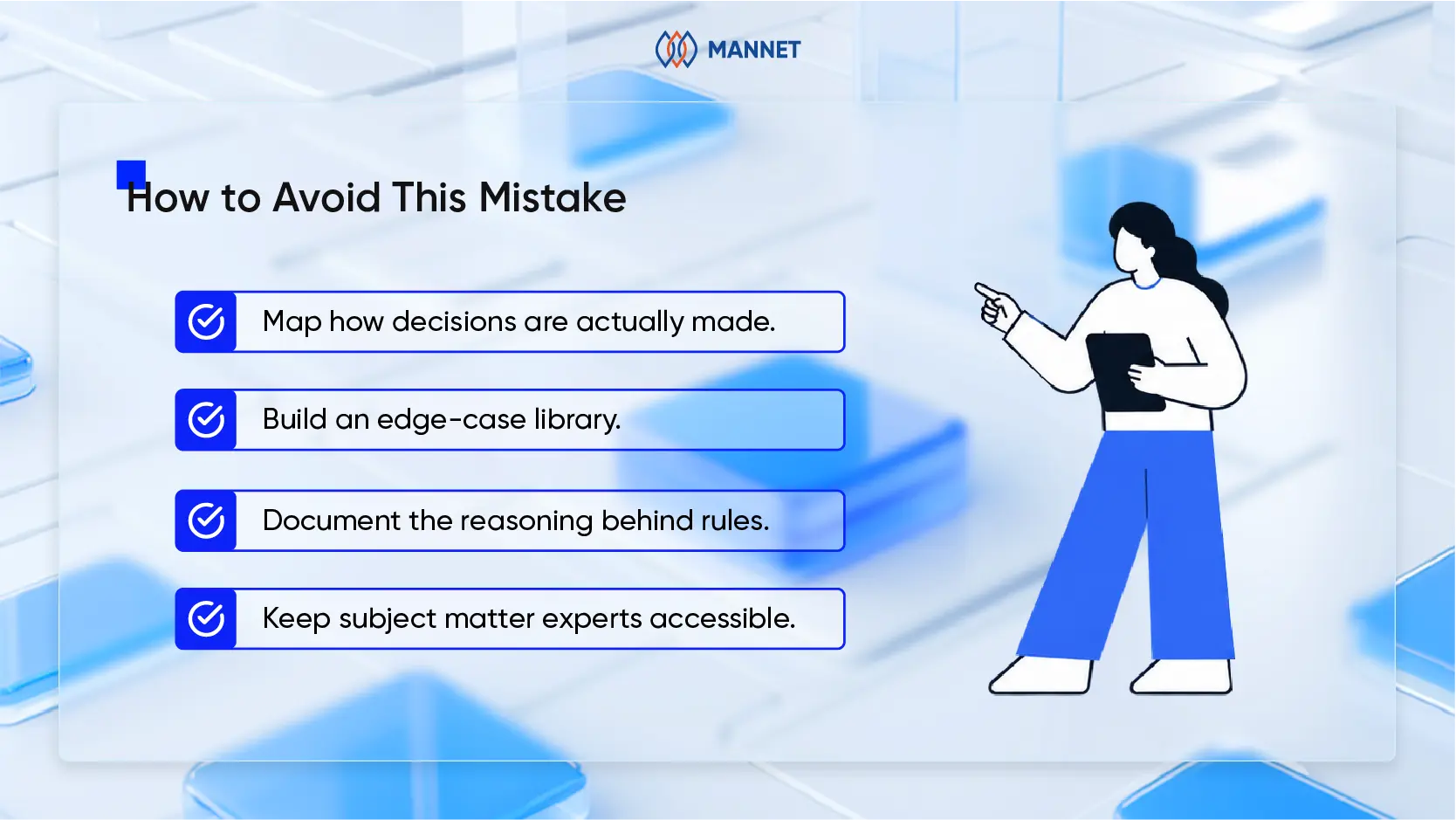
  • Map how decisions are actually made. Use structured sessions with subject matter experts to capture standard workflows, exceptions, judgment calls, and escalation paths.
  • Build an edge-case library. Collect and label real-world exceptions alongside representative cases when creating training and evaluation datasets.
  • Document the reasoning behind rules. Distinguish formal policies from informal habits so the AI team understands which decisions are mandatory and which can be adapted.
  • Keep subject matter experts accessible. Give the AI team ongoing access to the people who operate the process day to day, particularly during discovery, testing, and model evaluation.

6. Outsourcing strategy instead of execution

A costly AI outsourcing mistake is delegating core strategic decisions, such as problem definition, data governance, and model acceptance criteria, to an external provider instead of keeping those decisions within the organization. AI vendors can provide specialized technical expertise and delivery capacity, but the business should retain ownership of what the solution is expected to achieve and what constitutes an acceptable outcome. (Saigon Technology, 2026)

A practical division of responsibilities looks like this:

Keep in-house Outsource Co-own over time
Problem definition and success criteria Data pipeline engineering Monitoring and retraining
Data governance and compliance decisions Model training and experimentation
Model evaluation and acceptance MLOps setup
Production integration decisions Proof-of-concept development
Data labeling and annotation

Example

A healthcare provider outsources both the development of a diagnostic-support model and the definition of what constitutes a clinically acceptable false-negative rate. The internal team does not feel sufficiently equipped to establish the threshold, so the vendor makes the decision.

Without the necessary clinical context, the vendor sets a threshold optimized for overall model accuracy instead of accounting for the significantly higher consequences of missing a serious condition.

The model performs well against a general technical metric but poorly against the outcome that matters most to the organization. The mismatch only becomes visible after a near-miss incident.

The issue is not simply model performance. A critical business and clinical decision was assigned to the party with the least relevant context to make it.

How to avoid it

common ai outsourcing mistakes & how to avoid them

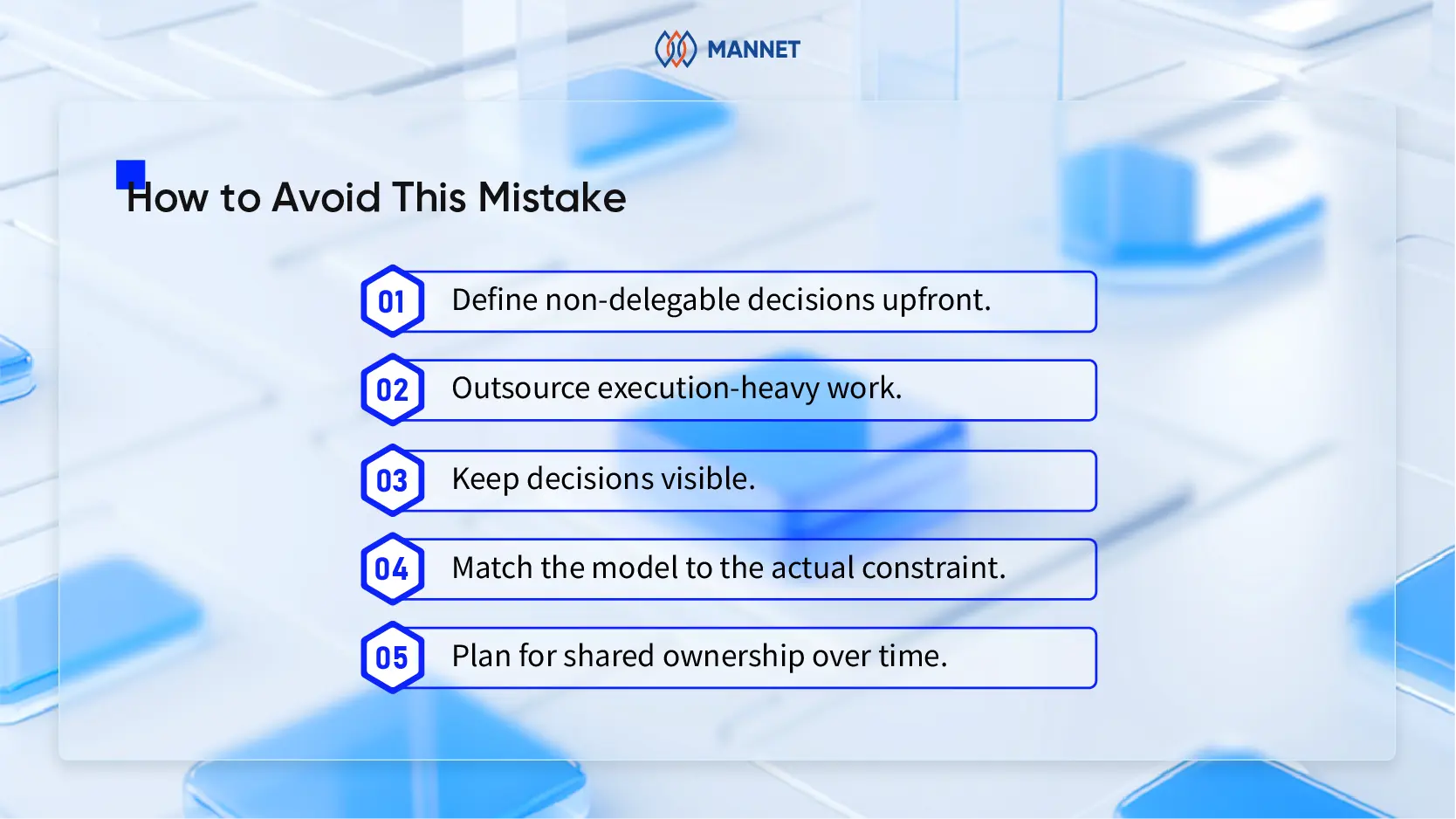
  • Define non-delegable decisions upfront. Retain ownership of problem framing, success criteria, acceptance thresholds, data governance, compliance, and production integration decisions.
  • Outsource execution-heavy work. Data pipelines, model training, experimentation, MLOps, proof-of-concept development, and data annotation are often well suited to external delivery when the requirements and governance framework are established. (Saigon Technology, 2026)
  • Keep decisions visible. Where possible, have external teams work within agreed repositories, documentation standards, and review processes so technical decisions and assumptions remain accessible to internal stakeholders.
  • Match the model to the actual constraint. If the primary challenge is delivery capacity rather than strategic or technical expertise, staff augmentation can add specialists while allowing the internal team to retain ownership of key decisions.
  • Plan for shared ownership over time. Monitoring, retraining, model evaluation, and continuous improvement should gradually involve internal teams so the organization can maintain effective oversight after the outsourcing engagement changes or ends.

7. Signing a contract that ignores AI-specific risk

A standard software outsourcing agreement may leave several AI-specific risks insufficiently defined. Beyond the IP and data ownership issues covered earlier, AI engagements require clearer treatment of probabilistic performance, model evaluation, liability for incorrect outputs, and the distinction between infrastructure availability and model quality.

Example

A fintech company carries over a standard 99.9% uptime SLA from a previous software agreement into its AI outsourcing contract. The fraud-detection system remains available throughout the quarter, technically meeting the SLA.

However, transaction patterns change, and the model’s false-positive rate gradually increases. Legitimate customers begin being flagged as potentially fraudulent, but the contract contains no model-performance threshold or monitoring requirement. Because the system remains operational, the issue can continue for weeks before it is identified and addressed.

The contract measured whether the system was available, but not whether it was still performing as intended.

How to avoid it

common ai outsourcing mistakes & how to avoid them

AI outsourcing contracts should address the following separately:

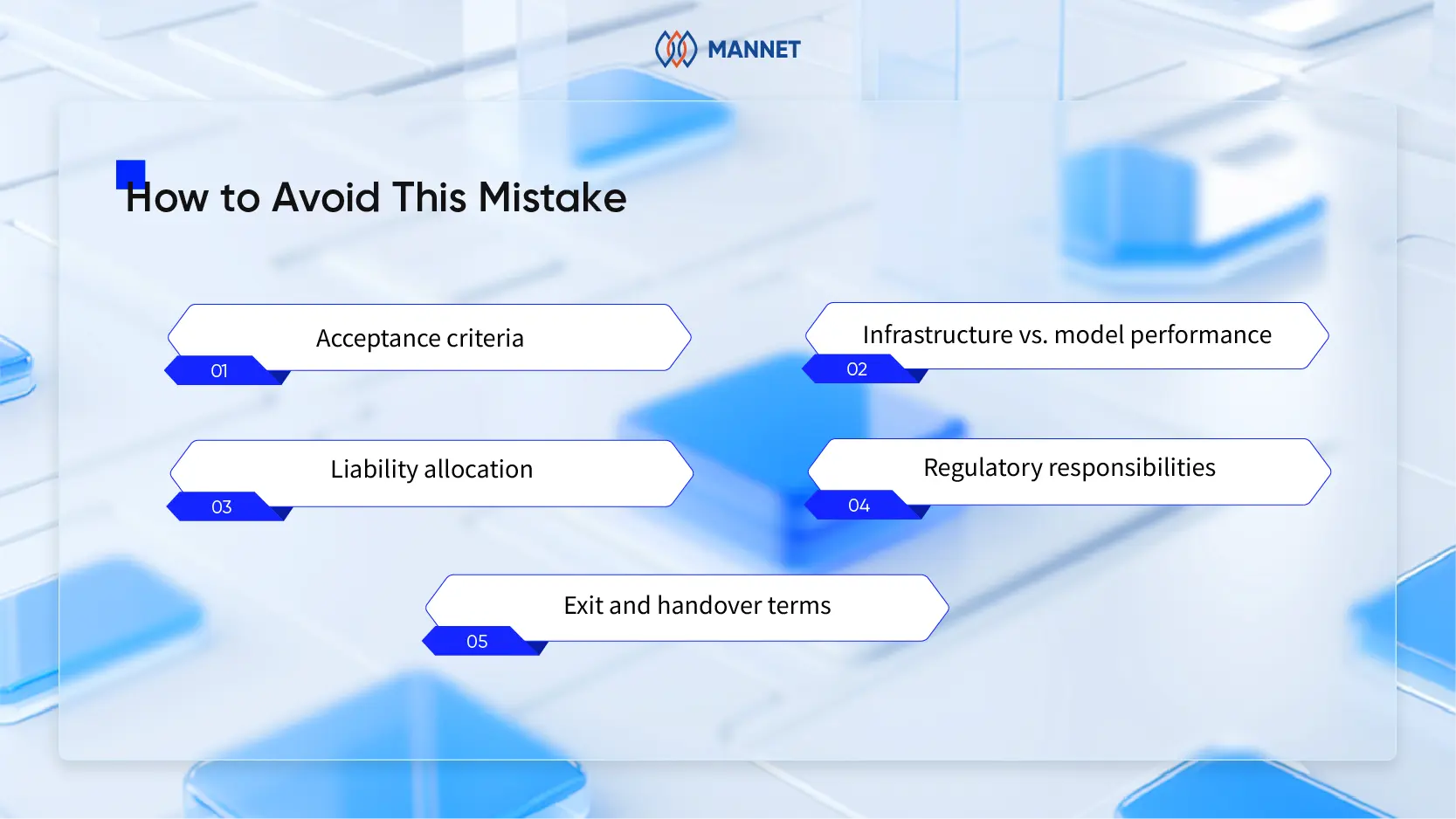
  • Acceptance criteria: Define evaluation datasets, test conditions, performance ranges, and acceptance procedures appropriate for probabilistic AI systems instead of relying solely on deterministic pass/fail criteria.
  • Infrastructure vs. model performance: Separate infrastructure uptime SLAs from model-performance requirements. Define relevant metrics, monitoring responsibilities, thresholds, and escalation or remediation procedures when performance changes.
  • Liability allocation: Clarify how responsibility is handled when incorrect predictions, recommendations, or generated outputs cause operational, financial, or customer impact, including any applicable limitations and exclusions.
  • Regulatory responsibilities: Assign responsibilities under applicable frameworks such as the EU AI Act and GDPR based on each party’s actual role in developing, providing, deploying, or operating the system.
  • Exit and handover terms:Establish requirements for data return or deletion, model and code access, documentation, credentials, knowledge transfer, and ongoing support before the provider becomes operationally critical.

A well-structured AI outsourcing contract should therefore define what is being delivered, how it will be evaluated, who is responsible when performance changes, and how the organization can regain operational control if the engagement ends.

8. Neglecting structured communication and executive sponsorship

Outsourcing development does not mean outsourcing ownership. AI engagements need an embedded internal technical lead and visible executive sponsorship to keep decisions aligned with business priorities.

An external AI team makes frequent judgment calls that depend on business context: what constitutes a useful prediction, which errors matter most, and when a model is ready for testing. A purely transactional relationship can leave the vendor without the context needed to make those decisions effectively. Research from Auxis on outsourcing failures across functions identifies executive sponsorship as an important factor in successful outsourcing relationships, particularly because visible leadership support influences how teams adopt and engage with change (Auxis, 2025).

Example

A vendor developing a churn-prediction model identifies an early ambiguity: does “churn” mean a canceled subscription or a customer who has stopped logging in? These definitions require different data, model logic, and business interventions. With no internal technical lead joining regular meetings, the question remains unresolved for three weeks. The vendor proceeds with the definition that appears most common in similar projects, only for the client to discover the mismatch during final review, after most of the project budget has been committed.

How to avoid it

common ai outsourcing mistakes & how to avoid them

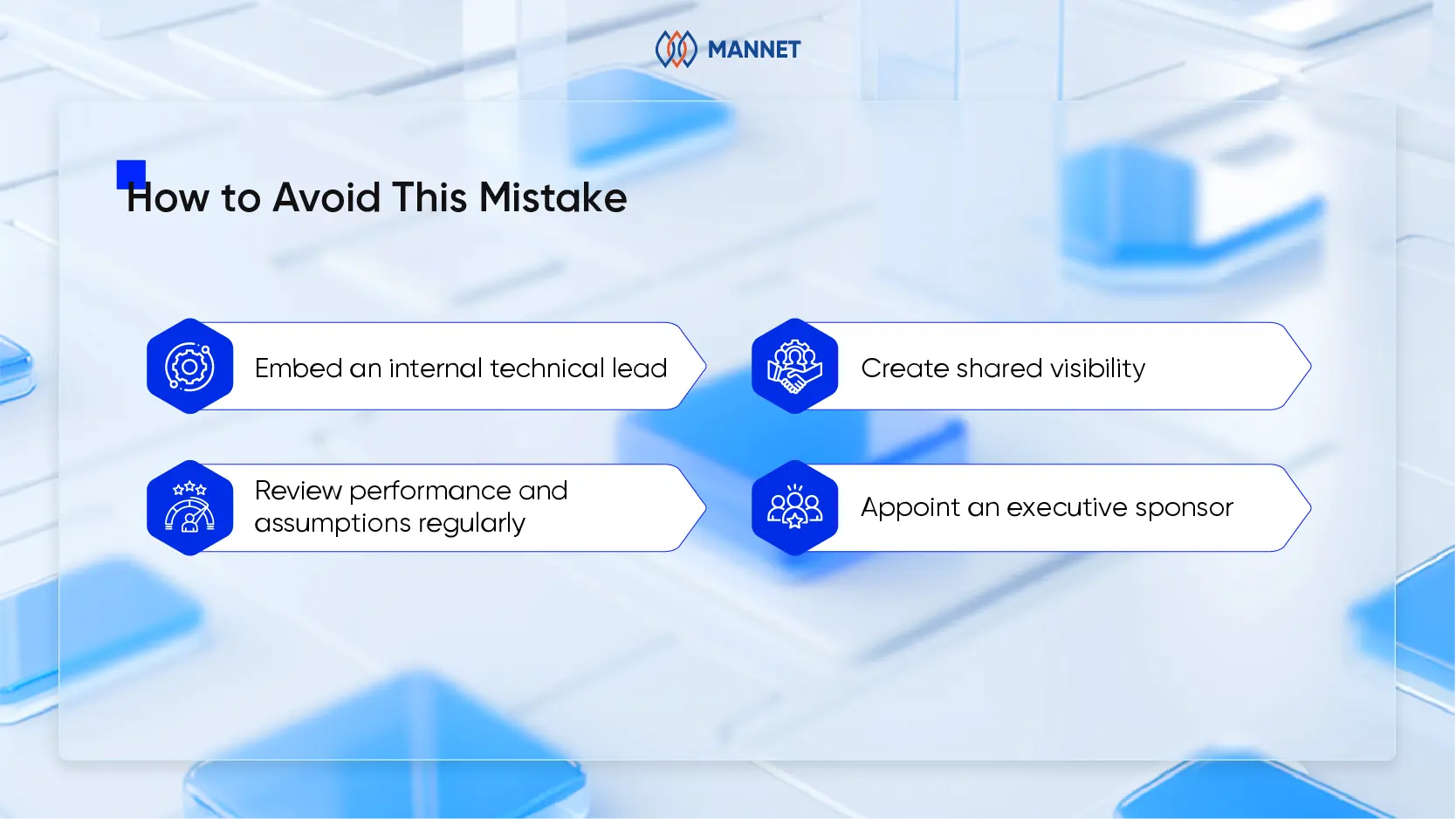
  • Embed an internal technical lead. Include a designated technical owner in vendor standups and key reviews. Deep ML expertise is not essential; the role is to resolve ambiguity, connect technical decisions to business context, and escalate issues quickly.
  • Create shared visibility. Give the vendor appropriate access to repositories, ticketing, CI/CD, and experiment-tracking tools so project decisions and technical progress remain transparent.
  • Review performance and assumptions regularly. Hold weekly model-performance reviews alongside sprint demos. Discuss what was delivered, what was learned, and which assumptions need to change.
  • Appoint an executive sponsor. A visible sponsor can reinforce the initiative’s business value, resolve cross-functional barriers, and support adoption among teams whose workflows will change.

9. Mistaking a proof of concept for a production system

A proof of concept answers one question: can this approach create enough value under controlled conditions to justify further investment? It does not demonstrate that the system is ready for real users, production workloads, or operational scale. Gartner reported that only 48% of AI projects reached production in its 2024 survey, with an average eight-month gap between prototype and production, highlighting the distance that can exist between experimentation and deployment (Gartner, 2024).

A successful PoC may rely on a limited dataset, a notebook, and temporary infrastructure, which can be appropriate for testing feasibility. Problems arise when the same build is treated as production-ready. S&P Global found that organizations scrapped an average of 46% of AI proofs of concept before broader adoption in 2025, illustrating how frequently projects fail to bridge the gap between experimentation and operational deployment (S&P Global, 2025).

Example

An insurance company’s outsourced PoC for automated claims triage performs well in demos using a curated dataset of several hundred historical claims. Production introduces a different set of requirements: ten times the data volume, integration with a legacy claims-management system, corporate identity authentication, and the ability to handle peak workloads. None of these conditions existed in the PoC environment. What appeared to be a quick win becomes a six-month integration project that was never included in the original budget.

How to avoid it

common ai outsourcing mistakes & how to avoid them

  • Define the path to production early. Before the PoC begins, ask: If this works, what needs to happen before real users can rely on it?
  • Plan the production layer from the start. Consider automated data pipelines, production-grade APIs, access controls, model versioning, drift detection, rollback procedures, and named operational ownership. Together, these capabilities form the foundation of MLOps.
  • Treat the PoC as feasibility validation. A 6-12 week discovery and PoC window can help validate the use case and technical approach, but should not be treated as a deployment timeline (Webellian, 2026).
  • Separate PoC and production budgets. Account explicitly for integration, infrastructure, security, testing, monitoring, and production hardening so the cost of deployment is visible from the outset.

10. Treating governance, security and human oversight as afterthoughts

Governance, security, and human oversight should be defined before an AI system reaches production, particularly when outsourcing introduces external access to sensitive data and systems. Building these controls reactively can leave organizations addressing privacy, liability, or operational risks only after an incident or problematic output has already occurred.

Outsourcing can expand the risk surface because data, systems, and model development activities may cross organizational or national boundaries. The relevant controls therefore need to cover both the technology itself and how the external team accesses, processes, and manages business data.

How to avoid it

common ai outsourcing mistakes & how to avoid them

  • Establish AI governance early. Create a cross-functional governance structure spanning business, technology, legal and compliance, with clear policies for privacy, acceptable data use, model risk and human oversight before production deployment.
  • Make security contractual and operational. Define encryption, role-based access, production-data permissions, retention and deletion requirements in the contract and verify that they are implemented in practice. Relevant certifications, such as ISO 27001, can form part of vendor due diligence.
  • Assess location alongside security controls. Offshore delivery does not inherently indicate higher security risk. Evaluate the provider’s technical controls, certifications, access practices, and applicable data-transfer requirements, with geographic location treated as one part of the overall assessment.
  • Define human review checkpoints. Identify which AI outputs require human validation before reaching customers, employees, or regulators, particularly for generative AI and other systems where incorrect outputs can have material consequences.

The mistake that undoes all the others: No exit plan for knowledge transfer

An AI outsourcing engagement can deliver a working model and still leave the organization operationally dependent on the vendor. Without a structured knowledge-transfer and exit plan, internal teams may struggle to understand, retrain, troubleshoot, or maintain the system after the contract ends. This dependency can become costly when a vendor changes its team, increases fees, discontinues a service, or becomes unavailable (Saigon Technology, 2026; AIVision, 2026).

AI systems are particularly exposed because operational knowledge often extends beyond source code. Teams need to understand data pipelines, model logic, evaluation methods, infrastructure, dependencies, monitoring, and retraining procedures. If that knowledge remains with the external team, the organization can lose the ability to maintain the system independently even when it technically owns the underlying assets.

Example

A distributor’s demand-forecasting model runs smoothly for a year under vendor management. When the vendor is acquired, and its original engineering team disperses, the distributor discovers that no internal engineer can explain key model features or troubleshoot the pipeline. Retraining also fails because a data source was deprecated eight months earlier without internal teams knowing. Rebuilding the missing knowledge takes longer and costs more than anticipated.

How to avoid it

common ai outsourcing mistakes & how to avoid them

  • Make knowledge transfer a contractual deliverable. Require internal engineers to demonstrate that they can retrain the model, troubleshoot a real failure, and perform essential maintenance before the transition period ends (Saigon Technology, 2026).
  • Require technical documentation for operation. Documentation should cover architecture, data pipelines, model versions, dependencies, debugging, retraining, optimization, and deployment procedures. Define a clear target for internal operability after handover (AIVision, 2026).
  • Document continuously. Keep repositories, environments, model artifacts, operating procedures, and key decisions documented throughout the engagement, instead of treating handover as a final administrative step.
  • Control the core assets. Confirm that the organization has appropriate access to repositories, cloud environments, datasets, model artifacts, deployment pipelines, and other assets required to operate the system.
  • Avoid single-person dependency. Distribute critical knowledge across multiple people on both the client and vendor sides so continuity does not depend on one engineer remaining available.

How to Choose the Right AI Outsourcing Partner

Avoiding common AI outsourcing mistakes starts with choosing a partner that can manage the full delivery lifecycle, from data readiness and model development to security, production deployment, and knowledge transfer. Technical expertise matters, but organizations should also assess delivery maturity, communication, governance, specialized talent, scalability, and long-term operational support.

The right evaluation framework can help organizations move beyond comparing hourly rates or polished demos and assess whether a potential partner has the capabilities, processes, and delivery model required for the specific AI initiative.

Want a practical framework for evaluating AI outsourcing providers? Read our guide on How to Choose the Right AI Outsourcing Partner for a detailed look at the key criteria, from proven AI expertise and specialized talent to delivery maturity, scalability, and long-term partnership potential.

FAQ About Common AI Outsourcing Mistakes and How to Avoid Them

1. What are the most common AI outsourcing mistakes?

Common AI outsourcing mistakes include:

  • Unclear business objectives
  • Treating AI like conventional software development
  • Skipping data readiness assessment
  • Choosing a vendor based primarily on price or demos
  • Overlooking data and IP ownership.

Other frequent issues include weak governance, unclear responsibilities, poor communication, and failing to plan for production and knowledge transfer.

2. Why do AI outsourcing projects fail?

AI outsourcing projects can fail because of poorly defined use cases, inadequate data, unrealistic performance expectations, weak vendor selection, unclear responsibilities, and insufficient production planning. Technical performance is only one part of the outcome; business alignment, data quality, governance, integration, and operational ownership also influence project success.

3. How can organizations avoid AI outsourcing mistakes?

Organizations can reduce outsourcing risk by defining the business problem and success criteria before development, assessing data readiness, selecting a partner based on relevant delivery experience, and establishing clear ownership of data, IP, and model assets. Contracts should also address AI-specific performance criteria, security, governance, post-deployment support, and knowledge transfer.

4. How is AI outsourcing different from traditional software outsourcing?

AI projects involve probabilistic outcomes and depend heavily on data quality, model evaluation, and continuous monitoring. AI performance can change as data, user behavior, or operating conditions change. AI outsourcing therefore requires delivery processes and contracts that accommodate experimentation, iterative evaluation, model monitoring, and potential retraining.

5. What should an AI outsourcing contract include?

An AI outsourcing contract should clearly define deliverables, data and IP ownership, permitted data use, security requirements, model evaluation and acceptance criteria, infrastructure and model-performance responsibilities, regulatory obligations, support requirements, documentation, knowledge transfer and exit procedures.

6. Who should own an outsourced AI project?

The organization should retain ownership of business objectives, success criteria, critical data decisions, governance requirements, and model acceptance. The external partner can take responsibility for specialized execution such as data engineering, model development, MLOps, and PoC delivery. Shared ownership may be appropriate for ongoing monitoring, retraining and continuous improvement.

Where Talent Strategy Meets AI Outsourcing

Most advice on AI outsourcing focuses entirely on the vendor relationship. But several of the mistakes above, especially outsourcing strategic decisions and ending up with no internal capability, trace back to a single root cause: not having the right people inside the organization to own the outcome. That’s where outsourcing and talent strategy reinforce each other.

  • Internal technical leads and first ML hires are your practical insurance against every knowledge-transfer failure described above. IT recruitment services help you find them, and our guide to building a talent pipeline shows how to keep strong candidates flowing before a role even opens.
  • Flexible capacity helps while scope is still moving. IT staff augmentation puts specialists directly inside your own team rather than behind a vendor’s wall, while you can also hire software developers to extend engineering capacity or hire QA engineers so testing of pipelines and model outputs doesn’t get squeezed out under deadline pressure.
  • High-volume data work, such as collection, labeling, and annotation, often needs teams larger than a permanent hiring plan can supply quickly. Mass recruitment services are built to stand up those teams at speed.
  • Continuous hiring across several AI initiatives is easier to sustain with RPO services, which absorb the sourcing and screening load.
  • New AI functions need foundations beyond code: role definitions, structures and people practices. That’s the ground covered by HR consultation and set-up.
  • Expanding into Vietnam? EOR services and managed payroll let you employ talent compliantly without setting up a local entity first.

Conclusion: Building an AI Outsourcing Strategy That Holds Up

AI outsourcing can provide access to specialized talent, accelerate experimentation, and expand delivery capacity. The risks emerge when outsourcing is treated as a simple transfer of development work. Data readiness, technical ownership, governance, communication, production planning, and knowledge transfer all shape what happens after the first model is delivered.

The strongest outsourcing strategies therefore create a clear division of responsibility: external partners contribute specialized execution and capacity, while the organization retains ownership of its business objectives, critical data, strategic decisions, and long-term AI capability. The goal is not simply to deliver an AI solution, but to build one that can be governed, integrated, maintained, and scaled as business requirements evolve.

The ManNet approach: Scaling AI capability with control

For organizations building AI capabilities in Vietnam, the right talent model can be as important as the outsourcing model itself. ManNet combines IT recruitment, IT staff augmentation, and flexible workforce solutions to help businesses access specialized AI and engineering talent while retaining the level of internal ownership their operating model requires.

Whether an organization needs to recruit specialized IT talent, add specialists through IT staff augmentation, or establish a compliant team in Vietnam through EOR services, the objective is consistent: build the right capabilities around the AI strategy, with clear ownership from development through long-term operation.

common ai outsourcing mistakes & how to avoid them

Top 06 Công Ty Mass Recruitment tại Việt Nam | 2026

Khi quy mô sản xuất tăng tốc, bộ máy tuyển dụng nội bộ thường nhanh chóng chạm ngưỡng quá tải. Một phễu tuyển dụng bị tắc nghẽn ở giai đoạn bứt phá này sẽ lập tức kích hoạt chuỗi rủi ro dây chuyền: trượt tiến độ vận hành nhà máy, chi phí cơ hội tăng vọt theo ngày trống vị trí, và chất lượng nhân sự sụt giảm do áp lực hạ chuẩn sơ tuyển.

Lúc này, tìm kiếm một dịch vụ tuyển dụng số lượng lớn (Mass Recruitment) chuyên nghiệp không đơn thuần là giải pháp chữa cháy, mà là quyết định chiến lược nhằm bảo toàn hiệu suất vận hành. Bài viết này là cẩm nang phân tích và đánh giá các công ty mass recruitment – đơn vị cung cấp dịch vụ tuyển dụng số lượng lớn hàng đầu tại Việt Nam, mang đến góc nhìn quản trị độc lập cho các Head of TA, giám đốc nhân sự (CHRO) và giám đốc vận hành (COO) trước quyết định lựa chọn đối tác đồng hành.

Tóm Tắt Nhanh

  • Bài viết so sánh 6 đơn vị cung cấp dịch vụ mass recruitment hàng đầu tại Việt Nam: ManNet, ManpowerGroup, Adecco, Navigos Group, JAC Recruitment và Talentnet.
  • Khung đánh giá 5 chiều giúp doanh nghiệp pressure-test năng lực thực chiến của đối tác trước khi ký hợp đồng: sourcing & đường ống ứng viên, tỷ lệ chuyển đổi phễu, tốc độ phản hồi, công nghệ/dữ liệu và cam kết SLA.
  • Mỗi đơn vị phù hợp với một phân khúc khác nhau: ManpowerGroup và Adecco mạnh về lao động sản xuất tại nhà máy; ManNet mạnh về vận hành số (BPO, CSKH, dữ liệu); Navigos Group và Talentnet cung cấp giải pháp nhân sự toàn trình; JAC Recruitment chuyên biệt cho doanh nghiệp FDI Nhật Bản.
  • Phần cuối bài hướng dẫn xây dựng bảng quản trị KPI (time-to-fill, cost-per-hire, offer acceptance rate, tỷ lệ giữ chân sau 90 ngày) để quản trị hiệu quả hợp tác sau khi ký hợp đồng.

5 Tiêu Chí Cốt Lõi Khi Đánh Giá Đơn Vị Cung Ứng Nhân Lực Quy Mô Lớn (Mass Recruitment)

Để tối ưu hóa chiến lược quản trị nhân sự và đảm bảo tiến độ vận hành, ban lãnh đạo vận hành (COO) và đội ngũ giám đốc nhân sự (CHRO) cần thiết lập một hệ thống kiểm soát chất lượng khắt khe trước khi tiến hành ký kết hợp đồng với đối tác tuyển dụng hàng loạt.

5 tiêu chí độc lập dưới đây đóng vai trò như những “bộ lọc” tiêu chuẩn, giúp doanh nghiệp đánh giá chính xác năng lực thực thi và giảm thiểu rủi ro vận hành. Mỗi tiêu chí đại diện cho một mắt xích kiểm soát chất lượng riêng biệt, đảm bảo tính minh bạch và hiệu quả toàn diện cho chiến dịch.

tiêu chí đánh giá công ty mass recruitment

1. Quy mô & độ sẵn sàng của nguồn ứng viên

Đây là thước đo nền tảng phản ánh năng lực thực sự của đối tác tuyển dụng. Doanh nghiệp cần xác định rõ: Đơn vị dịch vụ sở hữu hệ thống dữ liệu ứng viên sẵn sàng hay chỉ bắt đầu tìm kiếm từ đầu sau khi hợp đồng được ký kết?

Một đối tác uy tín tiêu chuẩn quốc tế sẽ chứng minh năng lực qua:

  • Dữ liệu ứng viên thực tế được phân loại bài bản theo từng lĩnh vực chuyên môn.
  • Năng lực tiếp cận tệp ứng viên thụ động.
  • Mạng lưới tìm kiếm đa kênh đồng bộ: từ hệ thống nền tảng số, chương trình giới thiệu nội bộ đến các kênh nguồn lao động địa phương chuyên biệt.

2. Tỷ lệ chuyển đổi phễu tuyển dụng & kiểm soát chất lượng đầu vào

Khối lượng hồ sơ lớn sẽ không mang lại giá trị vận hành nếu tỷ lệ chuyển đổi qua các vòng bị hao hụt do tiêu chuẩn sàng lọc thiếu đồng nhất.

Thay vì căn cứ vào số lượng hồ sơ cam kết bàn giao, doanh nghiệp nên yêu cầu đối tác cung cấp số liệu chuyển đổi thực tế (conversion rate) từ các dự án có quy mô tương đương. Quy trình lọc hồ sơ và phỏng vấn sơ bộ càng chuẩn xác ngay từ đầu, doanh nghiệp càng tối ưu hóa được thời gian và chi phí của hội đồng phỏng vấn nội bộ.

3. Tốc độ phản hồi & mức độ linh hoạt trong điều phối

Chỉ số thời gian lấp đầy vị trí (time-to-fill) không chỉ phản ánh tốc độ tìm kiếm nhân sự, mà còn là thước đo mức độ trơn tru trong toàn bộ quy trình điều phối vận hành của đối tác:

  • Tốc độ thiết lập lịch phỏng vấn: Khả năng sắp xếp và chốt lịch nhanh chóng, chính xác cho hội đồng tuyển dụng.
  • Hiệu quả truyền thông hai chiều: Tốc độ xử lý thông tin và kết nối nhịp nhàng giữa ứng viên và bộ phận quản lý trực tiếp tại xưởng.
  • Sự đồng bộ trong quy trình onboarding: Đảm bảo thời điểm nhân sự hội nhập khớp hoàn hảo với tiến độ và kế hoạch sản xuất của nhà máy.

Mọi cam kết vận hành từ một đối tác chuyên nghiệp đều phải được định lượng bằng các chỉ số SLA (Service Level Agreement) cụ thể, thay vì những lời hứa hẹn định tính.

4. Nền tảng công nghệ & quản trị dữ liệu tuyển dụng

Trong quản trị hiện đại, một chiến dịch tuyển dụng quy mô lớn không thể vận hành thủ công. Doanh nghiệp cần đánh giá năng lực công nghệ của đối tác qua hai yếu tố cốt lõi:

  • Hệ thống quản lý tuyển dụng (ATS): Đơn vị dịch vụ có chuẩn hóa quy trình và theo dõi luồng hồ sơ (candidate pipeline) trên nền tảng ATS chuyên nghiệp?
  • Báo cáo kỹ thuật số thời gian thực (real-time dashboard): Doanh nghiệp có được phân quyền truy cập dashboard để chủ động theo dõi tiến độ từng phút, hay phải thụ động chờ đợi các file báo cáo Excel thủ công vào cuối tuần?

Một nền tảng công nghệ minh bạch chính là “tấm kính chắn trong suốt” giúp doanh nghiệp nắm quyền chủ động kiểm soát, giám sát hiệu quả và dự báo chính xác tiến độ chiến dịch.

5. Cơ chế cam kết dịch vụ & mô hình tài chính minh bạch

Chính sách bảo hành và cấu trúc chi phí là thước đo cuối cùng phản ánh mức độ uy tín cũng như năng lực đồng hành dài hạn của đối tác:

  • Điều khoản bảo hành nhân sự: Thời gian bảo hành đổi mới kéo dài bao lâu và quy trình thay thế nhân sự được kích hoạt như thế nào?
  • Cơ chế xử lý rủi ro tài chính: Rõ ràng trong các quy định về hoàn phí hoặc cấn trừ chi phí khi phát sinh biến động nhân sự.
  • Mốc tính phí dịch vụ: Chi phí phải gắn liền với mốc thời gian nhân sự thực tế nhận việc (start date) và đi làm ổn định tại nhà máy/doanh nghiệp.

Mô hình hợp tác bền vững cần gắn chặt quyền lợi tài chính của đơn vị cung ứng với tỷ lệ nhận việc và độ gắn bó thực tế của lao động, tránh tư duy “thu phí dựa trên số lượng hồ sơ bàn giao”.

Top Đơn Vị Cung Cấp Dịch Vụ Tuyển Dụng Số Lượng Lớn Hàng Đầu Tại Việt Nam

Đơn vị Thế mạnh cốt lõi Lĩnh vực mũi nhọn Mô hình dịch vụ nổi bật
ManNet Hệ sinh thái dịch vụ nhân sự toàn trình:

Kết hợp linh hoạt giữa mass recruitment tốc độ cao, RPO và executive search chuyên sâu cho khối kỹ thuật – sản xuất; tích hợp mảng EOR & payroll trong hệ sinh thái LTS Group.

Sản xuất & công nghệ (Kỹ sư, Quản lý nhà máy FDI, nhân sự đa ngôn ngữ); Ngân hàng – tài chính, BPO/CSKH/IT Helpdesk, Automotive, FMCG. – Mass recruitment chuẩn hóa số;

– RPO & executive search cho nhà máy FDI;

– Giải pháp EOR & payroll trọn gói.

ManpowerGroup Việt Nam Năng lực chuyển đổi nguồn quy mô lớn:

Doanh nghiệp 100% vốn nước ngoài đầu tiên được cấp phép cung ứng lao động tại Việt Nam; mạng lưới toàn cầu tại 80 quốc gia; khả năng bàn giao tới 3.000 lao động/tháng/khách hàng.

Sản xuất, chế biến & chế tạo, ngân hàng – bảo hiểm, dược phẩm. – Mass recruitment lao động phổ thông & kỹ thuật;

– Staffing & outsourcing;

– RPO quy mô lớn.

Adecco Việt Nam Quy chuẩn vận hành chuẩn quốc tế:

Thành viên của Adecco Group toàn cầu (hoạt động từ 2011), năng lực vận hành song hành hàng trăm chỉ tiêu tuyển dụng cùng lúc cho các chiến dịch mở rộng quy mô.

Sản xuất xuất khẩu, chuỗi cung ứng, dịch vụ chuyên môn B2B. – Mass recruitment mở rộng nhà máy/cơ sở mới,

– Payroll & staffing services.

Navigos Group (Navigos Search / VietnamWorks) Cơ sở dữ liệu ứng viên hàng đầu thị trường:

Hơn 20 năm thương hiệu tại Việt Nam; sở hữu hệ sinh thái VietnamWorks với tệp hồ sơ ứng viên sâu rộng cùng đội ngũ chuyên viên tư vấn phân hóa theo ngành.

Công nghệ thông tin, sản xuất & dệt may, ngân hàng – tài chính. – Executive search (Nhân sự cấp trung & cao);

– RPO & mass recruitment qua nền tảng s.

JAC Recruitment Việt Nam Mạng lưới tuyển dụng chuyên sâu vốn Nhật:

Thuộc mạng lưới JAC toàn cầu, chuyên gia am hiểu sâu sắc văn hóa doanh nghiệp Nhật Bản và tiêu chuẩn kỹ thuật nhà máy.

Doanh nghiệp FDI Nhật Bản trong khối sản xuất có vị trí yêu cầu năng lực tiếng Nhật. – Executive search & headhunting chuyên sâu cho khối sản xuất vốn Nhật.
Talentnet Phương pháp luận quản trị quốc tế:

Khởi nguồn từ bộ phận Dịch vụ Nhân sự của PwC Việt Nam (hơn 20 năm kinh nghiệm), đối tác chiến lược của Mercer & ADP Streamline, cung cấp bộ giải pháp HR toàn diện.

FMCG, bán lẻ, ngân hàng – bảo hiểm, sản xuất quy mô lớn. – Mass recruitment cho dự án mở rộng kinh doanh;

– RPO, BPO, PEO & payroll.

1. ManNet: Đối tác nhân sự toàn diện từ nhà máy đến vận hành số

công ty mass recruitment hàng đầu Việt Nam ManNet

Tổng quan

ManNet là đơn vị cung cấp giải pháp nhân sự chiến lược thuộc hệ sinh thái LTS Group, có trụ sở chính tại Hà Nội. ManNet là một trong số ít đối tác tại Việt Nam giải quyết đồng thời hai đầu bài toán nhân sự trọng điểm của doanh nghiệp: Tuyển dụng quy mô lớn cho khối vận hành số (BPO, CSKH, xử lý dữ liệu, IT Helpdesk) và Tuyển dụng chuyên sâu cho khối kỹ thuật – sản xuất, ô tô & xe điện, FMCG, ngân hàng – tài chính và du lịch – khách sạn.

Thay vì vận hành mô hình đơn lẻ, ManNet xây dựng hệ sinh thái nhân sự toàn trình, từ mass recruitment, RPO, executive search đến EOR (Employer of Record) và quản lý bảng lương (payroll), giúp các tập đoàn đa quốc gia xử lý trọn vẹn vòng đời nhân sự dưới một đầu mối quản lý duy nhất.

Thông tin tổng quan

  • Trụ sở: Hà Nội, Việt Nam
  • Website: https://www.mannet.tech/  
  • Mô hình: Thành viên của LTS Group; cung cấp giải pháp nhân sự toàn trình (mass recruitment, RPO, executive search, EOR & payroll).
  • Lĩnh vực trọng tâm: Sản xuất (manufacturing), ngân hàng – tài chính (FSI), ô tô & xe điện (Automotive & EV), hàng tiêu dùng nhanh (FMCG), du lịch & khách sạn (Hospitality & tourism), công nghệ & BPO/CSKH.

Thế mạnh nổi bật

  • Hệ sinh thái dịch vụ tích hợp toàn trình: Sở hữu năng lực kết hợp linh hoạt giữa mass recruitment tốc độ cao cho khối vận hành và RPO/executive search cho nhóm vị trí kỹ thuật, quản lý nhà máy và khối thương mại. Việc tích hợp sẵn giải pháp EOR và payroll giúp các doanh nghiệp FDI tối ưu hạ tầng nhân sự, vận hành tuân thủ ngay từ ngày đầu mà chưa cần lập pháp nhân nội địa ngay lập tức.
  • Chuyên môn hóa sâu cho khối nhà máy FDI & kỹ thuật cao:
    • Sản xuất & ô tô (Automotive & EV): Mạng lưới ứng viên am hiểu tiêu chuẩn khắt khe (IATF 16949, ISO, HACCP, GMP), với các vị trí chuyên môn từ kỹ sư quy trình/sản xuất (PE/ME/PD), kỹ sư chất lượng (PQE/SQE/IQC), kỹ sư pin EV/BMS đến nhân tài AI/xe tự hành (gán nhãn dữ liệu ADAS, xử lý dữ liệu ô tô) tại các cụm công nghiệp trọng điểm như Bắc Ninh, Thái Nguyên, Ninh Bình, Hải Phòng.
    • FMCG, du lịch & khách sạn: Cung ứng trọn vẹn từ xưởng sản xuất (R&D, QA/QC, chuỗi cung ứng) đến khối thương mại thị trường (Sales GT/MT, trade marketing, KAM, quản lý khách sạn/F&B, nhân sự đa ngôn ngữ).
  • Mass recruitment tốc độ cao cho khối vận hành số: Bàn giao danh sách hồ sơ đạt chuẩn trong 2-5 ngày làm việc cho BPO, CSKH đa ngôn ngữ, data processing/AI data labeling và IT helpdesk-NOC-SOC, với ngưỡng triển khai linh hoạt từ 20 nhân sự/vị trí trở lên.
  • Tốc độ sàng lọc vượt trội nhờ AI SONATA độc quyền: Nền tảng AI SONATA có khả năng xử lý 5.000 – 7.000 CV/tháng dựa trên thuật toán phân tích ngữ nghĩa (semantic matching) với độ chính xác đạt 92%.
  • Mạng lưới 300.000+ nhân tài & ứng viên đa ngôn ngữ: Trực tiếp kết nối nguồn ứng viên đã qua thẩm định kỹ năng chuyên môn và thành thạo các ngôn ngữ Anh, Trung, Nhật, Hàn, giúp kết nối giao tiếp hiệu quả giữa nhà máy/cơ sở nội địa với trụ sở chính toàn cầu.
  • Cam kết SLA & chính sách bảo hành minh bạch: Phản hồi thông tin trong 24 giờ. Áp dụng chính sách bảo hành thay thế miễn phí minh bạch: 15 ngày cho nhóm mass/vận hành sơ cấp; 60 ngày cho nhóm kỹ thuật, chất lượng, bếp và quản lý; từ 7 đến 30 ngày cho các dự án ngắn hạn hoặc chiến dịch cao điểm theo mùa (20+ nhân sự).
  • Track record & tuân thủ bảo mật tuyệt đối: Triển khai thành công 364+ dự án cho hơn 60 khách hàng doanh nghiệp tại 15+ quốc gia (CSAT 96%). Danh mục đối tác tiêu biểu gồm các tập đoàn toàn cầu như LG Electronics, Panasonic, Samsung, Concentrix, SK Telecom, Toshiba, VNPT và Bảo Việt. Tuân thủ nghiêm ngặt Nghị định 13/2023/NĐ-CP về bảo vệ dữ liệu cá nhân (PDP) và áp dụng NDA song phương ngay từ ngày đầu.
  • Bảo chứng hạ tầng từ LTS Group & LTS GDS: Ngoài dịch vụ tuyển dụng, khách hàng có thể khai thác hạ tầng kỹ thuật chuyên sâu từ LTS Group như kiểm thử phần mềm, nâng cấp nhân sự IT (IT staff augmentation), tư vấn thiết lập nhân sự và xử lý/gán nhãn dữ liệu AI chuyên sâu.

Lĩnh vực mũi nhọn

  • Sản xuất, ô tô & xe điện (Automotive & EV): Nhân sự kỹ thuật, kỹ sư R&D/Pin/BMS, quản lý chất lượng IATF 16949, quản lý nhà máy và kỹ sư AI/dữ liệu xe tự hành.
  • Ngân hàng – tài chính & khối vận hành số: Dịch vụ BPO, CSKH đa ngôn ngữ, xử lý & dán nhãn dữ liệu AI, IT Helpdesk/NOC/SOC.
  • Hàng tiêu dùng nhanh (FMCG) & du lịch – khách sạn: Đội ngũ vận hành nhà máy/khách sạn, QA/QC, chuỗi cung ứng, cùng khối thương mại (Sales GT/MT, trade marketing, DOSM, F&B) và nhân sự đa ngôn ngữ.

Giải pháp trọng tâm

Chân dung doanh nghiệp mục tiêu

Doanh nghiệp FDI đa ngành, từ tập đoàn sản xuất/lắp ráp ô tô & EV, tổ chức ngân hàng – tài chính, nhà máy FMCG, tổ hợp khách sạn – resort quốc tế đến các trung tâm BPO/CSKH – đang tìm kiếm một đối tác nhân sự chiến lược duy nhất có năng lực bao phủ từ tuyển dụng số lượng lớn tốc độ cao, headhunting kỹ thuật chuyên sâu đến quản trị hạ tầng nhân sự (EOR/payroll) chuẩn tuân thủ.

2. ManpowerGroup Việt Nam

công ty mass hiring hàng đầu Việt Nam Manpower

Tổng quan

Thành lập năm 2008 với 100% vốn đầu tư từ ManpowerGroup toàn cầu, ManpowerGroup Việt Nam là thành viên của tập đoàn nhân sự có hơn 70 năm kinh nghiệm và mạng lưới hoạt động tại khoảng 80 quốc gia. Đây là doanh nghiệp 100% vốn nước ngoài đầu tiên được Bộ Lao động – Thương binh và Xã hội Việt Nam cấp phép hoạt động trong lĩnh vực cung ứng, cho thuê lại lao động và dịch vụ tuyển dụng. Với bề dày hoạt động tại thị trường Việt Nam, ManpowerGroup là một trong những thương hiệu lâu năm trong ngành, nổi bật với năng lực huy động và cung ứng lực lượng lao động phổ thông và lao động kỹ thuật ở quy mô lớn.

Thông tin cơ bản

  • Website: http://manpower.com.vn
  • Mạng lưới: Thuộc ManpowerGroup toàn cầu, hiện diện tại khoảng 80 quốc gia

Thế mạnh nổi bật

  • Năng lực vận hành ở quy mô lớn đã được chứng minh: Theo chia sẻ của đại diện ManpowerGroup Việt Nam, đơn vị có khả năng chuyển đổi/tiếp nhận tới 3.000 lao động cho một khách hàng trong vòng một tháng tại khu vực phía Bắc, với tốc độ bàn giao đạt tới 800 vị trí/tháng cho một dự án đơn lẻ.
  • Giấy phép tiên phong trong ngành: Là đơn vị 100% vốn nước ngoài đầu tiên được cấp phép đầy đủ cho dịch vụ cung ứng lao động tại Việt Nam, tạo nền tảng pháp lý vững chắc cho các mô hình cho thuê lại lao động quy mô lớn.
  • Kinh nghiệm toàn cầu được bản địa hóa: Kế thừa phương pháp luận và công cụ vận hành từ mạng lưới ManpowerGroup trên toàn thế giới, kết hợp với đội ngũ vận hành hiểu rõ thị trường lao động Việt Nam.
  • Mô hình dịch vụ đa dạng: Bên cạnh mass recruitment, ManpowerGroup còn cung cấp các dịch vụ staffing outsourcing, RPO và tư vấn nguồn lực lao động.

Lĩnh vực mũi nhọn

Sản xuất (dệt may, giày da), chế biến, chế tạo (đặc biệt là lắp ráp linh kiện điện tử), ngân hàng – bảo hiểm, dược phẩm và nhà hàng – khách sạn.

Giải pháp trọng tâm

  • Mass recruitment cho lao động phổ thông và kỹ thuật tại nhà máy, đặc biệt khi cần số lượng lớn trong thời gian ngắn.
  • Staffing & outsourcing (cho thuê lại lao động) cho nhu cầu nhân sự linh hoạt theo mùa vụ hoặc dự án.
  • RPO quy mô lớn khi doanh nghiệp cần chuyển giao toàn bộ quy trình tuyển dụng cho một đối tác duy nhất.

Phù hợp nhất với

Tập đoàn sản xuất đang mở rộng hoặc thành lập nhà máy mới tại Việt Nam, cần huy động hàng trăm đến hàng nghìn lao động để vận hành trực tiếp trong thời gian ngắn.

3. Adecco Việt Nam

công ty mass recruitment hàng đầu Việt Nam Adecco

Tổng quan

Adecco Việt Nam là thành viên của Adecco Group – một trong những tập đoàn cung ứng nhân sự toàn cầu lớn nhất, có mặt tại hàng chục quốc gia. Tại Việt Nam, Adecco chính thức hoạt động từ năm 2011 và đã xây dựng mạng lưới khách hàng đa dạng thuộc nhiều lĩnh vực, với năng lực lõi nằm ở khả năng triển khai các chiến dịch tuyển dụng quy mô lớn cho giai đoạn mở rộng kinh doanh.

Thông tin cơ bản

Thế mạnh nổi bật

  • Năng lực tuyển dụng đồng thời số lượng lớn: Đội ngũ chuyên trách mass recruitment của Adecco có thể xử lý đồng thời hàng trăm vị trí cho các đợt mở rộng kinh doanh hoặc nhu cầu thời vụ.
  • Nền tảng toàn cầu Adecco Group: Kế thừa quy trình vận hành và công cụ quản trị tuyển dụng đã được chuẩn hóa trên quy mô toàn cầu, áp dụng vào bối cảnh thị trường lao động Việt Nam.
  • Dịch vụ tích hợp: Bên cạnh mass recruitment, Adecco Việt Nam còn cung cấp dịch vụ quản lý tiền lương (payroll) và các giải pháp nhân sự chuyên môn khác, giúp doanh nghiệp giảm số lượng đầu mối nhà cung cấp.

Lĩnh vực mũi nhọn

Sản xuất phục vụ xuất khẩu và nhóm dịch vụ chuyên môn.

Giải pháp trọng tâm

  • Mass recruitment cho các đợt mở rộng nhà máy hoặc thành lập cơ sở sản xuất mới.
  • Payroll song song với tuyển dụng, khi doanh nghiệp cần một đầu mối duy nhất cho cả tuyển dụng và vận hành nhân sự sau tuyển dụng.

Phù hợp nhất với

Doanh nghiệp sản xuất xuất khẩu và các tổ chức có vốn đầu tư nước ngoài cần một đối tác nhân sự toàn cầu với quy trình được chuẩn hóa.

4. Navigos Group (Navigos Search / VietnamWorks)

công ty mass recruitment hàng đầu Việt Nam Navigos

Tổng quan

Navigos Group được thành lập năm 2002, hiện là một trong những đơn vị cung cấp giải pháp nhân sự lâu đời và lớn nhất Việt Nam, vận hành song song hai thương hiệu: VietnamWorks – nền tảng tuyển dụng trực tuyến sở hữu cơ sở dữ liệu ứng viên thuộc nhóm lớn nhất thị trường;  và Navigos Search, đơn vị chuyên về tuyển dụng cấp trung và cấp cao (executive search).

Thông tin cơ bản:

Thế mạnh nổi bật

  • Cơ sở dữ liệu ứng viên quy mô lớn: VietnamWorks là một trong những nền tảng tuyển dụng trực tuyến lâu đời nhất Việt Nam, tích lũy cơ sở dữ liệu hồ sơ ứng viên thuộc nhóm lớn nhất trên thị trường qua hơn hai thập kỷ hoạt động.
  • Đội ngũ tư vấn chuyên trách theo ngành: Navigos Search tổ chức đội ngũ tư vấn viên theo từng ngành dọc chuyên biệt (CNTT, may mặc, sản xuất, ngân hàng), giúp nâng cao độ chính xác trong đánh giá năng lực chuyên môn của ứng viên.
  • Danh mục dịch vụ đa dạng: Tuyển dụng theo hợp đồng (contingent), tuyển dụng cấp cao theo hình thức retained, RPO và tư vấn quản trị nhân sự.
  • Uy tín thương hiệu lâu năm: Hơn 20 năm hiện diện liên tục tại thị trường Việt Nam, với văn phòng tại cả Hà Nội và TP.HCM.

Lĩnh vực mũi nhọn

CNTT, may mặc/dệt may, sản xuất và ngân hàng – tài chính – nhờ cơ cấu đội ngũ chuyên trách theo ngành được duy trì ổn định nhiều năm.

Mô hình dịch vụ phù hợp nhất:

  • Tuyển dụng cấp trung – cao (executive search) qua Navigos Search cho các vị trí quản lý, chuyên gia.
  • RPO khi doanh nghiệp cần chuyển giao một phần hoặc toàn bộ quy trình tuyển dụng.
  • Tuyển dụng số lượng lớn cho các vị trí phổ biến, tận dụng lợi thế cơ sở dữ liệu ứng viên của VietnamWorks.

Phù hợp nhất với

Doanh nghiệp cần kết hợp giữa tuyển dụng số lượng lớn cho các vị trí phổ thông/trung cấp và tuyển dụng cấp cao trong cùng một đối tác, đặc biệt trong các ngành CNTT, sản xuất và tài chính.

5. JAC Recruitment Việt Nam

công ty mass recruitment hàng đầu Việt Nam JAC

Tổng quan

JAC Recruitment Việt Nam là một phần của mạng lưới toàn cầu JAC Recruitment – tập đoàn tuyển dụng có nguồn gốc Nhật Bản với văn phòng tại nhiều thị trường châu Á và Anh. JAC chính thức có mặt tại Việt Nam từ năm 2013, với văn phòng tại TP.HCM và Hà Nội được định vị như những đơn vị chuyên biệt kết nối nhân sự có năng lực tiếng Nhật và đa ngôn ngữ cho doanh nghiệp FDI.

Thông tin cơ bản:

Thế mạnh nổi bật

  • Mạng lưới toàn cầu JAC: Là một mắt xích trong hệ thống JAC Recruitment hiện diện tại Nhật Bản, nhiều thị trường châu Á và Anh, giúp doanh nghiệp Nhật Bản đầu tư vào Việt Nam tiếp cận một đối tác tuyển dụng đã quen thuộc với thị trường gốc.
  • Chuyên môn hóa theo ngành: Đội ngũ tư vấn được bố trí chuyên trách theo từng ngành nghề, am hiểu sâu sắc nhu cầu tuyển dụng đặc thù của từng lĩnh vực thay vì vận hành theo mô hình tổng quát.
  • Thế mạnh về nhân sự song ngữ: Có uy tín riêng trong việc kết nối nhân sự thông thạo tiếng Nhật và đa ngôn ngữ – nhóm nhân sự vốn khan hiếm và đòi hỏi kênh tìm nguồn chuyên biệt.

Lĩnh vực mũi nhọn

Doanh nghiệp FDI Nhật Bản trong lĩnh vực sản xuất có các vị trí đòi hỏi năng lực tiếng Nhật ở nhiều cấp bậc, từ nhân viên vận hành đến quản lý cấp trung.

Mô hình dịch vụ phù hợp nhất

  • Tuyển dụng cấp trung – cao/executive search cho khối sản xuất có vốn đầu tư Nhật Bản.
  • Tuyển dụng các vị trí yêu cầu năng lực tiếng Nhật ở quy mô vừa, gắn với yêu cầu ngoại ngữ đặc thù hơn là thuần túy về số lượng.

Phù hợp nhất với

Doanh nghiệp Nhật Bản hoặc có vốn đầu tư Nhật Bản đang mở rộng sản xuất tại Việt Nam và cần nhân sự cầu nối song ngữ Nhật – Việt ở nhiều cấp bậc.

6. Talentnet

công ty mass recruitment hàng đầu Việt Nam Talentnet

Tổng quan

Talentnet khởi nguồn từ bộ phận dịch vụ nhân sự của PwC Việt Nam, sau đó phát triển độc lập và tích lũy hơn 20 năm kinh nghiệm tại thị trường lao động Việt Nam. Là đối tác chiến lược của Mercer và ADP Streamline, Talentnet định vị là một trong số ít đơn vị tại Việt Nam cung cấp bộ giải pháp nhân sự toàn trình dưới một mái nhà – từ executive search, HR outsourcing (gồm RPO, BPO, PEO), payroll đến tư vấn nhân sự và khảo sát lương.

Thông tin cơ bản

  • Website: http://talentnetgroup.com
  • Đối tác chiến lược: Mercer, ADP Streamline
  • Dịch vụ mass recruitment chuyên trách từ: 2016

Thế mạnh nổi bật

  • Track record mass recruitment đã được công bố: Theo thông tin Talentnet công bố, dịch vụ mass recruitment của đơn vị đã triển khai thành công cho các thương hiệu lớn, trong đó có chiến dịch tuyển hơn 150 vị trí cho ZARA, 40 vị trí cho Uber và 100 vị trí cho HSBC.
  • Bộ giải pháp nhân sự toàn trình: Là một trong số ít đơn vị tại Việt Nam cung cấp đầy đủ executive search, HR outsourcing (RPO/BPO/PEO), payroll và tư vấn nhân sự dưới một nhà cung cấp duy nhất, giúp doanh nghiệp giảm số lượng đầu mối quản lý.
  • Nền tảng phương pháp luận quốc tế: Quan hệ đối tác chiến lược với Mercer (khảo sát lương, tư vấn tổ chức) và ADP Streamline (nền tảng payroll toàn cầu) mang lại phương pháp luận được kiểm chứng quốc tế.
  • Kinh nghiệm phục vụ khách hàng đa ngành: Phục vụ danh mục khách hàng trải rộng từ tập đoàn đa quốc gia đến doanh nghiệp Việt Nam lớn, trong nhiều lĩnh vực khác nhau.

Lĩnh vực mũi nhọn

FMCG, bán lẻ, ngân hàng – bảo hiểm và sản xuất – các ngành có đặc thù tuyển dụng theo mùa vụ hoặc mở rộng chuỗi cửa hàng/chi nhánh.

Giải pháp trọng tâm

  • Mass recruitment cho các dự án mở rộng kinh doanh hoặc nhu cầu thời vụ ngắn hạn (mở chuỗi cửa hàng, ra mắt dịch vụ mới).
  • RPO/BPO/PEO khi doanh nghiệp cần thuê ngoài một phần hoặc toàn bộ chức năng nhân sự.
  • Payroll tích hợp cùng tuyển dụng, tận dụng quan hệ đối tác với ADP Streamline.

Phù hợp nhất với

Doanh nghiệp bán lẻ, FMCG hoặc dịch vụ tài chính cần một đối tác nhân sự toàn trình, có khả năng mở rộng linh hoạt theo các đợt kinh doanh ngắn hạn.

Dịch Vụ Mass Recruitment Của ManNet Cho Doanh Nghiệp Đa Ngành

Phần lớn doanh nghiệp đánh giá đối tác mass recruitment dựa trên ba yếu tố cốt lõi:

  • Tốc độ triển khai;
  • Năng lực kỹ thuật chuyên sâu;
  • Mức độ giảm thiểu rủi ro tài chính.

Dưới đây là cách ManNet vận hành cụ thể trên cả ba trục này:

Công ty mass recruitment hàng đầu Việt Nam

1. Tốc độ triển khai theo SLA phân tầng

Thay vì áp dụng một mốc thời gian chung cho mọi loại vị trí, ManNet phân tầng SLA theo đặc thù của nhóm nhu cầu:

  • Phản hồi tư vấn: Hoàn tất phân tích yêu cầu tuyển dụng trong 24 giờ.
  • Khối vận hành (Data/Back-office): Bàn giao CV đạt chuẩn trong 2-4 ngày làm việc.
  • Khối CSKH/Kỹ thuật: Bàn giao CV đạt chuẩn trong 3-5 ngày làm việc.

Cách phân tầng này giúp doanh nghiệp lập kế hoạch tiến độ chính xác cho từng nhóm vị trí trong cùng một chiến dịch, thay vì một cam kết chung thiếu thực tế.

2. Mạng lưới nguồn ứng viên chuyên biệt theo lĩnh vực

Với khối sản xuất, ManNet duy trì mạng lưới ứng viên kỹ thuật – kỹ sư quy trình/sản xuất (PE/ME/PD), kỹ sư chất lượng (PQE/SQE/IQC), bảo trì, an toàn – môi trường (EHS) – cùng điều phối viên đa ngôn ngữ Trung – Nhật – Hàn phục vụ nhà máy FDI tại các cụm công nghiệp trọng điểm như Bắc Ninh, Ninh Bình, Thái Nguyên.

Với khối vận hành số, mạng lưới ứng viên thành thạo tiếng Anh,  tiếng Nhật, tiếng Hàn được ưu tiên, phục vụ trong các vị trí CSKH, hỗ trợ kỹ thuật và vận hành khu vực.

Sự phân chia nguồn theo lĩnh vực thay vì một database chung giúp rút ngắn thời gian sàng lọc và nâng độ phù hợp chuyên môn ngay từ vòng đầu.

3. Cơ chế bảo hành gắn trách nhiệm tài chính với chất lượng bàn giao

Mọi vị trí đều đi kèm chính sách bảo hành thay thế: 7-15 ngày làm việc cho khối vận hành phổ biến, và kéo dài tới 2 tháng cho các vị trí kỹ thuật-quản lý sản xuất đòi hỏi thời gian đánh giá năng lực thời gian dài hơn. Nếu nhân sự không đáp ứng yêu cầu trong giai đoạn thử việc, ManNet bàn giao nhân sự thay thế hoàn toàn miễn phí, loại bỏ rủi ro chi phí tuyển lại phát sinh ngoài kế hoạch cho doanh nghiệp.

4. Hạ tầng công nghệ hỗ trợ toàn trình

Quy trình sourcing và điều phối của ManNet được hỗ trợ bởi hệ thống theo dõi ứng viên (ATS) và báo cáo tiến độ theo thời gian thực, cho phép doanh nghiệp giám sát trực tiếp tỷ lệ chuyển đổi qua từng nấc của phễu tuyển dụng – thay vì chỉ nhận báo cáo tổng hợp cuối chiến dịch.

5. Tích hợp EOR và payroll khi cần mở rộng nhanh tại Việt Nam

Với doanh nghiệp quốc tế chưa có pháp nhân tại Việt Nam, ManNet có thể triển khai song song dịch vụ CNTT & HR consultation như EOR và quản lý bảng lương ngay trong quá trình tuyển dụng, giúp nhân sự mới có thể nhận việc hợp pháp mà không phải chờ hoàn tất thủ tục thành lập công ty con.

Câu Hỏi Thường Gặp Về Dịch Vụ Tuyển Dụng Số Lượng Lớn

Mass recruitment khác gì so với RPO?

Mass recruitment tập trung vào tốc độ và quy mô – bàn giao nhanh một số lượng lớn ứng viên cho cùng một nhóm vị trí trong thời gian ngắn. RPO (Recruitment Process Outsourcing) là mô hình rộng hơn: doanh nghiệp chuyển giao một phần hoặc toàn bộ quy trình tuyển dụng, bao gồm cả mass recruitment lẫn tuyển dụng chuyên sâu, cho đối tác vận hành liên tục, thường áp dụng khi doanh nghiệp cần một đầu mối tuyển dụng dài hạn thay vì một chiến dịch riêng lẻ.

Doanh nghiệp cần tuyển dưới 20 vị trí có dùng được dịch vụ mass recruitment không?

Phần lớn đối tác mass recruitment đặt ngưỡng tối thiểu khoảng 20 nhân sự cho cùng một vị trí để mô hình này thực sự tạo lợi thế về chi phí và tốc độ so với tuyển dụng thông thường. Nếu nhu cầu thấp hơn ngưỡng này, doanh nghiệp nên trao đổi trực tiếp với đối tác để được tư vấn mô hình dịch vụ phù hợp hơn, thay vì ép vào khung mass recruitment.

Chi phí dịch vụ mass recruitment được tính như thế nào?

Chi phí thường được thiết kế linh hoạt theo vị trí, số lượng tuyển dụng và phạm vi dự án, không có bảng giá cố định công khai. Một số đối tác, như ManNet, chỉ xuất hóa đơn sau khi ứng viên chính thức bắt đầu làm việc (start date) theo hợp đồng thương mại đã ký, giúp doanh nghiệp gắn chi phí trực tiếp với kết quả bàn giao thực tế.

Có thể tuyển nhiều vị trí khác nhau trong cùng một chiến dịch không?

Có. Các đối tác lớn đều có thể triển khai đồng thời nhiều nhóm vị trí (ví dụ: data, CSKH, kỹ thuật) trong cùng một dự án, với tiến độ và điều khoản bảo hành riêng cho từng nhóm.

Nếu ứng viên nghỉ việc sớm sau khi được tuyển, doanh nghiệp có được hỗ trợ gì?

Hầu hết đối tác uy tín đều có chính sách bảo hành thay thế trong một khoảng thời gian nhất định sau khi nhân sự nhận việc, thường từ 7 ngày đến 2 tháng tùy theo mức độ phức tạp của vị trí. Doanh nghiệp nên yêu cầu điều khoản này được nêu rõ bằng văn bản trước khi ký hợp đồng.

Làm sao để biết một đối tác mass recruitment có thực sự đủ năng lực hay chỉ là cam kết trên giấy?

Yêu cầu đối tác cung cấp số liệu cụ thể từ các chiến dịch trước đây, tỉ lệ chuyển đổi thực tế qua từng nấc phễu, thời gian bàn giao thực tế (không phải thời gian cam kết), và danh sách khách hàng tham chiếu có thể kiểm chứng – thay vì chỉ dừng ở các cam kết định tính chung chung như “nhanh”, “chất lượng cao”.

Đối Tác Chiến Lược Tối Ưu Phễu Năng Lực Doanh Nghiệp

Không có một đơn vị mass recruitment nào là giải pháp vạn năng cho mọi bài toán nhân sự. Quyết định lựa chọn đối tác phù hợp thực chất là một phép đối chiếu chiến lược: giữa nhu cầu thực tế của doanh nghiệp (từ lao động sản xuất, nhân sự vận hành số đến nhân sự song ngữ) với thế mạnh cốt lõi và mô hình dịch vụ của đơn vị cung ứng, đồng thời được kiểm chứng qua năng lực thực chiến thực tế.

Ranh giới giữa một thương vụ mua dịch vụ đơn thuần và một mối quan hệ hợp tác chiến lược nằm ở tư duy quản trị sau ký kết. Thay vì dừng lại ở việc kiểm soát số lượng CV bàn giao, các Head of TA và COO dẫn đầu thị trường đang chuyển sang quản trị đối tác bằng bảng KPI toàn trình, bao gồm time-to-fill, cost-per-hire, offer acceptance rate và tỷ lệ giữ chân sau 90 ngày. Đây chính là đòn bẩy giúp tối ưu hóa liên tục từ phễu tuyển dụng ngắn hạn đến đường ống nhân tài dài hạn.

Khi tư duy chuyển dịch từ “mua dịch vụ tuyển dụng” sang “hợp tác tối ưu phễu năng lực”, doanh nghiệp không chỉ giải bài toán số lượng trước mắt mà còn thiết lập năng lực mở rộng quy mô bền vững cho các đợt tăng trưởng tiếp theo.

Hy vọng những chia sẻ trên đã mang đến cho Quý doanh nghiệp góc nhìn tổng quan để lựa chọn đối tác nhân sự phù hợp. Nếu doanh nghiệp đang tìm kiếm giải pháp tuyển dụng chuyên nghiệp và hiệu quả, hãy liên hệ ngay với ManNet để được tư vấn chi tiết!
Công ty mass recruitment hàng đầu Việt Nam

AI Outsourcing Pricing Models & Costs in Vietnam | 2026 Guide

AI outsourcing pricing can be difficult to evaluate because the quoted price rarely tells the whole cost story. A proposal may look straightforward, yet the budget can expand once data preparation, model evaluation, tooling, integration, security, and governance are factored in. Two vendors can quote very different prices for a similar AI project because they may be pricing different scopes, risks, and delivery assumptions.

This guide breaks down the three most common AI outsourcing pricing models, with 2026 rate benchmarks, the factors that influence cost, often-overlooked expenses, and a practical framework for building and pressure-testing your budget.

Whether your company is evaluating vendor proposals for the first time or reviewing an existing engagement, you will have a clearer basis for comparing quotes, identifying potential cost gaps, and assessing whether a price reflects the full scope of delivery.

Let’s break it down.

Popular AI Outsourcing Pricing Models

Before comparing numbers, it helps to define what falls inside the scope. AI outsourcing means engaging an external team to design, build, or maintain AI capabilities, most commonly:

  • Conversational AI: customer-facing chatbots, internal support assistants, voice agents
  • AI agents and workflow automation: systems that take actions across tools, not just answer questions
  • AI-powered applications and features: recommendation engines, document processing, intelligent search, content generation built into an existing product
  • Custom machine learning models: computer vision, forecasting, scoring, and classification trained on your own data
  • Data and MLOps foundations: pipelines, data preparation, model deployment, monitoring, and retraining infrastructure
  • LLM integration: connecting commercial models to your systems with the RAG, evaluation, and guardrail layers that make them production-safe

Each carries a materially different price tag, and AI outsourcing pricing follows three primary structures that allocate cost, control, and delivery risk differently. Choosing the right structure affects total spend far more than negotiating an hourly rate down by a few dollars.

popular ai outsourcing models

Pricing model summary (table)

Pricing model Best suited for Pricing basis Advantages Considerations
IT staff augmentation Extending an existing engineering team while retaining full delivery control Hourly or monthly rate per engineer Fast deployment (1-3 weeks); full client control; scale up or down on demand; IP and knowledge stay in-house Client carries project management and delivery governance overhead
Outcome-based dedicated team Ongoing product roadmaps needing delivery accountability without internal PM capacity Monthly team fee, including governance layer Committed sprint deliverables; reduced client PM burden; sprint and monthly reporting included 20-30% premium over raw staffing rates; typically 6-month minimum
Project-based fixed price Clearly scoped, well-documented deliverables with stable requirements Lump sum per project or milestone Budget certainty; vendor absorbs execution risk Change orders are frequent and costly in AI work; limited flexibility once signed

IT staff augmentation for AI talent / Hourly pricing

Staff augmentation charges an hourly or monthly rate per engineer, with external talent working as an extension of your existing team. Your organisation retains control over priorities, architecture, workflows, and delivery, while the provider supplies the specialised capability you need.

This model works best when the gap is AI talent capacity. For example, an organisation may have a defined product roadmap and engineering team but need to add an ML engineer, data engineer, or LLM specialist without making a long-term hire.

2025-2026 Vietnam AI talent rate benchmarks

Pricing varies primarily by specialisation and seniority, with AI/ML and GenAI roles typically commanding a premium over general development because of their more specialised skill requirements.

Role Junior / Entry Mid-Level Senior / Specialist
Full-stack / general developer $18-30/hr $30-50/hr $50-70/hr
Data engineer $20-35/hr $35-60/hr $60-85/hr
AI / ML engineer $25-40/hr $45-70/hr $70-90/hr
GenAI / LLM engineer $35-50/hr $60-85/hr $85-110/hr
QA / automation engineer $18-28/hr $28-40/hr $40-55/hr
Tech lead / solution architect $35-50/hr $50-75/hr $75-110/hr

Sources: Kyanon Digital (2026), Tinasoft (2026). Rates reflect managed-delivery benchmarks, not local salary data.

When comparing rates, look beyond the headline number. Three factors usually explain the gap between quotations:

  • Skill scarcity: A general developer and an LLM engineer operate in very different talent markets.
  • Level of ownership: Senior specialists may contribute to architecture, technical decisions, and complex problem-solving (apart from simply executing assigned tasks).
  • What’s included in the rate: Provider pricing may cover recruitment, screening, onboarding, account management, replacement, and other delivery overheads, making it different from an employee’s salary.

This is why the lowest hourly rate is not necessarily the lowest total cost. A cheaper engineer who requires more onboarding or technical supervision can cost more over the life of an engagement than a higher-rate specialist who becomes productive faster.

The trade-off is equally important: staff augmentation provides capability, not project ownership. Your organisation remains responsible for managing priorities, coordinating the work, and owning delivery outcomes. In return, you gain the flexibility to adjust team capacity or specialist skills as AI requirements evolve.

Best fit: organisations with established technical leadership that need targeted AI expertise or flexible capacity while retaining direct control over how the work is delivered.

Outcome-based / Dedicated agile team engagements / Monthly pricing

Outcome-based pricing packages a dedicated agile team into a fixed monthly engagement, with the commercial focus shifting from hours consumed to agreed sprint outcomes. Alongside engineers, the provider typically supplies delivery management, sprint planning, QA coordination, and reporting, creating a managed delivery layer around the technical team.

For AI projects with evolving requirements, this model can provide a middle ground between hiring individual specialists and outsourcing the entire project: the client retains strategic direction and backlog priorities, while the provider takes greater responsibility for organising the team and executing each sprint.

Team size Typical composition Monthly cost range
Starter (3 people) 2 developers + 1 QA $10,000- 17,000
Core (5 people) 3 developers + 1 QA + 1 tech lead / Scrum Master $ 15,000- 28,000
Standard (7 people) 4–5 developers + 1-2 QA + tech lead + Scrum Master $ 24,000- 42,000
Growth (10 people) 6 developers + 2 QA + tech lead + Scrum Master + BA $ 38,000- 65,000
Scale (15+ people) Multi-squad structure with dedicated governance $60,000- 100,000+

Sources: Kyanon Digital (2026); Tinasoft (2026) and SotaTek (2026). Rates are indicative managed-team benchmarks and vary by role mix, seniority, scope, and delivery requirements.

What are you paying for beyond engineering hours?

The monthly premium is primarily tied to the delivery layer around the engineers:

  • Team coordination: Sprint planning, task allocation, ceremonies, and progress tracking.
  • Quality governance: QA planning, review processes, and release readiness.
  • Delivery visibility: Structured reporting against backlog, sprint goals, and agreed outcomes.
  • Scalability: A structured team that can expand or adjust as the product roadmap changes.

This means the right comparison is not simply monthly team cost vs. staff augmentation rates. A dedicated agile team also absorbs part of the coordination workload that would otherwise sit with the client. Kyanon, for example, positions its dedicated agile model around committed sprint outcomes and reduced management overhead through provider-led governance.

Best fit: organisations that have product direction and technical requirements defined, but want a provider to take greater responsibility for team orchestration and sprint-level execution without handing over the entire project.

Project-based fixed-price AI development

Fixed-price AI development sets a lump-sum fee for a defined scope, with payment tied to agreed milestones or deliverables. The vendor takes on more execution risk, while the client gains greater budget predictability. This model is most suitable when the requirements, acceptance criteria, and expected outputs can be defined with reasonable certainty.

Project type Typical duration Cost range
AI/ML proof of concept or prototype Weeks to 3 months Under $20,000
AI feature integration into an existing product 3-6 months $50,000-180,000
Data pipeline + BI / analytics layer 3-7 months $60,000-180,000
Enterprise AI platform (pipelines, MLOps, governance) 6-18 months $150,000-400,000+
Legacy modernisation with AI components 8-18 months $150,000-500,000+

Sources: Kyanon Digital (2026) and Tinasoft (2026). Ranges are indicative and vary by scope, complexity, integration requirements, and delivery team.

The trade-off is certainty versus flexibility. Fixed pricing can protect the budget, but changes in scope typically require change requests or contract adjustments.

For AI projects, buyers should pay particular attention to:

  • Scope definition: Are deliverables and acceptance criteria measurable?
  • Technical uncertainty: How much is known about data, model performance, and integration requirements?
  • Change policy: What happens when requirements evolve?
  • Post-launch costs: Are testing, deployment, monitoring, and maintenance included?

Best fit: defined AI features, prototypes, integrations, or implementation projects where budget predictability matters more than maximum flexibility.

Key takeaways

  • Staff augmentation fits teams with technical leadership in place that need specialised AI talent quickly while retaining day-to-day control and knowledge in-house.
  • Dedicated agile teams fit ongoing AI roadmaps where team continuity and delivery accountability matter alongside flexibility.
  • Fixed-price projects fit clearly defined, stable scopes where budget predictability matters more than flexibility when requirements evolve.

Key Factors Influencing AI Outsourcing Cost

Once the engagement model is chosen, the final cost depends on what is being built, who is building it, and how much delivery complexity the engagement carries. The eight factors below can materially shift an AI outsourcing budget, from the expertise required and project maturity to data readiness, team structure, governance, location, and compliance.

key factors influencing ai outsourcing cost

Understanding these variables helps TA and procurement teams separate a genuine rate difference from a difference in scope, capability, or delivery responsibility.

AI role and specialization

A general software engineer and a GenAI/LLM specialist may sit on the same project but operate in very different talent markets. In Vietnam, available benchmarks indicate 10-15% for ML engineering, 15-20% for computer vision, and 20-25% for NLP/LLM development over baseline developer rates.

Specialisation Indicative premium Why it costs more
Generative AI / LLM +20-25% Strong demand and limited production-level talent
Computer vision +15-20% Specialised expertise across imaging, detection, and visual AI
ML engineering +10-15% Deeper modelling and production engineering requirements
MLOps / production AI Premium varies Combines ML, cloud, deployment, monitoring, and production operations

Source: SmartDev (2025); SecondTalent’s developer rate analysis. Premiums are indicative and should not be treated as fixed market rates.

Takeaway

Apart from the job title, compare vendors by capability and seniority to understand what the quoted rate actually represents. A higher rate may reflect a narrower skill set, production experience, or responsibility for taking AI systems beyond experimentation into deployment.

Seniority and scarcity

Seniority and talent availability are key drivers of AI outsourcing rates. Tinasoft (2026) estimates that AI/ML specialists command roughly a 40-60% premium over general software development rates at equivalent seniority. At the same time, Vietnam-based AI talent remains cost-competitive against major Western markets, with senior AI engineers typically priced substantially below equivalent US, UK, or Australian talent.

The premium reflects more than years of experience. Production-level AI expertise is a narrower talent segment: designing models is only one part of the role; deploying, evaluating, monitoring, optimising, and maintaining AI systems requires additional engineering depth. Vietnam’s 2026 salary benchmarks similarly show a significant progression from junior to senior and lead AI engineering profiles, reflecting differences in technical ownership and production responsibility.

Takeaway

For TA and procurement teams, this makes seniority alone an incomplete pricing benchmark. When evaluating an outsourcing quotation, assess the capability behind the rate:

  • Production experience: Has the specialist deployed and maintained AI systems in production?
  • Technical depth: Does the profile cover the specific stack required, such as GenAI/LLM, MLOps, computer vision, or ML infrastructure?
  • Level of responsibility: Is the role focused on implementation, or does it include architecture and technical decision-making?
  • Talent availability: How specialised is the profile, and how difficult would it be to source or replace?

The practical implication is straightforward: a higher rate can be justified when it buys deeper expertise, greater technical ownership, or access to a scarcer talent segment. Vendor comparisons should therefore evaluate the capability delivered at a given rate, not the hourly figure in isolation.

Prototype, production feature, or enterprise AI platform?

The same AI use case can carry very different budgets depending on how close it needs to get to production. A prototype is primarily designed to validate feasibility. Once that system needs to support real users, the scope expands into evaluation, integration, monitoring, reliability, security, and ongoing cost control. At enterprise scale, data pipelines, MLOps, governance, and multiple system integrations add another layer of complexity.

That is why project maturity often matters more to the final budget than the AI model itself. Current 2026 benchmarks place projects from sub-$20,000 prototypes to $150,000-$400,000+ enterprise AI platforms, reflecting the increasing engineering and operational requirements at each stage.

Takeaway

For TA and procurement teams, the important distinction is what the vendor considers “production-ready.” A quotation should make clear whether it covers:

  • Evaluation: performance benchmarks, test datasets, and acceptance criteria
  • Integration: APIs, existing systems, workflows, and data pipelines
  • Reliability: monitoring, error handling, fallback or human-review paths
  • Operations: deployment, MLOps, maintenance, and usage-related costs
  • Enterprise requirements: security, compliance, scalability, and governance

A lower initial quote can therefore reflect a narrower delivery scope rather than a more cost-efficient solution. The most useful comparison is to align vendors on the same definition of “done” before comparing the numbers.

Team composition and size

Team size affects the economics of AI outsourcing, but composition determines where the budget goes. A larger team can spread onboarding, tooling, management, and delivery overhead across more people, potentially reducing the blended cost per engineer. But adding headcount does not automatically improve cost efficiency if the team is heavily weighted toward senior or highly specialised roles.

A five-person team could comprise one tech lead, two mid-level engineers, one data engineer, and one QA specialist, or five senior AI/ML specialists. The headcount is identical, but the cost structure can be materially different. In practice, role mix, seniority, and delivery responsibility matter as much as team size when assessing a monthly engagement.

Takeaway

For TA and procurement teams, the more useful benchmark is therefore cost against the capability mix required for delivery, rather than cost per head alone:

  • Specialist-heavy teams command higher rates but may be necessary for complex AI architecture, model development, or MLOps.
  • Balanced teams combine senior oversight with mid-level execution and QA, creating a different cost profile for ongoing delivery.
  • Lean teams reduce monthly spend but may leave more technical coordination and delivery responsibility with the client.

A lower blended rate is not automatically more efficient if the team lacks the senior coverage or specialist expertise required by the scope. Conversely, a higher rate may be justified when the team structure provides capabilities that would otherwise require additional hiring or management overhead.

Data readiness and evaluation requirements

Data readiness can materially change the economics of an AI engagement before model development even begins. Cleaning fragmented data, resolving inconsistencies, building pipelines, and creating labelled or representative datasets can add substantial engineering effort to the original scope.

IBM found that only 29% of technology leaders strongly agreed that their enterprise data met the quality, accessibility, and security standards needed to efficiently scale generative AI.

The evaluation layer creates another cost dimension. A production AI system needs more than a model that performs well in a demonstration. Teams may need representative test datasets, performance benchmarks, acceptance thresholds, edge-case testing, and ongoing evaluation to determine whether model changes improve or degrade results. Gartner reports that 63% of organisations surveyed either lack or are unsure whether they have the data-management practices needed for AI, highlighting how often data readiness remains unresolved at the start of an AI initiative.

Takeaway

For TA, procurement, and business stakeholders evaluating an AI proposal, the key is to establish what data and evaluation work is included in the quoted scope:

  • Data preparation: cleaning, labelling, transformation, and pipeline development
  • Evaluation framework: test datasets, metrics, acceptance criteria, and edge cases
  • Data ownership: which activities remain with the client and which are handled by the provider
  • Post-deployment evaluation: monitoring, re-evaluation, and maintenance as data or models change

If these assumptions are left undefined, vendors may be pricing different levels of data readiness and quality assurance under the same project brief. Making them explicit before comparing proposals gives procurement teams a more meaningful view of the actual delivery cost.

Delivery and governance requirements

The delivery model affects cost because it determines how much coordination and accountability the client is buying alongside engineering capacity. Hourly staff augmentation may offer a lower headline rate, but the client typically retains responsibility for task management, prioritisation, technical coordination, and day-to-day delivery. A managed or dedicated team can incorporate sprint planning, technical oversight, QA, reporting, and delivery management into the engagement.

This creates an important distinction in AI outsourcing: the quoted rate may cover either engineering capacity or a broader delivery function. Two proposals with similar team profiles can therefore produce different total costs depending on where management responsibility sits.

For example:

  • Staff augmentation: lower delivery overhead in the vendor fee, but more coordination remains with the client.
  • Dedicated agile team: higher provider involvement, with governance, QA, and delivery coordination built into the engagement.
  • Project-based delivery: greater vendor accountability for defined outcomes, with execution risk reflected in the commercial model.

For TA and procurement, the relevant comparison is therefore not the hourly or monthly rate in isolation, but the amount of delivery responsibility included in that rate. A lower quote can shift management effort back to the internal team, while a higher quote may incorporate functions that would otherwise require additional PM, QA, or technical leadership capacity.

Before comparing proposals, clarify who owns prioritisation, sprint management, QA, reporting, technical decisions, and delivery risk. This makes the underlying cost structure much easier to compare on a like-for-like basis.

Location and talent market

Location can influence AI outsourcing rates, but its impact depends on the talent profile being sourced. Ho Chi Minh City remains Vietnam’s largest technology market and typically commands the highest engineering rates, while Hanoi offers a similarly deep talent base and Da Nang provides a lower-cost alternative. For specialised AI roles, however, talent availability and expertise can matter more than the city itself.

Market Cost positioning Talent profile / consideration
Ho Chi Minh City Highest among major hubs Largest concentration of technology and outsourcing employers; strong availability of specialised engineering talent
Hanoi Close to HCMC Strong enterprise, R&D, university, and technology ecosystem
Da Nang Typically lower More cost-efficient market, with a smaller pool of senior and specialised AI talent

Recent 2026 benchmarks put median permanent software-engineer salaries at approximately, according to PayMetric Labs:

  • VND 43.6M/month in HCMC
  • VND 41.55M in Hanoi
  • VND 34.1M in Da Nang

SmartDev estimates Da Nang development rates at around 20-25% below HCMC for comparable talent. These figures should be treated as directional benchmarks rather than fixed AI outsourcing rates.

Takeaway

For TA and procurement teams, location is therefore best evaluated alongside specialisation, seniority, availability, and delivery requirements. A lower-cost market may offer an attractive headline rate, but limited access to specialised AI talent can affect sourcing time, team composition, or the premium required for scarce profiles.

The practical benchmark is not simply cost by city, but the combination of rate, talent availability, and capability fit for the required scope.

Compliance and security requirements

Security and compliance requirements can influence AI outsourcing cost before any engineering work begins. Projects involving personal, financial, healthcare, or other regulated data may require stronger access controls, auditability, data-processing agreements, security assessments, and specific certifications. For Vietnam-based engagements, the Law on Personal Data Protection and Decree 356/2025/NĐ-CP have been in force since January 1, 2026, adding a more defined regulatory framework for personal-data processing and cross-border transfers.

The commercial impact is often indirect. Compliance requirements can narrow the pool of qualified vendors and add work around security documentation, audits, data handling, access management, and contractual controls. Certifications such as ISO 27001 or SOC 2 can therefore function as vendor qualification criteria rather than simple procurement checkboxes, particularly for enterprise and regulated-industry engagements.

Requirement Potential cost implication
Security certification May narrow the vendor pool and require certified security processes
Data-processing requirements Adds contractual, documentation, and data-handling obligations
Access & audit controls Requires logging, permissions, monitoring, and evidence trails
Cross-border data processing May introduce additional assessment and governance requirements
Industry-specific compliance Can require additional controls, certifications, or security reviews

For TA and procurement teams, compliance should be treated as a vendor qualification criterion as well as a cost consideration. Security certifications, data-processing terms, audit requirements, and data residency should be established during vendor evaluation, before commercial proposals are compared. This helps prevent a low headline rate from becoming a higher total cost once additional controls or contractual requirements are introduced.

Comparing vendors on the same security, privacy, and governance requirements provides a more meaningful view of commercial value and reduces the risk of selecting a lower-cost proposal that does not meet the organisation’s operational or regulatory requirements.

In-house Hiring vs. AI Staff Augmentation vs. Full Project Outsourcing

Beyond pricing models sits a broader resourcing decision: build permanent AI capability in-house, add specialised capacity through staff augmentation, or transfer delivery responsibility to an external provider. The three models differ not only in cost, but also in who manages the work, who carries delivery responsibility, how quickly capacity can be added, and where knowledge remains after the engagement.

Cost and control comparison

Factor In-house hiring AI staff augmentation Full project outsourcing
What you are buying Permanent AI capability Specialist capacity A defined project outcome
Cost structure Salary + benefits + recruitment + employment overhead Hourly/monthly rate per specialist Fixed project fee or milestone-based pricing
Upfront investment Highest – hiring, onboarding, infrastructure, and potentially local entity setup Low–moderate – sourcing and onboarding are typically handled by the provider Low internal hiring investment; project budget can still be substantial
Time to first capacity Slowest – typically weeks to months for specialised hiring Fast – often days to weeks once requirements are confirmed Moderate – discovery, scoping, team mobilisation, and kickoff are required
Day-to-day control Full High – client directs priorities, workflows, and tools Lower – vendor manages delivery against agreed scope
Delivery accountability Internal team Client Vendor, against agreed deliverables / SOW
Management burden Highest – hiring, performance, retention, and team management remain internal Moderate – client manages augmented engineers Lower – vendor manages delivery, QA, and coordination
Flexibility to scale Low-moderate – constrained by hiring and employment commitments High – capacity can be added or reduced relatively quickly Moderate – changes typically require scope or commercial adjustments
Knowledge retention Highest – capability and domain knowledge remain permanently in-house High – engineers work within the client’s systems, processes, and documentation Depends on contract and knowledge-transfer provisions
IP & data control Direct and internal Typically client-controlled, subject to contract Contract-dependent; ownership and access should be defined in the SOW
Compliance responsibility Primarily internal Shared between client and provider More delivery responsibility sits with the provider, while client obligations remain
Best fit Long-term, business-critical AI capability Evolving roadmaps and specialised skill gaps Defined outcomes where delivery ownership can sit externally

Sources: 2026 comparisons from Global IT Vision, Lifted, DigiWorks, and current Vietnam hiring benchmarks. Actual cost, timeline, IP ownership, and compliance responsibilities depend on the contract, jurisdiction, role mix, and project scope.

When to choose staff augmentation

Staff augmentation is most suitable when the organisation already has the leadership and delivery structure to manage AI work internally, but needs additional specialist capacity. The model keeps priorities, architecture, workflows, and day-to-day coordination with the client while the provider supplies the required talent.

It tends to fit when:

  • The AI roadmap is ongoing and likely to evolve, making flexible capacity more valuable than a fixed delivery scope.
  • Internal technical leadership can direct priorities, review work, and manage dependencies.
  • The organisation needs specialised capabilities quickly without committing to permanent headcount.
  • Product knowledge, IP, and working practices need to remain closely integrated with the internal team.
  • Engineering capacity may need to scale with roadmap demand.

The key requirement is management capacity on the client side. Augmentation adds capability, but the organisation continues to own the operating system around that capability.

When to choose full project outsourcing

Full project outsourcing becomes more appropriate when the organisation wants the provider to take responsibility for coordinating and delivering a defined outcome. The vendor typically manages the delivery team, planning, execution, quality processes, and project risks within an agreed scope, while the client retains business ownership and acceptance responsibility.

It tends to fit when:

  • The scope and deliverables are sufficiently defined to establish clear acceptance criteria.
  • Internal technical leadership is limited or unavailable to manage day-to-day engineering.
  • The organisation wants to reduce internal delivery and coordination overhead.
  • The initiative is a discrete project rather than an ongoing extension of the product engineering function.
  • The commercial model can accommodate change control if requirements evolve.

The critical procurement question is therefore not simply “How much does the project cost?” but “Which delivery responsibilities are included in that price?”

Hybrid model in practice

Once the delivery model is selected, vendor evaluation should move beyond rate cards. The objective is to verify that the provider can deliver the capability, security controls, and continuity represented in the proposal. Current 2026 vendor-diligence frameworks recommend validating evidence such as certifications, data-handling practices, production references, and contractual protections rather than relying on vendor claims alone.

Due-diligence area What to verify Potential red flag
Technical capability Role-specific assessment, architecture discussion, relevant AI/ML experience Evaluation based primarily on CVs
Production track record Verifiable references for comparable live production systems Pilots or demos presented as production deployments
Security & compliance Current ISO 27001 / SOC 2 or relevant equivalent evidence; DPA and security controls Certifications or controls cannot be independently verified
Data governance Data location, access controls, retention, subprocessors, model-training terms Unclear use or retention of client data
Delivery governance Named delivery owner, reporting cadence, escalation and change-control process Responsibility remains ambiguous after contract signature
Scalability Documented process for adding, replacing, or reallocating specialists “We can scale” without defined capacity or SLA
Continuity & knowledge transfer Documentation, replacement process, exit and handover provisions Critical knowledge concentrated in one or two individuals
Commercial resilience Transparent assumptions, rate structure, change-order mechanism Low headline price with major scope exclusions

The final comparison should bring these dimensions back to the commercial model: rate, capability, delivery responsibility, risk allocation, and internal management effort. The lowest quoted rate is not necessarily the lowest total cost if the organisation must absorb substantial coordination, technical leadership, or remediation work outside the contract.

Verdict

If AI is becoming central to your product roadmap, staff augmentation delivers better long-term economics and control than repeatedly outsourcing discrete projects to different vendors. Each new vendor relationship restarts onboarding, re-establishes context, and leaves institutional knowledge outside your organisation.

Full project outsourcing remains the correct call for bounded, well-specified work where you genuinely lack capacity to direct delivery. In-house hiring becomes competitive once headcount justifies dedicated local HR and recruitment infrastructure, typically past 15-20 engineers.

Companies without a Vietnam legal entity can access the same talent pool without entity-setup delays through EOR services, generally the fastest route from hiring decision to a productive engineer on the ground.

Hidden Costs and Budget Planning for AI Outsourcing

The quoted development rate is only one component of an AI outsourcing budget. Discovery, data preparation, infrastructure, security, specialist ramp-up, and post-launch continuity can all introduce additional costs depending on the engagement scope. These expenses are not necessarily hidden by the provider; they are often simply outside the engineering rate itself.

Seven cost areas deserve particular attention when pressure-testing an AI outsourcing proposal:

hidden costs and budget planning for AI outsourcing

1. Discovery, onboarding and knowledge transfer

Initial discovery, architecture alignment, documentation review, environment setup, and knowledge transfer consume delivery capacity before feature development begins. The quality of this phase can also affect downstream rework and delivery efficiency.

2. Data preparation, evaluation, and unit economics

Data cleaning, labelling, evaluation-set development, retrieval infrastructure, and modelling cost per request can become significant parts of an AI engagement. These activities determine whether a prototype can operate reliably and economically at production scale.

3. AI tooling, infrastructure and compute

The development quote may not include cloud environments, GPU compute, model/API usage, vector databases, storage, monitoring, or production inference. Unlike a one-time engineering fee, many of these costs continue to scale with usage after deployment.

4. Specialized talent acquisition and team ramp-up

Scarce AI specialists can affect both the time and cost required to assemble the right delivery team. Additional senior expertise may also be required during architecture, productionisation, or complex integration phases.

5. Security, compliance and IP protection

Security reviews, data-processing requirements, access controls, auditability, IP provisions, and regulatory requirements can introduce additional delivery and governance work—particularly for enterprise and regulated-industry projects.

6. Attrition, replacement and continuity risk

Team changes can create replacement, onboarding, knowledge-transfer, and productivity costs that are not visible in the original rate. Contractual replacement terms and structured documentation can reduce the financial impact of delivery disruption.

7. Scope changes, scaling and contingency

AI requirements can evolve as evaluation results, data constraints, or production usage reveal new requirements. A defensible budget should therefore distinguish the initial scope, expected scaling costs, and contingency for material changes instead of treating the quoted project price as the complete TCO.

Takeaway

Compare the quoted engineering cost with the full cost of getting the AI system from discovery to production and keeping it reliable after launch. The seven cost categories above provide the starting point for that assessment.

How to Build an AI Outsourcing Budget

A credible AI outsourcing budget requires a clear view of delivery costs, operating expenses, and budget exposure across the engagement lifecycle. The planning process should progressively translate the required business capability into scope, team capacity, duration, operating costs, and contingency. This gives TA, procurement, technology, and finance stakeholders a consistent basis for evaluating vendor proposals and managing cost exposure throughout the engagement.

how to build an ai outsourcing budget

1. Define the required AI capability

Budget planning should begin with the business outcome and required level of production readiness.

“Reduce support-ticket volume by 30%” represents a different investment profile from “build a chatbot.” The initial scope should establish whether the engagement covers:

  • Prototype / POC: technical feasibility and initial validation
  • Production feature: deployment within an existing product or workflow
  • Enterprise AI platform: integration, evaluation, monitoring, governance, and ongoing operations

Current 2026 benchmarks illustrate the scale difference: focused AI prototypes can fall below $20,000, while enterprise AI platforms can reach $150,000–400,000+, depending on complexity and production requirements.

2. Select the engagement model

The commercial model should reflect scope stability, internal delivery capacity, and the level of delivery responsibility retained by the organisation.

Operating condition Typical engagement model
Evolving roadmap + internal technical leadership Staff augmentation
Continuous delivery + limited internal delivery capacity Dedicated team
Defined scope + measurable acceptance criteria Project-based outsourcing

The choice affects the allocation of management effort, delivery accountability, change risk, and commercial exposure. This makes the engagement model an important input to the budget itself.

3. Estimate team capacity and delivery duration

The budget should be modelled around the minimum effective team required for the agreed scope, with capacity adjusted as delivery requirements become clearer.

For planning purposes, current Vietnam benchmarks place a five-person dedicated team at approximately $ 15,000- $ 25,000 per month, with the final rate influenced by seniority, role composition, AI specialisation, and delivery structure.

A practical baseline is:

Blended monthly team cost × expected delivery duration

The estimate should then be tested against:

  • Seniority and role mix
  • Technical leadership and QA coverage
  • Data engineering requirements
  • Productionisation and deployment workload
  • Ramp-up and scale-up requirements
  • Client-side dependencies and approval cycles

Duration is a major budget variable. A lower monthly rate can still produce a higher project cost when the delivery period extends.

4. Add data, infrastructure, and delivery costs

The delivery team represents one part of the AI budget. Production engagements can also generate costs across data, infrastructure, model consumption, tooling, security, integration, and ongoing operations.

A 2026 enterprise AI budgeting framework from StackAI, for example, separates implementation services, infrastructure and platform, security and governance, change management, and ongoing operations as distinct cost categories. IBM similarly recommends connecting AI spend across cloud, tokens, applications, suppliers, and business units to establish a complete view of TCO.

Cost category Budget consideration
Discovery & onboarding Architecture alignment, environment setup, documentation, knowledge transfer
Data & evaluation Preparation, labelling, testing, benchmarking, ongoing evaluation
Infrastructure & compute Cloud, GPU, storage, inference, and production environments
AI tooling Model/API usage, observability, vector databases, development tools
Security & compliance Assessments, access controls, documentation, audits, regulatory requirements
Integration & deployment Connecting AI capabilities to existing systems and production workflows

These categories should be modelled separately where possible because their cost behaviour differs. Some are one-time investments, some scale with usage, and others become recurring operating expenses after launch. Oliver Wyman’s 2026 analysis similarly highlights the shift toward a hybrid AI cost structure combining fixed subscriptions with variable usage-based spending.

5. Build a contingency based on uncertainty

Contingency should correspond to the areas of uncertainty within the business case.

A higher reserve may be appropriate when:

  • Data quality has not been fully validated
  • The AI use case remains technically unproven
  • Acceptance criteria are still evolving
  • Production usage is difficult to forecast
  • The engagement uses a fixed-price commercial structure
  • External dependencies may affect the delivery timeline

A validated use case with established architecture, clear acceptance criteria, and stable data allows for a tighter budget range.

For finance and procurement stakeholders, separating the base delivery budget from the risk reserve provides greater visibility into the assumptions behind the approved investment.

6. Example: Estimating a 6-month AI team budget

Consider a five-person team delivering a production AI feature: 1 tech lead, 2 AI/ML engineers, 1 data engineer, and 1 QA engineer.

Budget item Planning assumption Illustrative cost
Core delivery team ~$22,000/month × 6 months $132,000
Discovery & onboarding One-time allocation $5,000
AI tooling & compute ~$750/month × 6 months $4,500
Security & compliance setup One-time allocation $5,000
Subtotal $146,500
Contingency 10% of subtotal $14,650
Illustrative 6-month budget ≈ $161,000

Illustrative planning scenario based on the benchmark ranges discussed above. Actual costs vary by seniority mix, technology stack, data readiness, infrastructure requirements, security requirements, and delivery scope.

The $161,000 figure represents one planning scenario. Its greater value lies in showing how the budget is constructed: delivery capacity, operating costs, and risk reserve are modelled as separate components.

For perspective: the same five-person team hired in Silicon Valley would exceed this total in base salary alone within approximately two months.

A practical budgeting framework

For internal planning and vendor comparison, the model can be expressed as:

Total AI outsourcing budget = Delivery cost + Data & evaluation + Infrastructure & tooling + Security/compliance + Contingency

Each vendor proposal can then be assessed against four commercial questions:

  1. What is included in the quoted rate?
  2. Which costs scale with usage, team size, or project duration?
  3. Which responsibilities remain with the client?
  4. What are the commercial implications of changes to scope, timeline, or capacity?

This structure gives TA, procurement, technology, and finance teams a common basis for comparing proposals, identifying budget exposure, and establishing clearer commercial assumptions before an AI engagement begins. McKinsey’s 2026 research similarly highlights cost attribution, visibility into AI consumption, and financial accountability as important capabilities as enterprise AI spending scales.

How to Evaluate an AI Outsourcing Pricing Proposal

A competitive AI outsourcing proposal should make the commercial assumptions behind the price easy to evaluate. Comparing the headline hourly or monthly rate alone can conceal differences in team composition, delivery scope, infrastructure costs, risk allocation, and contractual obligations. Gartner’s 2026 sourcing guidance highlights the need to compare AI pricing models and metrics systematically, while its procurement guidance recommends separating bundled licensing, services, and AI costs to improve financial visibility.

how to evaluate an ai outsourcing proposal

Check what the rate includes

Start by converting the rate card into a clear scope-of-cost matrix. Confirm whether the proposal includes:

  • AI tooling, model/API usage, and development environments
  • Data preparation and evaluation activities
  • Architecture, deployment, and integration
  • Sprint planning, QA, reporting, and delivery management
  • Security and compliance activities
  • Post-launch support and maintenance

This is particularly important when vendors bundle professional services, licensing, and AI-related costs into a single commercial line. Unbundling these components creates a more meaningful basis for proposal comparison and budget planning.

Compare team composition

The same monthly budget can represent materially different delivery capacity. Request the proposed role mix, seniority, allocation, and responsibilities for each team member.

Proposal dimension What to compare
Role mix AI/ML, data engineering, QA, DevOps/MLOps, tech leadership
Seniority Junior, mid-level, senior, specialist, lead
Allocation Full-time vs. part-time involvement
Leadership coverage Tech lead, architect, delivery lead
Specialisation GenAI/LLM, computer vision, MLOps, NLP, etc.

A five-person team with broad mid-level coverage can have a very different capability profile from a smaller team built around senior AI specialists and technical leadership, even when the monthly commercial value is similar.

Validate production AI experience

Production experience provides a more relevant capability signal than prototype volume alone. Ask for evidence of comparable systems that have moved beyond experimentation into live environments, including the role the provider played in architecture, deployment, monitoring, and ongoing optimisation.

Useful validation points include:

  • Comparable AI use cases and technical architecture
  • Production deployment history
  • Scale and user volume where disclosure is possible
  • Evaluation and monitoring approach
  • Experience handling model failures, drift, or performance degradation
  • Verifiable client references

This distinction matters because production AI introduces operational requirements around evaluation, monitoring, resilience, security, and ongoing model management. Deloitte’s AI governance framework similarly identifies performance validation, monitoring, third-party risk, and audit-ready evidence as important controls across the AI lifecycle.

Review IP, data, security, and exit rights

The commercial proposal should be assessed together with the contractual rights attached to the engagement. Confirm:

Area Questions to resolve
IP ownership Who owns newly developed code, models, prompts, documentation, and other project outputs?
Data rights Where is client data stored and processed? Who can access it?
Model training Can client data, prompts, or outputs be used to train or improve third-party models?
Security What certifications, controls, audits, and incident procedures apply?
Subprocessors Which third parties have access to data or infrastructure?
Exit & portability How are data, code, documentation, credentials, and other assets returned at termination?

These terms can materially affect long-term commercial exposure. Deloitte recommends addressing IP ownership, data governance, security, and contractual protections in GenAI supplier arrangements, while Gartner’s 2026 guidance specifically highlights IP/data ownership and data extraction and deletion rights as important exit considerations.

Assess scaling, replacement, and continuity terms

The commercial model should remain workable as the engagement changes. Before signing, establish the terms governing team expansion, reduction, replacement, and knowledge transfer.

Commercial point What to clarify
Scaling up Lead time, available capacity, and applicable rate changes
Scaling down Notice period and minimum commitment
Replacement Replacement timeline and conditions for role substitution
Key-person dependency Process for replacing critical specialists
Knowledge transfer Documentation and handover obligations
Continuity Coverage during leave, attrition, or transition periods

For a 12-month engagement, these terms can have a meaningful effect on total cost and delivery continuity. Deloitte’s outsourcing guidance also identifies key personnel retention and exit/disentanglement provisions as important elements of the sourcing contract.

The commercial comparison

After these checks, evaluate proposals across five comparable dimensions:

Rate → Scope → Capability → Risk allocation → Contract terms

The objective is to establish whether each proposal is pricing the same delivery requirement under comparable assumptions. A lower headline rate can represent a different team mix, fewer included services, greater client-side management effort, or additional costs outside the quoted scope.

For TA and procurement teams, the most useful output is therefore a normalised comparison of total expected cost and delivery responsibility, with assumptions documented before commercial negotiations begin.

FAQ About AI Outsourcing Pricing

1. How much does AI outsourcing cost in 2026?

AI outsourcing costs vary significantly by engagement model, role mix, seniority, project scope, and production requirements. Current Vietnam benchmarks provide the following planning ranges:

  • Staff augmentation: approximately $20-110/hour, depending on role and seniority. AI/ML and GenAI/LLM specialists sit toward the upper end of the range.
  • Dedicated teams: approximately $10,000-100,000+/month, depending on team size and delivery structure. A five-person team typically falls around $15,000-25,000/month in current Vietnam benchmarks.
  • Fixed-price projects: from under $20,000 for focused prototypes to $150,000-400,000+ for enterprise AI platforms, depending on integration, data, infrastructure, and governance requirements.

These figures should be treated as indicative market benchmarks. A comparable team can produce materially different project costs depending on scope maturity, seniority mix, data readiness, and delivery responsibility.

2. What’s the real difference between staff augmentation and project-based AI outsourcing pricing?

The two models allocate capacity, delivery responsibility, and commercial risk differently.

With staff augmentation, the organisation pays for engineering capacity while retaining control over priorities, architecture, and day-to-day delivery. It is generally suited to evolving roadmaps where internal technical leadership is already established.

With project-based outsourcing, the vendor prices a defined scope and assumes greater responsibility for delivery against agreed milestones and acceptance criteria. This model is better suited to projects with stable requirements and clearly measurable outputs. Fixed-price models are commonly positioned for well-defined projects with clear deliverables and timelines.

3. Why do AI specialists cost 40-60% more than general developers?

The premium reflects both specialised delivery requirements and talent-market scarcity.

Production AI work can require capabilities across model development, data engineering, evaluation, deployment, inference optimisation, monitoring, and AI-specific cost management. These requirements extend beyond conventional application development.

Current Vietnam benchmarks put AI/ML specialists around $45-65/hour, compared with approximately $25-40/hour for general development, with higher rates applying to senior and scarce specialisations.

The relevant comparison for procurement is therefore the capability and seniority included in the rate, alongside the scope of responsibility attached to each role.

4. Is it cheaper to build an AI team in-house or use staff augmentation?

The answer depends on headcount requirements, hiring horizon, entity structure, and the amount of internal infrastructure already in place.

Staff augmentation can reduce the fixed overhead associated with local recruitment, employment administration, and maintaining a permanent specialist bench. It also allows organisations to access specialised AI capability without committing immediately to long-term headcount.

In-house hiring can become more relevant when an organisation has sustained demand for a larger local team, requires direct employment relationships, and has the HR, recruitment, compliance, and management infrastructure to support that workforce.

For organisations entering Vietnam without an established local setup, an EOR-supported hiring model can provide another route between direct entity establishment and project outsourcing.

5. Do I need a Vietnamese legal entity to hire AI engineers there?

A Vietnamese entity is not always required. An Employer of Record (EOR) can employ local personnel on behalf of an overseas organisation while handling local employment administration, payroll, and compliance. SmartDev, for example, describes EOR as a model for entering a new market without establishing a local legal entity.

The appropriate structure depends on headcount, employment duration, control requirements, tax and labour obligations, and the organisation’s longer-term market strategy.

For shorter-term or variable AI capacity requirements, staff augmentation can provide another route to accessing Vietnam-based engineering talent without establishing a permanent local workforce.

6. How do I evaluate whether an AI outsourcing pricing proposal is fair?

Start with commercial comparability, then assess technical capability and contractual exposure.

Five areas should be reviewed:

  1. Rate coverage: What engineering, QA, delivery management, tooling, infrastructure, and support are included?
  2. Team composition: Which roles, seniority levels, allocation, and AI specialisations are actually proposed?
  3. Production experience: Can the vendor demonstrate comparable AI systems operating in production?
  4. IP, data, and security: How are ownership, data processing, model-training rights, security controls, and exit obligations defined?
  5. Scaling and continuity: What terms apply when the team needs to expand, contract, or replace key specialists?

The objective is to compare proposals on a like-for-like basis across total expected cost, delivery capability, and commercial responsibility. A headline hourly rate provides only one part of that comparison.

For a deeper evaluation framework, see our guide on how to choose the right AI outsourcing company, or review our guide to AI outsourcing companies in Vietnam.

Pricing AI Outsourcing as a Strategic Decision

AI outsourcing pricing is ultimately about how an organisation chooses to acquire, scale, and govern AI capability. The rate attached to an engineer, team, or project is only one part of that equation. The larger consideration is how effectively the commercial model aligns talent, delivery capacity, risk, and long-term business requirements.

As AI moves from experimentation into production, pricing discipline becomes part of AI strategy. Organisations that can connect vendor cost with capability, usage, delivery outcomes, and future scalability are better positioned to make informed sourcing decisions as requirements evolve.

For companies building AI capability in Vietnam, ManNet provides IT staff augmentation and recruitment services, supported by EOR, RPO, and HR consulting capabilities. The focus is on giving international organisations a practical path to access Vietnam’s technology talent while building workforce capacity around their specific operating model.

The objective is simple: build the AI capability the business needs, with a commercial structure that can scale with it.

ai outsourcing pricing

UncategorizedUncategorizedUncategorizedUncategorizedUncategorizedUncategorizedUncategorizedUncategorizedUncategorized

AI Outsourcing: How to Access AI Talent, Cut Costs & Scale Faster

AI outsourcing is the practice of using external AI specialists, engineering teams, or service providers to build, deploy, and scale AI solutions. Companies typically use AI outsourcing to access scarce AI talent, accelerate project delivery, reduce hiring costs, and gain expertise that may not exist internally.

As demand for AI engineers, machine learning specialists, and GenAI experts continues to outpace supply, AI outsourcing has become a common strategy for organizations looking to move AI initiatives from experimentation to production without the delays of traditional hiring.

This guide explains how AI outsourcing works, the most common outsourcing models, which AI roles are frequently outsourced, key cost drivers, potential risks, and how to evaluate the right partner. It also explores why Vietnam is emerging as a leading destination for AI talent and outsourcing services.

Let’s dive in!
What is AI Outsourcing?

AI outsourcing is the practice of partnering with an external provider to access the expertise, talent, or delivery capacity needed to build, deploy, and scale AI solutions. Rather than relying solely on in-house hiring, organizations use outsourcing to accelerate AI initiatives, fill specialized skill gaps, and reduce the time and cost of building AI capabilities.

The term AI outsourcing is often used as a catch-all, but in practice it covers several distinct engagement models. Understanding the differences is essential because the right model depends on whether your priority is delivering an AI project, expanding engineering capacity, or building a long-term AI organization.

The most common AI outsourcing models include:

Model How it works Best for
Project-Based AI Development An outsourcing partner takes ownership of delivering a defined AI solution, from model development to deployment, based on an agreed scope, timeline, and outcome. Organizations that need end-to-end AI delivery but lack the internal resources or expertise to execute the project.
AI Staff Augmentation AI engineers, ML specialists, or MLOps experts join your existing team while remaining employed by an outsourcing partner. Your team retains technical ownership, while the partner manages sourcing, hiring, and administration. Companies that already have engineering leadership and need to scale AI delivery quickly.
AI Recruitment (RPO) A recruitment partner sources, evaluates, and places permanent AI professionals directly into your organization. Businesses building an in-house AI function for long-term growth.
Employer of Record (EOR) An EOR legally employs AI professionals in countries where your company has no local entity, handling payroll, tax, and compliance while they work exclusively for your team. Global companies hiring AI talent internationally without establishing a local subsidiary.

Beyond talent acquisition, organizations may also work with providers offering AI consulting to define AI strategy or managed AI services to operate, monitor, and continuously optimize production AI systems. These models often complement – not replace – talent-based outsourcing.

In reality, most enterprises combine multiple approaches. For example, a company may hire an AI Lead through RPO, expand delivery capacity with AI staff augmentation, and use an EOR to onboard specialized AI engineers in new markets. The best approach depends on your business goals, existing technical capabilities, and the level of control you want to maintain throughout the AI lifecycle.

Why Companies Are Outsourcing AI in 2026

AI outsourcing has evolved from a cost-saving tactic into a strategic growth lever. As enterprise AI adoption accelerates, organizations face mounting pressure to access scarce expertise, reduce time-to-market, and scale AI capabilities without significantly expanding permanent headcount. Several market forces are driving this shift.

ai outsourcing data

Grand View Research, 2026 

1. The AI talent gap is slowing AI adoption

Demand for AI engineers, LLM specialists, MLOps professionals, and AI architects continues to outpace supply across most markets. According to Deloitte’s State of AI in the Enterprise 2026, the AI skills gap is now the single biggest barrier preventing organizations from integrating AI at scale. At the same time, Deloitte reports that 42% of organizations believe their AI strategy is highly prepared, yet far fewer feel ready in terms of talent, infrastructure, and operational capabilities – highlighting a widening execution gap rather than a strategy gap.

ai outsourcing data

(Source: Deloitte, State of AI in the Enterprise 2026).

For many businesses, AI outsourcing has become the fastest way to access specialized expertise without waiting months to recruit highly sought-after talent.

2. AI talent has become increasingly expensive

Experienced AI professionals command a significant premium over traditional software engineering roles, driven by intense competition for expertise in machine learning, GenAI, and AI infrastructure. Deloitte also notes that many organizations are unable to fill nearly half of AI-related positions, forcing companies to compete aggressively on compensation while delaying critical AI initiatives. (Source: Deloitte Tech Trends 2025).

Rather than absorbing these long-term hiring and retention costs upfront, many organizations use outsourcing to convert fixed talent investments into more flexible operating costs.

3. AI adoption is scaling faster than internal hiring

Enterprise AI has moved well beyond experimentation. Deloitte’s 2026 research found that worker access to AI increased by 50% during 2025, while the number of organizations with at least 40% of AI projects in production is expected to double within six months. Yet talent availability has not kept pace with deployment ambitions.

ai outsourcing data

(Source: Deloitte, State of AI in the Enterprise 2026).

For many organizations, the bottleneck is no longer deciding whether to invest in AI but finding the engineering capacity to deliver.

4. Speed has overtaken cost as the primary driver

ai outsourcing data

Traditional outsourcing was largely motivated by labor cost arbitrage. AI outsourcing is different. Today’s priority is accelerating execution by gaining immediate access to specialized AI capabilities that are difficult to build internally.

Instead of spending several hiring cycles assembling an AI team, companies can quickly onboard experienced AI engineers, data scientists, or MLOps specialists through staff augmentation or dedicated team models, allowing AI initiatives to move from concept to production much faster.

5. Organizations want flexibility while AI use cases continue to evolve

Despite growing investment, enterprise AI remains an evolving capability. Deloitte’s latest GenAI research found that more than two-thirds of organizations expect fewer than 30% of their current GenAI experiments to reach full-scale deployment in the near term, underscoring the importance of validating AI initiatives before committing to permanent organizational structures. (Source: Deloitte, State of Generative AI in the Enterprise Q4 2025).

AI outsourcing allows businesses to launch pilots, validate business value, and scale successful initiatives without taking on the long-term cost and organizational risk of hiring permanent teams too early.

Taken together, these trends explain why AI outsourcing has become a core workforce strategy rather than a tactical sourcing decision. The next step is determining which outsourcing model best fits your business objectives, technical maturity, and long-term AI roadmap.

AI Outsourcing Use Cases

AI outsourcing use cases by industry

AI outsourcing creates the greatest business value when applied to well-defined business problems rather than broad AI ambitions. Across industries, organizations are increasingly partnering with external AI teams to accelerate implementation, access specialized expertise, and validate AI initiatives before committing to long-term hiring.

While every industry has unique requirements, the most successful AI outsourcing engagements typically focus on high-volume, data-intensive processes where automation, prediction, or intelligent decision-making can deliver measurable business outcomes within months rather than years.

ai outsourcing use cases by industry

The table below highlights some of the most common AI outsourcing use cases across major industries and the AI talent typically required to deliver them.

Industry Business priorities Representative AI use cases Typical AI roles
Banking & Financial Services Risk management, compliance, operational efficiency Fraud detection, credit scoring, intelligent document processing, robo-advisory platforms ML Engineers, Data Scientists, MLOps Engineers
Healthcare & Life Sciences Better patient care, regulatory compliance, administrative efficiency Medical imaging analysis, predictive health analytics, clinical documentation, revenue cycle automation AI Engineers, NLP Engineers, Computer Vision Engineers
Insurance Faster claims processing, fraud prevention, underwriting automation Claims triage, AI underwriting, fraud analytics, document intelligence ML Engineers, NLP Engineers, Data Engineers
Retail & E-commerce Customer experience, personalization, inventory optimization Recommendation engines, AI customer support, demand forecasting, pricing optimization LLM Engineers, Data Scientists, AI Engineers
Technology & SaaS Product innovation, engineering productivity AI copilots, semantic search, AI-powered QA, intelligent support automation GenAI Engineers, AI Architects, Full-stack AI Engineers
Telecommunications Network reliability, customer support Predictive maintenance, network optimization, conversational AI, customer analytics ML Engineers, Data Engineers, AI Engineers
Manufacturing & Supply Chain Operational efficiency, quality control Computer vision inspection, predictive maintenance, logistics optimization, inventory forecasting Computer Vision Engineers, MLOps Engineers, Data Engineers

Four AI capabilities driving enterprise AI adoption

While AI use cases vary across industries, most enterprise AI initiatives can be grouped into four recurring capability areas. Understanding these capabilities helps organizations identify where AI can create the greatest business value and what type of AI talent is required to deliver it.

AI capability Most common industries
Intelligent document processing Banking, Insurance, Healthcare, Real Estate
Predictive analytics Financial Services, Manufacturing, Retail, Logistics
Conversational AI Retail, SaaS, Telecom, Healthcare
AI-enabled products &operations SaaS, Manufacturing, Logistics, Enterprise Software

1. Intelligent document processing & workflow automation

Business objective: Eliminate repetitive manual work and improve operational efficiency.

Many organizations still rely on employees to process invoices, contracts, insurance claims, compliance documents, purchase orders, medical records, and other document-heavy workflows. These processes are often slow, labor-intensive, and vulnerable to human error.

AI-powered document processing combines OCR, Natural Language Processing (NLP), and Large Language Models (LLMs) to extract, classify, validate, and organize information from structured and unstructured documents. When integrated into enterprise workflows, these systems can automate approvals, trigger downstream actions, and significantly reduce processing time.

Representative use cases

  • Invoice and accounts payable automation
  • Contract analysis and compliance checks
  • Insurance claims processing
  • Medical documentation and coding
  • Know Your Customer (KYC) verification
  • HR document management

Typical AI roles

  • NLP Engineers
  • Machine Learning Engineers
  • AI Engineers
  • AI QA Specialists

Business outcomes

✓ Faster document processing

✓ Reduced operational costs

✓ Improved data accuracy

✓ Better regulatory compliance

2. Predictive analytics & intelligent decision-making

Business objective: Make faster, more accurate decisions using enterprise data.

Many organizations collect vast amounts of operational data but struggle to transform it into actionable insights. Predictive AI models help businesses anticipate future events rather than simply reporting historical performance.

These solutions combine machine learning, statistical modeling, and real-time data pipelines to forecast demand, detect fraud, assess risk, optimize pricing, and predict equipment failures before they occur.

Representative use cases

  • Fraud detection
  • Credit scoring
  • Demand forecasting
  • Predictive maintenance
  • Customer churn prediction
  • Recommendation engines
  • Dynamic pricing

Typical AI roles

  • Data Scientists
  • ML Engineers
  • Data Engineers
  • MLOps Engineers

Business outcomes

✓ Better forecasting accuracy

✓ Reduced business risk

✓ Higher operational efficiency

✓ Faster data-driven decision-making

3. Conversational AI & customer experience

Business objective: Deliver faster, more personalized customer interactions at scale.

Advances in Generative AI have transformed customer engagement. Instead of relying solely on scripted chatbots, organizations are deploying AI assistants capable of understanding natural language, retrieving enterprise knowledge, and completing multi-step tasks.

These systems support customers, employees, and internal operations across industries, from answering product questions and scheduling appointments to assisting customer service teams and providing internal knowledge support.

Representative use cases

  • AI chatbots
  • AI agents
  • Voice assistants
  • Internal knowledge assistants
  • Customer support automation
  • Employee productivity copilots

Typical AI roles

  • LLM Engineers
  • Prompt Engineers
  • Backend AI Engineers
  • AI Solution Architects

Business outcomes

✓ 24/7 customer support

✓ Faster response times

✓ Lower service costs

✓ Improved customer satisfaction

4. AI-enabled products & intelligent operations

Business objective: Embed AI directly into products and core business operations.

For many organizations, AI is no longer an add-on feature – it is becoming a fundamental part of the product itself. Technology companies are integrating AI into software through copilots, semantic search, recommendation engines, and agentic workflows, while manufacturers and logistics providers are using AI to optimize production, monitor assets, and improve supply chain performance.

These initiatives often require cross-functional engineering teams capable of designing, deploying, and operating production-grade AI systems.

Representative use cases

  • AI copilots
  • Semantic search
  • Computer vision inspection
  • Predictive maintenance
  • Supply chain optimization
  • Workflow automation
  • AI-powered quality assurance

Typical AI roles

  • GenAI Engineers
  • AI Architects
  • Computer Vision Engineers
  • MLOps Engineers
  • Full-stack AI Engineers

Business outcomes

✓ Faster product innovation

✓ Improved operational efficiency

✓ Better user experiences

✓ Greater competitive differentiation

A common pattern across every industry

Although business priorities vary – from fraud detection in financial services to predictive maintenance in manufacturing – the underlying engineering challenges remain remarkably consistent. Organizations must prepare high-quality data, build and validate AI models, integrate them with existing systems, deploy them into production, and continuously monitor performance as business requirements evolve.

Delivering these initiatives rarely depends on a single AI specialist. Successful AI projects require cross-functional teams that combine AI engineers, machine learning experts, data engineers, MLOps specialists, software engineers, and domain experts. Building this capability entirely in-house can be both time-consuming and costly, particularly as demand for experienced AI talent continues to outpace supply.

To accelerate delivery while retaining full control over product architecture and intellectual property, many organizations extend their existing engineering teams through AI staff augmentation services. This model allows businesses to quickly onboard specialized AI talent that integrates into their internal workflows, development processes, and product roadmap, providing the flexibility to scale AI initiatives without the delays and long-term commitments of traditional hiring.

Which AI Outsourcing Model Fits Your Business?

Choosing to outsource AI talent is only the first decision. The next, and often more important, question is how to engage external expertise.

There is no one-size-fits-all outsourcing model. The right approach depends on your internal engineering capabilities, hiring timeline, desired level of control, and long-term business objectives. A startup building its first AI-powered product has very different needs from an enterprise scaling an established AI platform.

The four most common AI outsourcing models each solve a different business challenge.

Model Best for Who manages the team? Time to get started Long-term ownership
Project-based AI development Building a complete AI solution with limited internal AI expertise Vendor Medium Vendor during delivery
AI staff augmentation Scaling an existing engineering team with specialized AI talent Client Fast Client
Recruitment (RPO) Hiring permanent AI professionals Client Medium Client
Employer of record (EOR) Hiring AI talent in countries without a legal entity Client Fast Client

Although each model has its place, they differ significantly in terms of control, flexibility, scalability, and long-term talent strategy.

Project-based AI development

Project-based outsourcing is best suited for organizations that want a partner to take full responsibility for delivering a defined AI solution, from requirements gathering and model development to deployment and ongoing support.

This approach works well when internal AI capabilities are limited or when the objective is to deliver a specific business outcome rather than build an in-house AI function.

Best suited for:

  • Building a proof of concept (PoC)
  • Developing an AI application from scratch
  • Delivering a fixed-scope AI project
  • Organizations without dedicated AI leadership

Advantages

  • End-to-end delivery
  • Minimal internal resource requirements
  • Predictable project scope

Considerations

  • Less day-to-day technical control
  • Knowledge transfer should be planned early
  • Scope changes may increase delivery costs

AI staff augmentation

For organizations that already have an engineering team, AI staff augmentation is often the fastest way to expand delivery capacity.

Instead of outsourcing the project itself, companies integrate experienced AI engineers, machine learning specialists, or MLOps professionals directly into their existing teams. Internal leaders continue to own the architecture, priorities, and product roadmap, while the outsourcing partner handles sourcing, recruitment, payroll, and administrative management.

This model has become increasingly popular among enterprises adopting Generative AI because it combines rapid scalability with full technical ownership.

Best suited for:

  • Scaling AI product development
  • Accelerating GenAI initiatives
  • Filling niche AI skill gaps
  • Supporting existing engineering teams

Advantages

  • Fast onboarding
  • Full engineering control
  • Flexible team scaling
  • Lower hiring risk

Considerations

  • Requires internal technical leadership
  • Success depends on effective onboarding and collaboration

Why it matters: For organizations that already know what they want to build but lack the bandwidth to execute, staff augmentation often delivers the best balance of speed, flexibility, and long-term control.

Recruitment process outsourcing (RPO)

If AI capability is becoming a permanent competitive advantage rather than a short-term initiative, hiring full-time AI professionals may be the right investment.

Through Recruitment Process Outsourcing (RPO), a specialist recruitment partner manages sourcing, technical screening, employer branding, and hiring operations while successful candidates join your organization as permanent employees.

Best suited for:

  • Building an internal AI Center of Excellence
  • Long-term AI product organizations
  • Scaling engineering teams sustainably

Advantages

  • Permanent knowledge retention
  • Strong cultural integration
  • Long-term workforce planning

Considerations

  • Longer hiring timelines
  • Higher long-term employment costs
  • Ongoing retention challenges

Employer of record (EOR)

Many global companies identify exceptional AI talent in countries where they have no legal entity. Establishing a local subsidiary simply to hire a small engineering team is often expensive and time-consuming.

An Employer of Record (EOR) removes this barrier by becoming the legal employer, handling payroll, tax, benefits, and local compliance while the engineers work exclusively for your organization.

Best suited for:

  • Hiring AI talent internationally
  • Expanding into Vietnam without setting up a legal entity
  • Building distributed AI teams

Advantages

  • Fast international hiring
  • Full legal compliance
  • Reduced administrative complexity

AI staff augmentation vs. recruitment vs. EOR: Which model fits?

Model Best for Control level Typical timeline Commitment
Project-based outsourcing A defined, one-off AI build Lower – vendor owns delivery Weeks to months Project-length only
AI staff augmentation Filling a skills or capacity gap on an existing team High – you manage the work 1-4 weeks to onboard Flexible, scales up/down
AI recruitment / RPO Building a permanent, long-term AI function Full – direct hire Weeks, depending on seniority Permanent
EOR for AI hires Hiring a specific candidate where you have no legal entity Full – you direct the work Days to a few weeks Flexible, no entity required

What Does AI Outsourcing Cost?

One of the most common questions organizations ask before outsourcing AI development is: “How much will it cost?” The answer depends on far more than hourly engineering rates.

AI outsourcing costs are influenced by:

  • The type of AI expertise required;
  • The project complexity;
  • The engagement model
  • The team size;
  • The location of the engineering team.

For example, building a proof of concept with two machine learning engineers has a very different cost profile from scaling a production-grade AI platform supported by AI architects, MLOps engineers, and data engineers.

Rather than optimizing for the lowest hourly rate, successful organizations focus on achieving the best balance between engineering quality, speed, scalability, and long-term return on investment.

The table below summarizes the primary factors that influence AI outsourcing costs.

Cost driver Why it matters
AI roles required Specialized roles such as AI Architects, GenAI Engineers, and MLOps Engineers typically command higher rates than general software engineers.
Project complexity Fine-tuning foundation models or building production AI systems requires significantly more expertise than integrating off-the-shelf AI APIs.
Engagement model Project-based outsourcing, staff augmentation, RPO, and EOR each have different pricing structures and cost implications.
Team size & duration Larger or longer-term engagements generally increase overall investment but may reduce the average cost per engineer over time.
Location Engineering rates, talent availability, and hiring competition vary considerably across global markets.

For many organizations, the goal is not simply to reduce development costs but to maximize the value delivered by every AI hire. Choosing the right engagement model and sourcing strategy often has a greater impact on total project cost than hourly rates alone.

-> Want a detailed breakdown of AI outsourcing pricing? Read our guide to AI Outsourcing Cost: Pricing Models, Regional Rates & Cost Optimization to compare engagement models, understand regional cost differences, and estimate the investment required for your AI initiatives.

As we’ll explore in the next section, where you source AI talent is another major factor influencing both cost and delivery outcomes. This is one of the reasons why Vietnam has become an increasingly attractive destination for companies looking to scale AI engineering teams efficiently.

Common Risks of AI Outsourcing and How to Avoid Them

Like any strategic technology initiative, AI outsourcing comes with trade-offs. The most successful organizations are not those that avoid risk entirely, but those that anticipate potential challenges and put the right governance, processes, and talent strategy in place from the start.

The table below summarizes the most common risks associated with AI outsourcing and practical ways to mitigate them.

Common risk How to mitigate it
Hiring the wrong AI expertise Clearly define the skills required (e.g., LLM engineering, MLOps, computer vision, or data engineering) and work with a partner capable of validating technical capabilities.
Poor integration with internal teams Treat outsourced engineers as an extension of your product team, with shared tools, sprint ceremonies, documentation, and communication channels.
Data security and IP concerns Establish robust NDAs, access controls, secure development environments, and clear ownership of code, models, and intellectual property before work begins.
Scaling too quickly or too slowly Start with a focused team, validate outcomes, and expand capacity incrementally as business needs evolve.
Choosing a partner based on cost alone Evaluate engineering quality, AI expertise, delivery processes, and long-term collaboration, not just hourly rates.

While every organization faces different challenges, these risks are manageable with the right outsourcing strategy and governance model.

1. Hiring the wrong AI talent

Not all AI engineers have the same expertise. A team experienced in traditional machine learning may not be the right fit for building GenAI applications, while a strong data scientist may not have production MLOps experience.

Before engaging an outsourcing partner, define the business problem first, then identify the technical capabilities required to solve it. Matching the right specialists to the right initiative is often more important than simply expanding headcount.

2. Treating outsourced engineers as an external vendor

One of the most common reasons AI outsourcing initiatives underperform is organizational rather than technical. When external engineers work in isolation from product managers, designers, and internal developers, knowledge sharing slows, and delivery quality suffers.

Organizations that achieve the best results integrate outsourced AI specialists directly into their engineering workflows – using the same sprint planning, collaboration tools, code review processes, and technical standards as internal teams.

3. Underestimating data governance

AI systems are only as reliable as the data they are trained on and the environments in which they operate.

Before development begins, organizations should establish clear policies covering data access, security, compliance, model ownership, and intellectual property. This is particularly important in regulated industries such as financial services, healthcare, and insurance.

4. Scaling without a clear roadmap

AI initiatives often begin with a proof of concept but quickly expand as new opportunities emerge. Scaling too aggressively before validating business outcomes can increase costs without delivering meaningful value.

A phased approach, starting with a focused team and expanding as milestones are achieved, helps organizations balance speed with long-term sustainability.

5. Choosing price over long-term value

While cost is an important consideration, it should rarely be the primary decision factor.

The most successful AI outsourcing partnerships are built on engineering quality, communication, domain expertise, and the ability to scale over time. A lower hourly rate can quickly become more expensive if projects require extensive rework, onboarding, or management overhead.

For this reason, organizations should evaluate outsourcing partners thoroughly based on technical expertise, delivery maturity, talent quality, cultural fit, and cost.

Key takeaway

Most AI outsourcing challenges stem from planning and execution rather than the outsourcing model itself. By selecting the right technical expertise, integrating external engineers into internal workflows, and establishing strong governance from the outset, organizations can significantly reduce delivery risk while accelerating AI adoption.

If your team is looking to extend your engineering team with pre-vetted AI specialists, explore ManNet’s IT Staff Augmentation Services to see how global companies build scalable AI teams in Vietnam while maintaining full ownership of their products, codebase, and intellectual property.

How to Choose the Right AI Outsourcing Partner

Selecting an AI outsourcing partner is about more than comparing hourly rates or team size. The right partner should strengthen your team’s engineering capability, reduce delivery risk, and scale alongside your business.

As AI projects become increasingly complex, organizations should evaluate outsourcing providers across technical expertise, delivery maturity, talent quality, and long-term partnership potential.

The following framework can help guide your evaluation.

Evaluation criteria What to look for
Proven AI expertise Demonstrated experience across AI/ML, Generative AI, data engineering, MLOps, and production AI deployment, with a proven track record of delivering enterprise AI solutions.
Access to specialized talent The ability to source niche roles such as AI Engineers, ML Engineers, Data Scientists, MLOps Engineers, Prompt Engineers, and AI Architects as project needs evolve.
Flexible engagement models Support for staff augmentation, dedicated teams, recruitment (RPO), or Employer of Record (EOR), allowing your sourcing strategy to adapt as AI initiatives mature.
Technical screening and hiring process A rigorous technical vetting process that identifies AI professionals with the right combination of engineering expertise, business understanding, problem-solving ability, communication skills, and long-term team fit.
Delivery and collaboration practices Experience working within Agile environments, distributed product teams, modern DevOps workflows, and enterprise collaboration tools.
Security and compliance Clear processes for IP protection, data security, confidentiality, and compliance with relevant regulations.

While every business has unique requirements, the strongest AI outsourcing partnerships typically share these characteristics.

Questions to ask before choosing a partner

Before committing to an outsourcing provider, it is worth asking a few practical questions:

  • Have they successfully delivered AI projects or placed AI specialists with organizations similar to yours?
  • Can they source niche AI roles beyond general software engineers?
  • How do they technically assess AI candidates before presenting them?
  • Can they scale your team up or down as project priorities change?
  • How do they protect intellectual property, confidential data, and code ownership?
  • What level of support do they provide after engineers are onboarded?

The answers to these questions often reveal far more about a partner’s capabilities than pricing alone.

Why Many Companies Choose ManNet

At ManNet, we believe successful AI outsourcing starts with the right engineering talent.

Rather than offering a one-size-fits-all delivery model, we help organizations choose the engagement approach that best fits their stage of AI adoption:

Our recruitment process combines deep technical screening, market knowledge, and access to Vietnam’s growing AI talent network, empowering global companies to scale engineering teams efficiently while maintaining full ownership of their products, architecture, and intellectual property.

-> Explore ManNet’s AI talent solutions to learn how we help organizations build high-performing AI teams through flexible staffing and recruitment models.

Key takeaway

The right AI outsourcing partner should do more than fill vacancies. They should help you access specialized expertise, integrate seamlessly with your engineering organization, and provide the flexibility to scale as your AI strategy evolves.

Choosing a partner with proven AI recruitment capability, strong technical assessment processes, and flexible engagement models can significantly reduce hiring risk while accelerating the delivery of AI initiatives.

FAQs about AI Outsourcing

Can AI outsourcing work for startups as well as enterprises?

Yes. AI outsourcing is suitable for organizations at every stage of growth. Startups often use it to access specialized AI expertise without the cost and time required to build an in-house team, while larger enterprises leverage outsourcing to accelerate delivery, fill niche skill gaps, or scale existing AI initiatives. The right engagement model depends on your business objectives, internal capabilities, and long-term hiring strategy.

What AI roles are most commonly outsourced?

Organizations typically outsource a wide range of AI and data roles, including:

  • AI Engineers
  • Machine Learning Engineers
  • Data Scientists
  • Data Engineers
  • MLOps Engineers
  • AI Architects
  • Prompt Engineers
  • AI QA Engineers

The optimal team composition depends on the complexity of your AI initiative. For example, a Generative AI application may require Prompt Engineers and AI Engineers, while a production-scale AI platform often requires Data Engineers and MLOps specialists to support deployment and ongoing operations.

Can outsourced AI engineers work as part of my internal team?

Absolutely. Under a staff augmentation model, outsourced AI professionals work as an extension of your engineering organization rather than as a separate delivery team. They typically use your existing development tools, sprint processes, communication platforms, and coding standards while collaborating closely with your product managers, designers, and software engineers.

This approach enables organizations to increase engineering capacity without sacrificing visibility, collaboration, or control over product development.

How long does it take to hire AI talent through an outsourcing partner?

The timeline depends on the seniority and specialization of the role, as well as the engagement model you choose. Compared with traditional recruitment, which can take several months for highly specialized AI positions, working with an established outsourcing partner often enables organizations to onboard qualified AI professionals much faster through access to pre-vetted talent networks.

For companies operating in fast-moving markets, reducing hiring time can be just as valuable as reducing hiring costs.

Who owns the intellectual property in an AI outsourcing engagement?

Intellectual property ownership should always be clearly defined before development begins. In most professional outsourcing engagements, the client retains ownership of the source code, AI models, documentation, and other project deliverables, while the outsourcing partner provides the engineering expertise needed to build and support the solution.

To minimize risk, organizations should establish clear contractual agreements covering IP ownership, confidentiality, data security, and access controls before onboarding any external team members.

Can I start with one AI engineer and scale my team later?

Yes. Many organizations begin with a single AI specialist or a small cross-functional team to validate a proof of concept before expanding their AI capability. Once priorities become clearer, additional AI engineers, data scientists, MLOps specialists, or QA engineers can be added incrementally as the project grows.

This phased approach allows businesses to control costs, reduce hiring risk, and scale engineering capacity based on measurable business outcomes rather than assumptions.

How ManNet Approaches AI Talent Sourcing for AI-Driven Organizations

Most enterprise tech buyers evaluating AI outsourcing in Vietnam focus on three core metrics: specialized technical skill, deployment speed, and financial risk mitigation.

Unlike traditional software development vendors competing for broad project budgets, ManNet operates as a pure talent architecture layer. The company’s core mission is to inject the precise engineering resources needed to accelerate development, whether those professionals operate within an in-house corporate team or alongside an external vendor.

Talent deployment velocity

Traditional recruitment cycles for specialized tech roles in Southeast Asia often exceed 45 days. ManNet compresses this pipeline via strict Service Level Agreements (SLAs):

  • 4 Working Hours: Completion of comprehensive technical requirements analysis.
  • 3-5 Business Days: Delivery of a curated, pre-vetted specialist shortlist.
  • 7 Calendar Days: Deployment of a complete, cross-functional engineering team.

This velocity advantage directly prevents roadmaps from stalling and eliminates the heavy opportunity costs associated with vacant engineering seats.

Full-stack AI engineering bench

Deploying production-grade artificial intelligence requires a multi-disciplinary tech squad. ManNet provides instant access to a vetted network of 10,000+ IT professionals, allowing organizations to seamlessly:

  • Hire machine learning engineers to architect and train complex neural networks.
  • Deploy Data Engineers to clean raw databases and build secure pipelines.
  • Embed MLOps Specialists to manage containerization, scaling, and real-time drift telemetry.
  • Integrate QA Automation Engineers to validate system outputs before live deployment.

Flexible managed staffing models

ManNet offers agile engagement structures designed to scale smoothly alongside an organization’s specific technical maturity curve:

  • IT recruitment & direct hire: Tailored for companies looking to permanently fill local technical roles without building an in-house recruitment pipeline from scratch.
  • IT staff augmentation: Ideal for tech leaders needing to rapidly inject engineering capacity into specific sprints without increasing fixed headcount overhead.
  • EOR & BOT subsidiary setup: A comprehensive, integrated blueprint covering local payroll, legal compliance, and operational setup for global enterprises building permanent offshore development centers in Vietnam.

Algorithmic vetting & risk mitigation

To protect software roadmaps from early candidate attrition and slow hiring cycles, ManNet provides a dual-layer safety net:

  • Passive candidate sourcing: Utilizing AI-powered ATS infrastructure to mine GitHub and LinkedIn data, capturing high-performing passive talent unavailable on standard job boards.
  • 60-day performance guarantee: Providing a complimentary candidate replacement or a 50% fee deduction if an embedded engineer fails to meet organizational performance standards within the first two months.

Final Verdict: Choosing the Right AI Engineering Strategy in Vietnam

There is no one-size-fits-all model for AI outsourcing in Vietnam. The optimal strategic choice depends entirely on how much ownership an organization requires over its technical infrastructure, product roadmap, and core intellectual property (IP).

The ManNet distinction: Why retain control?

For fast-moving tech organizations that refuse to lock themselves into rigid external vendor contracts or give up absolute ownership of their codebases, standard project-based outsourcing introduces unnecessary risks.

ManNet offers the ultimate hybrid approach. By separating execution capacity from headcount overhead, the company enables organizations to keep their core strategy in-house while instantly scaling up engineering velocity. Whether a business needs to hire machine learning engineers for a single project milestone, leverage flexible IT staff augmentation services for rapid development sprints, or utilize compliant employer of record (EOR) models to build a permanent tech hub in Vietnam, ManNet handles the operational heavy lifting under one roof.

ai outsourcing

How to Choose the Right AI Outsourcing Company

Knowing how to choose an AI outsourcing company has become a strategic priority as organizations accelerate AI adoption. According to McKinsey, 88% of organizations have adopted AI, yet only about one-third have successfully scaled it beyond the pilot stage. One of the biggest reasons is selecting the wrong delivery partner – many vendors claim AI expertise. Still, far fewer possess the technical depth required to build, deploy, and support production-ready AI systems.

This guide provides a practical framework for how to choose an AI outsourcing company, covering the evaluation criteria, technical capabilities, security and governance practices, and engagement models that matter most when assessing potential partners. Whether an enterprise is launching its first AI initiative or expanding an existing AI capability, these best practices can help reduce delivery risk and improve long-term project outcomes.

Let’s dive in!

How to Choose the Right AI Outsourcing Company

Selecting an AI outsourcing partner is fundamentally different from choosing a traditional software development vendor. The success of an AI initiative depends not only on engineering execution but also on data quality, model performance, deployment maturity, and the ability to improve AI systems after launch continuously.

Rather than evaluating vendors based solely on hourly rates or company size, enterprises should assess whether a partner can support the full AI lifecycle—from data preparation and model development to deployment, monitoring, and long-term optimization.

Looking for an overview of AI outsourcing models, costs, and delivery approaches? Read our complete guide to AI Outsourcing before comparing providers.

The following framework highlights the six areas that matter most when evaluating an AI outsourcing partner.

how to choose ai outsourcing company

Technical capability

Technical expertise is the foundation of every successful AI outsourcing engagement. While many software companies now advertise AI services, relatively few possess hands-on experience building production-grade AI systems.

When assessing technical capability, look beyond programming languages or framework logos. Instead, evaluate whether the partner has demonstrated expertise across the modern AI technology stack, including:

  • Machine Learning and Deep Learning
  • Generative AI and Large Language Models (LLMs)
  • Retrieval-Augmented Generation (RAG)
  • AI Agents and workflow automation
  • Computer Vision
  • Natural Language Processing (NLP)
  • Data Engineering
  • MLOps and model deployment
  • Cloud AI platforms (AWS, Azure, Google Cloud)

Questions to ask

  • Has the company deployed AI systems into production?
  • Can the engineering team explain architectural decisions and model trade-offs?
  • Does the team include specialists rather than generalist software engineers?

Red flags

  • AI expertise limited to chatbot demos or proofs of concept.
  • No evidence of production deployments.
  • Heavy reliance on third-party APIs without proprietary engineering capability.

AI portfolio

An AI portfolio provides one of the clearest indicators of a partner’s delivery capability. Technical presentations and service pages can describe what a company offers; completed AI projects demonstrate how that expertise performs under real business conditions.

The strongest portfolios consistently show three characteristics: production deployment, business relevance, and measurable outcomes. When reviewing an AI outsourcing company’s portfolio, look beyond the number of projects completed. Instead, evaluate the complexity of the use cases, the maturity of the solutions, and the business impact achieved.

What to evaluate

When reviewing case studies, consider the following questions:

  • Has the company deployed AI solutions into production environments?
  • Does the portfolio include projects across multiple AI domains, such as Generative AI, LLMs, computer vision, NLP, predictive analytics, or intelligent automation?
  • Are the business objectives, technical approach, and measurable outcomes clearly explained?
  • Does the company demonstrate experience maintaining and optimizing AI systems after deployment?

A portfolio should explain the business problem, the AI architecture, and the operational impact with equal clarity.

Evaluation checklist

Evaluation Area What to Look For
Production experience AI solutions deployed in live business environments with ongoing operational support.
Breadth of AI expertise Experience across multiple AI disciplines, including Generative AI, machine learning, NLP, computer vision, MLOps, and AI automation.
Industry relevance Case studies addressing business challenges similar to those faced by your organization.
Business outcomes Quantifiable improvements such as higher accuracy, shorter processing time, increased productivity, or lower operating costs.
Technical credibility Clear documentation of the solution architecture, technology stack, deployment approach, and integration strategy.
Client validation Public case studies, customer testimonials, or reference projects demonstrating successful delivery.

Red flags

The following signals often indicate limited AI delivery maturity:

  • Case studies focused exclusively on prototype applications or internal demonstrations.
  • Marketing materials describing AI capabilities without explaining implementation details.
  • No measurable business outcomes or customer references.
  • Limited evidence of post-deployment support, model monitoring, or continuous improvement.

Recommended practice

Ask vendors to walk through one production AI project from end to end, including the business problem, data pipeline, model selection, deployment architecture, post-launch monitoring, and measurable business results. A capable AI partner should be able to explain not only what was built, but also why specific technical decisions were made and how the solution created business value.

Industry expertise

AI systems are built around business processes, operational workflows, and domain-specific data. The same machine learning techniques can produce very different results depending on the industry’s regulations, terminology, data quality, and decision-making requirements.

A partner with relevant industry experience typically reaches production faster because less time is spent understanding business logic, defining data requirements, and validating model outputs. Familiarity with industry-specific regulations and operational constraints also reduces implementation risk throughout the project lifecycle.

What to evaluate

Industry expertise should be demonstrated through practical delivery experience rather than a list of sectors on a company’s website. During vendor evaluation, consider whether the partner can demonstrate:

  • Experience solving AI challenges similar to those faced by the organization.
  • Familiarity with industry-specific data structures, workflows, and terminology.
  • Knowledge of regulatory or compliance requirements relevant to the industry.
  • Case studies demonstrating measurable business outcomes in comparable operating environments.

The objective is not to find a partner that has worked with identical companies, but one that understands the operational context in which AI will be deployed.

Examples of industry-specific AI expertise

Industry Examples of AI applications
Financial services & insurance Fraud detection, credit risk modeling, intelligent document processing, claims automation
Healthcare & life sciences Clinical documentation, medical imaging, patient support, revenue cycle optimization
Manufacturing Predictive maintenance, visual quality inspection, production planning, demand forecasting
Retail & E-commerce Recommendation engines, customer segmentation, demand forecasting, conversational AI
Logistics & supply chain Route optimization, inventory forecasting, warehouse automation, supply chain analytics
SaaS & technology AI copilots, intelligent search, support automation, product analytics

Questions to ask during vendor evaluation

  • Which AI projects has the company delivered within the same or adjacent industries?
  • How did industry-specific requirements influence the AI solution design?
  • What business KPIs were used to measure project success?
  • Which compliance, security, or governance standards were addressed during implementation?

Red flags

Industry expertise may be limited if a vendor:

  • Presents generic AI capabilities without industry-specific case studies.
  • Cannot explain how business workflows influenced model design or deployment decisions.
  • Has little experience working with regulated environments where governance, security, or compliance play a critical role.
  • Focuses primarily on technical implementation while overlooking business adoption and operational integration.

Recommended practice

Industry expertise becomes increasingly important as AI initiatives move beyond experimentation. Projects involving proprietary data, customer-facing applications, or regulated environments often require engineering teams to work closely with business stakeholders, compliance teams, and domain specialists. Selecting a partner with experience in similar operating environments can significantly shorten the learning curve and improve the likelihood of successful deployment.

Data security & governance

AI projects often require access to an organization’s most valuable assets – customer information, proprietary datasets, internal documents, source code, and business processes. As AI models become increasingly integrated into core operations, data security and governance should be evaluated as strategic capabilities rather than compliance checklists.

An experienced AI outsourcing partner should demonstrate a structured approach to protecting data throughout the entire delivery lifecycle, from data access and model development to deployment and ongoing operations.

What to evaluate

Security practices should extend beyond signed NDAs. During vendor evaluation, consider whether the partner has established policies and technical controls covering:

  • Information security management (e.g., ISO 27001)
  • Compliance with applicable regulations such as GDPR, HIPAA, or industry-specific standards
  • Role-based access control (RBAC) and least-privilege access
  • Data encryption in transit and at rest
  • Secure development and deployment practices
  • Audit logging and activity monitoring
  • Intellectual property (IP) ownership and confidentiality agreements

For organizations developing AI with proprietary data, governance around model training data, prompts, generated outputs, and source code ownership should also be clearly defined before project delivery begins.

Questions to ask during vendor evaluation

  • Which security certifications and compliance standards does the company maintain?
  • How is customer data stored, accessed, and protected throughout the project?
  • Who owns the AI models, source code, prompts, and training data after delivery?
  • How are access permissions managed for distributed engineering teams?
  • What incident response procedures are in place in the event of a security breach?

Red flags

Security risks often become apparent long before implementation begins. Warning signs include:

  • No recognized information security certifications or documented security policies.
  • Unclear ownership of intellectual property, AI models, or project deliverables.
  • Limited visibility into access controls or data handling procedures.
  • Inability to explain how confidential data is isolated across different client projects.
  • Security documentation provided only after contract negotiations have started.

Recommended practice

For enterprise AI initiatives involving sensitive customer information or proprietary business data, request a security review early in the vendor selection process. Reviewing governance policies, security certifications, access control procedures, and contractual ownership terms before technical discussions helps identify potential risks while evaluation options remain open.

MLOps capability

Building an accurate AI model is only one stage of a successful AI initiative. Long-term business value depends on how well AI systems perform after deployment. As data evolves and user behavior changes, model accuracy can gradually decline without continuous monitoring, retraining, and operational governance.

An AI outsourcing partner should demonstrate capabilities that extend beyond model development to include the processes, infrastructure, and engineering practices required to deploy, monitor, and continuously improve AI systems in production.

What to evaluate

A mature MLOps capability should support the entire AI lifecycle, from deployment through continuous improvement. Key areas to evaluate include:

  • Automated model deployment and version control
  • CI/CD pipelines for machine learning workflows
  • Model monitoring and performance tracking
  • Data and model drift detection
  • Automated retraining pipelines
  • Rollback and recovery procedures
  • Integration with cloud platforms and existing DevOps environments

These capabilities help guarantee AI models remain accurate, reliable, and maintainable as business requirements, user behavior, and underlying data evolve.

Questions to ask during vendor evaluation

  • How are AI models deployed, updated, and versioned in production?
  • Which tools and processes support model monitoring and lifecycle management?
  • How does the team detect and respond to model or data drift?
  • What process governs model retraining, validation, and release?
  • How are new model versions tested before production deployment?

Red flags

Limited MLOps maturity often becomes apparent when a provider:

  • Focuses primarily on model development without explaining post-deployment operations.
  • Has no documented process for monitoring model performance over time.
  • Relies heavily on manual deployment and update workflows.
  • Cannot explain how models are retrained, versioned, or rolled back if performance deteriorates.

Recommended practice

Ask shortlisted vendors to explain how an AI model is managed six to twelve months after deployment. A mature partner should be able to describe the complete operational lifecycle, from deployment and monitoring to drift detection, retraining, and continuous optimization. This conversation often reveals more about delivery maturity than a technical architecture diagram alone.

Communication & collaboration

Even the strongest AI engineering team can struggle without structured collaboration. AI projects typically involve multiple stakeholders, including engineering, data, product, compliance, and business teams – making communication a critical factor in delivery quality and project velocity.

An effective AI outsourcing partner should establish clear communication processes, consistent reporting, and transparent project governance from the beginning of the engagement. This enables faster decision-making, reduces misunderstandings, and keeps development aligned with evolving business priorities.

What to evaluate

A well-defined collaboration model should include:

  • Dedicated project managers or technical leads responsible for day-to-day coordination.
  • Regular sprint planning, stand-ups, and review meetings to maintain delivery transparency.
  • Clear reporting on progress, risks, and milestones, supported by project management tools.
  • Documentation standards covering technical decisions, architecture, APIs, and deployment processes.
  • Working-hour overlap that enables timely communication across time zones.
  • Strong English communication skills, particularly for customer-facing engineers and technical leads.

These practices help ensure external engineers operate as an integrated extension of the internal team rather than a separate delivery unit.

Questions to ask during vendor evaluation

  • How are project updates, risks, and delivery milestones communicated?
  • Who serves as the primary technical and project management contact?
  • Which collaboration tools are used for project management, documentation, and communication?
  • How are technical decisions documented and shared across teams?
  • What level of time-zone overlap can be provided for ongoing collaboration?

Red flags

Communication challenges often emerge early in an engagement. Common warning signs include:

  • No clearly assigned project manager or technical lead.
  • Irregular reporting or limited visibility into project progress.
  • Heavy reliance on informal communication with little documentation.
  • Slow response times during the evaluation process.
  • Difficulty explaining technical concepts in a clear and structured manner.

Recommended practice

Pay close attention to the vendor evaluation process itself. The responsiveness, clarity of communication, quality of technical discussions, and consistency of follow-up during vendor selection often reflect how the team will collaborate once the project begins. A well-managed evaluation process is frequently a strong indicator of delivery discipline.

Scalability

AI initiatives rarely remain the same from start to finish. A project may begin with a proof of concept, expand into production deployment, and eventually require a larger multidisciplinary team to support ongoing development, monitoring, and optimization. An outsourcing partner should be able to scale alongside these changing requirements without disrupting delivery.

Scalability extends beyond increasing team size. It also includes the ability to add specialized expertise, adapt engagement models, and support different stages of the AI lifecycle as business priorities evolve.

What to evaluate

An AI outsourcing partner should demonstrate the ability to scale across both people and delivery models, including:

  • Rapid team expansion as project scope or delivery timelines increase.
  • Access to specialized AI talent, such as ML engineers, data engineers, MLOps specialists, AI architects, and AI QA engineers.
  • Flexible engagement models, including IT Staff Augmentation, Dedicated Teams, Recruitment (RPO), and Employer of Record (EOR).
  • Support for long-term collaboration, from initial discovery through production support and continuous improvement.
  • The ability to scale across multiple projects, business units, or geographic regions when required.

A partner with flexible delivery capabilities enables organizations to respond more effectively to changing priorities while avoiding the delays and costs associated with repeated hiring cycles.

Questions to ask during vendor evaluation

  • How quickly can additional AI engineers or specialists be onboarded?
  • Which AI roles can be provided as project requirements evolve?
  • Can the engagement model change as the project moves from pilot to production?
  • What processes support knowledge transfer and onboarding as the team grows?
  • Has the company successfully scaled AI teams for similar enterprise engagements?

Red flags

Scalability limitations often become visible when a provider:

  • Has a narrow talent pool with limited AI specialization.
  • Depends heavily on subcontractors to increase delivery capacity.
  • Offers only a single engagement model regardless of business needs.
  • Cannot provide a clear plan for scaling teams while maintaining delivery quality and knowledge continuity.

Recommended practice

Discuss the next phase of the project, not just the current scope. Ask prospective partners how they would support a scenario in which a three-person AI team expands to ten specialists, or a successful pilot evolves into a multi-year production program. The quality of that scaling strategy often reveals whether the partner is prepared for long-term collaboration rather than short-term project delivery.

Before making a final decision

Selecting an AI outsourcing partner is a long-term engineering decision, not simply a procurement exercise. The strongest candidates consistently demonstrate technical expertise, production AI experience, domain knowledge, security maturity, operational excellence, and the ability to scale alongside evolving business needs.

A structured evaluation framework helps enterprises compare providers against the criteria that have the greatest impact on delivery success, reducing the likelihood of costly rework, implementation delays, or vendor lock-in.

For organizations evaluating providers in Vietnam, our guide to the Top AI Outsourcing Companies in Vietnam compares leading vendors across AI capabilities, delivery models, industry expertise, enterprise readiness, and engagement strengths, helping technology leaders identify the most suitable partner for their AI strategy.

Structuring the Engagement for Success

Selecting a capable AI outsourcing partner establishes the foundation, but consistent delivery comes from a well-defined engagement model. Enterprise AI projects involve evolving business requirements, multiple stakeholder groups, and continuous technical refinement. A structured delivery approach provides the governance needed to maintain alignment, manage risk, and support predictable execution from initial discovery through long-term operations.

Although every AI initiative follows its own roadmap, successful engagements generally progress through three phases: validating the opportunity, building a production-ready solution, and enabling sustainable operations after deployment.

how to choose ai outsourcing company engagement structure

Phase 1. Discovery & proof of concept (PoC)

The Discovery phase establishes technical feasibility and business alignment before significant engineering resources are committed. This stage enables both parties to develop a shared understanding of the business challenge, the available data, the success criteria, and the delivery approach.

Typical activities include:

  • Defining business objectives and measurable success metrics.
  • Assessing data availability, quality, and readiness.
  • Identifying technical constraints and integration requirements.
  • Selecting an appropriate AI architecture and technology stack.
  • Developing a focused Proof of Concept (PoC) to validate key assumptions.

A successful PoC demonstrates whether the proposed solution can achieve the intended business outcome while providing the confidence required to move into production development.

Success indicators

  • Business objectives and KPIs are clearly defined.
  • Data quality supports reliable model development.
  • Technical feasibility has been validated through the PoC.
  • Stakeholders align on the implementation roadmap and investment priorities.

Recommended practice

Establish measurable evaluation criteria before PoC development begins. Clear success metrics help teams determine whether the initiative is ready for production, requires additional refinement, or should be redirected toward a different approach.

Phase 2. Production development

Following successful validation, the engagement shifts toward engineering a secure, scalable, and production-ready AI solution. The emphasis expands from model performance to operational reliability, system integration, governance, and user adoption.

This phase typically includes:

  • Developing production-grade AI models.
  • Building scalable data pipelines.
  • Integrating AI capabilities into existing applications and enterprise platforms.
  • Implementing MLOps pipelines for deployment, monitoring, and model lifecycle management.
  • Conducting quality assurance, performance testing, and security validation.
  • Optimizing system performance prior to production release.

Successful delivery depends on close collaboration between AI engineers, software developers, data engineers, MLOps specialists, QA engineers, product owners, and business stakeholders. Well-defined governance and communication processes help maintain alignment throughout iterative development.

Success indicators

  • AI solutions are successfully deployed into production environments.
  • Performance, scalability, and security requirements are achieved.
  • Monitoring and governance processes support ongoing operations.
  • Business teams begin realizing measurable operational or commercial value.

Practical tips

Clearly define ownership across engineering, product, and business teams before development accelerates. Well-established decision-making responsibilities reduce delivery delays, simplify change management, and improve collaboration throughout the project lifecycle.

Phase 3. Operational enablement & continuous improvement

Once an AI solution is deployed, the focus shifts toward operational excellence, long-term maintainability, and continuous improvement. As business requirements evolve and new data becomes available, AI systems require ongoing monitoring, optimization, and governance to sustain performance over time.

This phase combines knowledge transfer, operational readiness, and AI lifecycle management, enabling internal teams to confidently manage the solution while maintaining the flexibility to scale future initiatives.

Typical activities include:

  • Preparing comprehensive technical and operational documentation.
  • Conducting architecture walkthroughs and knowledge-sharing sessions.
  • Establishing monitoring, alerting, and incident response procedures.
  • Supporting model performance monitoring, drift detection, and retraining strategies.
  • Defining long-term ownership, governance, and support responsibilities.
  • Planning future enhancements, feature expansion, or team scaling as business needs evolve.

Whether an organization continues working with its outsourcing partner or gradually transitions ownership to internal teams, a structured operational model helps preserve engineering knowledge, reduce delivery risk, and support continuous business value.

Success indicators

  • Internal teams understand the solution architecture, operational workflows, and deployment processes.
  • Documentation is complete, current, and accessible.
  • Monitoring and governance processes support reliable day-to-day operations.
  • Ownership and support responsibilities are clearly defined across all stakeholders.
  • AI systems continue to evolve through regular optimization, retraining, and incremental enhancements.

Recommended practice

Plan operational readiness from the beginning of the engagement. Incorporating documentation, knowledge sharing, and collaborative engineering practices throughout the project creates a smoother transition to long-term operations while reducing dependency on individual team members.

Best Practices for Effective AI Outsourcing Engagement and Management

Successful AI outsourcing extends beyond selecting the right partner and establishing a well-structured engagement model. Long-term outcomes are shaped by how internal and external teams collaborate throughout the delivery lifecycle. Organizations that consistently achieve successful AI implementations typically adopt operating practices that encourage transparency, shared ownership, and continuous alignment between business objectives and technical execution.

The following practices have become common among enterprises that successfully scale AI initiatives from pilot projects into production environments.

best practice how to choose ai outsourcing company

Treat your outsourcing partner as an extension of the team

The strongest AI outsourcing engagements operate as one integrated engineering organization with shared objectives, transparent communication, and collective ownership of delivery outcomes. External AI specialists should contribute to engineering discussions alongside internal teams instead of working as an isolated delivery function.

Embedding outsourced engineers into everyday workflows accelerates knowledge sharing, shortens feedback loops, and enables faster decision-making as business priorities evolve.

Teams that work as a unified organization typically achieve:

  • Faster engineering decisions through direct collaboration.
  • Greater knowledge sharing across internal and external teams.
  • Higher code quality through shared technical reviews.
  • Better continuity as projects scale or requirements change.

Recommended practices

  • Include outsourced engineers in sprint planning, backlog refinement, and retrospectives.
  • Invite them to architecture reviews and technical design discussions.
  • Define shared engineering goals and delivery KPIs across both teams.
  • Establish regular feedback sessions between internal leaders and external engineers.

Work in a shared delivery environment

Fragmented collaboration introduces unnecessary friction throughout the delivery lifecycle. Separate project management systems, documentation repositories, or communication channels often reduce visibility and slow decision-making.

A shared delivery environment creates a single source of truth for everyone involved, allowing engineering teams to collaborate more efficiently while maintaining transparency across the project.

A shared environment typically includes:

  • Project management(Jira, Azure DevOps, Linear)
  • Documentation(Confluence, Notion)
  • Source code repositories(GitHub, GitLab, Bitbucket)
  • Communication platforms(Slack, Microsoft Teams)
  • CI/CD pipelines and monitoring dashboards

Recommended practices

  • Use the same collaboration tools across internal and outsourced teams.
  • Maintain a single documentation repository for technical decisions.
  • Grant appropriate repository and dashboard access from the beginning of the engagement.
  • Standardize engineering workflows, coding guidelines, and release processes.

Review more than delivery progress

Sprint velocity and milestone completion provide useful delivery signals, but they represent only one dimension of an AI project’s health. Effective governance also evaluates technical performance, operational readiness, and business outcomes.

Executive reviews should regularly assess:

  • Model performance(accuracy, latency, drift)
  • Data quality and availability
  • Infrastructure stability
  • Security and compliance
  • User adoption and stakeholder feedback
  • Business KPIs and ROI

This broader perspective enables leadership teams to identify emerging risks early while ensuring technical execution remains aligned with business priorities.

Recommended practices

  • Schedule monthly governance reviews alongside sprint ceremonies.
  • Review business KPIs together with engineering metrics.
  • Track technical risks before they affect delivery timelines.
  • Adjust priorities based on evolving business objectives.

Remove data bottlenecks early

Many AI initiatives slow down long before model development begins. Data availability, quality, governance, and system integration frequently determine delivery speed more than algorithm selection.

Preparing data early helps engineering teams focus on solution development while reducing downstream delays.

Key areas to validate include:

  • Data availability
  • Data quality and consistency
  • Data ownership
  • Privacy and compliance requirements
  • Integration complexity

Recommended practices

  • Complete a structured data readiness assessment during Discovery.
  • Resolve data ownership questions before development begins.
  • Define governance and access policies early.
  • Prioritize production-quality datasets for model training.

Measure success by business impact

The value of AI outsourcing is ultimately measured through business outcomes. Technical excellence creates lasting impact when it contributes to operational efficiency, customer experience, revenue growth, or strategic decision-making.

Organizations should monitor a balanced set of technical and business indicators, including:

  • Productivity improvements
  • Cost reduction
  • Revenue growth
  • Customer satisfaction
  • Operational efficiency
  • Return on investment (ROI)

Aligning engineering metrics with business KPIs provides a clearer picture of long-term performance and helps guide future AI investment decisions.

Recommended practices

  • Define business KPIs before development begins.
  • Review business and engineering metrics together throughout the engagement.
  • Measure adoption alongside model performance.
  • Use outcomes to inform future AI roadmap decisions.

How to Measure ROI of AI Development Outsourcing

AI outsourcing delivers value across multiple dimensions, many of which extend beyond engineering productivity. While reduced development costs and faster hiring are common objectives, executive teams increasingly evaluate AI investments based on their contribution to business performance, operational efficiency, and long-term organizational capability.

Establishing ROI metrics before an engagement begins provides a common framework for business leaders, product owners, and engineering teams. It also enables organizations to measure progress consistently throughout the AI lifecycle instead of relying on delivery milestones alone.

A practical ROI framework typically combines five complementary perspectives.

measure roi of ai development outsourcing

Measure delivery speed

One of the most immediate benefits of AI outsourcing is accelerating access to specialized expertise. Instead of spending months recruiting scarce AI talent, organizations can rapidly expand engineering capacity and begin development sooner.

Key metrics include:

  • Time-to-hirefor AI specialists.
  • Time-to-project kickoff after resource approval.
  • Time-to-Proof of Concept (PoC).
  • Time-to-production deployment.
  • Release frequency for new AI capabilities.

Reducing delivery timelines enables organizations to validate ideas earlier, respond to market opportunities faster, and shorten the path from concept to business value.

Recommended practice

Benchmark project timelines before outsourcing begins and compare actual delivery performance against historical in-house projects wherever possible.

Measure operational efficiency

Many AI initiatives focus on improving internal processes by automating repetitive work, streamlining operations, or supporting employees with intelligent decision-making.

Typical performance indicators include:

  • Hours saved through automation.
  • Reduction in manual processing time.
  • Productivity improvements across business teams.
  • Lower operating costs.
  • Faster turnaround times for critical workflows.

These metrics help quantify efficiency gains while providing a clear baseline for future optimization initiatives.

Recommended practice

Measure operational performance before implementation to establish a reliable baseline. Comparing pre- and post-deployment metrics provides a more accurate view of AI’s contribution to business operations.

Measure AI system performance

Business value depends on AI systems performing reliably in production. Measuring technical performance helps ensure models continue meeting quality expectations as data, user behavior, and business requirements evolve.

Organizations commonly monitor:

  • Prediction accuracy.
  • Precision and recall.
  • Inference latency.
  • Model drift.
  • System availability and uptime.
  • Production incident rates.

These engineering metrics provide early signals when models require retraining, optimization, or infrastructure improvements.

Recommended practice

Review technical KPIs alongside business metrics instead of evaluating them independently. Strong model performance should translate into measurable business outcomes over time.

Measure business outcomes

AI initiatives ultimately support broader organizational goals. Measuring commercial and operational impact helps determine whether the investment contributes to strategic priorities.

Depending on the use case, organizations may track:

  • Revenue growth.
  • Customer satisfaction (CSAT or NPS).
  • Conversion rate improvements.
  • Reduced fraud losses or operational risk.
  • Customer retention.
  • Faster service delivery.
  • Employee satisfaction and adoption.

Business metrics provide the strongest evidence of long-term ROI and support future investment decisions across the AI portfolio.

Recommended practice

Define business KPIs during project planning and align them with executive reporting cycles so stakeholders can monitor value creation throughout the engagement.

Measure organizational capability

Successful AI outsourcing strengthens an organization’s ability to deliver future AI initiatives more efficiently. Beyond project-specific outcomes, many enterprises evaluate how outsourcing contributes to long-term capability building.

Useful indicators include:

  • Time required to launch subsequent AI initiatives.
  • Scalability of engineering capacity.
  • Growth in internal AI knowledge and technical maturity.
  • Effectiveness of knowledge transfer.
  • Ability to expand AI adoption across additional business functions.

Organizations that build reusable capabilities often achieve greater long-term returns than those measuring individual projects in isolation.

Recommended practice

Include capability-building objectives within the engagement plan, such as documentation standards, technical workshops, and structured knowledge transfer, to strengthen internal AI maturity over time.

A practical AI outsourcing ROI scorecard

Tracking a balanced combination of technical, operational, and business KPIs provides a more comprehensive view of AI outsourcing performance than relying on cost savings alone.

ROI dimension Representative KPIs
Delivery speed Time-to-hire, Time-to-PoC, Time-to-production, Release frequency
Operational efficiency Productivity gains, Hours saved, Cost reduction, Cycle time improvement
AI system performance Accuracy, Precision, Recall, Latency, Model drift, Uptime
Business outcomes Revenue growth, Conversion rate, Customer satisfaction, Risk reduction
Organizational capability Knowledge transfer, Team scalability, AI adoption, Internal capability growth

Organizations should select KPIs that reflect the objectives of each AI initiative rather than applying a single measurement framework across every project. For example, a customer service chatbot may prioritize resolution time and customer satisfaction, while a predictive maintenance solution may focus on equipment uptime and maintenance cost reduction.

Common Mistakes to Avoid when Choosing an AI Outsourcing Company

Choosing an AI outsourcing partner involves more than comparing technical capabilities or hourly rates. Many unsuccessful engagements can be traced back to decisions made before development even begins, during vendor selection, project planning, and governance design.

The following mistakes appear consistently across AI outsourcing engagements and often lead to longer delivery timelines, higher costs, and lower business value. Recognizing these risks early enables organizations to establish stronger partnerships and improve delivery outcomes from the outset.

common mistakes when choosing ai outsourcing company

Selecting a software vendor without proven AI delivery experience

Many software development companies now promote AI services, yet production AI requires capabilities that extend well beyond traditional application engineering. Expertise in machine learning, data engineering, MLOps, LLM deployment, and AI governance plays a significant role in determining whether an AI initiative successfully reaches production.

Potential impact

  • Longer experimentation cycles.
  • Technical rework during production.
  • Limited scalability.
  • Higher implementation risk.

How to avoid it

Evaluate evidence of production AI delivery, including deployed AI systems, engineering case studies, MLOps practices, and the technical backgrounds of delivery teams. A strong portfolio should demonstrate measurable business outcomes rather than prototype demonstrations alone.

Defining project scope before assessing data readiness

Organizations often invest significant effort into defining AI features while overlooking the condition of the underlying data. Data quality, accessibility, governance, and integration requirements frequently determine project timelines and model performance.

Potential impact

  • Delayed project delivery.
  • Reduced model accuracy.
  • Increased engineering effort.
  • Higher implementation costs.

How to avoid it

Include a structured data readiness assessment during Discovery. Confirm data availability, ownership, governance requirements, and integration complexity before committing to development timelines.

Prioritizing cost over long-term value

Lower hourly rates rarely translate into lower total project costs. Engineering quality, delivery efficiency, communication effectiveness, and operational maturity have a much greater influence on overall project success.

Potential impact

  • Higher maintenance costs.
  • Frequent rework.
  • Extended delivery schedules.
  • Lower return on investment.

How to avoid it

Evaluate providers using a balanced scorecard covering technical expertise, delivery maturity, communication, security, scalability, and long-term business value rather than pricing alone.

Treating the outsourcing team as an external vendor

AI initiatives depend on close collaboration between engineering, product, data, and business stakeholders. Limited communication and isolated delivery models often slow decision-making and reduce knowledge sharing.

Potential impact

  • Misaligned priorities.
  • Slower issue resolution.
  • Reduced engineering productivity.
  • Knowledge silos.

How to avoid it

Embed external engineers into existing engineering workflows, planning sessions, architecture discussions, and governance meetings to create a unified delivery organization.

Overlooking MLOps and post-deployment operations

Production deployment represents an important milestone, but long-term value depends on maintaining model performance after release. Monitoring, retraining, governance, and operational support should be planned from the beginning of the engagement.

Potential impact

  • Declining model performance.
  • Undetected model drift.
  • Increased operational risk.
  • Reduced business value over time.

How to avoid it

Assess the provider’s MLOps capabilities, including monitoring, automated deployment, model versioning, retraining workflows, and operational support processes before the engagement begins.

Measuring success only by delivery milestones

Completing development on schedule does not necessarily indicate project success. Executive teams ultimately evaluate AI initiatives based on measurable business outcomes.

Potential impact

  • Limited executive visibility.
  • Difficulty demonstrating ROI.
  • Misaligned investment priorities.
  • Reduced stakeholder confidence.

How to avoid it

Define business KPIs alongside technical metrics during project planning and review both throughout the engagement. Delivery progress, model performance, operational efficiency, and commercial outcomes should all contribute to project evaluation.

When to Outsource AI Development

AI outsourcing is most effective when it addresses a clearly defined business challenge rather than serving as a default resourcing strategy. While every organization’s AI roadmap is different, certain situations consistently benefit from external expertise, whether the priority is accelerating delivery, accessing specialized skills, or scaling successful initiatives.

Understanding these scenarios helps leadership teams determine when outsourcing can strengthen internal capabilities and create greater business value throughout the AI lifecycle.

when to outsource ai development

Lack of in-house AI expertise

Many organizations have mature software engineering teams but limited experience delivering production AI systems. Machine learning, Generative AI, MLOps, data engineering, and AI governance require specialized knowledge that differs significantly from traditional software development.

Developing these capabilities internally often involves substantial investment in recruitment, training, and experimentation. For organizations launching new AI initiatives, this learning curve can delay delivery and increase implementation risk.

AI outsourcing enables companies to supplement existing engineering teams with experienced specialists who bring established technical practices, production experience, and domain knowledge from previous AI implementations.

AI outsourcing is particularly valuable when projects require expertise in:

  • Machine Learning and Deep Learning
  • Generative AI and Large Language Models (LLMs)
  • Retrieval-Augmented Generation (RAG)
  • Data Engineering and Feature Engineering
  • MLOps and AI infrastructure
  • AI governance and model monitoring

Need faster time-to-market

For many organizations, the timing of an AI initiative is closely tied to business opportunity. Delays in assembling the right engineering team can postpone product launches, slow digital transformation programs, or allow competitors to establish an early advantage.

Recruiting experienced AI professionals often takes several months, particularly for senior or niche roles. AI outsourcing shortens this timeline by providing immediate access to engineering capacity that is already familiar with modern AI frameworks, cloud platforms, and production delivery practices.

Organizations commonly outsource AI development to accelerate:

  • Proof of Concept (PoC) delivery
  • Minimum Viable Product (MVP) development
  • Production AI implementation
  • AI feature releases within existing products
  • Enterprise AI transformation initiatives

When speed is a strategic priority, reducing team ramp-up time can be just as valuable as accelerating software development itself.

Temporary AI capability gaps

AI talent requirements often fluctuate throughout a project’s lifecycle. A team may need additional expertise during data preparation, model training, cloud deployment, or production rollout without requiring those resources permanently.

Rather than expanding long-term headcount for short-term demand, many organizations augment their internal teams with external AI specialists during critical delivery phases.

Typical situations include:

  • Supporting a high-priority product release
  • Implementing new AI technologies
  • Addressing short-term resource constraints
  • Providing specialist expertise for a specific workstream
  • Backfilling difficult-to-fill AI engineering roles

This flexible approach enables organizations to respond to changing project demands while maintaining strategic ownership of products, architecture, and technology decisions.

Scaling successful pilots

Proofs of Concept demonstrate technical feasibility, but enterprise adoption introduces an entirely different set of engineering challenges. Moving from a successful pilot to a production environment often requires stronger capabilities in infrastructure, security, monitoring, governance, integration, and operational support.

Many organizations discover that the team responsible for building a PoC does not necessarily possess the experience required to operate AI systems reliably at scale.

External AI engineering teams can help accelerate this transition by supporting:

  • Production-grade MLOps implementation
  • Cloud infrastructure and deployment automation
  • Enterprise system integration
  • Model monitoring and lifecycle management
  • Performance optimization and scalability

For organizations seeking to expand AI beyond experimentation, outsourcing can help bridge the gap between technical validation and sustainable production deployment.

Building new AI-powered products or business applications

AI is increasingly becoming a core component of digital products and enterprise software rather than a standalone innovation initiative. Whether developing AI copilots, intelligent document processing platforms, recommendation engines, or industry-specific business applications, organizations often need multidisciplinary expertise that extends beyond software engineering.

Successful AI product development typically combines expertise in machine learning, backend engineering, cloud infrastructure, data engineering, MLOps, user experience, and domain knowledge.

AI outsourcing allows organizations to assemble these capabilities more efficiently while allowing internal product teams to focus on roadmap execution, customer insights, and strategic product decisions.

Common examples include:

  • AI copilots and virtual assistants
  • Knowledge management and enterprise search platforms
  • Document intelligence solutions
  • Predictive analytics applications
  • Recommendation and personalization engines
  • Industry-specific AI software products

Optimizing overhead cost

Building an internal AI capability involves significantly more than hiring engineers. Recruitment, onboarding, technical training, infrastructure, management overhead, employee retention, and workforce planning all contribute to the total cost of ownership.

For organizations with evolving AI roadmaps, maintaining a permanently sized AI team may not always represent the most efficient use of resources. Outsourcing provides greater flexibility by allowing engineering capacity to scale alongside business demand while reducing fixed operational commitments.

Organizations frequently adopt outsourcing to:

  • Reduce recruitment and onboarding costs
  • Scale engineering teams according to project demand
  • Access specialized expertise without permanent hiring
  • Improve resource utilization across multiple initiatives
  • Increase budget predictability for AI programs

Evaluating AI investment through the lens of total cost of ownership (TCO) rather than salary alone provides a more accurate picture of long-term financial impact.

Key takeaway

The decision to outsource AI development should align with an organization’s business objectives, technical maturity, and delivery priorities. Companies often realize the greatest value when outsourcing provides capabilities that are difficult to build internally within the required timeframe, supports the transition from experimentation to production, or enables AI initiatives to scale without slowing broader business objectives.

As AI adoption continues to expand across industries, the most successful organizations increasingly combine internal strategic ownership with specialized external expertise, creating delivery models that balance speed, flexibility, and long-term capability building.

The Alternate Playbook: Retaining In-House Strategic Control with ManNet

For enterprises that prefer to retain full ownership of their proprietary codebases, core intellectual property (IP), and system architecture rather than offloading the entire execution lifecycle to a closed external vendor, project-based outsourcing may not be the optimal path.

ManNet’s specialized IT Staff Augmentation Services provide a highly flexible alternative. Instead of relinquishing control of the product roadmap, organizations can strategically inject the exact engineering resources required at each stage of the AI lifecycle:

  • Stuck on Stage 1 & 2? Inject a senior Data Scientist or Big Data Consultant through ManNet’s IT Recruitment Services and Executive Search solutions to audit corporate data landscapes, organize legacy structures, and build clean pipelines.
  • Ready for Stage 3? Instantly scale up the internal squad by choosing to hire AI & Machine Learning engineers from ManNet’s premium talent pool to code, train, and validate neural networks.
  • Prepping for Stage 4 & 5? Deploy specialized MLOps Engineers to build automated deployment pipelines and real-time monitoring infrastructure directly inside the organization’s native cloud environment using agile IT staff augmentation
  • Expanding Global Teams in Vietnam?Leverage ManNet’s Employer of Record (EOR) services and Build-Operate-Transfer (BOT) support to seamlessly manage local payroll, labor compliance, and offshore subsidiary setup under a unified provider.

Through this hybrid talent strategy, organizations secure elite Vietnamese technical velocity, optimize engineering budgets, and accelerate development speed while maintaining 100% internal control over their strategic technical assets.

How ManNet Approaches AI Talent Sourcing for AI-Driven Organizations

Most enterprise tech buyers evaluating AI outsourcing in Vietnam focus on three core metrics: specialized technical skill, deployment speed, and financial risk mitigation.

Unlike traditional software development vendors competing for broad project budgets, ManNet operates as a pure talent architecture layer. The company’s core mission is to inject the precise engineering resources needed to accelerate development, whether those professionals operate within an in-house corporate team or alongside an external vendor.

Talent deployment velocity

Traditional recruitment cycles for specialized tech roles in Southeast Asia often exceed 45 days. ManNet compresses this pipeline via strict Service Level Agreements (SLAs):

  • 4 Working Hours: Completion of comprehensive technical requirements analysis.
  • 3-5 Business Days: Delivery of a curated, pre-vetted specialist shortlist.
  • 7 Calendar Days: Deployment of a complete, cross-functional engineering team.

This velocity advantage directly prevents roadmaps from stalling and eliminates the heavy opportunity costs associated with vacant engineering seats.

Full-stack AI engineering bench

Deploying production-grade artificial intelligence requires a multi-disciplinary tech squad. ManNet provides instant access to a vetted network of 10,000+ IT professionals, allowing organizations to seamlessly:

  • Hire machine learning engineers to architect and train complex neural networks.
  • Deploy Data Engineers to clean raw databases and build secure pipelines.
  • Embed MLOps Specialists to manage containerization, scaling, and real-time drift telemetry.
  • Integrate QA Automation Engineers to validate system outputs before live deployment.

Flexible managed staffing models

ManNet offers agile engagement structures designed to scale smoothly alongside an organization’s specific technical maturity curve:

  • IT recruitment & direct hire: Tailored for companies looking to permanently fill local technical roles without building an in-house recruitment pipeline from scratch.
  • IT staff augmentation: Ideal for tech leaders needing to rapidly inject engineering capacity into specific sprints without increasing fixed headcount overhead.
  • EOR & BOT subsidiary setup: A comprehensive, integrated blueprint covering local payroll, legal compliance, and operational setup for global enterprises building permanent offshore development centers in Vietnam.

Algorithmic vetting & risk mitigation

To protect software roadmaps from early candidate attrition and slow hiring cycles, ManNet provides a dual-layer safety net:

  • Passive candidate sourcing: Utilizing AI-powered ATS infrastructure to mine GitHub and LinkedIn data, capturing high-performing passive talent unavailable on standard job boards.
  • 60-day performance guarantee: Providing a complimentary candidate replacement or a 50% fee deduction if an embedded engineer fails to meet organizational performance standards within the first two months.

FAQs About Choosing an AI Outsourcing Company

1. How long does it typically take to onboard an AI outsourcing team?

The onboarding timeline depends on the engagement model, project complexity, and required skill sets. For AI staff augmentation, experienced engineers can often join an existing team within a few weeks. Larger dedicated teams or project-based engagements may require additional time for discovery, technical alignment, and knowledge transfer before development begins.

2. What roles are typically included in an AI outsourcing team?

AI outsourcing teams vary by project, but they commonly include AI/ML Engineers, Data Engineers, MLOps Engineers, Backend Engineers, Cloud Engineers, QA Engineers, and Technical Project Managers. Enterprise initiatives may also involve Solution Architects, Data Scientists, AI Consultants, or Domain Experts depending on business requirements.

3. Can an AI outsourcing partner work with an existing in-house engineering team?

Yes. Many organizations adopt a hybrid delivery model where internal teams retain ownership of product strategy, architecture, and business priorities while external AI specialists contribute technical expertise and additional engineering capacity. This collaborative approach often accelerates delivery while preserving strategic control.

4. How can companies protect intellectual property (IP) when outsourcing AI development?

Protecting IP starts with clear contractual agreements covering ownership, confidentiality, and data governance. Organizations should also evaluate a partner’s security certifications, access controls, secure development practices, and compliance processes to ensure sensitive data, proprietary models, and source code remain protected throughout the engagement.

5. What engagement model is best for AI outsourcing projects?

The most suitable model depends on business objectives, internal capabilities, and project scope. AI staff augmentation is often ideal for extending existing engineering teams, dedicated development teams support long-term product development, while project-based outsourcing works well for clearly defined AI initiatives with fixed deliverables. Many organizations combine these models as their AI strategy evolves.

Final Verdict: Choosing the Right AI Outsourcing Company in Vietnam

There is no one-size-fits-all model for AI outsourcing in Vietnam. The optimal strategic choice depends entirely on how much ownership an organization requires over its technical infrastructure, product roadmap, and core intellectual property (IP).

The ManNet distinction: Why retain control?

For fast-moving tech organizations that refuse to lock themselves into rigid external vendor contracts or give up absolute ownership of their codebases, standard project-based outsourcing introduces unnecessary risks.

ManNet offers the ultimate hybrid approach. By separating execution capacity from headcount overhead, the company enables organizations to keep their core strategy in-house while instantly scaling up engineering velocity. Whether a business needs to hire machine learning engineers for a single project milestone, leverage flexible IT staff augmentation services for rapid development sprints, or utilize compliant Employer of Record (EOR) models to build a permanent tech hub in Vietnam, ManNet handles the operational heavy lifting under one roof.

how to choose ai outsourcing company cta

EOR vs PEO: How to Choose the Right Workforce Model

Hiring across borders has become a strategic advantage, but it also introduces complex challenges around employment laws, payroll, tax compliance, and HR administration. To simplify global hiring, many organizations turn to either an Employer of Record (EOR) or a Professional Employer Organization (PEO).

While both support workforce management, they serve different business needs and legal structures. Choosing the wrong model can create unnecessary compliance risks and operational complexity.

This guide breaks down exactly how EOR vs PEO differ, when each model makes strategic sense, how to choose the right structure for where your business is headed, and which providers are leading the market in 2026 and beyond.

Let’s dive in!

Understanding the PEO Model: Your Co-Employer in the Domestic Arena

A Professional Employer Organization (PEO) functions as a co-employer. When you bring a PEO on board, you enter into a contractual co-employment arrangement: the PEO takes on administrative HR responsibilities while you retain full control over day-to-day operations, hiring decisions, and performance management.

Under this model, the PEO runs payroll under its own federal employer identification number, sponsors group health insurance and benefits, files employment taxes, and manages workers’ compensation. Because PEOs aggregate employees across multiple client companies, they can negotiate group-level rates on benefits that most small to mid-sized businesses simply can’t access independently.

The PEO model is particularly well-suited for organizations that:

  • Already hold a legal entity in the country or state where they’re hiring
  • Want to extend their HR capabilities without building a full in-house HR department
  • Are focused on domestic or regional hiring and long-term workforce development
  • Have between 5 and 150 employees and need a structured HR infrastructure at scale

According to the National Association of Professional Employer Organizations (NAPEO), businesses using PEOs grow 7 to 9% faster and experience 10 to 14% lower employee turnover than their peers. However, a PEO comes with one non-negotiable prerequisite: your business must be legally registered as an entity in the location where you want to hire.

Understanding the EOR Model: Your Legal Employer in Every New Market

An Employer of Record (EOR) takes the concept a step further and in an entirely different direction. Rather than sharing employment responsibilities, an EOR becomes the full legal employer of your workforce in jurisdictions where your business has no entity.

The EOR signs employment contracts directly with workers, processes payroll under its own local entity, handles statutory contributions and tax compliance, and assumes complete legal liability for employment-related obligations. Your organization retains operational control – you direct work, set goals, manage performance – but the EOR handles every layer of the formal employer-employee relationship in that jurisdiction.

This is the core of the EOR value proposition: you can hire in Germany, Vietnam, Brazil, or Singapore without establishing a local subsidiary, navigating foreign business registration, or waiting out the 2 to 4 months that entity setup typically requires. An EOR can have a fully compliant employee onboarded in as little as two days.

EOR services are typically the right fit for organizations that:

  • Want to hire internationally without setting up local entities
  • Are testing a new market before committing to a long-term operational footprint
  • Need to move quickly on a specific hire without the overhead of entity establishment
  • Operate distributed or remote-first teams across multiple countries simultaneously
  • Want to transfer compliance risk entirely to a specialist provider

EOR vs. PEO: A Side-by-Side Breakdown

The table below maps out how EOR and PEO compare across the dimensions that matter most in strategic workforce decisions:

Criteria PEO EOR Best for
Legal structure Co-employment Sole legal employer EOR: full liability transfer
Entity requirement Required Not required EOR: borderless hiring
Geographic scope Domestic/single country Global, multi-country EOR: international expansion
Compliance risk Shared with client Fully borne by EOR EOR: risk mitigation
Speed to hire Moderate Days (not months) EOR: rapid market entry
HR services depth Broad (benefits, wellness, L&D) Narrower but specialized PEO: domestic HR depth
Cost model 2–12% payroll or $40–$200/emp/mo $300–$800+/emp/mo PEO: cost-effective domestically
Ideal company size 5–150 employees Any size EOR: flexible at all stages
Employee benefits pool Large group access Statutory + market-based PEO: pooled domestic benefits
Transition flexibility Long-term commitment Can exit when the entity is set up EOR: market testing

EOR vs. PEO: Key Differences

eor vs peo key differences

Legal employer status: The defining line

This is the cornerstone distinction. With a PEO, your company remains the legal employer – the PEO co-employs your staff and shares administrative responsibility, but you retain legal standing and shared compliance liability. With an EOR, the provider steps in as the sole legal employer. Employment contracts are drawn up between the EOR and the worker. Legal risk is transferred, not shared.

Entity requirements: The expansion enabler

A PEO requires you to already have a registered legal entity in the country or state where you plan to hire. An EOR operates through its own local entities, meaning you can hire in a new market without first going through the costly, time-consuming process of business registration. Conversely, if your company already holds a functioning legal entity in a foreign market, it generally cannot use an EOR for local hires.

Geographic reach: Domestic depth vs. Global breadth

PEOs are optimized for domestic or single-country operations. Their strength lies in building a robust HR infrastructure within an established market. Some providers market themselves as ‘global PEOs,’ but if they still require entity setup before hiring, they are functioning in practice as a PEO, not an EOR. EORs, on the other hand, are architected for borderless hiring, leading providers operate across 150 to 200+ countries.

Compliance risk distribution

Under a co-employment (PEO) arrangement, your company and the PEO share liability. If a compliance issue surfaces, for example, a misclassification, a late tax filing, or a breach of local labor regulations, both parties carry exposure. With an EOR, liability shifts almost entirely to the provider. Because the EOR is the employer of record, it bears the weight of payroll accuracy, tax compliance, statutory benefits, and adherence to local employment law.

Speed and flexibility

Time-to-hire is where EORs decisively pull ahead. Setting up a legal entity abroad typically takes two to four months. An EOR, armed with its own in-country entities and compliance infrastructure, can onboard a new hire in days. This speed advantage makes EORs particularly attractive for IT and technology companies that need to move fast on talent, before a candidate accepts another offer or a competitor establishes a regional presence first.

Cost Comparison: Breaking Down the Price of Each Model

Surface-level pricing comparisons between EOR and PEO can be misleading. A monthly per-employee fee rarely tells the whole story. To make an informed financial decision, organizations need to account for direct fees, entity-related costs, and the cost of compliance risk, all of which behave very differently across the two models.

eor vs peo comparison factor

EOR pricing models

EOR providers generally use one of three pricing structures:

  • Fixed monthly fee per employee: The most common model, with fees typically ranging from $199 to $800+ per employee per month, depending on the country, seniority level, and provider. This structure offers predictable budgeting and is straightforward to model as teams scale.
  • Percentage of salary: Some EOR providers charge a percentage of the employee’s gross salary – typically between 10% and 20% – rather than a flat fee. This model can become expensive for senior or highly compensated hires.
  • Hybrid or tiered pricing: Certain platforms combine a lower base fee with add-ons for benefits administration, immigration support, or equity management, offering flexibility but requiring careful review of the total cost package.

For reference, leading EOR platforms in 2026 are priced roughly as follows: RemoFirst from $199/month, Multiplier from $400/month, Deel and Oyster from $599/month, Papaya Global from $650 to $800/month, and enterprise-grade providers like G-P and Velocity Global on custom quotes. These figures are per employee, per month, before statutory employer contributions, which the EOR also calculates and manages on your behalf.

PEO pricing models

PEO pricing typically takes one of two forms:

  • Percentage of payroll: Ranging from 2% to 12% of total payroll, this model scales with wage growth and headcount. It can become more expensive as salaries increase, though it often includes a broader suite of HR services at no additional cost.
  • Per-employee, per-month flat fee: Providers like Justworks offer flat pricing starting from $49 per employee per month – a model that simplifies budgeting and works well for smaller, fast-growing teams. ADP TotalSource prices at approximately 4% of payroll, while Insperity ranges from 5% to 9%, depending on the service tier selected.

PEO pricing looks attractively lower than EOR pricing until the full picture is accounted for.

Cost comparison factors

When organizations weigh up the real cost of each model, several factors shift the balance significantly:

Entity setup costs

Establishing a legal entity in a foreign country typically costs between $10,000 and $50,000 per market. And that’s before ongoing maintenance, local legal counsel, annual filings, and banking infrastructure. These costs are absent from the EOR model, since the provider’s entity absorbs them.

Entity maintenance overhead

Once established, a foreign entity carries continuous costs, such as local accountants, tax filings, regulatory reporting, registered agent fees, and compliance monitoring. For organizations with one to ten employees in a given country, these costs can easily dwarf the EOR’s monthly fee.

Speed-related costs

Every week that an entity’s setup delays a hire is a week of lost productivity. For IT companies filling specialist technical roles, the cost of a delayed hire, measured in project delays, contract penalties, or lost candidate momentum, often exceeds several months of EOR fees.

Compliance penalty risk

With a PEO, your organization retains partial liability for compliance errors. In jurisdictions with strict enforcement – as is increasingly the case across Europe, Latin America, and Southeast Asia – a single misclassification or payroll error can trigger penalties that far exceed the difference in service pricing.

Benefits of economies of scale

PEOs often provide access to pooled benefits packages at group rates, which can be genuinely lower than what a small company would secure independently. EOR benefits are typically statutory plus market-rate additions, which may or may not match pooled pricing depending on the country.

EOR vs PEO pricing: Comparison table

Cost Factor EOR PEO
Base fee per employee $300-$800+/month $40-$200/month or 2-12% of payroll
Entity setup cost None (provider’s entity) $10,000-$50,000+ per country if needed
Entity maintenance None Ongoing legal, tax, and admin costs
Speed to first payroll 2-5 business days 2-4 weeks (domestic) / months (new country)
Compliance penalty risk Absorbed by EOR Shared – client retains partial exposure
Benefits negotiation leverage Market-based, per country Group pooling – often lower domestic rates
True total cost (new country) Typically lower when entity avoided Higher once entity setup & maintenance factored in

EOR vs. PEO cost structure comparison. Entity-related costs can substantially alter the true cost of the PEO model in new markets.

Which model is more cost-effective?

The answer is context-dependent, but the logic is consistent: a PEO is more cost-effective when you already have a legal entity in the target market and are managing a domestically established team. An EOR is more cost-effective when entering a new market, testing a country before committing to a permanent presence, or hiring fewer than 10 to 15 employees in a jurisdiction where entity setup costs would be disproportionate.

Industry data supports this conclusion. When entity setup and maintenance costs are factored into the total cost of ownership, EOR services regularly come out as the more financially sound option for initial market entry – even with a higher monthly per-employee fee. Many organizations find that they break even against entity costs only once they reach 15 to 25 employees in a single country and are confident in a long-term local presence. Below that threshold, the EOR model almost always wins on a total-cost basis.

When to Use a PEO vs. When to Use an EOR

When a PEO makes strategic sense

The PEO model delivers maximum value under specific conditions. If your business is established, operating within one or two known markets, and looking to strengthen its domestic HR function without building an entire internal department, a PEO is likely the sharper tool.

  • You have a legal entity and an established workforce in the country of hire
  • You want Fortune 500-level benefits packages for a sub-150 headcount
  • You need a consistent HR infrastructure across multiple domestic states or regions
  • You’re focused on long-term workforce retention, employee development, and culture-building
  • You want to extend your internal HR capacity, not replace it

When an EOR makes strategic sense

The EOR model is purpose-built for a specific challenge: hiring where you don’t yet have a legal footprint.

  • You want to tap into a new country’s talent market without committing to a full entity setup
  • You need to onboard a specific hire quickly, in days, not months
  • You’re running a distributed or remote-first team across multiple countries
  • You want to test a new geographic market before making a long-term operational commitment
  • You need to transfer employment compliance risk entirely to a specialist provider
  • You’re scaling an IT or technology team across Asia-Pacific, Europe, or emerging markets

Transitioning Between EOR and PEO Models

Many companies don’t remain on a single model indefinitely. As business presence matures in a given market, the workforce model that made sense at entry may not be the right fit for the long term. Understanding how and when to transition between EOR and PEO is an important part of a comprehensive global HR strategy.

Why companies transition from EOR to PEO

The most common transition direction is from EOR to PEO, and it typically happens for one of three reasons:

Why Companies Transition from EOR to PEO

Scale threshold reached

Once a company crosses approximately 10 to 15 employees in a single country and has confidence in its long-term market commitment, the economics often shift in favor of establishing a local entity and moving to a PEO arrangement. At this headcount, the monthly EOR fee per employee begins to exceed the amortized cost of entity maintenance.

Desire for deeper domestic HR integration

As local teams grow, companies frequently want more comprehensive HR services – for example, workforce planning, local benefits customization, employee development programs, and culture-building initiatives – that PEOs are better positioned to deliver than EOR providers.

Local entity already established

Once a company sets up its own legal entity in a country (often to access local contracts, open bank accounts, or satisfy client requirements), the rationale for an EOR largely disappears. At that point, a PEO becomes a more natural co-employer partner.

The reverse transition – from PEO to EOR – is less common but occurs when companies expand globally beyond markets where they hold entities. Organizations already running a domestic PEO often layer in an EOR for their international hires, arriving at the hybrid model discussed later in this guide.

The transition process

Switching between EOR and PEO models is operationally manageable when planned carefully. Industry data suggests that a well-executed transition typically takes two to four weeks end-to-end. The key steps involve:

eor vs peo the transition process

Reviewing and exiting existing HR agreements

Whether transitioning away from an EOR or a PEO, the outgoing arrangement must be formally terminated with appropriate notice periods and clearance of outstanding payroll and benefit obligations.

Guaranteeing employment documentation continuity

All employment contracts, benefit enrollments, and statutory documentation must be transferred or reissued under the new provider’s structure. Employees should receive clear communication throughout to minimize disruption to their day-to-day experience.

Coordinating payroll cutover

The timing of the payroll transition requires careful coordination to avoid gaps in payment or duplicate deductions. Payroll continuity, including maintaining wage base calculations for tax purposes, must be preserved across the changeover.

Legal entity setup (if transitioning to a PEO)

If the transition involves establishing a new local entity, this process must be completed before the PEO arrangement can go live. Working with a specialist who can manage entity formation in parallel with the EOR wind-down significantly compresses the overall timeline.

When implemented well, transitions are largely seamless from the employee’s perspective. In many cases, the change is experienced positively – as an improvement in benefits access, HR service quality, or platform usability – rather than as a source of disruption.

The Hybrid Approach: When One Model Isn’t Enough

Many mature organizations find that neither model alone covers their full workforce footprint. It’s increasingly common for businesses to run a PEO for their domestic workforce and an EOR for international hires simultaneously. This hybrid approach allows companies to benefit from the PEO’s domestic HR depth – richer benefits, stronger cultural integration, broader employee wellness programs – while leveraging the EOR’s global reach to hire compliantly in markets where they don’t hold entities.

As organizations grow and establish entities in previously foreign markets, they can transition workers from an EOR arrangement to their own local entity or a domestic PEO – a natural evolution that the best providers are designed to support without friction.

Relevance for IT Talent Acquisition and Staff Augmentation

For technology companies and IT-focused organizations, the EOR vs. PEO decision carries added significance. The global competition for skilled developers, data engineers, cybersecurity professionals, and cloud architects is intense – and the best candidates don’t always sit in the same jurisdiction as your headquarters.

IT staffing firms and companies engaged in staff augmentation need an employment infrastructure that can keep pace with the talent market. When a client urgently needs a senior backend engineer onboarded in Poland or a DevOps specialist brought on in the Philippines, a two-month entity setup process is a non-starter. An EOR bridges that gap, enabling talent-first decisions without compliance second-guessing.

At the same time, organizations building domestic IT teams at scale benefit from the PEO’s ability to offer competitive benefits packages, thereby leveling the playing field against larger employers. The key is matching the employment model to the operational reality: EOR for fast, compliant global hiring; PEO for optimized domestic workforce management; and a hybrid structure when both are needed simultaneously.

Top EOR Providers in Vietnam

Vietnam has emerged as one of Southeast Asia’s most compelling hiring destinations – particularly for technology, manufacturing, and business services talent. With FDI into Vietnam reaching $36.6 billion in 2024 (a 32% year-on-year increase), demand for compliant, entity-free hiring solutions has grown sharply. EOR pricing in Vietnam typically ranges from $250 to $599 per employee per month, depending on the provider’s model and service scope.

For a deeper dive into provider comparisons, local pricing benchmarks, and what to look for when evaluating an EOR partner specifically for the Vietnamese market, refer to ManNet’s full resource: Best Employer of Record (EOR) Companies in Vietnam | 2026 Updated.

EOR vs PEO: Choosing the Right Model (Decision Framework)

Rather than defaulting to one model based on familiarity, organizations benefit from working through a structured set of questions:

Do you have a registered legal entity in the country where you plan to hire?

If yes, consider a PEO. If not, an EOR is the appropriate route.

Are you hiring in one market or across multiple countries simultaneously?

Multi-country expansion strongly favors an EOR.

How much compliance risk are you willing to retain?

If full liability transfer is a priority, choose an EOR. If shared responsibility is acceptable, a PEO may suffice.

How quickly do you need the hire in place?

For time-sensitive onboarding, EOR wins decisively on speed.

What is your long-term footprint strategy?

If you plan to establish a permanent entity, consider starting with an EOR and transitioning once the entity is active. If your market presence is established and indefinite, a PEO provides more durable HR depth.

What are your headcount projections in the target market?

Under 10 to 15 employees: EOR typically wins on total cost. Above 15 employees with long-term commitment: entity + PEO usually becomes more economical.

FAQs About EOR vs PEO

1. Can a company switch from an EOR to a PEO later?

Yes. Many companies begin with an EOR when entering a new market and transition to a PEO after establishing a local legal entity. The timing depends on hiring volume, long-term expansion plans, and operational requirements.

2. Is an EOR or PEO better for hiring remote employees internationally?

For companies without a legal entity in the target country, an Employer of Record (EOR) is generally the more suitable option because it can legally employ workers on the company’s behalf. A PEO typically requires the company to already have a registered local entity.

3. Who owns the employment relationship under an EOR and a PEO?

With an EOR, the provider is the legal employer while the client company manages the employee’s day-to-day responsibilities. Under a PEO model, employment responsibilities are shared through a co-employment arrangement, and the client company remains the legal employer.

4. What types of companies benefit most from EOR services?

EOR services are commonly used by startups, scale-ups, and multinational companies that want to hire employees quickly in new markets without establishing a local legal entity. They are particularly valuable for testing new markets, building distributed teams, and accelerating international expansion.

5. How do I choose the right EOR or PEO provider?

Evaluate providers based on their geographic coverage, compliance expertise, payroll accuracy, employee support, pricing transparency, security standards, and experience supporting companies of similar size and industry. The best provider should align with both current hiring needs and long-term global workforce strategy.

Final Verdict: Why Choose ManNet as Your Organization’s Recruiting Agency

At ManNet, we turn hiring into a strategic lever for growth. With deep expertise across IT recruitment, staff augmentation, and HR consulting, we help businesses make the right workforce decisions from the start, especially when navigating EOR vs. PEO.

From entering Vietnam without a legal entity to scaling teams under pressure, we design employment models that balance speed, compliance, and long-term sustainability. Our strength lies in combining local regulatory insight with a clear understanding of your business and talent strategy.

Whether your company is making the first hire or building for scale, ManNet supports the decisions that define how your organization grows – and how fast it gets there.

Explore more: https://www.mannet.tech/eor-services-in-vietnam/

eor vs peo

Top 12 AI Outsourcing Companies in Vietnam | 2026 Updated

Vietnam has quietly turned into one of the most credible destinations in Asia for AI outsourcing. The country now ranks among the world’s leading markets for offshore services, its IT outsourcing industry continues to grow at a double-digit pace, and its engineering workforce has evolved beyond general software delivery into specialized expertise in machine learning, computer vision, and generative AI.

For international businesses, that shift raises a practical question: which of the many AI outsourcing companies in Vietnam is actually worth a serious look, and how do you distinguish a genuine AI specialist from a software vendor that simply added “AI” to its service list?

This 2026 guide compares the top AI outsourcing companies in Vietnam, what they specialize in, who they serve best, and how to choose the right engagement model for your company’s AI initiatives.

Let’s dive in!

Selection Method for Leading AI Outsourcing Companies in Vietnam in 2026

The providers featured in this list were evaluated against the factors that most directly determine whether an AI outsourcing engagement in Vietnam actually delivers results.

  • AI expertise over general IT capabilities: Priority was given to companies with proven delivery experience in machine learning, NLP, computer vision, MLOps, and generative AI, rather than vendors that list AI as one of many generic services.
  • Engineering capabilities and technical infrastructure: We assessed the depth of AI engineering teams, dedicated AI labs or R&D capabilities, and expertise with modern AI technologies, including LLM APIs, vector databases, and cloud ML platforms.
  • Proven delivery track record: Evaluation considered documented AI projects, client portfolio, industry experience, and third-party credibility signals such as Clutch and GoodFirms reviews.
  • Flexible engagement models: Preference was given to providers that support multiple delivery models, including end-to-end AI development, project-based delivery, dedicated teams, and staff augmentation, to accommodate different business needs.
  • Security, compliance, and data governance: Because AI projects often involve sensitive data, we prioritized providers with mature security practices, recognized compliance standards, and experience serving regulated industries.
  • AI talent strength: Finally, we considered each company’s ability to attract, develop, and retain AI engineers in Vietnam’s highly competitive talent market, where experienced AI specialists remain in limited supply.

Top 12 AI Outsourcing Companies in Vietnam (2026)

1. ManNet – Human Network

Overview

ManNet occupies a highly unique position on this list compared to every other entry. While the majority of AI outsourcing firms in Vietnam operate as project-based, end-to-end vendors, where organizations hand over a project brief and receive a finished system, ManNet serves as the critical talent architecture layer across the technology ecosystem. Instead of competing as a software development house, the company specializes in sourcing, vetting, and embedding top-tier machine learning engineers, data scientists, MLOps specialists, and AI-capable developers. These engineering resources directly power in-house corporate labs and high-scale outsourced initiatives alike.

As a specialized subsidiary of LTS Group (established in 2016), ManNet focuses exclusively on IT and AI talent acquisition, managed staffing, and workforce expansion for international enterprises building advanced engineering capabilities in Vietnam. For organizations that demand absolute ownership of their AI roadmap, proprietary codebases, and architectural decisions – but require immediate, high-velocity execution capacity – this strategic distinction is paramount.

Why ManNet stands out

  • The talent infrastructure: Rather than executing one-off projects, ManNet builds the underlying team infrastructure, enabling enterprise clients to maintain full technical control and eliminate long-term vendor lock-in.
  • Ecosystem leverage: Backed by LTS Group’s robust technology ecosystem, ManNet has immediate access to deeply vetted, global-ready tech talent pools.
  • Flexible workforce scaling: Organizations can scale their AI engineering squads up or down via agile staff augmentation or build dedicated delivery centers tailored to dynamic development sprints.

Key information

Core services

ManNet provides an end-to-end talent and operational infrastructure designed for agile international scaling:

  • AI & IT staff augmentation: Deploying on-demand technical resources directly into existing client workflows.
  • IT recruitment & executive search: Dedicated talent acquisition for high-tier engineering, data science, and leadership roles.
  • Employer of record (EOR) services: Seamless local employment and payroll management without the immediate need for a local legal entity.
  • HR consulting & workforce expansion: Strategic guidance on market entry, labor compliance, and talent retention.
  • Build-operate-transfer (BOT) support: Assisting global enterprises in establishing, scaling, and eventually transferring ownership of dedicated offshore development centers.

Key strengths & operational metrics

  • The talent ecosystem: Immediate access to a rigorously vetted network of 10,000+ IT professionals specializing in high-demand domains, including Backend, AI/ML, Data Engineering, DevOps, and Quality Assurance (QA) from mid-level to niche expert tiers.
  • Rapid deployment SLAs: Comprehensive requirements analysis completed within 4 working hours, with personalized specialist shortlists delivered in 3-5 business days, and complete dedicated team deployment achieved within 7 days.
  • Risk mitigation guarantee: A robust 60-day replacement guarantee guaranteeing a complimentary profile replacement or a 50% fee deduction if an embedded engineer fails to align with performance expectations within the initial two months.
  • Next-gen sourcing infrastructure: Utilization of AI-powered Applicant Tracking Systems (ATS) and specialized GitHub/LinkedIn data mining to identify, engage, and secure passive, hard-to-reach AI talent.
  • Comprehensive lifecycle delivery: A unified provider covering the entire talent pipeline, allowing organizations to seamlessly hire software developers and QA engineers while anchoring full compliance and localized administrative support under one roof.
  • Global credibility integration: Backed by the cross-border footprint of LTS Group, leveraging international networks across Japan, the United States, and South Korea to ensure compliance and global delivery standards.

Ideal use cases & strategic fit

ManNet serves as the primary operational partner for specific organizational milestones:

  • In-house team expansion: Designed for enterprises that prioritize absolute ownership of their AI strategy, architecture, and Intellectual Property (IP) over project-based outsourcing, but lack immediate execution capacity.
  • Vendor augmentation: Ideal for companies already engaged with an AI vendor that require immediate, specialized ML or data engineering talent to fill sudden capability gaps.
  • Market entry optimization: Tailored for international organizations entering the Vietnamese tech hub for the first time, requiring an integrated partner to manage recruitment, EOR, and localized HR operations.
  • Velocity acceleration: Built for leadership teams that require rapid AI hiring velocity and cannot afford the multi-month timelines associated with building local recruitment capabilities from scratch.

Best for

Organizations that demand strategic control over their AI roadmap and intellectual property, but require fast, compliant, and highly reliable access to vetted Vietnamese engineering talent, whether through agile staff augmentation, direct-hire placement, or full subsidiary setup.

2. FPT Software

Overview

FPT Software stands as Vietnam’s largest IT services corporation by both revenue and headcount, maintaining an extensive global footprint across more than 30 countries. As the flagship subsidiary of FPT Corporation, the company operates FPT.AI as its dedicated artificial intelligence division. This specialized branch engineers enterprise-grade solutions in conversational AI, computer vision, intelligent document processing (IDP), and robotic process automation (RPA), while actively deploying advanced agentic AI architectures and large language model (LLM) integrations for Fortune 500 clients. To anchor its technical leadership, the organization has established a dedicated AI Research Hub, leveraging hundreds of in-house AI specialists and PhD-level researchers as part of its long-term infrastructure investment.

Key Information

Core services

FPT Software delivers end-to-end, project-based technology solutions and enterprise modernization blueprints:

  • End-to-end AI & machine learning development: Custom engineering of AI systems, predictive analytics models, and advanced machine learning algorithms from conceptual design to production.
  • Generative AI & LLM integration: Architecting and tuning large language models (LLMs) and agentic AI systems tailored for enterprise workflows and secure knowledge bases.
  • Conversational AI & intelligent automation: Deploying production-ready virtual assistants, smart chatbots, and robotic process automation (RPA) to streamline corporate operations.
  • Digital transformation & legacy modernization: Full-scale migration of legacy infrastructures to modern cloud architectures, data platforms, and secure enterprise ecosystems.
  • Managed IT services & global delivery: Offering fully outsourced IT maintenance, application management, and global support desk operations around the clock.

Key strengths & operational metrics

  • Unmatched delivery scale: Seamless global execution capabilities backed by an extensive offshore and nearshore delivery network spanning Japan, the United States, Europe, and the APAC region.
  • Proprietary AI product suite: A mature, production-ready ecosystem via FPT.AI, delivering high-accuracy conversational interfaces, speech recognition, and advanced document automation workflows.
  • Global market recognition: Consistently recognized in prestigious industry assessments, including IDC MarketScape and Gartner, for its robust AI-enabled services and execution reliability.
  • Deep domain expertise: Extensive legacy experience in managing complex technical integrations across heavily regulated sectors, including Telecommunications, Banking & Financial Services (BFSI), Automotive, Manufacturing, and Healthcare.

Ideal use cases & strategic fit

FPT Software serves as the primary operational partner for specific organizational milestones:

  • End-to-end system development: Designed for enterprises looking to outsource entire complex AI systems, where the vendor owns the product delivery from initial brief to deployment and maintenance.
  • Global digital transformation: Tailored for multinational corporations requiring a vendor with massive infrastructure to handle multi-year migration, modernization, and automation blueprints.
  • Cross-border resource consolidation: Built for leadership teams that need a single, highly certified partner capable of deploying large, multi-disciplinary tech squads across various international time zones simultaneously.

Best for

Large global enterprises and conglomerates that require a single, globally scaled technology partner capable of architecting, implementing, and running highly complex, multi-year AI initiatives and comprehensive digital transformation programs.

3. TMA Solutions

Overview

TMA Solutions stands as one of Vietnam’s longest-running and most established software engineering corporations. Founded in 1997, the company operates with a large-scale workforce of thousands of engineers across a global office network spanning Vietnam, Canada, the United States, Australia, Japan, and Germany. Anchored by nearly a decade of dedicated internal R&D, the organization commands a specialized AI Center and an innovative AI Agent Factory. These divisions house hundreds of AI engineers who design and deploy production-grade solutions in generative AI, autonomous agentic AI architectures, computer vision, and advanced predictive analytics. TMA’s enterprise delivery is structurally backed by ten specialized technology centers across the corporate group.

Key information

Core services

TMA Solutions provides comprehensive, engineering-focused software outsourcing and vertical-specific AI integration:

  • Generative AI & autonomous agent deployment: Constructing production-ready AI agents and custom large language model (LLM) ecosystems tailored via the TMA AI Agent Factory.
  • Predictive analytics & computer vision: Engineering machine learning models for predictive forecasting, predictive maintenance, complex object recognition, and real-time video analytics.
  • Full-cycle software engineering & outsourcing: Delivering end-to-end product development, application modernization, and system integration across diverse technology stacks.
  • Enterprise tech center setup: Establishing dedicated offshore development centers (ODCs) backed by specialized technology focus areas (e.g., IoT, Automotive, Cloud).
  • Data engineering & BI solutions: Designing scalable data pipelines, data warehouses, and business intelligence reporting architectures for large enterprise operations.

Key strengths & operational metrics

  • Pre-built AI infrastructure: Accelerating time-to-market with a catalog of 100+ pre-built AI solutions and components developed within the AI Agent Factory.
  • Three decades of legacy: An exceptional 29-year operational history characterized by deep institutional stability and highly sustained, multi-year enterprise client partnerships.
  • Deep regulated domain expertise: Superior engineering depth within highly complex, compliance-heavy verticals, including Telecommunications, Healthcare, FinTech, and Automotive systems.
  • Elite quality certifications: Operating under highly rigorous international standards, including CMMI Level 5 compliance and ISO 27001 information security management systems.

Ideal use cases & strategic fit

TMA Solutions serves as the primary operational partner for specific organizational milestones:

  • Accelerated AI prototyping: Designed for enterprises looking to leverage pre-existing, mature AI frameworks and blueprints to rapidly launch enterprise-grade AI applications.
  • High-compliance software engineering: Tailored for organizations in heavily regulated industries that mandate the highest level of software process maturity (CMMI Level 5) and security adherence.
  • Long-term capital upgrades: Built for leadership teams requiring a stable, financially robust offshore partner capable of sustaining large engineering operations over decades.

Best for

Enterprise buyers in telecommunications, healthcare, fintech, and other highly regulated industries that require a long-established technology partner with verified domain depth, extreme process maturity, and large-scale global delivery capacity.

4. KMS Technology

Overview

KMS Technology operates as a prominent US – and Vietnam-based technology corporation engineered around a distinct product-centric mindset rather than a traditional project-staffing model. Maintaining state-of-the-art software development hubs in Ho Chi Minh City and Da Nang, the organization anchors its AI capabilities around end-to-end, AI-native product engineering. Instead of treating artificial intelligence as a superficial, bolt-on feature, KMS specializes in embedding intelligent architectures directly into the core fabric of software applications. With a robust track record serving international clients across FinTech, Healthcare, and SaaS verticals, the company pairs its AI implementation with legacy strengths in high-velocity software testing and quality engineering.

Key information

  • Headquarters: Atlanta, USA (Vietnam Delivery Centers in Ho Chi Minh City and Da Nang)
  • Website: kms-technology.com

Core services

KMS Technology delivers specialized AI-native engineering and product modernization solutions:

  • AI-native product engineering: Designing and constructing specialized software architectures built from the ground up to support and scale artificial intelligence workloads.
  • SaaS solution modernization: Infusing advanced AI/ML capabilities, automated decision-making engines, and predictive features into enterprise SaaS platforms.
  • Next-gen software testing & quality engineering: Utilizing AI-driven automation frameworks, continuous testing pipelines, and rigid QA protocols to ensure application reliability.
  • FinTech & health tech architecture development: Building secure, compliant, and data-intensive software products tailored to standard industry regulations.
  • Product strategy & consulting: Partnering with leadership teams to define minimum viable products (MVPs), software roadmaps, and technical scale architectures.

Key strengths & operational metrics

  • SaaS product mindset: Exceptionally suited for growth-oriented companies building high-scale Commercial SaaS products rather than simple, static internal automation tools.
  • Unified engineering & QA discipline: Superior synergy between high-end AI development and enterprise-grade software testing, ensuring production-ready code with minimal technical debt.
  • Dual-market leadership structure: Seamless operational alignment combining US-based strategic management and compliance with the deep engineering velocity of Vietnam’s top tech talent.
  • Domain security architecture: Mature experience in handling data-sensitive, tightly regulated integrations within the global financial and medical sectors.

Ideal use cases & strategic fit

KMS Technology serves as the primary operational partner for specific organizational milestones:

  • Commercial SaaS scaling: Designed for software companies needing to quickly integrate AI modules into their commercial platforms without disrupting existing user bases.
  • High-stakes quality assurance: Tailored for technical teams requiring a vendor that can take full responsibility for complex code testing, automated compliance, and systemic validation.
  • US-compliant offshoring: Built for North American leadership teams that demand localized account management, synchronous communication, and absolute compliance with Western business standards.

Best for

Software product firms and SaaS companies that require a sophisticated AI development partner capable of blending rigorous engineering mechanics and strict QA disciplines directly into the AI deployment layer.

5. Rikkeisoft

Overview

Rikkeisoft, established in 2012, has architected one of Vietnam’s most visible and dedicated AI practices through its specialized R&D subsidiary, Rikkei AI. Operating with a substantial engineering workforce, the corporation holds an exceptionally dominant position in the Japanese technology outsourcing sector while steadily expanding its North American footprint. Rikkeisoft layers advanced artificial intelligence competencies, including generative AI, computer vision, and specialized voice recognition technologies – directly on top of its extensive core IT outsourcing, Business Process Outsourcing (BPO), and digital transformation infrastructures. The organization serves as a trusted modernization partner for premier Vietnamese conglomerates and national enterprises, including Viettel, VNPT, and Vingroup.

Key information

Core services

Rikkeisoft delivers applied AI solutions alongside large-scale software engineering and operational framework support:

  • Applied AI research & development: Engineering custom algorithms, specialized computer vision systems, and autonomous industrial AI applications developed through Rikkei AI.
  • Voice AI & language processing: Designing high-accuracy speech synthesis and localized natural language processing (NLP) models optimized for enterprise communication channels.
  • Generative AI implementation: Deploying corporate large language model (LLM) integrations, automated data extraction tools, and cognitive workplace assistants.
  • Full-scale software outsourcing: Delivering comprehensive web, mobile, and cloud application development backed by massive offshore production delivery capacity.
  • Business process outsourcing (BPO): Integrating smart automation and data management frameworks into high-volume corporate backend workflows.

Key strengths & operational metrics

  • Dedicated AI R&D core: Unlike generalist development shops, the organization possesses a specialized tech ecosystem division (Rikkei AI) purely focused on custom AI product engineering and innovation.
  • Elite Japan-market alignment: Deep institutional alignment, language fluency, and culturally synchronized delivery models tailored perfectly to the strict standards of the Japanese corporate market.
  • Multimodal technology coverage: Balanced expertise across text, vision, and voice AI domains, enabling comprehensive omnichannel solutions for enterprise buyers.
  • Agile, cost-efficient delivery: A highly competitive, optimized resource allocation structure that consistently yields fast-turnaround deployment cycles without sacrificing software stability.

Ideal use cases & strategic fit

Rikkeisoft serves as the primary operational partner for specific organizational milestones:

  • Japan-centric cross-border initiatives: Designed for organizations operating within or entering the Japanese economic sphere that require high-caliber, bilingual software engineering talent.
  • Multimodal solution engineering: Tailored for enterprises needing an AI partner capable of handling combined audio, visual, and textual data layers under a unified architecture.
  • Legacy system automation: Built for large-scale operations looking to inject smart AI automation into heavy legacy setups and high-volume business processes.

Best for

Companies, particularly those with a strategic focus on the Japanese market, demand an AI engineering partner that is structurally backed by a dedicated R&D subsidiary rather than a generalist IT development team treating AI as a secondary business line.

6. NTQ Solution

Overview

NTQ Solution, initiated in 2011 by five visionary founders, has evolved into a formidable global IT service provider and digital transformation partner. Headquartered in Hanoi, the corporation maintains a robust multi-national presence with strategically positioned branches in Japan, South Korea, Germany, Hong Kong, and the United States. NTQ Solution systematically anchors its engineering capabilities around the intersection of artificial intelligence, machine learning, the Internet of Things (IoT), and global SAP services. Operating across more than 20 countries, the company is highly recognized for its holistic methodology: embedding advanced AI capabilities and intelligent automation frameworks directly into comprehensive enterprise digitization blueprints rather than positioning artificial intelligence as an isolated, standalone offering.

Key information

Core services

NTQ Solution provides integrated digital transformation, smart automation, and enterprise ecosystem modernization:

  • Enterprise AI & machine learning integration: Injecting cognitive algorithms and predictive automation modules into complex, pre-existing corporate software architectures.
  • IoT & intelligent edge development: Building smart, interconnected hardware-software networks that leverage embedded AI to process real-time data at the edge.
  • SAP consulting & modernization: Optimizing enterprise resource planning (ERP) workflows by layering artificial intelligence onto standard SAP deployments.
  • Full-cycle digital transformation: Architecting comprehensive legacy modernization plans, cloud migrations, and cloud-native application development.
  • Cross-border application engineering: Developing high-availability web, mobile, and enterprise platforms tailored to diverse global market compliance standards.

Key strengths & operational metrics

  • Global delivery footprint: Seamless project execution and localized support across key international tech hubs, including Japan, South Korea, Western Europe, and North America.
  • Synergistic technology deployment: Exceptional capability to blend AI and machine learning with complex IoT and legacy enterprise systems under a single, unified architecture.
  • Proven enterprise reliability: A highly sustainable corporate track record backed by a portfolio of 760+ successfully delivered projects and trusted relationships with 350+ global enterprises.
  • Multi-language engineering depth: Strong technical command and cultural literacy required to execute complex, cross-border software initiatives requiring multi-language delivery.

Ideal use cases & strategic fit

NTQ Solution serves as the primary operational partner for specific organizational milestones:

  • AI-Infused industrial IoT: Designed for manufacturing, logistics, or infrastructure firms that require a vendor capable of connecting physical IoT devices with smart AI backend analytics.
  • Intelligent ERP modernization: Tailored for corporations seeking to upgrade their operational efficiency by embedding machine learning into their core SAP or internal data ecosystems.
  • Global ecosystem engineering: Built for enterprise leadership teams requiring a vendor with certified regional branches to maintain synchronous collaboration across multiple continents.

Best for

Medium to large enterprises executing broad digital transformation initiatives that require specialized AI capabilities smoothly woven into a larger SAP, IoT, or complex enterprise software program.

7. Savvycom

Overview

Savvycom, established in 2009 and headquartered in Hanoi, has strategically engineered its brand identity as a dedicated “AI-driven solution partner” rather than a generalist software outsourcing vendor. With over a decade and a half of operational delivery experience, the corporation is recognized as one of Vietnam’s premier digital technology companies.

Savvycom systematically applies advanced artificial intelligence across corporate automation, data analytics, and intelligent decision-support frameworks. Operating primarily within the Banking, Financial Services & Insurance (BFSI), Healthcare, Logistics, and Construction verticals, the company is highly regarded for its consultative, solution-led methodology – architecting technological roadmaps that originate from core business challenges rather than rigid, pre-defined technical specifications.

Key information

Core services

Savvycom delivers consultative AI implementation and domain-specific software ecosystem development:

  • Consultative AI strategy & architecture: Partnering with enterprise leadership to identify, evaluate, and design high-impact AI use cases aligned with core business objectives.
  • Intelligent data analytics & business intelligence: Engineering data science models and cognitive analytics platforms to drive predictive insights and automated decision-making.
  • FinTech & BFSI software engineering: Developing highly secure, compliant, and AI-infused digital banking, micro-finance, and algorithmic financial applications.
  • Smart logistics & construction automation: Constructing custom supply chain optimization algorithms, fleet tracking infrastructure, and AI-driven resource planning tools.
  • Custom enterprise application modernization: Upgrading legacy internal corporate platforms into scalable, cloud-native, and automated digital systems.

Key strengths & operational metrics

  • Pre-engineered AI frameworks: Accelerating project delivery and optimizing budgets via a mature catalog of 50+ AI-ready solution templates and pre-built operational modules.
  • High senior engineering ratio: Maintaining superior software delivery quality, with nearly 50% of the technical workforce composed of senior-level developers and technical architects.
  • Solution-led consultative model: Utilizing a sophisticated discovery process that guides non-technical enterprise buyers through the entire AI integration lifecycle from strategy to deployment.
  • Multi-vertical project footprint: A highly diversified and proven deployment portfolio across tightly regulated industries, demonstrating versatile engineering adaptable to complex sector rules.

Ideal use cases & strategic fit

Savvycom serves as the primary operational partner for specific organizational milestones:

  • Strategic AI discovery & prototyping: Designed for growing businesses requiring deep consulting to map out their data landscapes and validate AI use cases before investing in full-scale builds.
  • High-seniority resource sourcing: Tailored for organizations looking for a vendor with a high density of senior engineering talent to handle complex software system integrations without basic execution errors.
  • FinTech & supply chain optimization: Built for enterprise tech leaders in finance or logistics seeking an established partner with specialized experience in data security, predictive workflows, and automated compliance.

Best for

Mid-market organizations and rapidly growing businesses that require a highly consultative, solution-led partner capable of defining the right AI business case and technical architecture before committing capital to a complete system build.

8. Saigon Technology

Overview

Saigon Technology stands as an elite, ISO-certified software engineering corporation based in Ho Chi Minh City, maintaining a strong market reputation built on an unyielding adherence to Agile methodology. With over a decade of operational delivery experience and a workforce of several hundred highly skilled engineers distributed across multiple advanced development centers, the company has smoothly scaled its core software practice.

Today, it stands as a premier hub for custom artificial intelligence implementation, high-tier data analytics, and machine learning model integration. Serving an international clientele across North America, Europe, Australia, and Asia, Saigon Technology is recognized as a Microsoft Gold Partner, backed by strict compliance with world-class international standards for quality and information security.

Key information

Core services

Saigon Technology provides Agile-driven, enterprise-grade AI integration and dedicated software product development:

  • Custom AI & machine learning integration: Engineering bespoke predictive modeling, natural language processing (NLP), and neural network integrations into existing application ecosystems.
  • Agile software product engineering: Designing and scaling high-availability cloud-native, web, and mobile software applications from concept to production.
  • Big data & advanced analytics architecture: Constructing robust data pipelines, analytics engines, and business intelligence frameworks to process complex data layers.
  • Dedicated agile software teams: Providing single-client, cross-functional engineering squads tailored to seamlessly align with internal client development processes.
  • Cloud & DevOps modernization: Optimizing infrastructure efficiency, CI/CD automation, and secure enterprise migrations as an official Microsoft Gold Partner.

Key strengths & operational metrics

  • Rigorous agile governance: Exceptional delivery discipline powered by dedicated, single-client engineering teams that guarantee transparent sprint cycles, high adaptability, and absolute code clarity.
  • Microsoft Gold & Multi-ISO certification: Operating with verified compliance under ISO/IEC 27001 (Information Security Management) and ISO 9001 (Quality Management) global standards, alongside direct Microsoft engineering validation.
  • Mature custom engineering layer: AI implementation is not run as an isolated experiment but is structurally integrated into a mature, battle-tested software engineering framework.
  • High-transparency communication: Consistently cited in international client feedback for elite technical communication, seamless time-zone synchronization, and reliable product delivery.

Ideal use cases & strategic fit

Saigon Technology serves as the primary operational partner for specific organizational milestones:

  • High-process AI application builds: Designed for businesses requiring AI features built with the exact same architectural rigor, security standards, and process controls as mission-critical enterprise software.
  • Dedicated team co-sourcing: Tailored for international CTOs wanting a dedicated, long-term offshore software engineering squad that easily syncs with internal Scrum or Kanban workflows.
  • Regulated market software delivery: Built for enterprise leadership teams in Western markets that mandate strict data security governance, compliance with Western compliance models, and certified vendor security frameworks.

Best for

International businesses and enterprise tech buyers that demand AI capability delivered with the exact same rigor, predictability, and process discipline as a highly mature, custom software development engagement.

9. Axon Active

Overview

Axon Active operates as a premium, Swiss-owned software engineering corporation maintaining an extensive delivery infrastructure across Ho Chi Minh City, Da Nang, and Can Tho, alongside its corporate group headquarters in Lucerne, Switzerland. The company’s unique operational model seamlessly pairs Western European project management governance with the high-velocity technical capabilities of Vietnam’s engineering talent. This highly synchronized structure provides international clients with deep offshore cost efficiencies while eliminating the operational friction typically associated with cross-border development.

Axon Active’s specialized artificial intelligence practice centers on high-impact applied machine learning, including intelligent recommendation engines and advanced predictive analytics – delivered through a highly disciplined, sprint-based Agile methodology.

Key information

Core services

Axon Active delivers European-standard Agile software development and compliance-conscious AI integrations:

  • Applied machine learning & recommendation systems: Engineering custom predictive modeling algorithms, content recommendation architectures, and behavior analytics engines.
  • Agile software engineering (dedicated teams): Constructing fully cross-functional offshore development centers (ODCs) tailored to serve as long-term, direct extensions of client teams.
  • Compliance-driven data engineering: Designing robust data pipelines and processing frameworks that adhere to strict international data privacy and residency requirements.
  • Enterprise mobile & cloud application development: Crafting high-availability, scalable software products optimized for modern enterprise cloud environments.
  • Scrum-based agile consulting: Assisting international organizations in adopting, scaling, and optimizing mature Agile methodologies across their development workflows.

Key strengths & operational metrics

  • Swiss-standard project governance: Direct European leadership and project management principles integrated across all Vietnamese offshore delivery centers, ensuring total alignment with Western business standards.
  • Audit-ready AI implementation: Advanced AI-augmented development practices anchored by explicit technical governance, ensuring absolute transparency, traceability, and code auditability.
  • Deep GDPR & data privacy expertise: Exceptional structural familiarity with GDPR regulations and tight compliance models, critical for AI systems processing sensitive or personally identifiable information (PII).
  • Premium technical credentials: Long-standing status as a Microsoft Gold Partner combined with strict adherence to ISO 27001 information security management systems.

Ideal use cases & strategic fit

Axon Active serves as the primary operational partner for specific organizational milestones:

  • Euro-centric offshore development: Designed for European enterprises, specifically within the DACH region (Germany, Austria, Switzerland), that require synchronous, localized account management paired with offshore delivery.
  • Regulated market data processing: Tailored for organizations building AI tools within high-compliance frameworks where security audits, data segregation, and European privacy laws are mandatory.
  • Long-term agile team scaling: Built for engineering leaders who want a highly stable partner to establish dedicated software squads that operate under pure, uncompromised Scrum frameworks.

Best for

European corporations and compliance-focused enterprises that require highly secure, GDPR-conscious AI system development structurally managed under a reliable, Western-style project management framework.

10. Techvify

Overview

Techvify stands as one of the most dynamic and fast-growing entrants on this list. Founded in 2018, the corporation has rapidly scaled into a self-described “AI-powered enterprise engineering partner,” strategically reinvesting a substantial share of its gross profit directly back into internal AI research and development. Techvify systematically constructs its core service offerings around custom AI models, corporate copilots, and autonomous AI agents, seamlessly blending these technologies with enterprise cloud architectures, data engineering pipelines, and IoT ecosystems.

Operating with high-caliber delivery teams in Hanoi and Da Nang, alongside a dedicated regional office in Japan, Techvify differentiates itself by embedding highly specialized, AI-augmented engineering squads directly alongside client staff to accelerate product delivery while maintaining absolute quality governance.

Key information

  • Headquarters: Hanoi, Vietnam (with regional offices in Japan and delivery centers across Vietnam)
  • Website: techvify-software.com 

Core services

Techvify delivers AI-first engineering solutions and integrated, high-velocity technology deployment:

  • Custom AI model & agent development: Engineering bespoke machine learning models, domain-specific corporate copilots, and autonomous agentic AI workflows tailored for enterprise productivity.
  • AI-augmented engineering teams: Deploying integrated, cross-functional developer squads equipped with cutting-edge AI development tools to boost sprint velocity.
  • Enterprise cloud & data engineering: Designing scalable cloud infrastructures, modern data warehouses, and secure data orchestration pipelines to power advanced analytics engines.
  • Next-gen IoT system integration: Constructing smart, interconnected IoT networks backed by intelligent backend data processing and automation layers.
  • Full-cycle custom software engineering: Providing end-to-end web, mobile, and enterprise architecture development optimized for high-growth tech ecosystems.

Key strengths & operational metrics

  • AI-first corporate strategy: A clear, modern positioning anchored by continuous, aggressive reinvestment into applied AI research, ensuring early adoption of emerging software engineering paradigms.
  • Native AI service lines: Unlike legacy software firms that treat artificial intelligence as an incremental add-on, Techvify treats custom LLM configurations and autonomous agents as native core service lines.
  • Rigorous international compliance: Strict data handling, storage, and processing practices built to align with global regulatory frameworks, including GDPR, HIPAA, and ISO standards.
  • High-velocity engineering bench: A rapidly expanding, agile technical workforce with a deep cultural focus on technology adoption, rapid onboarding, and fast-turnaround sprint execution.

Ideal use cases & strategic fit

Techvify serves as the primary operational partner for specific organizational milestones:

  • Direct roadmap acceleration: Designed for fast-moving businesses that need to seamlessly inject a highly capable, AI-proficient technical squad into an existing product development pipeline.
  • HIPAA/GDPR-compliant AI builds: Tailored for organizations in the healthcare, finance, or international SaaS sectors that require strict, certified compliance parameters for training data and custom LLM deployments.
  • Emerging tech adoption sprints: Built for tech leaders looking to rapidly build prototypes, custom AI copilots, or specialized automated workflows using the latest industry frameworks.

Best for

Fast-moving enterprises and agile technology organizations that want to embed an AI-augmented engineering team directly into their existing product roadmap, rather than handing off a standalone project to an isolated external vendor.

How AI Outsourcing Works in Vietnam: A Strategic Step-by-Step Framework

how ai outsourcing works in Vietnam

While operational workflows adapt to the selected engagement model, a mature AI outsourcing lifecycle in Vietnam systematically unfolds across five clear-cut architectural stages.

For enterprise tech buyers and engineering leaders, understanding these micro-steps is critical to ensuring project predictability, managing cloud budgets, and preventing technical debt.

Stage 1: Use case definition & feasibility scoping

This initial phase isolates the core business bottleneck and audits the organization’s existing data infrastructure before writing any production code. Skipping this diagnostic phase is the primary reason why entry-level AI initiatives stall during late-stage development.

Step 1.1: Business logic mapping

Aligning strategic organizational goals with concrete machine learning capabilities. This involves converting a high-level business objective, such as “reducing customer churn”, into an automated predictive churn scoring model with defined performance benchmarks.

Step 1.2: Data maturity audit

Assisting technical teams in assessing historical logging, data volume, accessibility, and feature richness. This step verifies whether the internal data pipeline contains enough quality variables to effectively train a high-accuracy model.

Step 1.3: ROI & compute cost modeling

Estimating upfront engineering development capital against long-term operational computing costs (such as cloud infrastructure fees and GPU tokens) to calculate the true lifecycle ROI of the AI asset.

Technical output for stage 1:

  • A finalized Product Requirement Document (PRD),
  • A verified technical feasibility report,
  • A signed-off project roadmap.

Stage 2: Data preparation & infrastructure architecture planning

Because AI systems are entirely dependent on the quality of the data feeding them, this stage establishes the data pipeline, sanitization protocols, and the primary cloud infrastructure layout.

Step 2.1: Data ingestion & sanitization

Extracting raw data pools from disparate siloed corporate databases, removing duplicates, handling missing values, and executing secure data labeling workflows.

Step 2.2: Infrastructure mapping

Selecting the optimal target deployment environment, whether AWS, Google Cloud Platform (GCP), Microsoft Azure, or a Hybrid Cloud setup, and mapping out secure API connection points.

Step 2.3: Security & compliance setup

Structuring role-based data access control and encryption protocols to ensure the training data environments strictly align with global regulations like GDPR or HIPAA.

Technical output for stage 2: 

  • A cleaned, structured, production-ready training dataset,
  • An approved cloud architecture schematic.

Stage 3: Model development & iterative training lifecycle

Unlike traditional, deterministic software engineering, AI and machine learning development is fundamentally probabilistic. It relies on a continuous loop of testing, validation, and architectural refinement.

Step 3.1: Baseline model selection

Evaluating and testing pre-trained open-source frameworks (such as Llama or BERT) versus architecting custom neural network topologies tailored to the company’s specific proprietary data.

Step 3.2: Hyperparameter tuning

Running iterative training cycles on the processed dataset while constantly adjusting internal mathematical configurations to boost model accuracy and reduce classification errors.

Step 3.3: Bias & error mitigation

Validating the trained model against isolated test data pools to eliminate overfitting, ensure generalizability, and verify equitable automated decision-making.

Technical output for stage 3:

  • A trained, high-accuracy machine learning model weight repository,
  • Validated technical performance metrics.

Stage 4: Production deployment & MLOps infrastructure integration

Migrating a machine learning model out of an experimental research sandbox into a live production system requires strict engineering governance to handle real-world user traffic and high-concurrency requests.

Step 4.1: Model containerization

Packaging the trained model, software dependencies, and code runtimes into lightweight containers using tools like Docker, then orchestrating servers via Kubernetes for automated microservice scaling.

Step 4.2: CI/CD pipeline automation

Setting up automated Continuous Integration and Continuous Deployment (CI/CD) pipelines specifically tailored to handle automated machine learning testing and deployment scripts.

Step 4.3: Real-time drift monitoring

Deploying telemetry and data observability tools to actively watch for “data drift” or “concept drift” – which occurs when real-world user behavior shifts away from what the model was originally trained on.

Technical Output for Stage 4:

A live, scalable API endpoint running in the corporate production environment backed by automated system telemetry logging.

Stage 5: Continuous optimization & lifecycle support

Enterprise AI assets are highly dynamic. They require continuous post-launch maintenance, tuning, and monitoring to protect model accuracy and drive compounding business value over time.

Step 5.1: Feedback loop integration

Establishing automated engineering pipelines that continuously capture production edge-cases, anomalous inputs, and user feedback, feeding them safely back into the secure data storage layer.

Step 5.2: Periodic model retraining

Scheduling regular automated model updates and training intervals using the newly acquired real-world production data to actively combat natural model performance degradation.

Step 5.3: Feature set expansion

Layering new functionalities, connecting additional enterprise data streams, or integrating newly released foundational models into the architecture as the business scales.

Technical output for stage 5: 

A self-improving, secure enterprise AI engine that continuously adapts to changing market inputs and customer behavior.

The Alternate Playbook: Retaining In-House Strategic Control with ManNet

For enterprises that prefer to retain full ownership of their proprietary codebases, core intellectual property (IP), and system architecture rather than offloading the entire execution lifecycle to a closed external vendor, project-based outsourcing may not be the optimal path.

ManNet’s specialized IT Staff Augmentation Services provide a highly flexible alternative. Instead of relinquishing control of the product roadmap, organizations can strategically inject the exact engineering resources required at each stage of the AI lifecycle:

  • Stuck on Stage 1 & 2? Inject a senior Data Scientist or Big Data Consultant through ManNet’s IT Recruitment Services and Executive Search solutions to audit corporate data landscapes, organize legacy structures, and build clean pipelines.
  • Ready for Stage 3? Instantly scale up the internal squad by choosing to hire AI & Machine Learning engineers from ManNet’s premium talent pool to code, train, and validate neural networks.
  • Prepping for Stage 4 & 5? Deploy specialized MLOps Engineers to build automated deployment pipelines and real-time monitoring infrastructure directly inside the organization’s native cloud environment using agile IT staff augmentation
  • Expanding Global Teams in Vietnam?Leverage ManNet’s Employer of Record (EOR) services and Build-Operate-Transfer (BOT) support to seamlessly manage local payroll, labor compliance, and offshore subsidiary setup under a unified provider.

Through this hybrid talent strategy, organizations secure elite Vietnamese technical velocity, optimize engineering budgets, and accelerate development speed while maintaining 100% internal control over their strategic technical assets.

How ManNet Approaches AI Talent Sourcing for AI-Driven Organizations

Most enterprise tech buyers evaluating AI outsourcing in Vietnam focus on three core metrics: specialized technical skill, deployment speed, and financial risk mitigation.

Unlike traditional software development vendors competing for broad project budgets, ManNet operates as a pure talent architecture layer. The company’s core mission is to inject the precise engineering resources needed to accelerate development, whether those professionals operate within an in-house corporate team or alongside an external vendor.

ManNet ai outsourcing companies

1. Talent deployment velocity

Traditional recruitment cycles for specialized tech roles in Southeast Asia often exceed 45 days. ManNet compresses this pipeline via strict Service Level Agreements (SLAs):

  • 4 Working Hours: Completion of comprehensive technical requirements analysis.
  • 3-5 Business Days: Delivery of a curated, pre-vetted specialist shortlist.
  • 7 Calendar Days: Deployment of a complete, cross-functional engineering team.

This velocity advantage directly prevents roadmaps from stalling and eliminates the heavy opportunity costs associated with vacant engineering seats.

2. Full-stack AI engineering bench

Deploying production-grade artificial intelligence requires a multi-disciplinary tech squad. ManNet provides instant access to a vetted network of 10,000+ IT professionals, allowing organizations to seamlessly:

  • Hire machine learning engineers to architect and train complex neural networks.
  • Deploy Data Engineers to clean raw databases and build secure pipelines.
  • Embed MLOps Specialists to manage containerization, scaling, and real-time drift telemetry.
  • Integrate QA Automation Engineers to validate system outputs before live deployment.

3. Flexible managed staffing models

ManNet offers agile engagement structures designed to scale smoothly alongside an organization’s specific technical maturity curve:

  • IT recruitment & direct hire: Tailored for companies looking to permanently fill local technical roles without building an in-house recruitment pipeline from scratch.
  • IT staff augmentation: Ideal for tech leaders needing to rapidly inject engineering capacity into specific sprints without increasing fixed headcount overhead.
  • EOR & BOT subsidiary setup: A comprehensive, integrated blueprint covering local payroll, legal compliance, and operational setup for global enterprises building permanent offshore development centers in Vietnam.

4. Algorithmic vetting & risk mitigation

To protect software roadmaps from early candidate attrition and slow hiring cycles, ManNet provides a dual-layer safety net:

  • Passive candidate sourcing: Utilizing AI-powered ATS infrastructure to mine GitHub and LinkedIn data, capturing high-performing passive talent unavailable on standard job boards.
  • 60-day performance guarantee: Providing a complimentary candidate replacement or a 50% fee deduction if an embedded engineer fails to meet organizational performance standards within the first two months.

Frequently Asked Questions about AI Outsourcing Companies

What’s the difference between hiring an AI outsourcing company and using AI staff augmentation?

An AI outsourcing company typically takes ownership of a defined project: you hand off requirements, and the vendor manages design, development, and delivery end-to-end. AI staff augmentation brings individual vetted AI engineers or data scientists directly onto your own team, working inside your existing tools and reporting lines while you retain full control over architecture, IP, and direction. Project outsourcing suits one-off builds with clear scope; staff augmentation suits companies that want to build lasting in-house AI capability.

How much does AI outsourcing in Vietnam typically cost?

Pricing varies widely depending on scope, seniority, and engagement model, but Vietnamese AI talent generally costs a fraction of equivalent talent in North America or Western Europe without a proportional drop in quality. Project-based work is usually quoted per scope or sprint, while staff augmentation is typically priced as a monthly rate per engineer or a percentage-based placement fee for direct hires.

Is Vietnam only useful for cost savings, or is the AI talent genuinely strong?

Cost is a real factor, but it’s increasingly not the primary reason companies choose Vietnam. The country’s growing university pipeline in data science and AI, government investment in digital infrastructure, and two decades of software delivery experience now extending into machine learning, computer vision, and generative AI have made technical quality a genuine differentiator, not just a price advantage.

How do I know if a vendor’s “AI capability” is real or just marketing?

Ask for specifics: named AI projects (not just generic case studies), the technologies actually used (TensorFlow, PyTorch, specific LLM APIs, vector databases), and how the team handles data readiness and model iteration. A vendor that can only speak in generalities about “leveraging AI” across “various industries” without concrete examples is a signal to dig deeper before committing.

Should I outsource the whole AI project or just augment my team?

It depends on how much long-term ownership you want. If you’re testing a single use case with no internal AI capability yet, project-based outsourcing gets you a working result faster. If AI is going to be a core, ongoing part of your product or operations, staff augmentation usually pays off over time because the talent and institutional knowledge stay with you instead of resetting with every new vendor contract.

What should I check before signing a contract with an AI outsourcing company in Vietnam?

At minimum: data security practices and relevant compliance experience (GDPR, HIPAA, or Vietnam’s new AI Law where relevant), clear contractual ownership of code, models, and data once the engagement ends, the vendor’s actual vetting process for the engineers assigned to your project, and references from clients with a similar use case to yours.

Final Verdict: Choosing the Right AI Engineering Strategy in Vietnam

There is no one-size-fits-all model for AI outsourcing in Vietnam. The optimal strategic choice depends entirely on how much ownership an organization requires over its technical infrastructure, product roadmap, and core intellectual property (IP).

  • Choose ManNet if your priority is to retain full ownership of your products while scaling AI engineering capacity quickly. Through flexible IT Staff Augmentation, IT Recruitment (RPO), and Employer of Record (EOR) services, ManNet empowers organizations to access pre-vetted AI engineers, machine learning specialists, data engineers, and MLOps professionals who integrate directly into existing teams – without the overhead of traditional hiring or the loss of strategic control.
  • Choose FPT Software or TMA Solutions if the business requires a massive, globally scaled, enterprise-grade vendor to completely take over and run highly complex, multi-year, end-to-end digital transformation projects.
  • Choose KMS Technology or Rikkeisoft if the organization is building commercial SaaS platforms or requires an engineering partner backed by a highly dedicated, standalone AI research and development (R&D) subsidiary.
  • Choose NTQ Solution or Savvycom if the leadership team needs a deeply consultative, solution-led partner to weave specialized AI capabilities directly into existing enterprise systems like SAP, IoT, or custom cloud setups.

The ManNet distinction: Why retain control?

For fast-moving tech organizations that refuse to lock themselves into rigid external vendor contracts or give up absolute ownership of their codebases, standard project-based outsourcing introduces unnecessary risks.

ManNet offers the ultimate hybrid approach. By separating execution capacity from headcount overhead, the company enables organizations to keep their core strategy in-house while instantly scaling up engineering velocity. Whether a business needs to hire machine learning engineers for a single project milestone, leverage flexible IT staff augmentation services for rapid development sprints, or utilize compliant Employer of Record (EOR) models to build a permanent tech hub in Vietnam, ManNet handles the operational heavy lifting under one roof.

ai outsourcing companies ManNet services

Uncategorized

Forward Deployed Engineer (FDE)? Roles, Skills & Demand

What is FDE, and why are more enterprise technology companies building teams around this role?

As AI adoption moves from experimentation to implementation, organizations are discovering that technical success depends on more than great products alone. They need engineers who can bridge customer needs, business workflows, and software delivery. This demand has fueled the rise of the Forward Deployed Engineer (FDE) – a role that sits at the intersection of engineering, product, and client engagement.

In this guide, we’ll explore what an FDE does, how the role differs from traditional engineering positions, and why it is becoming an increasingly important talent priority for companies scaling AI and enterprise software solutions.

Let’s dive in!

What Is a Forward Deployed Engineer?

A Forward Deployed Engineer (FDE) is a software engineer who works directly with customers to implement, customize, and operationalize complex technology solutions in production environments.

Unlike traditional engineering roles that focus primarily on building products, FDEs are responsible for ensuring those products deliver measurable value in real-world business contexts. They sit at the intersection of software engineering, customer delivery, and product development, helping bridge the gap between what a product can do and what customers need it to achieve.

As AI and enterprise software deployments become increasingly complex, the FDE role has emerged as a critical link between technology vendors and their customers.

The core mission of an FDE

At its core, the mission of a Forward Deployed Engineer is simple: help customers achieve outcomes, not just deploy software.

Enterprise customers rarely operate in ideal conditions. They often have fragmented data systems, legacy infrastructure, complex business processes, and unique operational requirements that cannot be solved through standard product features alone.

FDEs work directly within these environments to:

  • Understand business and technical requirements
  • Design implementation approaches
  • Build integrations and custom workflows
  • Resolve deployment challenges
  • Accelerate adoption and time-to-value

Rather than treating implementation as a post-sales handoff, FDEs become active participants in the customer’s success journey.

How FDEs differ from traditional software engineers

Traditional software engineers primarily focus on developing scalable products for a broad user base. Their success is often measured by code quality, system performance, product velocity, and feature delivery.

FDEs operate much closer to the customer.

While they still write production-grade code, their responsibilities extend beyond engineering execution. They must understand customer workflows, identify operational constraints, communicate with stakeholders, and adapt solutions to specific business contexts.

In practice, an FDE may spend one part of the week debugging an integration issue and another part meeting with customer executives to understand why adoption is lagging.

The role requires both technical depth and business awareness – a combination that is relatively uncommon in traditional engineering organizations.

Why the role became essential in the AI era

The rise of AI has fundamentally changed the implementation challenge.

In traditional SaaS environments, software could often be deployed using standardized onboarding processes. AI systems are different. Their effectiveness depends heavily on data quality, workflow integration, user behavior, governance requirements, and ongoing iteration.

As a result, many organizations have discovered that building AI products is only part of the equation. Real value comes from successfully embedding those products into day-to-day operations.

This is where FDEs create disproportionate impact.

By working directly with customers, they help close the gap between AI capabilities and business outcomes, turning prototypes into production systems and experimentation into measurable ROI.

The three worlds an FDE must navigate

Successful FDEs operate across three domains simultaneously:

Software engineering
Building integrations, writing code, troubleshooting systems, and ensuring technical reliability.

Customer delivery
Working directly with client stakeholders, understanding requirements, managing expectations, and driving adoption.

Product development
Identifying recurring customer challenges and translating them into product improvements that benefit future deployments.

This combination is what makes the role so valuable and so difficult to hire for.

Organizations are not simply looking for engineers who can code. They need professionals who can understand customers, solve ambiguous problems, and deliver business outcomes while maintaining strong technical credibility.

Where Did the FDE Role Come From?

The Forward Deployed Engineer (FDE) model originated at Palantir, but the forces that created it are now shaping the entire enterprise technology industry.

Why Palantir created the FDE model

In the early 2010s, Palantir faced a challenge that many enterprise software companies still struggle with today: customers were buying powerful technology, but deploying it successfully was an entirely different problem.

Unlike traditional SaaS vendors, Palantir worked with government agencies, defense organizations, financial institutions, and large industrial enterprises. These environments were defined by strict compliance requirements, fragmented data ecosystems, legacy infrastructure, and highly specialized operational workflows.

In many cases, the technology itself was not the primary obstacle. The challenge was implementation.

To bridge that gap, Palantir embedded engineers directly into customer environments. Rather than serving as external consultants, these engineers became accountable for delivering real-world outcomes, such as configuring systems, solving integration challenges, adapting workflows, and ensuring customers could derive value from the platform.

This became the foundation of the Forward Deployed Engineer model.

Why the model worked

The approach created a feedback loop that benefited both customers and the product organization.

Customers gained direct access to highly technical problem-solvers who could rapidly address deployment challenges and accelerate adoption.

At the same time, FDEs provided product teams with firsthand visibility into how customers actually used the software. Instead of relying on feature requests or support tickets, engineering teams received insights directly from real-world deployments.

As a result, product improvements were informed by operational reality rather than assumptions.

This ability to connect customer outcomes with product evolution became one of the defining advantages of the model.

Why FDEs are no longer just a Palantir concept

What began as a specialized role at Palantir has since expanded across the enterprise software and AI ecosystem.

Companies such as OpenAI, Anthropic, Databricks, Scale AI, and many emerging AI startups now employ variations of the FDE model because they face a similar challenge: helping customers operationalize increasingly complex technology.

Modern AI deployments rarely succeed through self-service onboarding alone. They require workflow redesign, data integration, model customization, governance considerations, and close collaboration with stakeholders across the business.

As technology becomes more powerful and implementation becomes more complex, the need for engineers who can operate between product teams and customers continues to grow.

The rise of the FDE ultimately reflects a broader shift in enterprise technology: competitive advantage is no longer created solely by building great products. It increasingly depends on how effectively those products are deployed, adopted, and translated into business outcomes.

Why Demand for FDEs Is Growing

The growing demand for Forward Deployed Engineers is not simply a hiring trend. It reflects a broader shift in how enterprise software and AI products are built, deployed, and adopted.

Several market forces are making the role increasingly valuable.

AI products are harder to operationalize

Traditional SaaS products could often be deployed through standardized onboarding processes and configuration workflows.

AI systems are different. Their effectiveness depends on data quality, workflow integration, governance requirements, user adoption, and continuous iteration. Even when the underlying technology performs well, many organizations struggle to translate AI capabilities into measurable business outcomes.

As a result, implementation has become a strategic challenge rather than a technical afterthought.

FDEs help bridge this gap by working directly with customers to adapt solutions, resolve deployment obstacles, and accelerate time-to-value.

Enterprise customers expect outcomes, not features

The enterprise buying process has changed significantly.

Customers are no longer evaluating software solely on product capabilities. They are increasingly evaluating vendors based on their ability to deliver business outcomes.

For AI companies in particular, proving ROI has become a critical competitive differentiator.

This creates demand for engineers who can engage directly with customers, understand operational requirements, and ensure successful implementation beyond the initial sale.

In many organizations, FDEs have become the technical bridge between customer success, product, and engineering teams.

Product teams need faster customer feedback loops

One of the most valuable aspects of the FDE model is the quality of insight it generates.

Traditional product organizations often rely on support tickets, feature requests, surveys, or account managers to understand customer needs. While useful, these channels can create distance between product teams and real-world usage.

FDEs eliminate that distance.

By working directly inside customer environments, they gain firsthand visibility into implementation challenges, workflow bottlenecks, and unmet needs. These insights often lead to product improvements that benefit the broader customer base.

In this way, FDEs contribute not only to customer success but also to product strategy and innovation.

AI companies are adopting a services-led growth model

Many leading AI companies are discovering that product-led growth alone is insufficient for complex enterprise deployments.

Increasingly, growth depends on helping customers successfully implement and operationalize the technology.

This has given rise to what some industry observers describe as a services-led growth model, where customer-facing technical talent plays a critical role in driving adoption, expansion, and retention.

FDEs are a natural fit for this environment because they combine engineering expertise with customer-facing problem-solving.

As AI systems become more powerful and enterprise deployments become more complex, the value of engineers who can operate effectively across both domains is likely to continue growing.

What Does a Forward Deployed Engineer Actually Do?

While responsibilities vary by company, most Forward Deployed Engineers operate across four core areas: customer discovery, solution delivery, technical implementation, and product feedback.

Their role extends far beyond writing code. They are responsible for translating customer needs into working solutions while helping the organization learn from every deployment.

Understand customer workflows and business requirements

FDEs typically begin by immersing themselves in the customer’s environment.

Rather than relying solely on requirements documents or stakeholder interviews, they work directly with end users, operational teams, and decision-makers to understand how processes actually function in practice.

This often involves:

  • Mapping existing workflows
  • Identifying operational bottlenecks
  • Understanding data availability and quality
  • Evaluating technical constraints
  • Prioritizing high-impact use cases

The objective is not simply to gather requirements, but to uncover opportunities where technology can create measurable business value.

Design and validate solutions

Once requirements are understood, FDEs help define what success looks like and determine whether a proposed solution can realistically achieve it.

This phase often includes:

  • Technical feasibility assessments
  • Solution architecture design
  • Proof-of-concept development
  • AI model evaluation and testing
  • Success metric definition

For AI deployments in particular, validation is critical. Customer expectations, available data, and system realities frequently differ from initial assumptions. FDEs help bridge these gaps before significant resources are committed.

Build and deploy production solutions

Implementation is where FDEs differ most from traditional consultants.

Rather than handing recommendations back to the customer, they remain directly involved in execution.

Typical responsibilities include:

  • Writing production-grade code
  • Building APIs and integrations
  • Configuring infrastructure
  • Resolving deployment issues
  • Troubleshooting data pipelines
  • Optimizing performance and reliability

Their focus is on delivering solutions that function effectively within the customer’s actual operating environment, not just in controlled test scenarios.

Drive adoption and business outcomes

Successful deployment does not automatically translate into business value.

FDEs often work closely with customer stakeholders to ensure solutions are adopted, workflows are adjusted where necessary, and expected outcomes are achieved.

This may involve:

  • Supporting rollout initiatives
  • Training key users
  • Monitoring performance metrics
  • Identifying adoption barriers
  • Iterating based on user feedback

The goal is not simply to launch a solution, but to help customers realize measurable ROI.

Feed customer insights back into the product

One of the most strategic aspects of the role is the feedback loop it creates between customers and product teams.

Because FDEs operate closest to real-world deployments, they often identify recurring challenges, missing capabilities, and emerging use cases before anyone else in the organization.

These insights help:

  • Improve product functionality
  • Prioritize roadmap decisions
  • Identify new market opportunities
  • Reduce implementation friction for future customers

In many organizations, FDEs serve as a critical bridge between engineering, product, and customer teams, qualifying that lessons learned in the field directly influence how the product evolves.

What does a typical week look like?

A typical week for an FDE is highly varied.

They may spend part of their time meeting with customer stakeholders, part of their time building integrations or debugging production systems, and part collaborating internally with product, engineering, and research teams.

The common thread is ownership. Unlike many technical roles that focus on a single function, FDEs are accountable for helping customers move from technical capability to business outcome.

The Skills That Define High-Performing FDEs

The challenge of hiring Forward Deployed Engineers is not finding great engineers.

It is finding professionals who can simultaneously operate as engineers, problem-solvers, customer advisors, and product partners.

Many organizations discover that strong technical talent alone is not enough. The most effective FDEs combine multiple skill sets that are typically distributed across separate roles.

Technical depth and engineering versatility

At its foundation, the FDE role remains an engineering role.

FDEs are expected to write production-grade code, troubleshoot complex systems, and build solutions that can operate reliably in real-world environments.

Depending on the organization, this may include:

  • Full-stack software development
  • API design and integration
  • Cloud infrastructure (AWS, Azure, or GCP)
  • Data engineering and pipeline development
  • System architecture and scalability
  • AI and machine learning implementation

Unlike many customer-facing technical roles, FDEs are not simply advising on solutions. They are responsible for building and deploying them.

Problem solving in ambiguous environments

One of the defining characteristics of high-performing FDEs is their ability to operate effectively with incomplete information.

Customer environments rarely resemble the assumptions made during product development. Data may be inconsistent, processes may be undocumented, and stakeholder requirements may evolve throughout a project.

Successful FDEs excel at:

  • Rapidly diagnosing root causes
  • Identifying hidden constraints
  • Navigating uncertainty
  • Prioritizing high-impact opportunities
  • Converting complex problems into actionable solutions

This ability to create clarity from ambiguity is often what separates exceptional FDEs from strong software engineers.

Customer engagement and communication

FDEs spend a significant portion of their time working directly with customers.

As a result, technical expertise must be complemented by strong interpersonal and communication skills.

Top performers can:

  • Translate technical concepts into business language
  • Facilitate workshops and discovery sessions
  • Align stakeholders around priorities
  • Manage expectations during implementation
  • Build trust with both technical and non-technical audiences

In practice, an FDE may discuss system architecture with a CTO in one meeting and operational workflows with business users in the next.

The ability to move seamlessly between those conversations is critical.

Ownership and outcome orientation

Traditional engineering roles are often measured by technical outputs.

FDEs are measured by outcomes.

They are expected to take responsibility for the entire customer journey, from discovery and implementation to deployment and adoption.

This requires:

  • Strong project ownership
  • Bias toward execution
  • Comfort with accountability
  • Cross-functional collaboration
  • A willingness to solve problems outside a defined job scope

Many organizations describe their best FDEs as having a founder mindset: they focus relentlessly on achieving results rather than completing tasks.

AI and systems thinking

As AI adoption accelerates, modern FDEs increasingly need to understand how intelligent systems are deployed and integrated into business workflows.

Beyond technical AI knowledge, this requires systems thinking – the ability to understand how data, people, processes, and technology interact.

Leading FDEs are often involved in:

  • AI application deployment
  • Retrieval-augmented generation (RAG) systems
  • Agent workflows and orchestration
  • Model evaluation and optimization
  • Human-in-the-loop processes
  • AI governance and risk management

Their role is not simply to deploy AI, but to ensure it creates value within the broader operational environment.

Business acumen and industry awareness

The strongest FDEs understand that technology decisions are ultimately business decisions.

They can connect technical implementation to strategic objectives such as operational efficiency, revenue growth, risk reduction, or customer experience improvement.

This becomes especially important in highly regulated industries such as:

  • Financial services
  • Healthcare
  • Manufacturing
  • Energy
  • Government and defense

Understanding industry constraints, compliance requirements, and organizational dynamics often determines whether a deployment succeeds or fails.

Why FDE talent is difficult to hire

Each of these capabilities is valuable on its own.

The challenge is that FDEs are expected to combine all of them.

Organizations are effectively searching for professionals who can think like engineers, communicate like consultants, solve problems like product leaders, and execute like operators.

That combination remains relatively rare, which is one of the primary reasons demand for experienced FDE talent continues to outpace supply.

FDE vs. Other Technical Roles

Many organizations already have customer-facing technical roles. Understanding where FDEs are genuinely different, and where the boundaries blur, matters before committing to hiring for or building this function.

FDE vs. Solutions Engineer (SE) / Solutions Architect (SA)

Solutions Engineers and Architects are primarily pre-sales. Their role is to demonstrate what a product can do: build proofs of concept, run demos, scope implementations. They rarely write production-grade code inside a customer’s live environment. Once the deal closes, they typically move on.

FDEs pick up where SAs leave off, and go significantly further. They operate post-sale, writing real code, building actual integrations, and working in the customer’s production environment with real data. They also work with more ambiguity and own the outcome.

FDE vs. Customer Success Engineer (CSE)

Customer Success Engineers guide customers through onboarding and adoption. They excel at configuration, enablement, and technical guidance. What they do not do is extend the product itself, write production code for the customer, or fill gaps in the product’s current capabilities.

The distinction, simply put: CSEs work within what the product currently supports. FDEs extend it to fit what the customer actually needs.

FDE vs. Implementation Consultant

Implementation Consultants are skilled project managers and advisors. They manage timelines, stakeholder alignment, and configurations. When they hit a technical wall- a missing API endpoint, a data migration that the product cannot handle natively- they escalate to engineering.

FDEs eliminate that dependency by solving the technical problems themselves. They are the ones who remove the wall, not the ones who document it.

The core distinction across all comparisons: Traditional customer-facing technical roles work around the product. FDEs work inside it, and contribute back to it.

When Should a Company Hire Forward Deployed Engineers?

Not every technology company needs a dedicated Forward Deployed Engineering function.

Companies with highly standardized products, self-service onboarding, and minimal implementation complexity can often scale successfully through traditional engineering, customer success, and solutions architecture teams.

However, as products become more complex and customer environments become more diverse, organizations often encounter a point where existing teams struggle to bridge the gap between product capabilities and customer outcomes.

That is typically where FDEs create the most value.

Enterprise deployments require significant customization

The strongest signal that a company may need FDEs is when customer deployments repeatedly require work beyond standard product functionality.

This often includes:

  • Complex integrations with legacy systems
  • Custom workflows and business logic
  • Data transformation and migration challenges
  • Industry-specific compliance requirements
  • Unique infrastructure constraints

In these environments, implementation becomes an engineering problem rather than a configuration exercise.

If customer-facing teams frequently rely on core engineering resources to unblock deployments, an FDE function can provide a more scalable solution.

Customers are buying outcomes, not software

As enterprise technology markets mature, customers increasingly evaluate vendors based on business outcomes rather than product features.

They are not purchasing a platform simply because it has advanced capabilities. They are investing because they expect measurable improvements in efficiency, revenue, risk reduction, or decision-making.

When customers require significant guidance to achieve those outcomes, organizations often benefit from engineers who can work directly within customer environments and help operationalize the technology.

This is especially common in AI, data, cybersecurity, and enterprise platform companies.

Product adoption is slower than expected

A successful deployment does not automatically translate into successful adoption.

Many organizations discover that customers purchase their product, complete implementation, and still struggle to integrate it into daily workflows.

Common warning signs include:

  • Low product utilization after launch
  • Long time-to-value
  • Repeated onboarding delays
  • Frequent support escalations
  • Difficulty expanding accounts after initial deployment

FDEs can help address these issues by identifying operational barriers, redesigning workflows, and ensuring solutions align with how customers actually work.

Product and engineering teams lack customer visibility

As organizations scale, product teams often become increasingly disconnected from customer reality.

Feedback reaches engineering through multiple layers of account managers, support teams, implementation specialists, and customer success managers. By the time insights reach the product organization, important context is often lost.

FDEs create a direct feedback loop between customers and engineering.

Because they operate within live customer environments, they can identify recurring pain points, implementation bottlenecks, and unmet needs long before those issues appear in support tickets or roadmap discussions.

For many high-growth software companies, this feedback loop becomes a strategic advantage.

AI initiatives are moving beyond the pilot stage

This is perhaps the most important use case today.

Many organizations have successfully built AI prototypes, proofs of concept, and internal demonstrations. Far fewer have successfully deployed AI systems at scale.

The challenge is rarely the model itself.

Instead, organizations struggle with:

  • Data readiness
  • Workflow integration
  • Governance and compliance
  • User adoption
  • System reliability
  • Change management

FDEs help bridge the gap between technical capability and operational reality.

By working directly with customers and stakeholders, they assure AI solutions are not only deployed, but also embedded into business processes where they can generate measurable value.

Challenges of Building an FDE Function

While the benefits of Forward Deployed Engineering are significant, the model introduces operational challenges that organizations must actively manage.

Balancing customization and product scalability

FDEs often solve highly specific customer problems. Without clear governance, organizations can accumulate one-off customizations that increase technical debt and complicate future product development.

The most effective teams establish clear criteria for what should be productized versus what should remain customer-specific.

Preventing organizational dependency

As FDEs become known for solving difficult problems, internal teams may begin routing every technical challenge to them.

Without clearly defined engagement models, FDE teams risk becoming bottlenecks rather than force multipliers.

Hiring and retaining hybrid talent

The combination of engineering depth, business understanding, communication skills, and customer-facing confidence remains difficult to find.

This talent scarcity is one of the primary reasons demand for experienced FDEs continues to exceed supply.

Measuring success effectively

Traditional engineering metrics do not fully capture FDE impact.

Organizations must evaluate outcomes such as deployment success, customer adoption, implementation velocity, expansion revenue, and product feedback contributions alongside technical performance.

Frequently Asked Questions about FDE

What is the difference between a Forward Deployed Engineer and a Software Engineer?

While software engineers primarily focus on building and maintaining products, Forward Deployed Engineers work directly with customers to implement, customize, and operationalize those products in real-world environments. FDEs combine engineering expertise with customer-facing problem-solving and are often responsible for ensuring deployments achieve measurable business outcomes.

Are Forward Deployed Engineers only used by AI companies?

No. Although demand for FDEs has grown significantly with the rise of enterprise AI, the role originated in enterprise software long before the AI boom. Any organization that deploys complex technology solutions, particularly in industries such as finance, healthcare, manufacturing, or defense, may benefit from FDE capabilities.

When should a company hire a Forward Deployed Engineer?

Organizations should consider hiring FDEs when customer implementations require substantial engineering involvement, product adoption depends on hands-on technical support, or post-sales teams frequently encounter challenges that standard onboarding and implementation processes cannot address.

What skills are most important for a successful FDE?

High-performing FDEs typically combine strong software engineering capabilities with customer communication skills, business problem-solving ability, and a high degree of ownership. As AI adoption increases, familiarity with AI systems, data workflows, and enterprise integration challenges is becoming increasingly valuable.

Why are Forward Deployed Engineers in high demand?

As enterprise software and AI solutions become more complex, companies need technical talent that can bridge the gap between product capabilities and customer outcomes. FDEs help accelerate implementation, improve adoption, and provide direct feedback that informs product development, making them a strategic asset for many technology organizations.

Final Verdict

The FDE model is gaining traction because it solves a problem that has always existed in enterprise software – the gap between what a product promises in a demo and what it can actually deliver in production. As products become more AI-driven and more integration-heavy, that gap widens. FDEs are the engineering layer built to close it.

For organizations scaling enterprise software or AI solutions, FDEs can play a critical role in accelerating implementation, improving adoption, and creating stronger feedback loops between customers and product teams.

Organizations looking to hire FDEs or similar customer-facing technical talent can leverage ManNet’s IT Recruitment Services and IT Staff Augmentation Services to access experienced engineering professionals more efficiently.


Recruitment Strategies: 15 Ways to Scale Tech Teams Effectively

Hiring top tech talent in 2026 is no longer a sourcing challenge but a competition for speed, precision, and candidate engagement. Research shows that roughly 70% of the global workforce consists of passive candidates who are not actively applying for jobs (LinkedIn), meaning the best engineers, cloud specialists, and technology leaders are often beyond the reach of traditional job postings.

To compete in this market, organizations need recruitment strategies that go beyond posting vacancies and waiting for applications. In this guide, we explore 15 proven recruitment strategies that help IT leaders and talent acquisition teams attract stronger candidates, reduce hiring delays, and build high-performing tech teams at scale.

Let’s dive in!

1. Execute a Precision Technical Skills Gap Audit

Many hiring initiatives fail before sourcing even begins due to unclear role requirements.

Before launching recruitment efforts, organizations should assess their current technical capabilities against business priorities and product roadmap goals. A structured skills gap audit helps hiring teams identify exactly which capabilities are missing, where they are needed, and how they should be acquired.

Recommended actions

recruitment strategies - execute a precision technical skills gap audit

  • Assess engineering capabilities across teams, projects, and critical technology domains.
  • Align hiring priorities with 6-18 month business and product objectives.
  • Categorize roles by business impact, distinguishing critical leadership positions from scale-supporting roles.
  • Determine whether gaps should be addressed through permanent hiring, internal mobility, upskilling, or external talent augmentation.

Why it matters

Without a clear understanding of existing capabilities and future talent requirements, recruitment quickly becomes reactive. Recruiters spend valuable time refining role definitions, hiring managers struggle to align expectations, and candidate pipelines become filled with profiles that do not match business needs.

A well-executed skills gap audit creates a stronger hiring strategy from the outset, helping organizations prioritize investments, improve hiring accuracy, and build teams that support long-term growth rather than short-term headcount targets.

For companies entering new markets or expanding operations internationally, structured HR consultation and workforce planning can help ensure hiring decisions reflect local talent availability, compensation benchmarks, and regulatory considerations from the beginning.

2. Architect Proactive Talent Pipelines

One of the biggest mistakes in technology hiring is treating recruitment as a reactive process.

By the time a critical role is approved, the strongest candidates are often already engaged elsewhere. Organizations that consistently hire top talent build relationships before demand arises, creating a pipeline of qualified professionals who are already familiar with the company, its technology environment, and its growth ambitions.

Implementation framework

recruitment strategies - architect proactive talent pipelines

  • Engage technical communities through engineering events, webinars, open-source initiatives, and industry partnerships.
  • Maintain a structured talent database segmented by technology stack, seniority level, and hiring readiness.
  • Reconnect with high-potential candidates from previous hiring cycles who may be a fit for future opportunities.
  • Create talent communities where prospective candidates can stay informed about company updates, technical projects, and upcoming roles.

Why it matters

Reactive hiring often forces organizations into lengthy sourcing cycles, increased recruitment costs, and greater competition for a limited pool of qualified talent. In contrast, proactive talent pipelines shorten time-to-hire and improve candidate quality by ensuring relationships are already established before a hiring need emerges.

When a critical position opens, whether a Cloud Architect, AI Engineer, or Engineering Manager, the goal should not be to start searching. It should be to activate a network that has already been built.

For companies scaling across multiple locations or specialized technology domains, partnering with an experienced IT recruitment provider can help establish and maintain these talent pipelines more efficiently and at greater scale.

3. Engineer Precise, Outcome-Based Job Descriptions

A job description is often the first interaction a candidate has with your organization. For technical professionals, it can strongly influence whether they apply, explore further, or move on.

Yet many companies continue to rely on generic templates packed with lengthy requirement lists, vague expectations, and corporate buzzwords. Instead of attracting qualified talent, these job descriptions often discourage the very candidates they are designed to reach.

Best practices for high-performing job descriptions

  • Use clear, standardized job titles that reflect how candidates actually search for roles.
  • Distinguish essential skills from preferred qualifications to avoid unnecessarily shrinking the talent pool.
  • Clearly communicate the technologies, tools, and working environment candidates can expect.
  • Focus on measurable outcomes and expectations for the first 90 to 180 days rather than listing responsibilities alone.
  • Keep formatting concise, scannable, and mobile-friendly to improve the candidate experience.

Why it matters

The strongest candidates evaluate opportunities as carefully as employers evaluate candidates. A well-crafted job description helps them quickly understand the role, assess fit, and envision their potential impact within the organization.

Beyond improving application quality, optimized job descriptions also increase visibility across job boards and search engines. By incorporating relevant role-specific keywords and candidate-friendly language, organizations can expand their reach and attract more qualified talent without increasing recruitment spend.

4. Build a Strong Engineering Employer Brand

In competitive technology markets, attracting top talent requires more than offering competitive compensation. Candidates increasingly evaluate employers long before they enter a hiring process, researching company culture, technical challenges, leadership credibility, and employee experiences before deciding whether to engage.

For experienced engineers in particular, an employer brand is most effective when it reflects the realities of the engineering organization, apart from the broader corporate brand.

Implementation framework

recruitment strategies - build a strong engineering employer brand

  • Clearly communicate your technology stack, engineering practices, and approach to software development.
  • Highlight opportunities for technical ownership, innovation, and decision-making autonomy.
  • Showcase challenging projects, modern technologies, and the business impact of engineering work.
  • Demonstrate career growth opportunities through mentorship, learning programs, and leadership pathways.
  • Feature authentic stories from engineers, architects, and technical leaders across the organization.

Why it matters

The strongest candidates are evaluating your company just as carefully as you are evaluating them. Before responding to outreach or submitting an application, they often seek evidence that the organization provides meaningful technical challenges, a supportive engineering culture, and opportunities for long-term growth.

Organizations that invest in a credible engineering employer brand are better positioned to attract passive candidates, improve candidate engagement, and strengthen hiring outcomes over time. Content created by engineering leaders, technical case studies, and employee success stories can be particularly effective because they provide the authenticity and transparency that experienced professionals value.

Ultimately, employer branding is not a marketing exercise but a strategic recruitment asset that influences who enters your talent pipeline and how quickly critical roles can be filled.

5. Deploy a Multi-Channel Talent Sourcing Strategy

Relying on a single sourcing channel is no longer enough to compete for top technology talent.

Today’s candidates discover opportunities across a wide range of platforms, from professional networks and technical communities to social media and specialized job boards. Organizations that consistently attract high-quality talent adopt a multi-channel sourcing strategy that reaches candidates where they already spend their time.

Channel Best used for
LinkedIn Senior roles, management, structured InMail campaigns
GitHub / Stack Overflow profiles Specialized engineering talent; verify skills before first contact
Facebook & Instagram Employer brand storytelling, broader reach, and younger talent
Niche tech communities (Slack, Discord, local dev forums) Highly specialized, community-embedded technical profiles
Job boards (Indeed, tech-specific platforms) Volume sourcing; optimize listings for discoverability

Key actions

  • Use professional networks such as LinkedIn to engage experienced professionals and leadership-level candidates.
  • Leverage technical platforms and developer communities to identify candidates with specialized skills and relevant project experience.
  • Invest in employer branding across social media channels to increase visibility and strengthen candidate engagement.
  • Participate in industry groups, technical forums, and community events to build relationships with passive talent.
  • Optimize job advertisements for both job board visibility and search engine discoverability.

Why it matters

Different talent segments engage with different channels. While some candidates actively search job boards, many experienced professionals are more likely to respond through professional networks, technical communities, or referrals from trusted peers.

A diversified sourcing strategy expands access to talent pools that traditional recruiting methods often miss. It also reduces dependency on any single channel, improving recruitment resilience and helping organizations adapt to changing candidate behaviors.

The most effective organizations combine long-term employer brand building with targeted sourcing efforts. Together, these approaches increase visibility, strengthen candidate trust, and create a more sustainable pipeline of qualified technology talent.

6. Proactively Engage Passive Tech Talent

70% of the global tech workforce isn’t browsing job boards. The engineers you most want to hire are already delivering value somewhere else. (LinkedIn’s Global Talent Trends)

The professionals capable of the highest business impact are rarely applying. They must be systematically identified, intelligently approached, and carefully converted.

Sourcing framework:

recruitment strategies - proactively engage passive tech talent

  • Build hyper-specific candidate personas: primary tech stack, career trajectory, compensation drivers, and typical pain points in their current role
  • Execute precision Boolean search queries on LinkedIn Recruiter and other platforms to intercept profiles before they become active candidates
  • Reach out through InMail, professional communities, industry events, and warm referrals– cold outreach works when it’s relevant and respectful
  • Build a continuous sourcing cadence– don’t source only when roles go live; build relationships in advance

What to say when you reach out:

  • Reference their specific background; make the connection between their trajectory and the opportunity explicit
  • Respect brevity – senior engineers receive a lot of outreach; get to the point quickly
  • Frame the role as a natural next step, not a generic pitch
  • Make the next step obvious and low-friction

When internal sourcing teams hit capacity limits or lack local network depth, particularly in markets like Vietnam, specialized partners like ManNet’s IT Recruitment provide immediate, confidential access to pre-vetted local engineering pools.

7. Build a High-Performing Employee Referral Program

Your employees can be one of your most effective talent acquisition channels, especially in technology hiring.

Referred candidates often move through hiring processes faster, integrate into teams more smoothly, and demonstrate stronger long-term retention. Existing employees understand both the technical requirements of a role and the realities of working within the organization, making them uniquely positioned to identify strong-fit candidates.

How to strengthen your referral program

  • Offer meaningful incentives: Align referral rewards with role seniority, business impact, and hiring difficulty.
  • Reduce friction: Make the referral process simple, intuitive, and easy to complete.
  • Maintain visibility: Keep employees informed throughout the hiring process to encourage ongoing participation.
  • Recognize contributors: Celebrate successful referrals through internal communications and recognition programs.
  • Encourage team involvement: Create opportunities for candidates to connect with future teammates through informal conversations and team introductions.

Pro tip

Referral programs rarely succeed on incentives alone. Regular reminders, success stories, and periodic recognition initiatives help keep referrals top of mind and sustain participation over time.

8. Institutionalize Skills-Based Tech Hiring

Hire for capability, not credentials.

In technology hiring, academic background and years of experience do not always predict job performance. Many of today’s strongest engineers have built their expertise through hands-on projects, open-source contributions, bootcamps, certifications, or non-traditional career paths.

Organizations that prioritize demonstrated skills over formal credentials can access a broader talent pool and identify high-potential candidates who may be overlooked by traditional screening methods.

How to implement skills-based hiring

recruitment strategies - institutionalize skills-based tech hiring

  • Use technical assessments to evaluate role-specific skills consistently across candidates.
  • Incorporate practical coding challenges or take-home assignments that reflect real-world work.
  • Include live problem-solving exercises to assess collaboration, communication, and technical thinking.
  • Structure interviews around competencies and measurable past achievements rather than credentials alone.
  • Adopt standardized evaluation criteria to improve consistency and reduce bias in hiring decisions.

Pro tip

Start by reviewing your job descriptions. Prioritize the skills, outcomes, and capabilities required for success in the role, while removing unnecessary degree requirements or rigid experience thresholds. This simple change can significantly expand access to qualified technology talent.

9. Unlock Workforce Elasticity Through IT Staff Augmentation

Not every hiring need requires a permanent employee.

As technology projects become more dynamic, organizations need workforce strategies that balance long-term capability building with the flexibility to scale resources up or down as business demands change. Relying exclusively on permanent hiring can create delays when project timelines move faster than recruitment cycles.

recruitment strategies - unlock workforce elasticity through IT staff augmentation

When augmentation wins over permanent hiring:

  • Projects require niche expertise in areas such as AI, Data Engineering, Cloud, Cybersecurity, or emerging technologies.
  • Delivery timelines cannot accommodate traditional hiring cycles.
  • Additional capacity is needed while permanent recruitment is still in progress.
  • Organizations want to scale engineering resources quickly without committing to long-term headcount expansion.

IT Staff Augmentation bypasses traditional recruitment drag, eliminates overhead costs tied to permanent local payroll, and allows teams to scale up or down in direct response to real-time development cycles. For organizations actively scaling engineering capacity – including hiring software developers or QA engineers – augmentation provides a structural speed advantage that permanent-only hiring cannot match.

10. Augment Sourcing with AI and Predictive Analytics

AI-powered recruitment tools are now standard in high-performing talent acquisition functions. Organizations deploying them thoughtfully gain measurable edges in sourcing speed, screening accuracy, and candidate engagement. Those treating AI as a replacement for recruiter judgment tend to get the tradeoffs backwards.

High-ROI AI allocations in tech recruiting:

recruitment strategies - high-ROI AI allocations in tech recruiting

  • Resume parsing and early filtering: surface matching profiles faster; reduce unconscious bias at initial stages
  • Automated scheduling coordination: eliminate back-and-forth calendar management entirely
  • Personalized outreach at scale: maintain a human tone across high-volume candidate communications
  • Predictive turnover analytics: identify early signals of flight risk among current high-performers before a gap opens

According to SHRM’s 2025 data, 51% of organizations already use AI in recruitment, most commonly for JD generation (66%) and resume screening (44%).

The enterprise TA dashboard – metrics every team must be tracking:

  • Time-to-Fill
  • Time-to-Hire
  • Source-of-Hire ROI
  • Offer Acceptance Rate
  • Quality-of-Hire
  • First-Year Retention

Each metric tells a different story. Time-to-fill reveals pipeline depth. Offer acceptance rate signals EVP strength. First-year retention is the ultimate verdict on whether the entire process is working. For a deeper breakdown of how these connect, ManNet’s Recruitment Funnel Playbook maps each KPI to its corresponding funnel stage.

11. Refine the Candidate Experience Into a Brand Asset

Every interaction in your hiring process, from the job listing to the final debrief, shapes how candidates perceive your organization. For senior tech talent with multiple offers on the table, a poor experience doesn’t just cost you a hire. It costs you referrals, online reputation, and future pipeline quality.

The data is unambiguous:

  • 66%of tech professionals say a positive, transparent interview loop directly influenced their decision to sign an offer
  • 26%have actively walked away from disorganized or opaque evaluation processes
  • Leading friction points: unclear communication, inconsistent timelines, and interviews with no structured evaluation criteria

Actionable fixes that move the needle immediately:

  • Simplify the apply flow: audit your own application process end-to-end; every unnecessary step increases drop-off
  • Set communication SLAs: candidates should never be left in silence; establish explicit follow-up windows at each stage
  • Structure your technical interview loop: candidates should know what’s being assessed and why; interviewers should evaluate against consistent rubrics
  • Deliver timely feedback: even a brief, respectful rejection sent promptly leaves a lasting positive impression
  • Survey candidates post-process: rejected and hired; the signal from both groups is invaluable for continuous improvement

Candidates who don’t receive an offer but walk away feeling respected are more likely to reapply, refer colleagues, and speak positively about your organization. Every touchpoint is a branding moment.

12. Re-Engage Historical Pipelines and Corporate Alumni

Your talent database is one of the most underutilized assets in recruitment.

Many organizations invest significant time and resources in building candidate pipelines, only to restart sourcing from scratch whenever a new vacancy opens. In reality, past candidates who were once strong contenders may now have new skills, different career goals, or greater openness to new opportunities.

Re-engaging historical talent pipelines

  • Tag and categorize high-potential candidates within your ATS, particularly those who progressed to later interview stages.
  • Review previous finalist and runner-up candidates before launching external sourcing campaigns.
  • Personalize outreach by referencing prior interactions and clearly explaining why the new opportunity may be relevant.
  • Maintain periodic communication with promising candidates to keep relationships active over time.

Activating alumni networks

Former employees can also be a valuable source of future talent. Many organizations have successfully rehired “boomerang employees” who return with additional skills, broader industry experience, and a deeper understanding of the business.

To maintain strong alumni relationships:

  • Create alumni communities through LinkedIn groups, newsletters, or professional networking channels.
  • Share company updates, career opportunities, and industry insights with former employees.
  • Invest in positive offboarding experiences that leave the door open for future collaboration.
  • Host occasional alumni events to strengthen long-term engagement and professional connections.

13. Diversify Sourcing Channels and Build Strategic Campus Partnerships

Over-reliance on a single sourcing channel is a single point of failure in your talent supply chain.

High-performing talent acquisition functions run multiple channels simultaneously – continuously measuring performance and reallocating effort toward what converts.

Sourcing channels:

Channel Strength Best for
LinkedIn Professional reach, InMail Senior roles, passive outreach
Job boards (Indeed, tech-specific) Volume Mid-level, active candidates
Employee referrals Highest quality-of-hire All levels
GitHub / Stack Overflow Technical signal Specialized engineering
Campus partnerships Early pipeline Entry-level, graduate hires
Staff augmentation partners Speed + pre-vetting Urgent, niche, or scaled tech hiring

Elevating campus recruitment beyond transactional career fairs:

  • Sponsor deep technical research or capstone projects at universities with relevant CS/IT programs
  • Embed senior engineers as guest lecturers to build genuine brand equity among students before they enter the open market
  • Create structured internship-to-permanent pathways that convert top emerging talent before competitors see them
  • Build a dedicated graduate landing page showcasing growth trajectories, mentorship, and technical culture

For organizations scaling engineering capacity rapidly – including permanent hires, contract resources, and dedicated offshore teams – IT Staff Augmentation provides the channel agility to meet demand without depending on any single sourcing stream.

14. Standardize the Recruiter-Hiring Manager Partnership

Misalignment between TA and hiring managers is one of the primary drivers of hiring drag and candidate drop-off.

When these two parties are out of sync, the consequences cascade: unclear briefs lead to wasted sourcing cycles, slow feedback windows lose candidates to faster-moving competitors, and inconsistent evaluation criteria produce unpredictable hiring outcomes.

The partnership charter – ground rules that eliminate friction:

  • Mandate a formal kick-off alignment sync before any role goes live: lock down the non-negotiables, define what “great” looks like, and document it
  • Set explicit SLA windows: hiring managers must submit interview feedback within 24-48 hours; candidates are evaluating you on this timeline too
  • Establish a weekly data review cadence: track active roles, funnel metrics, and market feedback; adjust sourcing parameters when compensation or availability drifts from initial projections
  • Share market intelligence openly: if the role spec is unrealistic or below-market compensation is causing offer declines, surface this in week one, not week six
  • Recognize joint wins: when a hire works out, acknowledge it as shared ownership; this builds the partnership’s credibility and sustains the collaboration over time

When this relationship is optimized, everything downstream becomes more efficient: briefs are sharper, screening is more targeted, offers move faster, and hiring decisions carry genuine confidence.

15. Merge Onboarding Into the Full Talent Acquisition Lifecycle

The recruitment process concludes when the employee successfully integrates and delivers outcomes.

Research shows 86% of new hires determine their long-term commitment within the first six months. A structurally weak onboarding experience doesn’t just risk early attrition, it actively destroys the ROI of every sourcing hour, interviewer hour, and offer negotiation that preceded it.

The pre-onboarding phase (offer acceptance → Day 1):

  • Send proactive, personalized welcome communications immediately after signing
  • Provision equipment, system access, and tool credentials before the first day – eliminate the “nothing works on Day 1” experience entirely
  • Share a structured first-week agenda so new hires arrive with clarity, not anxiety

The 30/60/90-day success roadmap:

  • Set graduated, measurable milestones– what does success look like at each stage? Define it explicitly, not generically
  • Schedule regular manager check-ins(not ad hoc) to surface concerns before they become flight risks
  • Implement a peer buddy framework– pair new hires with an internal mentor to accelerate cultural integration and reduce the overwhelm of a new environment

For organizations operating distributed teams or engaging talent through IT Staff Augmentation or IT Recruitment Services, onboarding complexity multiplies across time zones, legal frameworks, and engagement models. Qualifying a consistent, genuinely integrative experience – regardless of location – requires deliberate design, not improvisation.

Summary: Turning Recruitment Strategy into Hiring Results

The gap between knowing these strategies and executing them consistently is where most organizations lose ground. Organizations that consistently attract and retain top technology talent tend to share four characteristics:

recruitment strategies - turning recruitment strategy into hiring results

Prioritize clarity before sourcing

Define hiring needs, success criteria, and skill requirements before launching recruitment efforts. Clear hiring objectives lead to stronger candidate pipelines and better hiring outcomes.

Invest in long-term talent infrastructure

Talent pipelines, employer branding, referral programs, and skills-based hiring frameworks require time to build, but they deliver compounding value over time.

Treat candidate experience as a strategic asset

Every interaction shapes how candidates perceive your organization. Transparency, responsiveness, and professionalism can significantly influence hiring success and employer reputation.

Leverage the right talent acquisition model

Not every hiring challenge should be solved the same way. Depending on business needs, organizations may benefit from a combination of direct hiring, staff augmentation, workforce consulting, and recruitment outsourcing strategies.

In specialized markets – particularly IT talent in emerging hubs like Vietnam – the most valuable hiring decision is often recognizing when internal sourcing capacity has reached its ceiling. Whether the need is targeted direct placement through IT Recruitment Services, immediate scale through IT Staff Augmentation, or foundational infrastructure through HR Consultation & Set-up, the right external partnership compresses timelines that would otherwise take years to build internally.

Frequently Asked Questions about Recruitment Strategies

What are the most effective recruitment strategies for hiring tech talent in 2026?

The most effective recruitment strategies include skills-based hiring, proactive talent pipeline development, employee referral programs, employer branding, multi-channel sourcing, AI-assisted recruitment, and structured candidate experience management. Organizations that combine multiple strategies typically achieve better hiring outcomes than those relying solely on job postings.

How can companies attract passive technology candidates?

Attracting passive candidates requires proactive sourcing, personalized outreach, strong employer branding, and consistent engagement through professional communities, industry events, and talent networks. Building relationships before a role becomes available is often more effective than recruiting only when vacancies arise.

What is the difference between IT recruitment and IT staff augmentation?

IT recruitment focuses on hiring permanent employees for long-term organizational needs, while IT staff augmentation provides access to external technical talent for project-based or short-term capacity requirements. Many organizations use both approaches as part of a broader workforce strategy.

How can organizations reduce time-to-hire for technical roles?

Companies can shorten hiring timelines by maintaining active talent pipelines, leveraging employee referrals, simplifying interview processes, re-engaging previous candidates, and using recruitment technology to automate administrative tasks such as sourcing and scheduling.

When should a company consider Recruitment Process Outsourcing (RPO)?

RPO is often a good fit when organizations need to scale hiring quickly, improve recruitment efficiency, access specialized sourcing expertise, or build a more structured recruitment function without significantly expanding internal talent acquisition teams.

Final Verdict

Technology recruitment has become a strategic business function rather than a purely operational HR activity. As competition for skilled talent continues to intensify, organizations that rely on reactive hiring approaches will increasingly struggle to meet growth objectives.

The most successful companies build recruitment capabilities that scale with the business: developing strong employer brands, nurturing talent communities, engaging passive candidates, embracing skills-based hiring, and continuously optimizing their hiring processes through data and technology.

While no single strategy guarantees hiring success, the organizations that consistently apply these principles are better positioned to attract, hire, and retain the talent needed to drive innovation and long-term growth.

For organizations looking to strengthen their technology hiring capabilities, exploring specialized solutions such as ManNet’s IT Recruitment Services, IT Staff Augmentation, and Recruitment Process Outsourcing (RPO) can provide additional flexibility and access to highly competitive talent markets.

recruitment strategies