

Hiring across borders has become a strategic advantage, but it also introduces complex challenges around employment laws, payroll, tax compliance, and HR administration. To simplify global hiring, many organizations turn to either an Employer of Record (EOR) or a Professional Employer Organization (PEO).
While both support workforce management, they serve different business needs and legal structures. Choosing the wrong model can create unnecessary compliance risks and operational complexity.
This guide breaks down exactly how EOR vs PEO differ, when each model makes strategic sense, how to choose the right structure for where your business is headed, and which providers are leading the market in 2026 and beyond.
Let’s dive in!
Understanding the PEO Model: Your Co-Employer in the Domestic Arena
A Professional Employer Organization (PEO) functions as a co-employer. When you bring a PEO on board, you enter into a contractual co-employment arrangement: the PEO takes on administrative HR responsibilities while you retain full control over day-to-day operations, hiring decisions, and performance management.
Under this model, the PEO runs payroll under its own federal employer identification number, sponsors group health insurance and benefits, files employment taxes, and manages workers’ compensation. Because PEOs aggregate employees across multiple client companies, they can negotiate group-level rates on benefits that most small to mid-sized businesses simply can’t access independently.
The PEO model is particularly well-suited for organizations that:
- Already hold a legal entity in the country or state where they’re hiring
- Want to extend their HR capabilities without building a full in-house HR department
- Are focused on domestic or regional hiring and long-term workforce development
- Have between 5 and 150 employees and need a structured HR infrastructure at scale
According to the National Association of Professional Employer Organizations (NAPEO), businesses using PEOs grow 7 to 9% faster and experience 10 to 14% lower employee turnover than their peers. However, a PEO comes with one non-negotiable prerequisite: your business must be legally registered as an entity in the location where you want to hire.
Understanding the EOR Model: Your Legal Employer in Every New Market
An Employer of Record (EOR) takes the concept a step further and in an entirely different direction. Rather than sharing employment responsibilities, an EOR becomes the full legal employer of your workforce in jurisdictions where your business has no entity.
The EOR signs employment contracts directly with workers, processes payroll under its own local entity, handles statutory contributions and tax compliance, and assumes complete legal liability for employment-related obligations. Your organization retains operational control – you direct work, set goals, manage performance – but the EOR handles every layer of the formal employer-employee relationship in that jurisdiction.
This is the core of the EOR value proposition: you can hire in Germany, Vietnam, Brazil, or Singapore without establishing a local subsidiary, navigating foreign business registration, or waiting out the 2 to 4 months that entity setup typically requires. An EOR can have a fully compliant employee onboarded in as little as two days.
EOR services are typically the right fit for organizations that:
- Want to hire internationally without setting up local entities
- Are testing a new market before committing to a long-term operational footprint
- Need to move quickly on a specific hire without the overhead of entity establishment
- Operate distributed or remote-first teams across multiple countries simultaneously
- Want to transfer compliance risk entirely to a specialist provider
EOR vs. PEO: A Side-by-Side Breakdown
The table below maps out how EOR and PEO compare across the dimensions that matter most in strategic workforce decisions:
| Criteria | PEO | EOR | Best for |
| Legal structure | Co-employment | Sole legal employer | EOR: full liability transfer |
| Entity requirement | Required | Not required | EOR: borderless hiring |
| Geographic scope | Domestic/single country | Global, multi-country | EOR: international expansion |
| Compliance risk | Shared with client | Fully borne by EOR | EOR: risk mitigation |
| Speed to hire | Moderate | Days (not months) | EOR: rapid market entry |
| HR services depth | Broad (benefits, wellness, L&D) | Narrower but specialized | PEO: domestic HR depth |
| Cost model | 2–12% payroll or $40–$200/emp/mo | $300–$800+/emp/mo | PEO: cost-effective domestically |
| Ideal company size | 5–150 employees | Any size | EOR: flexible at all stages |
| Employee benefits pool | Large group access | Statutory + market-based | PEO: pooled domestic benefits |
| Transition flexibility | Long-term commitment | Can exit when the entity is set up | EOR: market testing |
EOR vs. PEO: Key Differences
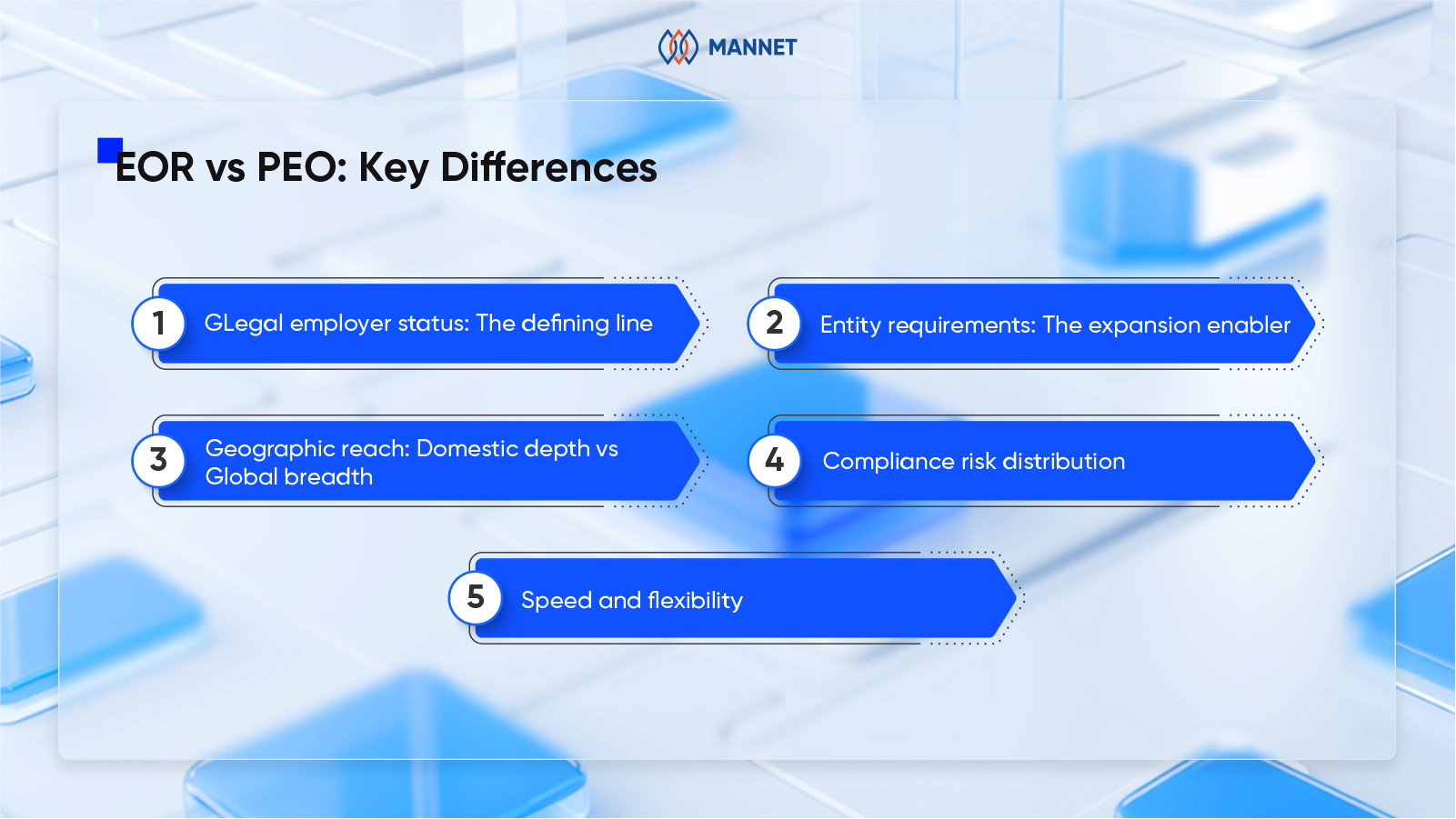
Legal employer status: The defining line
This is the cornerstone distinction. With a PEO, your company remains the legal employer – the PEO co-employs your staff and shares administrative responsibility, but you retain legal standing and shared compliance liability. With an EOR, the provider steps in as the sole legal employer. Employment contracts are drawn up between the EOR and the worker. Legal risk is transferred, not shared.
Entity requirements: The expansion enabler
A PEO requires you to already have a registered legal entity in the country or state where you plan to hire. An EOR operates through its own local entities, meaning you can hire in a new market without first going through the costly, time-consuming process of business registration. Conversely, if your company already holds a functioning legal entity in a foreign market, it generally cannot use an EOR for local hires.
Geographic reach: Domestic depth vs. Global breadth
PEOs are optimized for domestic or single-country operations. Their strength lies in building a robust HR infrastructure within an established market. Some providers market themselves as ‘global PEOs,’ but if they still require entity setup before hiring, they are functioning in practice as a PEO, not an EOR. EORs, on the other hand, are architected for borderless hiring, leading providers operate across 150 to 200+ countries.
Compliance risk distribution
Under a co-employment (PEO) arrangement, your company and the PEO share liability. If a compliance issue surfaces, for example, a misclassification, a late tax filing, or a breach of local labor regulations, both parties carry exposure. With an EOR, liability shifts almost entirely to the provider. Because the EOR is the employer of record, it bears the weight of payroll accuracy, tax compliance, statutory benefits, and adherence to local employment law.
Speed and flexibility
Time-to-hire is where EORs decisively pull ahead. Setting up a legal entity abroad typically takes two to four months. An EOR, armed with its own in-country entities and compliance infrastructure, can onboard a new hire in days. This speed advantage makes EORs particularly attractive for IT and technology companies that need to move fast on talent, before a candidate accepts another offer or a competitor establishes a regional presence first.
Cost Comparison: Breaking Down the Price of Each Model
Surface-level pricing comparisons between EOR and PEO can be misleading. A monthly per-employee fee rarely tells the whole story. To make an informed financial decision, organizations need to account for direct fees, entity-related costs, and the cost of compliance risk, all of which behave very differently across the two models.
EOR pricing models
EOR providers generally use one of three pricing structures:
- Fixed monthly fee per employee: The most common model, with fees typically ranging from $199 to $800+ per employee per month, depending on the country, seniority level, and provider. This structure offers predictable budgeting and is straightforward to model as teams scale.
- Percentage of salary: Some EOR providers charge a percentage of the employee’s gross salary – typically between 10% and 20% – rather than a flat fee. This model can become expensive for senior or highly compensated hires.
- Hybrid or tiered pricing: Certain platforms combine a lower base fee with add-ons for benefits administration, immigration support, or equity management, offering flexibility but requiring careful review of the total cost package.
For reference, leading EOR platforms in 2026 are priced roughly as follows: RemoFirst from $199/month, Multiplier from $400/month, Deel and Oyster from $599/month, Papaya Global from $650 to $800/month, and enterprise-grade providers like G-P and Velocity Global on custom quotes. These figures are per employee, per month, before statutory employer contributions, which the EOR also calculates and manages on your behalf.
PEO pricing models
PEO pricing typically takes one of two forms:
- Percentage of payroll: Ranging from 2% to 12% of total payroll, this model scales with wage growth and headcount. It can become more expensive as salaries increase, though it often includes a broader suite of HR services at no additional cost.
- Per-employee, per-month flat fee: Providers like Justworks offer flat pricing starting from $49 per employee per month – a model that simplifies budgeting and works well for smaller, fast-growing teams. ADP TotalSource prices at approximately 4% of payroll, while Insperity ranges from 5% to 9%, depending on the service tier selected.
PEO pricing looks attractively lower than EOR pricing until the full picture is accounted for.
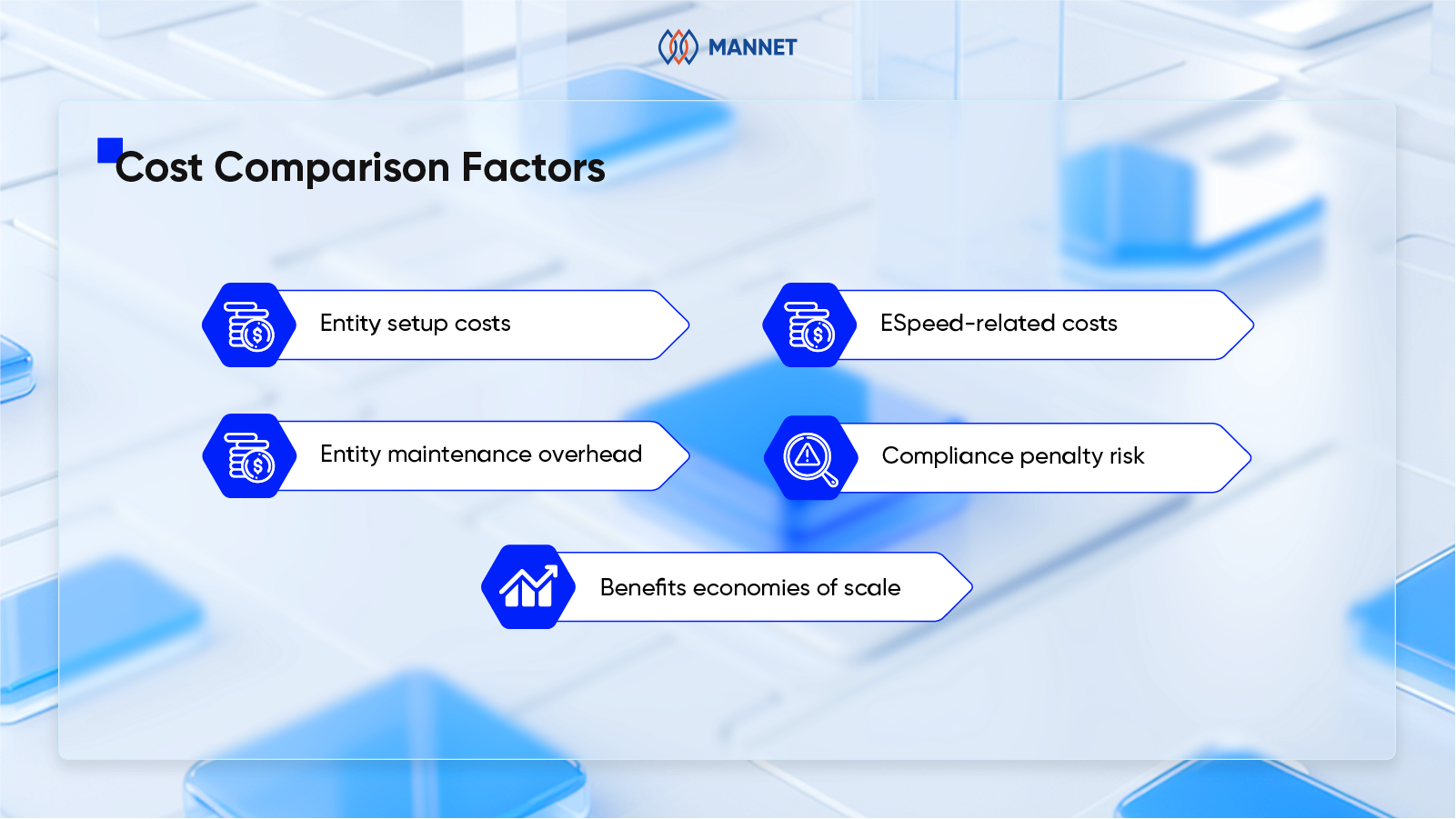
Cost comparison factors
When organizations weigh up the real cost of each model, several factors shift the balance significantly:
Entity setup costs
Establishing a legal entity in a foreign country typically costs between $10,000 and $50,000 per market. And that’s before ongoing maintenance, local legal counsel, annual filings, and banking infrastructure. These costs are absent from the EOR model, since the provider’s entity absorbs them.
Entity maintenance overhead
Once established, a foreign entity carries continuous costs, such as local accountants, tax filings, regulatory reporting, registered agent fees, and compliance monitoring. For organizations with one to ten employees in a given country, these costs can easily dwarf the EOR’s monthly fee.
Speed-related costs
Every week that an entity’s setup delays a hire is a week of lost productivity. For IT companies filling specialist technical roles, the cost of a delayed hire, measured in project delays, contract penalties, or lost candidate momentum, often exceeds several months of EOR fees.
Compliance penalty risk
With a PEO, your organization retains partial liability for compliance errors. In jurisdictions with strict enforcement – as is increasingly the case across Europe, Latin America, and Southeast Asia – a single misclassification or payroll error can trigger penalties that far exceed the difference in service pricing.
Benefits of economies of scale
PEOs often provide access to pooled benefits packages at group rates, which can be genuinely lower than what a small company would secure independently. EOR benefits are typically statutory plus market-rate additions, which may or may not match pooled pricing depending on the country.
EOR vs PEO pricing: Comparison table
| Cost Factor | EOR | PEO |
| Base fee per employee | $300-$800+/month | $40-$200/month or 2-12% of payroll |
| Entity setup cost | None (provider’s entity) | $10,000-$50,000+ per country if needed |
| Entity maintenance | None | Ongoing legal, tax, and admin costs |
| Speed to first payroll | 2-5 business days | 2-4 weeks (domestic) / months (new country) |
| Compliance penalty risk | Absorbed by EOR | Shared – client retains partial exposure |
| Benefits negotiation leverage | Market-based, per country | Group pooling – often lower domestic rates |
| True total cost (new country) | Typically lower when entity avoided | Higher once entity setup & maintenance factored in |
EOR vs. PEO cost structure comparison. Entity-related costs can substantially alter the true cost of the PEO model in new markets.
Which model is more cost-effective?
The answer is context-dependent, but the logic is consistent: a PEO is more cost-effective when you already have a legal entity in the target market and are managing a domestically established team. An EOR is more cost-effective when entering a new market, testing a country before committing to a permanent presence, or hiring fewer than 10 to 15 employees in a jurisdiction where entity setup costs would be disproportionate.
Industry data supports this conclusion. When entity setup and maintenance costs are factored into the total cost of ownership, EOR services regularly come out as the more financially sound option for initial market entry – even with a higher monthly per-employee fee. Many organizations find that they break even against entity costs only once they reach 15 to 25 employees in a single country and are confident in a long-term local presence. Below that threshold, the EOR model almost always wins on a total-cost basis.
When to Use a PEO vs. When to Use an EOR
When a PEO makes strategic sense
The PEO model delivers maximum value under specific conditions. If your business is established, operating within one or two known markets, and looking to strengthen its domestic HR function without building an entire internal department, a PEO is likely the sharper tool.
- You have a legal entity and an established workforce in the country of hire
- You want Fortune 500-level benefits packages for a sub-150 headcount
- You need a consistent HR infrastructure across multiple domestic states or regions
- You’re focused on long-term workforce retention, employee development, and culture-building
- You want to extend your internal HR capacity, not replace it
When an EOR makes strategic sense
The EOR model is purpose-built for a specific challenge: hiring where you don’t yet have a legal footprint.
- You want to tap into a new country’s talent market without committing to a full entity setup
- You need to onboard a specific hire quickly, in days, not months
- You’re running a distributed or remote-first team across multiple countries
- You want to test a new geographic market before making a long-term operational commitment
- You need to transfer employment compliance risk entirely to a specialist provider
- You’re scaling an IT or technology team across Asia-Pacific, Europe, or emerging markets
Transitioning Between EOR and PEO Models
Many companies don’t remain on a single model indefinitely. As business presence matures in a given market, the workforce model that made sense at entry may not be the right fit for the long term. Understanding how and when to transition between EOR and PEO is an important part of a comprehensive global HR strategy.
Why companies transition from EOR to PEO
The most common transition direction is from EOR to PEO, and it typically happens for one of three reasons:
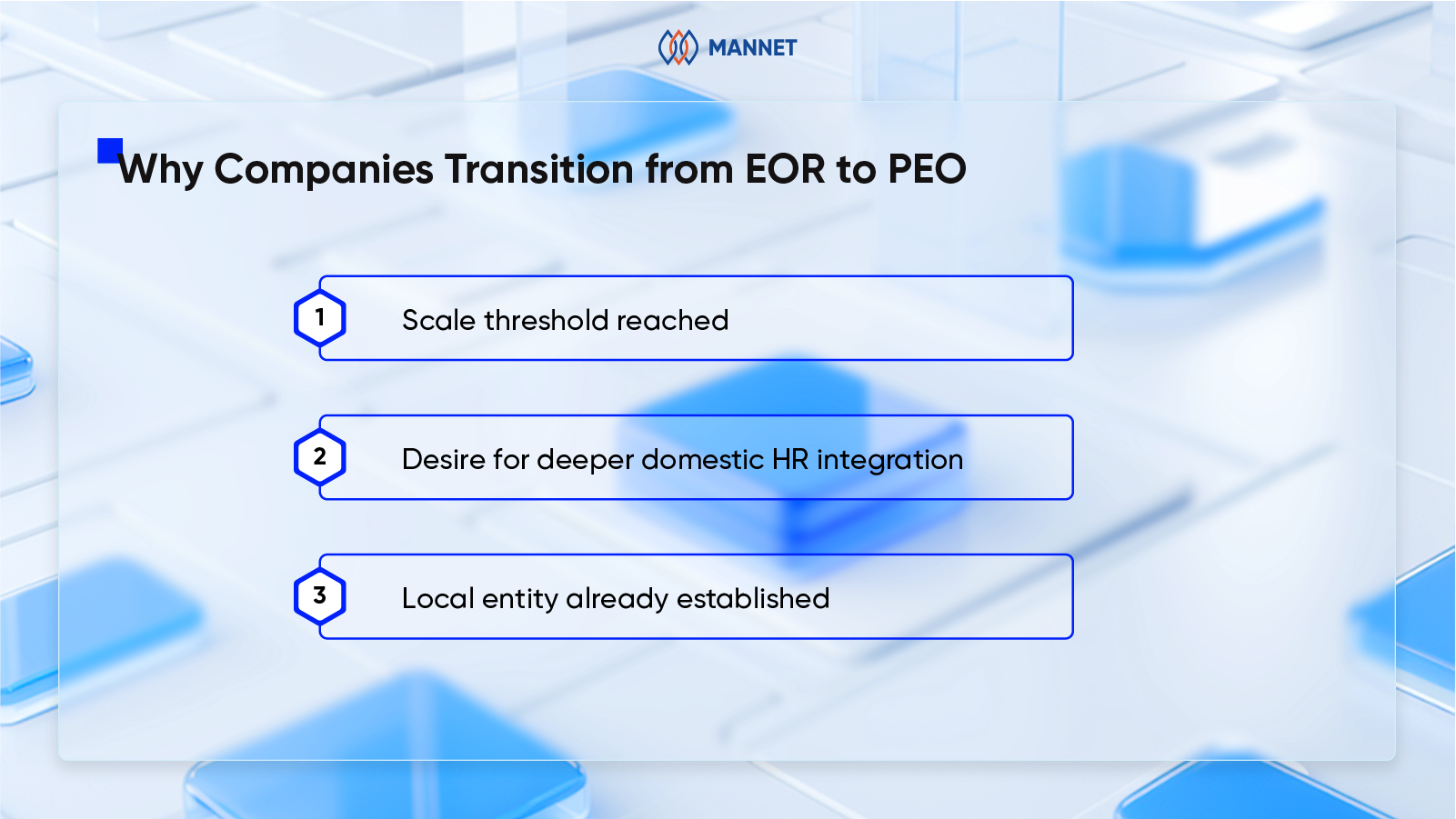
Scale threshold reached
Once a company crosses approximately 10 to 15 employees in a single country and has confidence in its long-term market commitment, the economics often shift in favor of establishing a local entity and moving to a PEO arrangement. At this headcount, the monthly EOR fee per employee begins to exceed the amortized cost of entity maintenance.
Desire for deeper domestic HR integration
As local teams grow, companies frequently want more comprehensive HR services – for example, workforce planning, local benefits customization, employee development programs, and culture-building initiatives – that PEOs are better positioned to deliver than EOR providers.
Local entity already established
Once a company sets up its own legal entity in a country (often to access local contracts, open bank accounts, or satisfy client requirements), the rationale for an EOR largely disappears. At that point, a PEO becomes a more natural co-employer partner.
The reverse transition – from PEO to EOR – is less common but occurs when companies expand globally beyond markets where they hold entities. Organizations already running a domestic PEO often layer in an EOR for their international hires, arriving at the hybrid model discussed later in this guide.
The transition process
Switching between EOR and PEO models is operationally manageable when planned carefully. Industry data suggests that a well-executed transition typically takes two to four weeks end-to-end. The key steps involve:
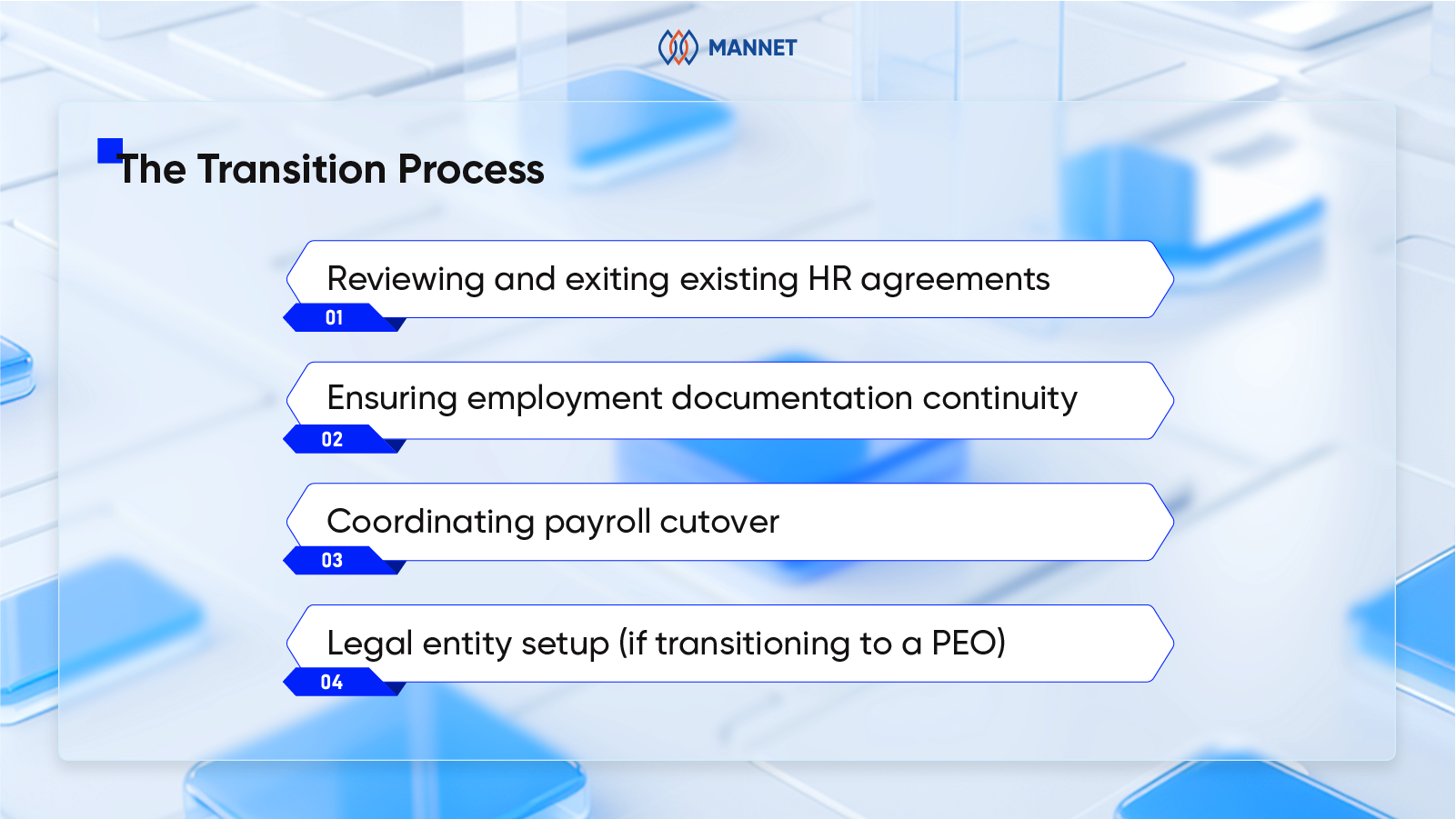
Reviewing and exiting existing HR agreements
Whether transitioning away from an EOR or a PEO, the outgoing arrangement must be formally terminated with appropriate notice periods and clearance of outstanding payroll and benefit obligations.
Guaranteeing employment documentation continuity
All employment contracts, benefit enrollments, and statutory documentation must be transferred or reissued under the new provider’s structure. Employees should receive clear communication throughout to minimize disruption to their day-to-day experience.
Coordinating payroll cutover
The timing of the payroll transition requires careful coordination to avoid gaps in payment or duplicate deductions. Payroll continuity, including maintaining wage base calculations for tax purposes, must be preserved across the changeover.
Legal entity setup (if transitioning to a PEO)
If the transition involves establishing a new local entity, this process must be completed before the PEO arrangement can go live. Working with a specialist who can manage entity formation in parallel with the EOR wind-down significantly compresses the overall timeline.
When implemented well, transitions are largely seamless from the employee’s perspective. In many cases, the change is experienced positively – as an improvement in benefits access, HR service quality, or platform usability – rather than as a source of disruption.
The Hybrid Approach: When One Model Isn’t Enough
Many mature organizations find that neither model alone covers their full workforce footprint. It’s increasingly common for businesses to run a PEO for their domestic workforce and an EOR for international hires simultaneously. This hybrid approach allows companies to benefit from the PEO’s domestic HR depth – richer benefits, stronger cultural integration, broader employee wellness programs – while leveraging the EOR’s global reach to hire compliantly in markets where they don’t hold entities.
As organizations grow and establish entities in previously foreign markets, they can transition workers from an EOR arrangement to their own local entity or a domestic PEO – a natural evolution that the best providers are designed to support without friction.
Relevance for IT Talent Acquisition and Staff Augmentation
For technology companies and IT-focused organizations, the EOR vs. PEO decision carries added significance. The global competition for skilled developers, data engineers, cybersecurity professionals, and cloud architects is intense – and the best candidates don’t always sit in the same jurisdiction as your headquarters.
IT staffing firms and companies engaged in staff augmentation need an employment infrastructure that can keep pace with the talent market. When a client urgently needs a senior backend engineer onboarded in Poland or a DevOps specialist brought on in the Philippines, a two-month entity setup process is a non-starter. An EOR bridges that gap, enabling talent-first decisions without compliance second-guessing.
At the same time, organizations building domestic IT teams at scale benefit from the PEO’s ability to offer competitive benefits packages, thereby leveling the playing field against larger employers. The key is matching the employment model to the operational reality: EOR for fast, compliant global hiring; PEO for optimized domestic workforce management; and a hybrid structure when both are needed simultaneously.
Top EOR Providers in Vietnam
Vietnam has emerged as one of Southeast Asia’s most compelling hiring destinations – particularly for technology, manufacturing, and business services talent. With FDI into Vietnam reaching $36.6 billion in 2024 (a 32% year-on-year increase), demand for compliant, entity-free hiring solutions has grown sharply. EOR pricing in Vietnam typically ranges from $250 to $599 per employee per month, depending on the provider’s model and service scope.
For a deeper dive into provider comparisons, local pricing benchmarks, and what to look for when evaluating an EOR partner specifically for the Vietnamese market, refer to ManNet’s full resource: Best Employer of Record (EOR) Companies in Vietnam | 2026 Updated.
EOR vs PEO: Choosing the Right Model (Decision Framework)
Rather than defaulting to one model based on familiarity, organizations benefit from working through a structured set of questions:
Do you have a registered legal entity in the country where you plan to hire?
If yes, consider a PEO. If not, an EOR is the appropriate route.
Are you hiring in one market or across multiple countries simultaneously?
Multi-country expansion strongly favors an EOR.
How much compliance risk are you willing to retain?
If full liability transfer is a priority, choose an EOR. If shared responsibility is acceptable, a PEO may suffice.
How quickly do you need the hire in place?
For time-sensitive onboarding, EOR wins decisively on speed.
What is your long-term footprint strategy?
If you plan to establish a permanent entity, consider starting with an EOR and transitioning once the entity is active. If your market presence is established and indefinite, a PEO provides more durable HR depth.
What are your headcount projections in the target market?
Under 10 to 15 employees: EOR typically wins on total cost. Above 15 employees with long-term commitment: entity + PEO usually becomes more economical.
FAQs About EOR vs PEO
1. Can a company switch from an EOR to a PEO later?
Yes. Many companies begin with an EOR when entering a new market and transition to a PEO after establishing a local legal entity. The timing depends on hiring volume, long-term expansion plans, and operational requirements.
2. Is an EOR or PEO better for hiring remote employees internationally?
For companies without a legal entity in the target country, an Employer of Record (EOR) is generally the more suitable option because it can legally employ workers on the company’s behalf. A PEO typically requires the company to already have a registered local entity.
3. Who owns the employment relationship under an EOR and a PEO?
With an EOR, the provider is the legal employer while the client company manages the employee’s day-to-day responsibilities. Under a PEO model, employment responsibilities are shared through a co-employment arrangement, and the client company remains the legal employer.
4. What types of companies benefit most from EOR services?
EOR services are commonly used by startups, scale-ups, and multinational companies that want to hire employees quickly in new markets without establishing a local legal entity. They are particularly valuable for testing new markets, building distributed teams, and accelerating international expansion.
5. How do I choose the right EOR or PEO provider?
Evaluate providers based on their geographic coverage, compliance expertise, payroll accuracy, employee support, pricing transparency, security standards, and experience supporting companies of similar size and industry. The best provider should align with both current hiring needs and long-term global workforce strategy.
Final Verdict: Why Choose ManNet as Your Organization’s Recruiting Agency
At ManNet, we turn hiring into a strategic lever for growth. With deep expertise across IT recruitment, staff augmentation, and HR consulting, we help businesses make the right workforce decisions from the start, especially when navigating EOR vs. PEO.
From entering Vietnam without a legal entity to scaling teams under pressure, we design employment models that balance speed, compliance, and long-term sustainability. Our strength lies in combining local regulatory insight with a clear understanding of your business and talent strategy.
Whether your company is making the first hire or building for scale, ManNet supports the decisions that define how your organization grows – and how fast it gets there.
Explore more: https://www.mannet.tech/eor-services-in-vietnam/