

AI outsourcing can accelerate access to specialized talent and technical capabilities, but the wrong outsourcing model can turn a promising initiative into a costly stalled project. Vague requirements, unvalidated data, rigid contracts, and unclear ownership can create problems long before development begins.
Research from RAND, MIT, and Gartner highlights the broader challenge: many enterprise AI initiatives struggle to move from experimentation to measurable business value. For organizations outsourcing AI development, the risks extend beyond technical performance to governance, data, integration, cost, and long-term ownership.
This guide explores the most common AI outsourcing mistakes & how to avoid them, from treating AI like conventional software development to choosing a partner without assessing its delivery and governance capabilities. It also provides practical measures for structuring the engagement, managing risk, and evaluating potential AI outsourcing partners before signing a contract.
Let’s dive in!
In brief
- AI outsourcing mistakes often start before development begins. Unclear business objectives, poorly defined scope, unrealistic timelines, and unvalidated data can create delivery problems that technical expertise alone cannot resolve.
- The most common AI outsourcing mistakes fall into five areas: Unclear requirements and success metrics; weak data readiness and governance; insufficient protection of intellectual property and security; poor integration with existing systems and workflows; and unclear ownership after deployment.
- AI projects require a different outsourcing approach from conventional software development.AI performance can depend on data quality, model selection, evaluation criteria, infrastructure, ongoing monitoring, and iterative development. Contracts and delivery plans need to account for these variables.
- Outsourcing execution does not mean outsourcing strategic ownership. Organizations should retain control over business objectives, critical data decisions, governance, risk thresholds, and success criteria while the outsourcing partner contributes specialized technical capabilities.
- A strong AI outsourcing partner is evaluated beyond technical skills. Relevant criteria include AI delivery experience, data and security practices, integration capabilities, documentation, knowledge transfer, communication, scalability, and post-deployment support.
- Avoiding AI outsourcing mistakes requires risk management throughout the engagement. From partner selection and contract design to development, testing, deployment, and handover, each stage should have defined responsibilities, measurable outcomes, and clear ownership.
- This guide covers 10 common AI outsourcing mistakes and practical ways to avoid them, with examples, industry data, and a framework for evaluating AI outsourcing partners before entering an engagement.
The Scale of The Problem, in Numbers
Before looking at individual AI outsourcing mistakes, it helps to understand the scale of the broader AI project challenge. The evidence points to a consistent pattern: getting an AI initiative into production and translating it into measurable business value remains difficult, even for organizations with significant investment and technical resources.
- 80%+ of AI projects are estimated to fail, according to research cited by RAND Corporation, roughly twice the failure rate of conventional IT projects. RAND’s own analysis highlights leadership and organizational decisions as the most frequently cited root causes of failure.
- 95% of enterprise generative AI pilots analyzed in MIT’s NANDA research delivered no measurable impact on the profit-and-loss statement. The study examined more than 300 public AI deployments alongside interviews and employee research, making the figure a measure of financial impact rather than technical functionality.
- 42% of organizations reported abandoning most of their AI initiatives before production in S&P Global Market Intelligence’s 2025 research, up from 17% the previous year. On average, organizations reported scrapping 46% of AI proof-of-concept projects before broader adoption.
- Only 48% of AI projects made it into production in Gartner’s 2024 survey, with the average journey from prototype to production taking approximately eight months.
- 63% of organizations surveyed by Gartner either did not have, or were unsure whether they had, the right data management practices for AI. Gartner subsequently predicted that organizations would abandon 60% of AI projects unsupported by AI-ready data through 2026.
- 84% of practitioners interviewed in RAND’s research cited one or more leadership-driven causes as the primary reason AI projects failed. These included solving the wrong business problem, communication gaps between business and technical teams, and unrealistic expectations around what AI could deliver.
Taken together, these figures point to an important distinction for organizations considering AI outsourcing: the core risk is rarely limited to the model or the engineering team. Project outcomes are also shaped by how the initiative is defined, governed, integrated into the business, and transferred to the organization that will ultimately operate it.
The talent equation
The delivery challenge is compounded by a highly competitive AI talent market. Stanford HAI’s 2026 AI Index reports that the number of AI researchers and developers moving to the United States has fallen 89% since 2017, indicating a significant shift in the global flow of specialized AI talent.
This helps explain why external sourcing remains an important part of the technology talent strategy. Deloitte’s 2024 Global Outsourcing Survey, based on responses from more than 500 executives, found that 80% of executives planned to maintain or increase investment in third-party outsourcing. The survey also highlights skilled talent and agility alongside cost reduction as key drivers for outsourcing.
For organizations outsourcing AI development, however, access to specialized talent is only one part of the equation. The more important question is whether the outsourcing model gives that talent the scope, data access, governance structure, business context, and long-term ownership required to turn an AI initiative into a production capability.
What Is AI Outsourcing?
AI outsourcing is the practice of engaging an external team to design, build, deploy, or maintain artificial intelligence and machine learning capabilities that an organization cannot, or does not want to, develop entirely in-house.
The scope extends well beyond model development. AI outsourcing can cover predictive models, recommendation engines, computer vision, natural language processing (NLP), generative AI applications, as well as the data engineering and MLOps capabilities required to operate these systems in production. It can also include the labor-intensive work of collecting, preparing, and labeling training data.
In practice, most AI outsourcing engagements fall into four broad models:
| Model | How it works | Best suited to | Where it can go wrong |
| Project-based | An external provider delivers a defined solution against an agreed scope and timeline. | Validating or delivering a clearly bounded AI use case. | Fixed scope can become restrictive as requirements evolve during AI development. |
| Dedicated team | An external team works exclusively on the organization’s AI roadmap. | Longer-term initiatives with evolving requirements and multiple development phases. | Without strong internal oversight, priorities can drift, and the external team can become disconnected from business goals. |
| Staff augmentation | External specialists integrate directly into the organization’s existing team and workflows. | Filling specific AI skill or capacity gaps while retaining internal technical control. | Effective onboarding and integration into internal systems, processes, and communication channels are essential. |
| Hybrid | External delivery capacity is combined with internal hiring and capability development. | Building long-term internal AI capabilities while maintaining external delivery capacity. | Knowledge transfer and ownership need to be planned deliberately from the beginning. |
These models can also be combined as an organization’s AI strategy evolves. For example, a business may use project-based delivery to validate an initial use case, add specialized AI engineers through staff augmentation as the initiative scales, and build permanent internal capability over time.
ManNet provides AI talent and outsourcing solutions across flexible engagement models, including AI staff augmentation, IT recruitment, and EOR, helping organizations access specialized AI and engineering talent while retaining the level of technical and operational control appropriate to their needs. ManNet AI Outsourcing Solutions
Ultimately, the model matters because it determines who owns delivery, who controls technical decisions, how quickly the team can scale, and what happens when the initial project ends. Many of the AI outsourcing mistakes discussed in the sections ahead can be traced back to choosing an engagement model or contract structure that does not match the organization’s actual objective.
Top 10 AI Outsourcing Mistakes and How to Avoid Them
1. Treating AI like a standard software project
One of the most common AI outsourcing mistakes is applying fixed-scope, deterministic software contracts to work that is inherently experimental, data-dependent, and subject to performance changes over time. AI development relies on probabilistic outcomes rather than a fully predictable specification, which can create friction when conventional software delivery models are applied without adjustment. (Saigon Technology, 2026)
In traditional software outsourcing, the process is relatively straightforward: the organization defines a feature, the development team builds it, and the result is tested against the agreed specification. AI introduces three additional variables.
First, the same code can produce different results as the underlying data changes. Second, a model may achieve 85% accuracy when the business requires 95%, and that outcome cannot be reliably determined before the model has been tested against representative data. Third, performance can decline after deployment as data drift and concept drift affect the relationship between inputs and expected outcomes. In other words, delivery does not necessarily end when the initial model goes live.
Worked example
A retail company signs a fixed-price, fixed-scope contract for a demand-forecasting model, with a single milestone: “deliver a model with 90% forecast accuracy.”
Three months into the project, the vendor discovers that two years of historical sales data are missing promotional flags. Without this information, the model cannot reliably distinguish a genuine demand spike from one driven by a discount campaign.
Because the contract is built around a single performance milestone, the project now has limited room to accommodate the discovery. The vendor may deliver a weaker model that technically satisfies the agreed requirement, or the client may need to approve additional change orders to address the data issue.
Neither outcome addresses the underlying problem: the original contract treated an uncertain AI development process as though its requirements and inputs were fully known from the start.
How to avoid it
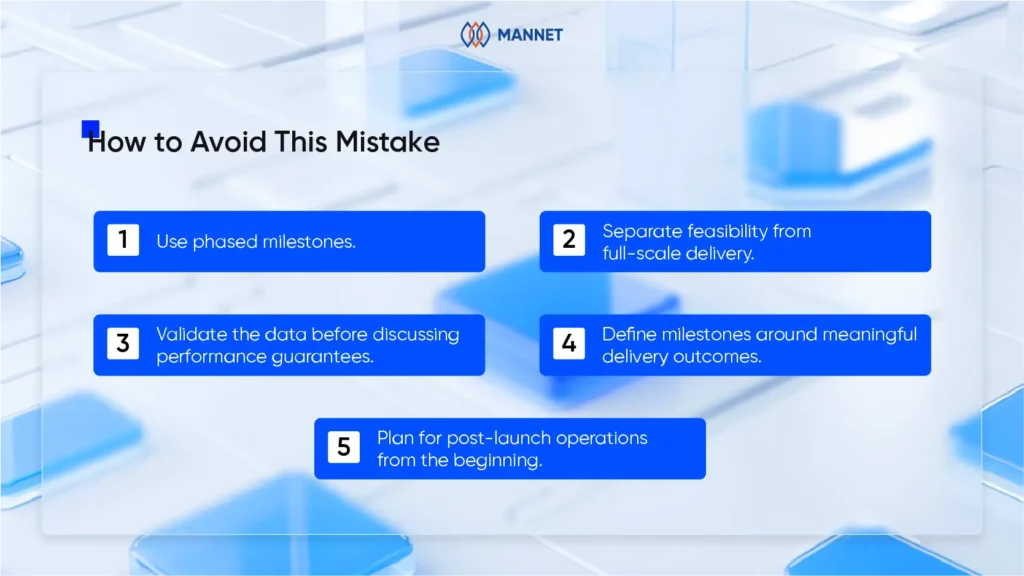
- Use phased milestones. Structure the engagement around stages such as data assessment and pipeline development, model development, and proof of concept, with a defined budget and go/no-go decision at each stage. (Saigon Technology, 2026)
- Separate feasibility from full-scale delivery. Run initial discovery and proof-of-concept work on a time-and-materials basis where appropriate. Once feasibility, data readiness, and technical requirements are better understood, transition to milestone-based or dedicated-team delivery.
- Validate the data before discussing performance guarantees. A vendor should inspect the organization’s actual or representative data before committing to a specific model-performance target. (Saigon Technology, 2026) An accuracy target agreed without sufficient data validation can create unrealistic expectations for both sides.
- Define milestones around meaningful delivery outcomes. Instead of making a single accuracy number the only acceptance criterion, consider measurable outcomes such as a pipeline operating successfully on production-representative data, a model meeting agreed evaluation criteria, or a proof of concept demonstrating the required business workflow.
- Plan for post-launch operations from the beginning. Monitoring, retraining, model evaluation, infrastructure, and ongoing maintenance should be considered part of the AI delivery lifecycle and reflected in the initial scope and budget.
2. Losing control of data and IP ownership
A common AI outsourcing mistake is assuming that paying for an AI project automatically gives the client ownership of the model, source code, training outputs, and fine-tuned weights. That assumption can be wrong, depending on the contract, the underlying technology, and the third-party components used to build the solution. Some vendors may retain rights to parts of the trained model or reserve rights to use certain client data to improve their services or models. (AIVision, 2026)
This can become one of the most consequential contractual blind spots in AI outsourcing because ownership and usage rights may remain unclear until the relationship changes or the project is transferred to another provider. An AI system can depend on proprietary client data, third-party datasets, open-source components, commercial foundation models, vendor-developed preprocessing logic, and custom model weights. A general “client owns the deliverables” clause may not clearly define the rights attached to each of these assets.
Worked example
A manufacturer outsources a defect-detection model built using years of proprietary inspection images, making the underlying dataset a potentially valuable business asset. The vendor’s standard contract includes a broad clause permitting the “use of data to improve service quality.”
Eighteen months later, the manufacturer sees a competitor’s product demonstration featuring a similar defect-detection capability. The manufacturer becomes concerned that patterns derived from its proprietary defect library may have contributed to a model or service subsequently offered to other organizations in the same industry.
The situation may be difficult to resolve if the original agreement did not clearly distinguish between client-owned data, model outputs, trained weights, derived insights, and vendor rights to reuse data. The contractual ambiguity can become as significant as the technical issue itself.
How to avoid it
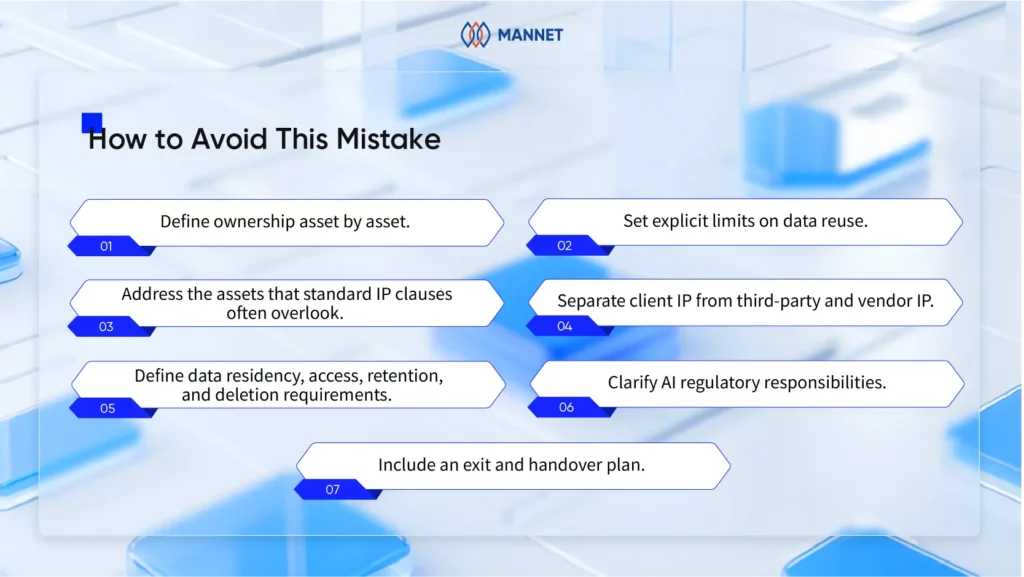
- Define ownership asset by asset. Clearly specify who owns the input data, output data, source code, custom-trained models, fine-tuned weights, documentation, and other project-specific deliverables. Where ownership cannot be transferred, define the scope, duration, and exclusivity of the license granted to the client. (AIVision, 2026)
- Set explicit limits on data reuse. Prohibit the use of production or proprietary client data for training general-purpose or third-party models unless the client has provided specific, written consent for that use. (AIVision, 2026)
- Address the assets that standard IP clauses often overlook. Fine-tuned weights, prompts, feature-engineering logic, preprocessing pipelines, evaluation datasets, embeddings, and other derived assets can each raise separate ownership or usage questions.
- Separate client IP from third-party and vendor IP.Identify which components come from the client, the outsourcing provider, open-source projects, or commercial model providers. Document the applicable licenses and any restrictions on modification, redistribution, or commercial use.
- Define data residency, access, retention, and deletion requirements. Specify where data can be stored and processed, who can access it, how long it may be retained, and how it must be returned or deleted when the engagement ends. Align these requirements with GDPR and other applicable data-protection obligations.
- Clarify AI regulatory responsibilities. For systems placed on the EU market or otherwise subject to the EU AI Act, define the relevant roles and responsibilities of the provider, deployer, and other parties involved in the AI system. The Act’s obligations apply progressively, with several provisions becoming applicable from 2 August 2026. EU AI Act — Regulation (EU) 2024/1689
- Include an exit and handover plan. Before development begins, define what happens to the data, models, weights, code, documentation, credentials, and other project assets when the engagement ends or moves to another provider. A clean exit should be part of the original contract, not negotiated after the relationship has broken down.
3. Skipping data readiness and scope assessment before hiring a vendor
One of the most avoidable AI outsourcing mistakes is hiring a vendor before confirming that the required data exists, can be accessed, and reflects real production conditions. Gartner reported that 63% of organizations either lacked the right data management practices for AI or were unsure whether they had them, highlighting how data readiness can become a major constraint before development even begins. (Gartner, 2025)
“Build us an AI chatbot” or “use AI to improve operations” describes an ambition, not a sufficiently defined project scope. Without a precise problem definition, an outsourcing partner cannot make informed technical trade-offs around data, architecture, model selection, evaluation, or deployment. Without usable data, even a highly capable team may spend the early stages of the engagement on data discovery, cleaning, integration, and access requests instead of model development.
Worked example
A logistics company hires a vendor to build a route-optimization model, expecting delivery within ten weeks. During the first month, the vendor discovers that driver GPS logs are stored in three incompatible formats across regional systems, with no unified timestamp standard.
The project was originally scoped as a model-development engagement. In practice, it has become a data-unification project that requires additional engineering work, internal coordination, and security reviews. The client had not budgeted for this work, and the original delivery timeline quickly became unrealistic.
The problem was not necessarily the vendor’s development capability. The project entered technical delivery before the organization had established whether the underlying data environment was ready for it.
How to avoid it
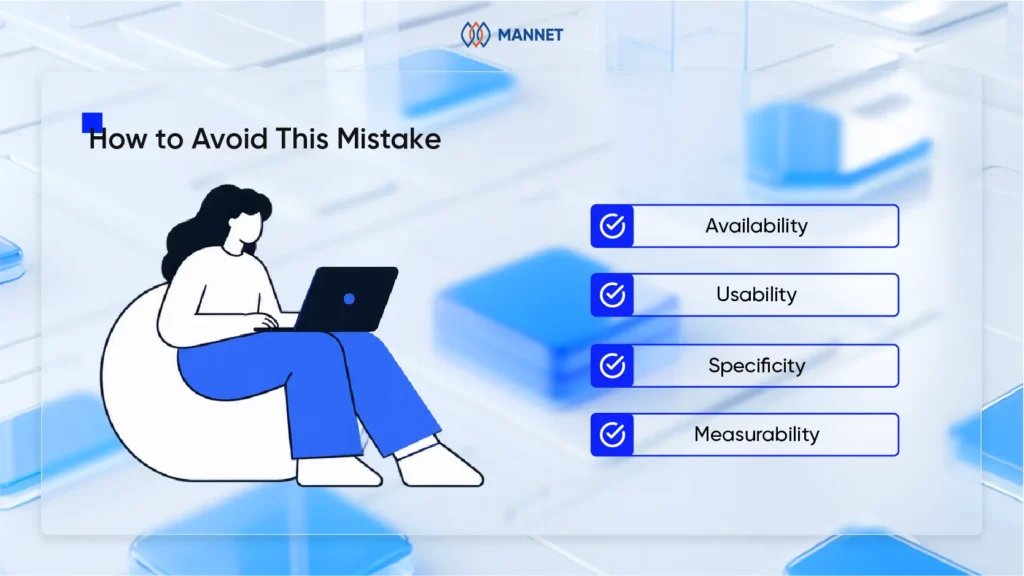
Run a focused AI readiness and scope assessment before committing to a large outsourcing engagement. At minimum, answer four questions:
- Availability: Where does the required data actually reside? Map the relevant systems, databases, files, APIs, third-party sources, and data owners.
- Usability: Is the data sufficiently complete, consistent, labeled, and representative of real production conditions? A curated sample can create a very different picture from the data the system will encounter after deployment.
- Specificity: Has the initial business ambition been translated into a defined workflow, user group, decision, and use case? “Improve operations with AI” needs to become a concrete problem that can be evaluated.
- Measurability: Do technical evaluation metrics connect to a business outcome? Depending on the use case, this could include hours saved, error rates reduced, forecast accuracy, processing time, conversion, or other operational measures.
If the data is not ready, make the first paid phase a data readiness or data strategy engagement instead of committing immediately to full model development. This gives both parties an opportunity to identify data gaps, integration requirements, security constraints, and realistic project parameters before larger delivery commitments are made.
Organizations should also resolve internal dependencies early. In outsourced AI projects, delays can arise from the client side when data access, security approvals, system credentials, procurement processes, or stakeholder decisions take weeks to complete. A capable vendor cannot progress against dependencies that remain unresolved internally.
The practical rule is simple: validate the data and define the decision before defining the model.
4. Choosing a vendor on price or a polished demo alone
A polished AI demo or a low price can create a misleading picture of a vendor’s actual delivery capability. AIVision’s review of AI partnerships across Vietnam and Southeast Asia found that roughly one-third of AI outsourcing projects in the region fail because of partner selection, rather than technology limitations. (AIVision, 2026)
A controlled demo built on clean, curated data says little about how a solution will perform against real production conditions. Two vendors may both claim AI expertise while having very different capabilities: one may have extensive experience operating models in production and managing MLOps, while another may primarily integrate third-party APIs into compelling prototypes. The difference may only become visible when the project encounters messy data, changing requirements, integration constraints, or post-launch maintenance.
Worked example
A food manufacturer selects a vendor after seeing a packaging-inspection demo achieving 99% accuracy on clean, well-lit sample images. Once deployed on the production line, dusty cameras, inconsistent lighting, and partial product occlusions reduce real-world accuracy to the low 80s.
Addressing these edge cases requires additional data preparation, model development, and infrastructure work that was not included in the original estimate. The project stalls at the pilot stage as the cost and scope expand. (AIVision, 2026)
How to avoid it
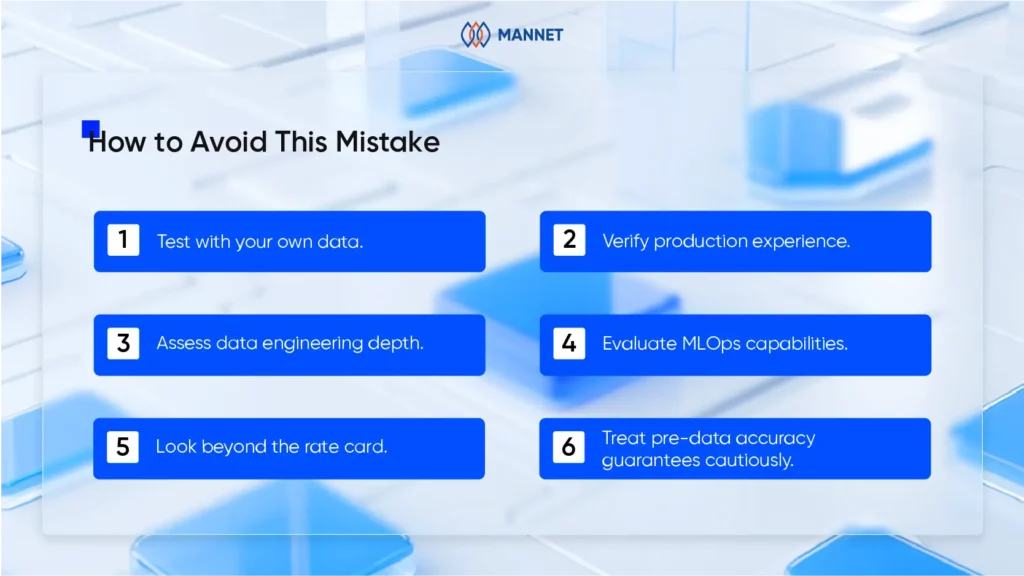
- Test with your own data. Before signing a large engagement, assess how the vendor handles imperfect inputs, missing fields, inconsistent formats, or other production-specific conditions. (AIVision, 2026)
- Verify production experience. Ask for relevant AI systems the team currently operates and how they monitor, maintain, and improve them.
- Assess data engineering depth. Explore how the team manages data pipelines, upstream changes, quality issues, and integration with existing systems.
- Evaluate MLOps capabilities. Review deployment, model versioning, monitoring, rollback, retraining, and post-launch support processes.
- Look beyond the rate card. Compare the delivery model, technical scope, operational support, and likely rework required alongside the initial project cost.
- Treat pre-data accuracy guarantees cautiously. Performance targets should be based on testing against representative data and agreed evaluation criteria, not a generic benchmark from a controlled demo.
5. Overlooking undocumented process knowledge
AI systems depend on the process knowledge behind the data, and much of that knowledge may exist only in employees’ experience rather than formal documentation. Every business has exceptions, judgment calls, and escalation rules that a standard process map rarely captures. When these details are missed, an AI system can reproduce the documented workflow while still making the wrong business decision.
Worked example
A company outsources a customer-support triage model to automatically route incoming tickets. Straightforward cases such as “billing question” or “password reset” are easy to document, and the model handles them well.
The problem is an exception known only to experienced support staff: when a ticket mentions a specific enterprise account together with the word “escalate,” it must bypass the standard queue entirely. Because this rule was never formally documented, it is absent from the training and evaluation process.
The model routes the ticket through the normal workflow, leaving a genuine enterprise issue unresolved for two days.
How to avoid it
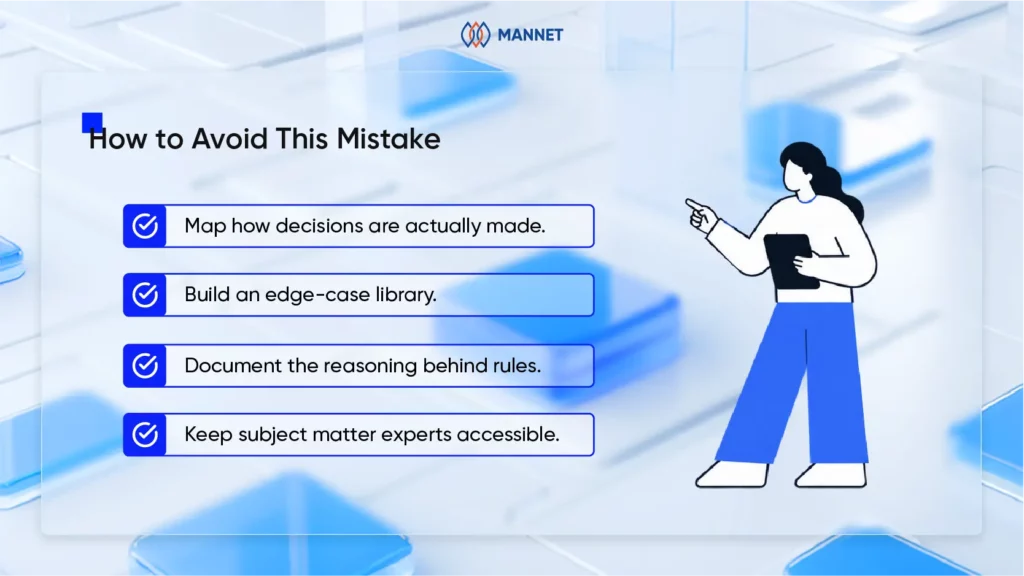
- Map how decisions are actually made. Use structured sessions with subject matter experts to capture standard workflows, exceptions, judgment calls, and escalation paths.
- Build an edge-case library. Collect and label real-world exceptions alongside representative cases when creating training and evaluation datasets.
- Document the reasoning behind rules. Distinguish formal policies from informal habits so the AI team understands which decisions are mandatory and which can be adapted.
- Keep subject matter experts accessible. Give the AI team ongoing access to the people who operate the process day to day, particularly during discovery, testing, and model evaluation.
6. Outsourcing strategy instead of execution
A costly AI outsourcing mistake is delegating core strategic decisions, such as problem definition, data governance, and model acceptance criteria – to an external provider instead of keeping those decisions within the organization. AI vendors can provide specialized technical expertise and delivery capacity, but the business should retain ownership of what the solution is expected to achieve and what constitutes an acceptable outcome. (Saigon Technology, 2026)
A practical division of responsibilities looks like this:
| Keep in-house | Outsource | Co-own over time |
| Problem definition and success criteria | Data pipeline engineering | Monitoring and retraining |
| Data governance and compliance decisions | Model training and experimentation | |
| Model evaluation and acceptance | MLOps setup | |
| Production integration decisions | Proof-of-concept development | |
| Data labeling and annotation |
Worked example
A healthcare provider outsources both the development of a diagnostic-support model and the definition of what constitutes a clinically acceptable false-negative rate. The internal team does not feel sufficiently equipped to establish the threshold, so the vendor makes the decision.
Without the necessary clinical context, the vendor sets a threshold optimized for overall model accuracy instead of accounting for the significantly higher consequences of missing a serious condition.
The model performs well against a general technical metric but poorly against the outcome that matters most to the organization. The mismatch only becomes visible after a near-miss incident.
The issue is not simply model performance. A critical business and clinical decision was assigned to the party with the least relevant context to make it.
How to avoid it
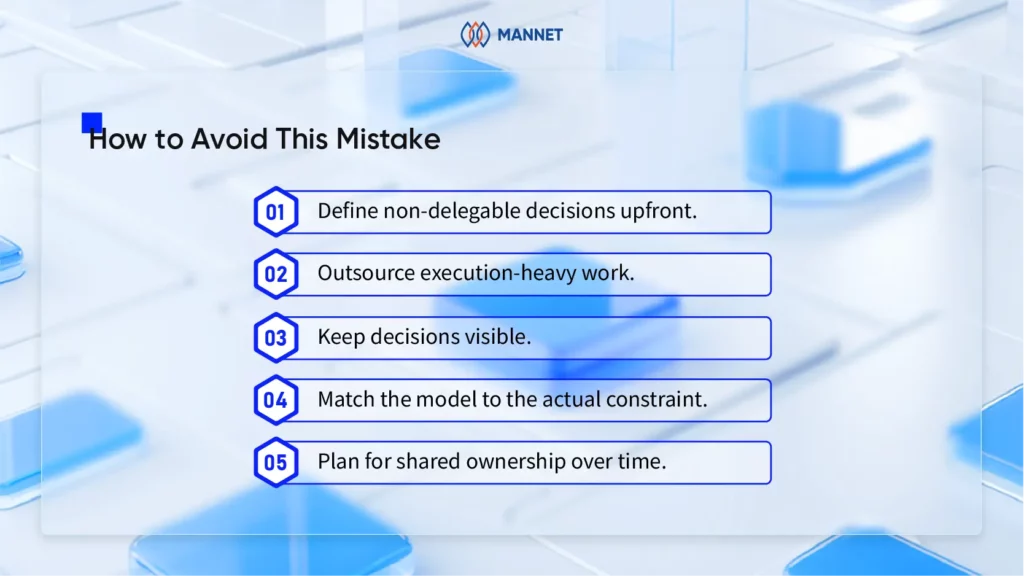
- Define non-delegable decisions upfront. Retain ownership of problem framing, success criteria, acceptance thresholds, data governance, compliance, and production integration decisions.
- Outsource execution-heavy work. Data pipelines, model training, experimentation, MLOps, proof-of-concept development, and data annotation are often well suited to external delivery when the requirements and governance framework are established. (Saigon Technology, 2026)
- Keep decisions visible. Where possible, have external teams work within agreed repositories, documentation standards, and review processes so technical decisions and assumptions remain accessible to internal stakeholders.
- Match the model to the actual constraint. If the primary challenge is delivery capacity rather than strategic or technical expertise, staff augmentation can add specialists while allowing the internal team to retain ownership of key decisions.
- Plan for shared ownership over time. Monitoring, retraining, model evaluation, and continuous improvement should gradually involve internal teams so the organization can maintain effective oversight after the outsourcing engagement changes or ends.
7. Signing a contract that ignores AI-specific risk
A standard software outsourcing agreement may leave several AI-specific risks insufficiently defined. Beyond the IP and data ownership issues covered earlier, AI engagements require clearer treatment of probabilistic performance, model evaluation, liability for incorrect outputs, and the distinction between infrastructure availability and model quality.
Worked example
A fintech company carries over a standard 99.9% uptime SLA from a previous software agreement into its AI outsourcing contract. The fraud-detection system remains available throughout the quarter, technically meeting the SLA.
However, transaction patterns change, and the model’s false-positive rate gradually increases. Legitimate customers begin being flagged as potentially fraudulent, but the contract contains no model-performance threshold or monitoring requirement. Because the system remains operational, the issue can continue for weeks before it is identified and addressed.
The contract measured whether the system was available, but not whether it was still performing as intended.
How to avoid it
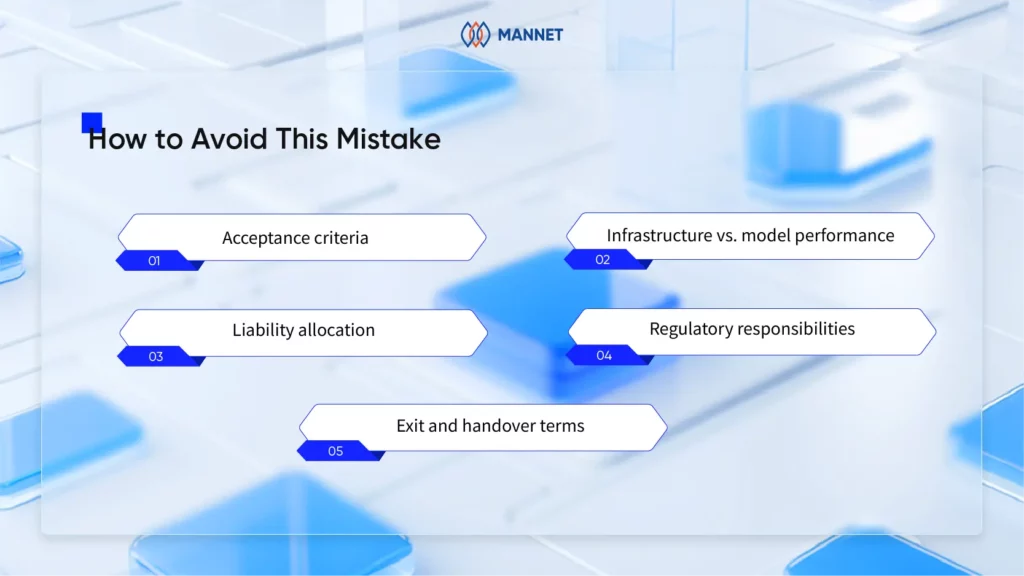
AI outsourcing contracts should address the following separately:
- Acceptance criteria: Define evaluation datasets, test conditions, performance ranges, and acceptance procedures appropriate for probabilistic AI systems instead of relying solely on deterministic pass/fail criteria.
- Infrastructure vs. model performance: Separate infrastructure uptime SLAs from model-performance requirements. Define relevant metrics, monitoring responsibilities, thresholds, and escalation or remediation procedures when performance changes.
- Liability allocation: Clarify how responsibility is handled when incorrect predictions, recommendations, or generated outputs cause operational, financial, or customer impact, including any applicable limitations and exclusions.
- Regulatory responsibilities: Assign responsibilities under applicable frameworks such as the EU AI Act and GDPR based on each party’s actual role in developing, providing, deploying, or operating the system.
- Exit and handover terms:Establish requirements for data return or deletion, model and code access, documentation, credentials, knowledge transfer, and ongoing support before the provider becomes operationally critical.
A well-structured AI outsourcing contract should therefore define what is being delivered, how it will be evaluated, who is responsible when performance changes, and how the organization can regain operational control if the engagement ends.
8. Neglecting structured communication and executive sponsorship
Outsourcing development does not mean outsourcing ownership. AI engagements need an embedded internal technical lead and visible executive sponsorship to keep decisions aligned with business priorities.
An external AI team makes frequent judgment calls that depend on business context: what constitutes a useful prediction, which errors matter most, and when a model is ready for testing. A purely transactional relationship can leave the vendor without the context needed to make those decisions effectively. Research from Auxis on outsourcing failures across functions identifies executive sponsorship as an important factor in successful outsourcing relationships, particularly because visible leadership support influences how teams adopt and engage with change (Auxis, 2025).
Worked example
A vendor developing a churn-prediction model identifies an early ambiguity: does “churn” mean a canceled subscription or a customer who has stopped logging in? These definitions require different data, model logic, and business interventions. With no internal technical lead joining regular meetings, the question remains unresolved for three weeks. The vendor proceeds with the definition that appears most common in similar projects, only for the client to discover the mismatch during final review, after most of the project budget has been committed.
How to avoid it
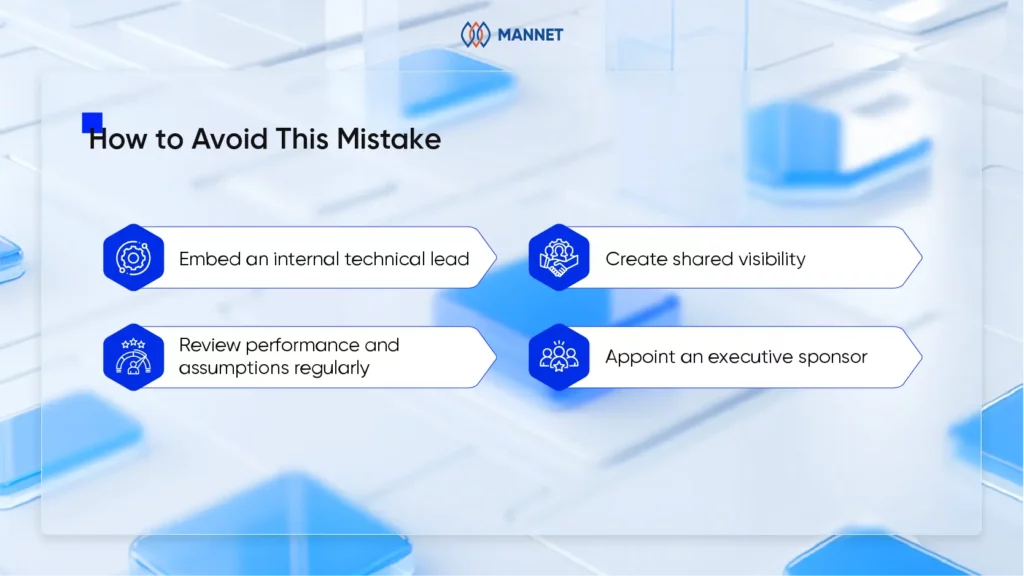
- Embed an internal technical lead. Include a designated technical owner in vendor standups and key reviews. Deep ML expertise is not essential; the role is to resolve ambiguity, connect technical decisions to business context, and escalate issues quickly.
- Create shared visibility. Give the vendor appropriate access to repositories, ticketing, CI/CD, and experiment-tracking tools so project decisions and technical progress remain transparent.
- Review performance and assumptions regularly. Hold weekly model-performance reviews alongside sprint demos. Discuss what was delivered, what was learned, and which assumptions need to change.
- Appoint an executive sponsor. A visible sponsor can reinforce the initiative’s business value, resolve cross-functional barriers, and support adoption among teams whose workflows will change.
9. Mistaking a proof of concept for a production system
A proof of concept answers one question: can this approach create enough value under controlled conditions to justify further investment? It does not demonstrate that the system is ready for real users, production workloads, or operational scale. Gartner reported that only 48% of AI projects reached production in its 2024 survey, with an average eight-month gap between prototype and production, highlighting the distance that can exist between experimentation and deployment (Gartner, 2024).
A successful PoC may rely on a limited dataset, a notebook, and temporary infrastructure, which can be appropriate for testing feasibility. Problems arise when the same build is treated as production-ready. S&P Global found that organizations scrapped an average of 46% of AI proofs of concept before broader adoption in 2025, illustrating how frequently projects fail to bridge the gap between experimentation and operational deployment (S&P Global, 2025).
Worked example
An insurance company’s outsourced PoC for automated claims triage performs well in demos using a curated dataset of several hundred historical claims. Production introduces a different set of requirements: ten times the data volume, integration with a legacy claims-management system, corporate identity authentication and the ability to handle peak workloads. None of these conditions existed in the PoC environment. What appeared to be a quick win becomes a six-month integration project that was never included in the original budget.
How to avoid it
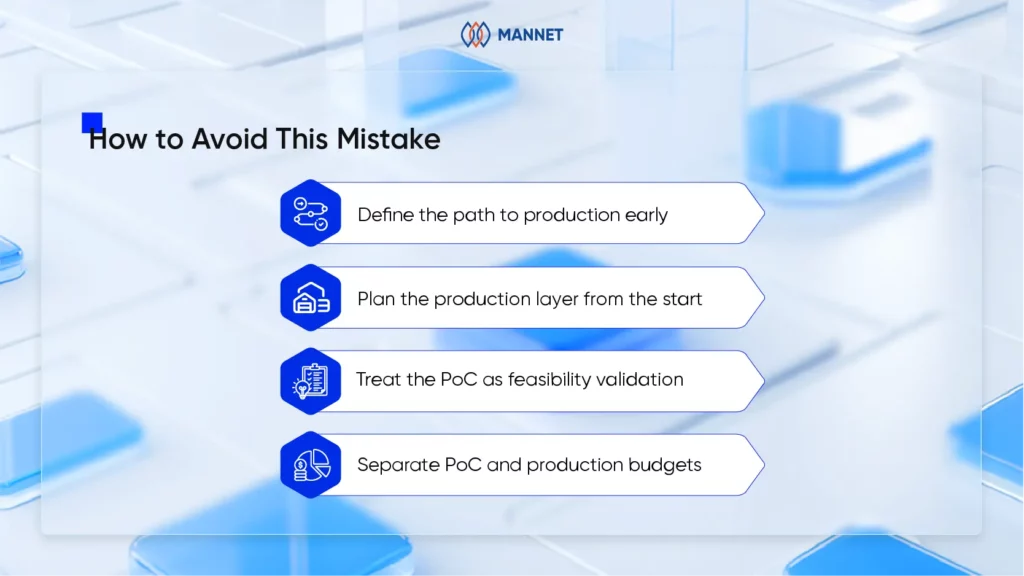
- Define the path to production early. Before the PoC begins, ask: If this works, what needs to happen before real users can rely on it?
- Plan the production layer from the start. Consider automated data pipelines, production-grade APIs, access controls, model versioning, drift detection, rollback procedures, and named operational ownership. Together, these capabilities form the foundation of MLOps.
- Treat the PoC as feasibility validation. A 6-12 week discovery and PoC window can help validate the use case and technical approach, but should not be treated as a deployment timeline (Webellian, 2026).
- Separate PoC and production budgets.Account explicitly for integration, infrastructure, security, testing, monitoring, and production hardening so the cost of deployment is visible from the outset.
10. Treating governance, security and human oversight as afterthoughts
Governance, security and human oversight should be defined before an AI system reaches production, particularly when outsourcing introduces external access to sensitive data and systems. Building these controls reactively can leave organizations addressing privacy, liability or operational risks only after an incident or problematic output has already occurred.
Outsourcing can expand the risk surface because data, systems, and model development activities may cross organizational or national boundaries. The relevant controls therefore need to cover both the technology itself and how the external team accesses, processes and manages business data.
How to avoid it
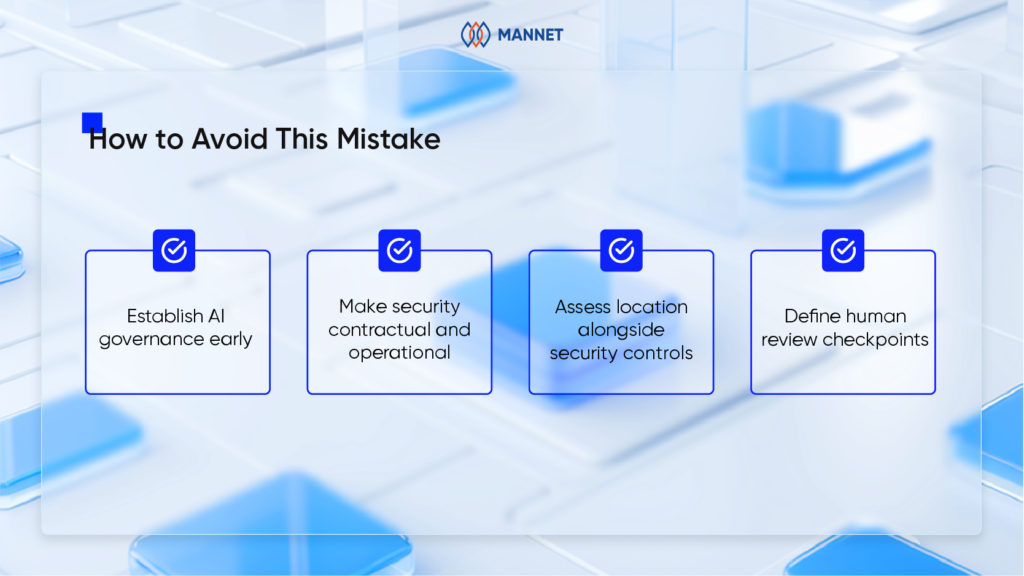
- Establish AI governance early. Create a cross-functional governance structure spanning business, technology, legal and compliance, with clear policies for privacy, acceptable data use, model risk and human oversight before production deployment.
- Make security contractual and operational. Define encryption, role-based access, production-data permissions, retention and deletion requirements in the contract and verify that they are implemented in practice. Relevant certifications, such as ISO 27001, can form part of vendor due diligence.
- Assess location alongside security controls. Offshore delivery does not inherently indicate higher security risk. Evaluate the provider’s technical controls, certifications, access practices, and applicable data-transfer requirements, with geographic location treated as one part of the overall assessment.
- Define human review checkpoints. Identify which AI outputs require human validation before reaching customers, employees, or regulators, particularly for generative AI and other systems where incorrect outputs can have material consequences.
The mistake that undoes all the others: No exit plan for knowledge transfer
An AI outsourcing engagement can deliver a working model and still leave the organization operationally dependent on the vendor. Without a structured knowledge-transfer and exit plan, internal teams may struggle to understand, retrain, troubleshoot, or maintain the system after the contract ends. This dependency can become costly when a vendor changes its team, increases fees, discontinues a service, or becomes unavailable (Saigon Technology, 2026; AIVision, 2026).
AI systems are particularly exposed because operational knowledge often extends beyond source code. Teams need to understand data pipelines, model logic, evaluation methods, infrastructure, dependencies, monitoring, and retraining procedures. If that knowledge remains with the external team, the organization can lose the ability to maintain the system independently even when it technically owns the underlying assets.
Worked example
A distributor’s demand-forecasting model runs smoothly for a year under vendor management. When the vendor is acquired, and its original engineering team disperses, the distributor discovers that no internal engineer can explain key model features or troubleshoot the pipeline. Retraining also fails because a data source was deprecated eight months earlier without internal teams knowing. Rebuilding the missing knowledge takes longer and costs more than anticipated.
How to avoid it
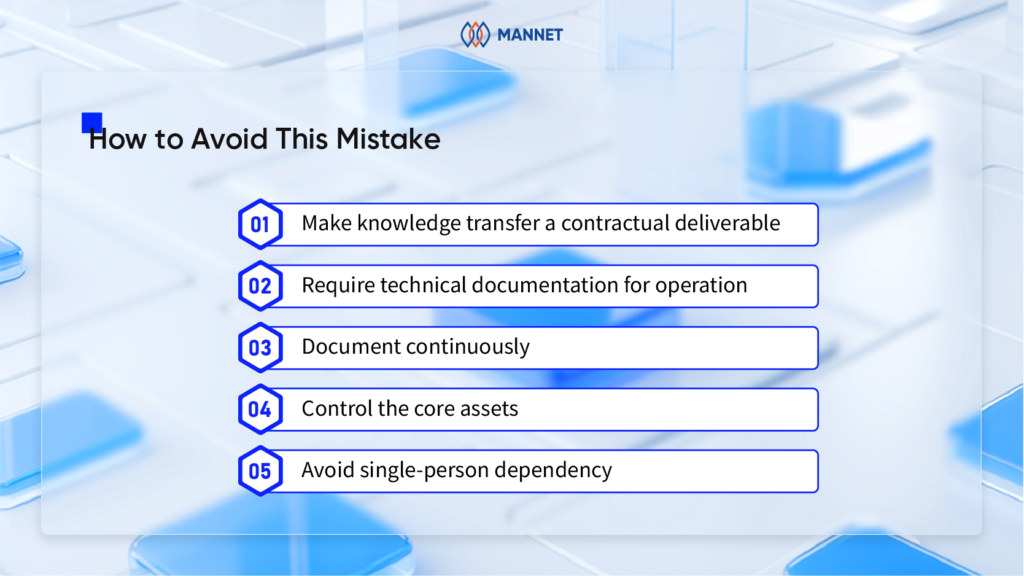
- Make knowledge transfer a contractual deliverable. Require internal engineers to demonstrate that they can retrain the model, troubleshoot a real failure, and perform essential maintenance before the transition period ends (Saigon Technology, 2026).
- Require technical documentation for operation. Documentation should cover architecture, data pipelines, model versions, dependencies, debugging, retraining, optimization, and deployment procedures. Define a clear target for internal operability after handover (AIVision, 2026).
- Document continuously. Keep repositories, environments, model artifacts, operating procedures, and key decisions documented throughout the engagement, instead of treating handover as a final administrative step.
- Control the core assets. Confirm that the organization has appropriate access to repositories, cloud environments, datasets, model artifacts, deployment pipelines, and other assets required to operate the system.
- Avoid single-person dependency. Distribute critical knowledge across multiple people on both the client and vendor sides so continuity does not depend on one engineer remaining available.
How to Choose the Right AI Outsourcing Partner
Avoiding common AI outsourcing mistakes starts with choosing a partner that can manage the full delivery lifecycle, from data readiness and model development to security, production deployment, and knowledge transfer. Technical expertise matters, but organizations should also assess delivery maturity, communication, governance, specialized talent, scalability, and long-term operational support.
The right evaluation framework can help organizations move beyond comparing hourly rates or polished demos and assess whether a potential partner has the capabilities, processes, and delivery model required for the specific AI initiative.
Want a practical framework for evaluating AI outsourcing providers? Read our guide on How to Choose the Right AI Outsourcing Partner for a detailed look at the key criteria, from proven AI expertise and specialized talent to delivery maturity, scalability, and long-term partnership potential.
FAQ About Common AI Outsourcing Mistakes and How to Avoid Them
1. What are the most common AI outsourcing mistakes?
Common AI outsourcing mistakes include:
- Unclear business objectives
- Treating AI like conventional software development
- Skipping data readiness assessment
- Choosing a vendor based primarily on price or demos
- Overlooking data and IP ownership.
Other frequent issues include weak governance, unclear responsibilities, poor communication, and failing to plan for production and knowledge transfer.
2. Why do AI outsourcing projects fail?
AI outsourcing projects can fail because of poorly defined use cases, inadequate data, unrealistic performance expectations, weak vendor selection, unclear responsibilities, and insufficient production planning. Technical performance is only one part of the outcome; business alignment, data quality, governance, integration, and operational ownership also influence project success.
3. How can organizations avoid AI outsourcing mistakes?
Organizations can reduce outsourcing risk by defining the business problem and success criteria before development, assessing data readiness, selecting a partner based on relevant delivery experience, and establishing clear ownership of data, IP, and model assets. Contracts should also address AI-specific performance criteria, security, governance, post-deployment support, and knowledge transfer.
4. How is AI outsourcing different from traditional software outsourcing?
AI projects involve probabilistic outcomes and depend heavily on data quality, model evaluation, and continuous monitoring. AI performance can change as data, user behavior, or operating conditions change. AI outsourcing therefore requires delivery processes and contracts that accommodate experimentation, iterative evaluation, model monitoring, and potential retraining.
5. What should an AI outsourcing contract include?
An AI outsourcing contract should clearly define deliverables, data and IP ownership, permitted data use, security requirements, model evaluation and acceptance criteria, infrastructure and model-performance responsibilities, regulatory obligations, support requirements, documentation, knowledge transfer and exit procedures.
6. Who should own an outsourced AI project?
The organization should retain ownership of business objectives, success criteria, critical data decisions, governance requirements, and model acceptance. The external partner can take responsibility for specialized execution such as data engineering, model development, MLOps, and PoC delivery. Shared ownership may be appropriate for ongoing monitoring, retraining, and continuous improvement.
Where Talent Strategy Meets AI Outsourcing
Most advice on AI outsourcing focuses entirely on the vendor relationship. But several of the mistakes above, especially outsourcing strategic decisions and ending up with no internal capability, trace back to a single root cause: not having the right people inside the organization to own the outcome. That’s where outsourcing and talent strategy reinforce each other.
- Internal technical leads and first ML hires are your practical insurance against every knowledge-transfer failure described above. IT recruitment services help you find them, and our guide to building a talent pipeline shows how to keep strong candidates flowing before a role even opens.
- Flexible capacity helps while scope is still moving. IT staff augmentation puts specialists directly inside your own team rather than behind a vendor’s wall, while you can also hire software developers to extend engineering capacity or hire QA engineers so testing of pipelines and model outputs doesn’t get squeezed out under deadline pressure.
- High-volume data work, such as collection, labeling, and annotation, often needs teams larger than a permanent hiring plan can supply quickly. Mass recruitment services are built to stand up those teams at speed.
- Continuous hiring across several AI initiatives is easier to sustain with RPO services, which absorb the sourcing and screening load.
- New AI functions need foundations beyond code: role definitions, structures, and people practices. That’s the ground covered by HR consultation and set-up.
- Expanding into Vietnam? EOR services and managed payroll let you employ talent compliantly without setting up a local entity first.
Conclusion: Building an AI Outsourcing Strategy That Holds Up
AI outsourcing can provide access to specialized talent, accelerate experimentation, and expand delivery capacity. The risks emerge when outsourcing is treated as a simple transfer of development work. Data readiness, technical ownership, governance, communication, production planning, and knowledge transfer all shape what happens after the first model is delivered.
The strongest outsourcing strategies therefore create a clear division of responsibility: external partners contribute specialized execution and capacity, while the organization retains ownership of its business objectives, critical data, strategic decision,s and long-term AI capability. The goal is not simply to deliver an AI solution, but to build one that can be governed, integrated, maintained, and scaled as business requirements evolve.
The ManNet approach: Scaling AI capability with control
For organizations building AI capabilities in Vietnam, the right talent model can be as important as the outsourcing model itself. ManNet combines IT recruitment, IT staff augmentation, and flexible workforce solutions to help businesses access specialized AI and engineering talent while retaining the level of internal ownership their operating model requires.
Whether an organization needs to recruit specialized IT talent, add specialists through IT staff augmentation, or establish a compliant team in Vietnam through EOR services, the objective is consistent: build the right capabilities around the AI strategy, with clear ownership from development through long-term operation.