

AI outsourcing is the practice of using external AI specialists, engineering teams, or service providers to build, deploy, and scale AI solutions. Companies typically use AI outsourcing to access scarce AI talent, accelerate project delivery, reduce hiring costs, and gain expertise that may not exist internally.
As demand for AI engineers, machine learning specialists, and GenAI experts continues to outpace supply, AI outsourcing has become a common strategy for organizations looking to move AI initiatives from experimentation to production without the delays of traditional hiring.
This guide explains how AI outsourcing works, the most common outsourcing models, which AI roles are frequently outsourced, key cost drivers, potential risks, and how to evaluate the right partner. It also explores why Vietnam is emerging as a leading destination for AI talent and outsourcing services.
Let’s dive in!
What is AI Outsourcing?
AI outsourcing is the practice of partnering with an external provider to access the expertise, talent, or delivery capacity needed to build, deploy, and scale AI solutions. Rather than relying solely on in-house hiring, organizations use outsourcing to accelerate AI initiatives, fill specialized skill gaps, and reduce the time and cost of building AI capabilities.
The term AI outsourcing is often used as a catch-all, but in practice it covers several distinct engagement models. Understanding the differences is essential because the right model depends on whether your priority is delivering an AI project, expanding engineering capacity, or building a long-term AI organization.
The most common AI outsourcing models include:
| Model | How it works | Best for |
| Project-Based AI Development | An outsourcing partner takes ownership of delivering a defined AI solution, from model development to deployment, based on an agreed scope, timeline, and outcome. | Organizations that need end-to-end AI delivery but lack the internal resources or expertise to execute the project. |
| AI Staff Augmentation | AI engineers, ML specialists, or MLOps experts join your existing team while remaining employed by an outsourcing partner. Your team retains technical ownership, while the partner manages sourcing, hiring, and administration. | Companies that already have engineering leadership and need to scale AI delivery quickly. |
| AI Recruitment (RPO) | A recruitment partner sources, evaluates, and places permanent AI professionals directly into your organization. | Businesses building an in-house AI function for long-term growth. |
| Employer of Record (EOR) | An EOR legally employs AI professionals in countries where your company has no local entity, handling payroll, tax, and compliance while they work exclusively for your team. | Global companies hiring AI talent internationally without establishing a local subsidiary. |
Beyond talent acquisition, organizations may also work with providers offering AI consulting to define AI strategy or managed AI services to operate, monitor, and continuously optimize production AI systems. These models often complement – not replace – talent-based outsourcing.
In reality, most enterprises combine multiple approaches. For example, a company may hire an AI Lead through RPO, expand delivery capacity with AI staff augmentation, and use an EOR to onboard specialized AI engineers in new markets. The best approach depends on your business goals, existing technical capabilities, and the level of control you want to maintain throughout the AI lifecycle.
Why Companies Are Outsourcing AI in 2026
AI outsourcing has evolved from a cost-saving tactic into a strategic growth lever. As enterprise AI adoption accelerates, organizations face mounting pressure to access scarce expertise, reduce time-to-market, and scale AI capabilities without significantly expanding permanent headcount. Several market forces are driving this shift.
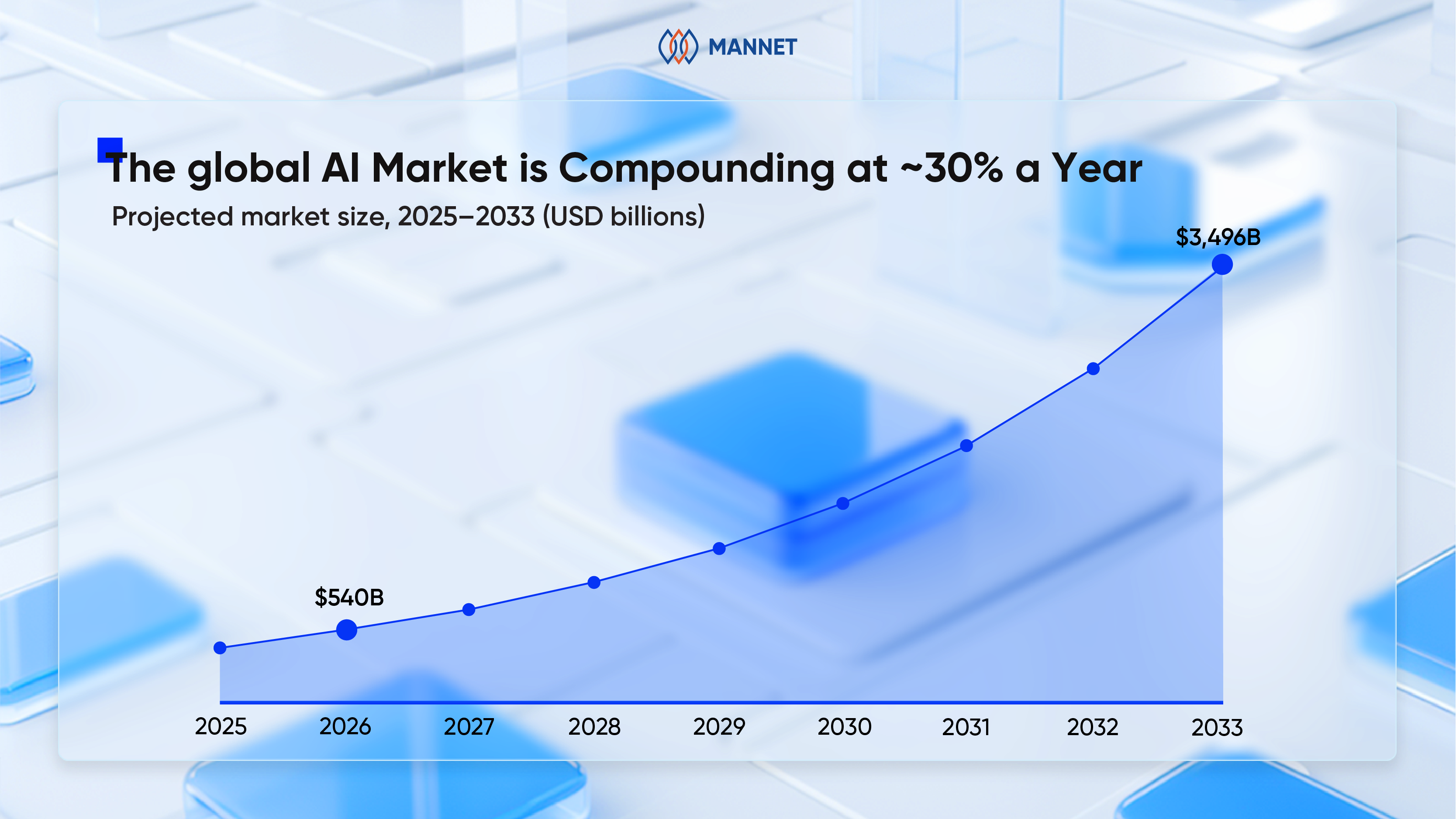
Grand View Research, 2026
1. The AI talent gap is slowing AI adoption
Demand for AI engineers, LLM specialists, MLOps professionals, and AI architects continues to outpace supply across most markets. According to Deloitte’s State of AI in the Enterprise 2026, the AI skills gap is now the single biggest barrier preventing organizations from integrating AI at scale. At the same time, Deloitte reports that 42% of organizations believe their AI strategy is highly prepared, yet far fewer feel ready in terms of talent, infrastructure, and operational capabilities – highlighting a widening execution gap rather than a strategy gap.
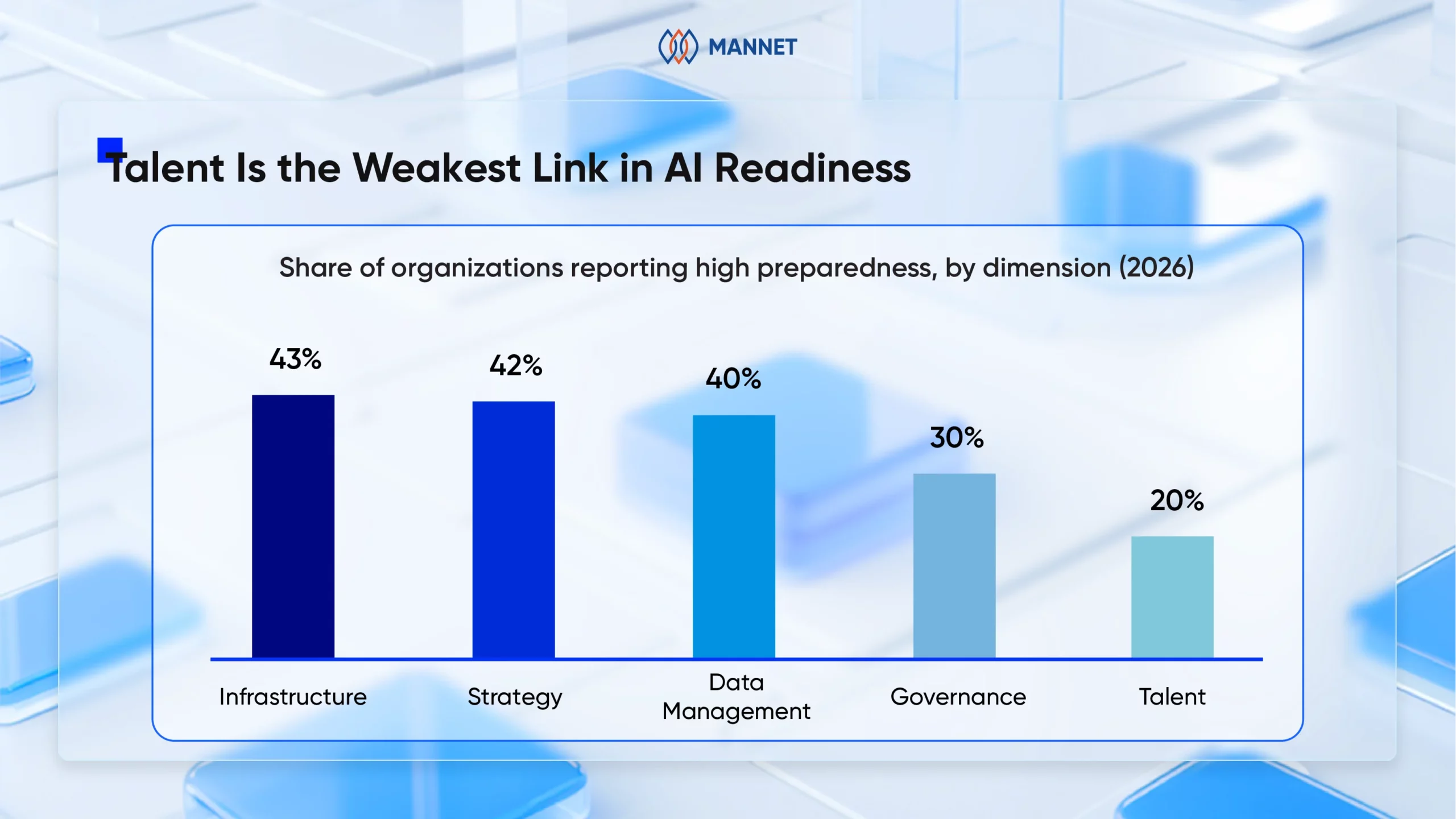
(Source: Deloitte, State of AI in the Enterprise 2026).
For many businesses, AI outsourcing has become the fastest way to access specialized expertise without waiting months to recruit highly sought-after talent.
2. AI talent has become increasingly expensive
Experienced AI professionals command a significant premium over traditional software engineering roles, driven by intense competition for expertise in machine learning, GenAI, and AI infrastructure. Deloitte also notes that many organizations are unable to fill nearly half of AI-related positions, forcing companies to compete aggressively on compensation while delaying critical AI initiatives. (Source: Deloitte Tech Trends 2025).
Rather than absorbing these long-term hiring and retention costs upfront, many organizations use outsourcing to convert fixed talent investments into more flexible operating costs.
3. AI adoption is scaling faster than internal hiring
Enterprise AI has moved well beyond experimentation. Deloitte’s 2026 research found that worker access to AI increased by 50% during 2025, while the number of organizations with at least 40% of AI projects in production is expected to double within six months. Yet talent availability has not kept pace with deployment ambitions.
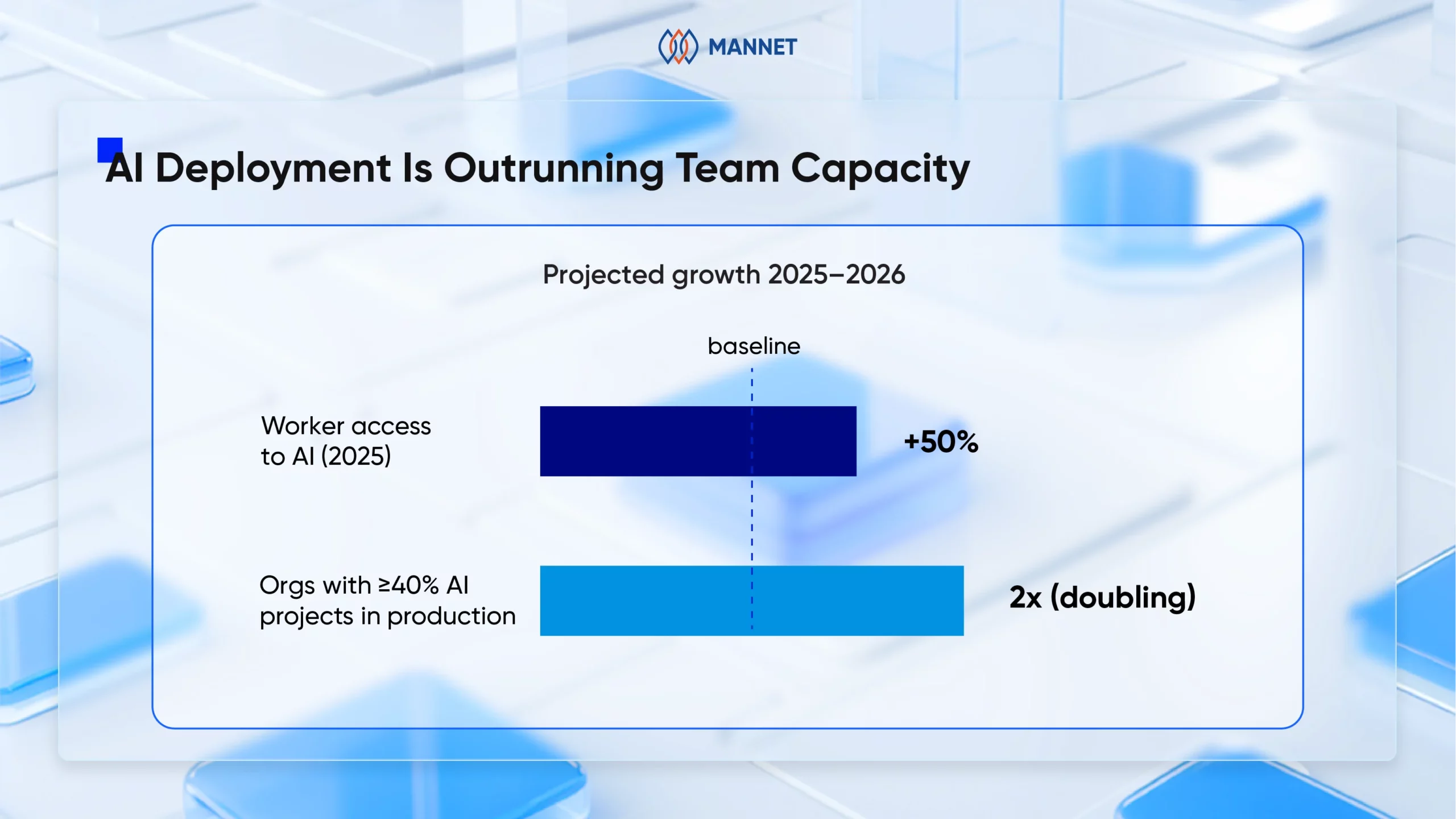
(Source: Deloitte, State of AI in the Enterprise 2026).
For many organizations, the bottleneck is no longer deciding whether to invest in AI but finding the engineering capacity to deliver.
4. Speed has overtaken cost as the primary driver
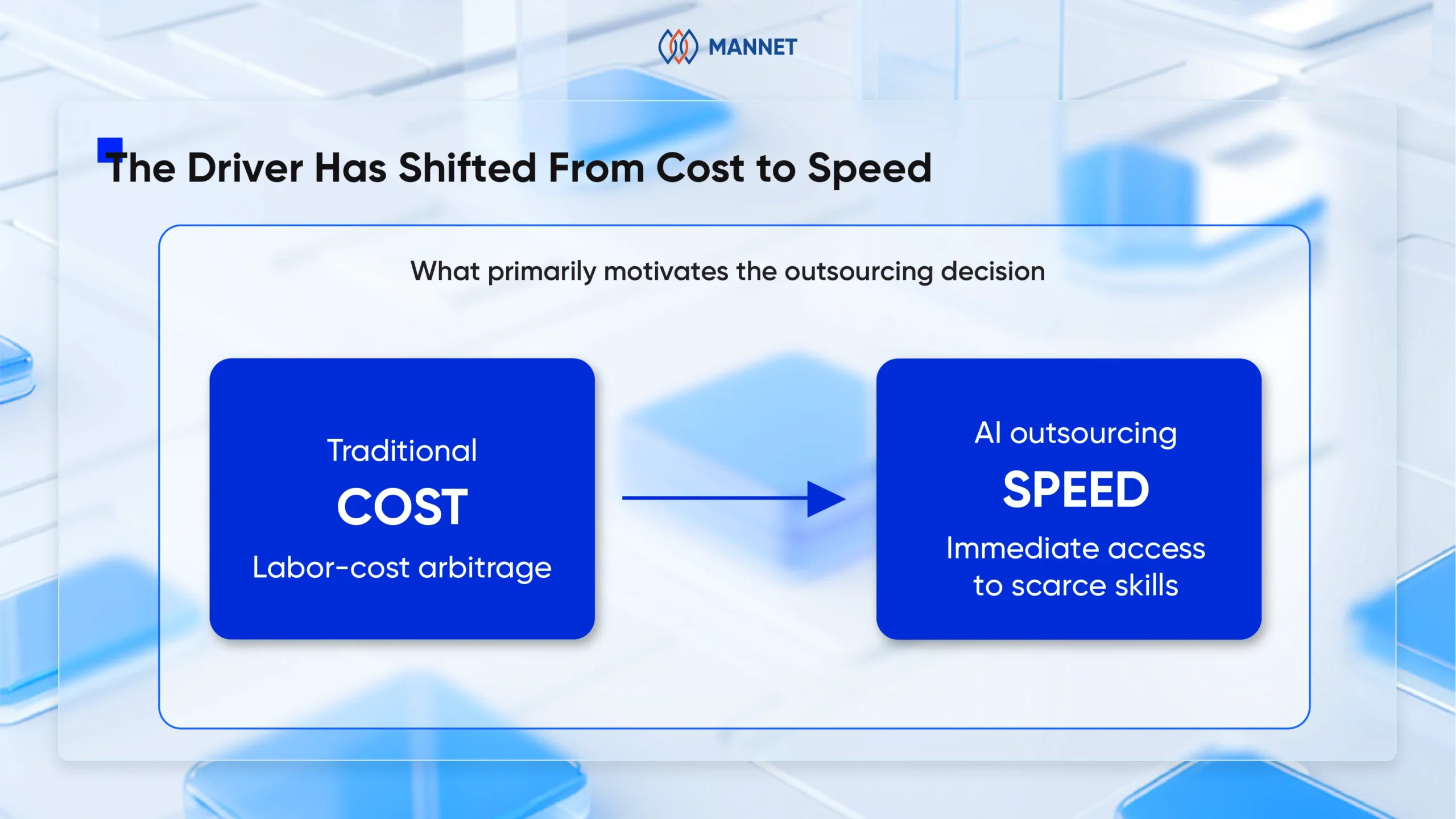
Traditional outsourcing was largely motivated by labor cost arbitrage. AI outsourcing is different. Today’s priority is accelerating execution by gaining immediate access to specialized AI capabilities that are difficult to build internally.
Instead of spending several hiring cycles assembling an AI team, companies can quickly onboard experienced AI engineers, data scientists, or MLOps specialists through staff augmentation or dedicated team models, allowing AI initiatives to move from concept to production much faster.
5. Organizations want flexibility while AI use cases continue to evolve
Despite growing investment, enterprise AI remains an evolving capability. Deloitte’s latest GenAI research found that more than two-thirds of organizations expect fewer than 30% of their current GenAI experiments to reach full-scale deployment in the near term, underscoring the importance of validating AI initiatives before committing to permanent organizational structures. (Source: Deloitte, State of Generative AI in the Enterprise Q4 2025).
AI outsourcing allows businesses to launch pilots, validate business value, and scale successful initiatives without taking on the long-term cost and organizational risk of hiring permanent teams too early.
Taken together, these trends explain why AI outsourcing has become a core workforce strategy rather than a tactical sourcing decision. The next step is determining which outsourcing model best fits your business objectives, technical maturity, and long-term AI roadmap.
AI Outsourcing Use Cases
AI outsourcing use cases by industry
AI outsourcing creates the greatest business value when applied to well-defined business problems rather than broad AI ambitions. Across industries, organizations are increasingly partnering with external AI teams to accelerate implementation, access specialized expertise, and validate AI initiatives before committing to long-term hiring.
While every industry has unique requirements, the most successful AI outsourcing engagements typically focus on high-volume, data-intensive processes where automation, prediction, or intelligent decision-making can deliver measurable business outcomes within months rather than years.
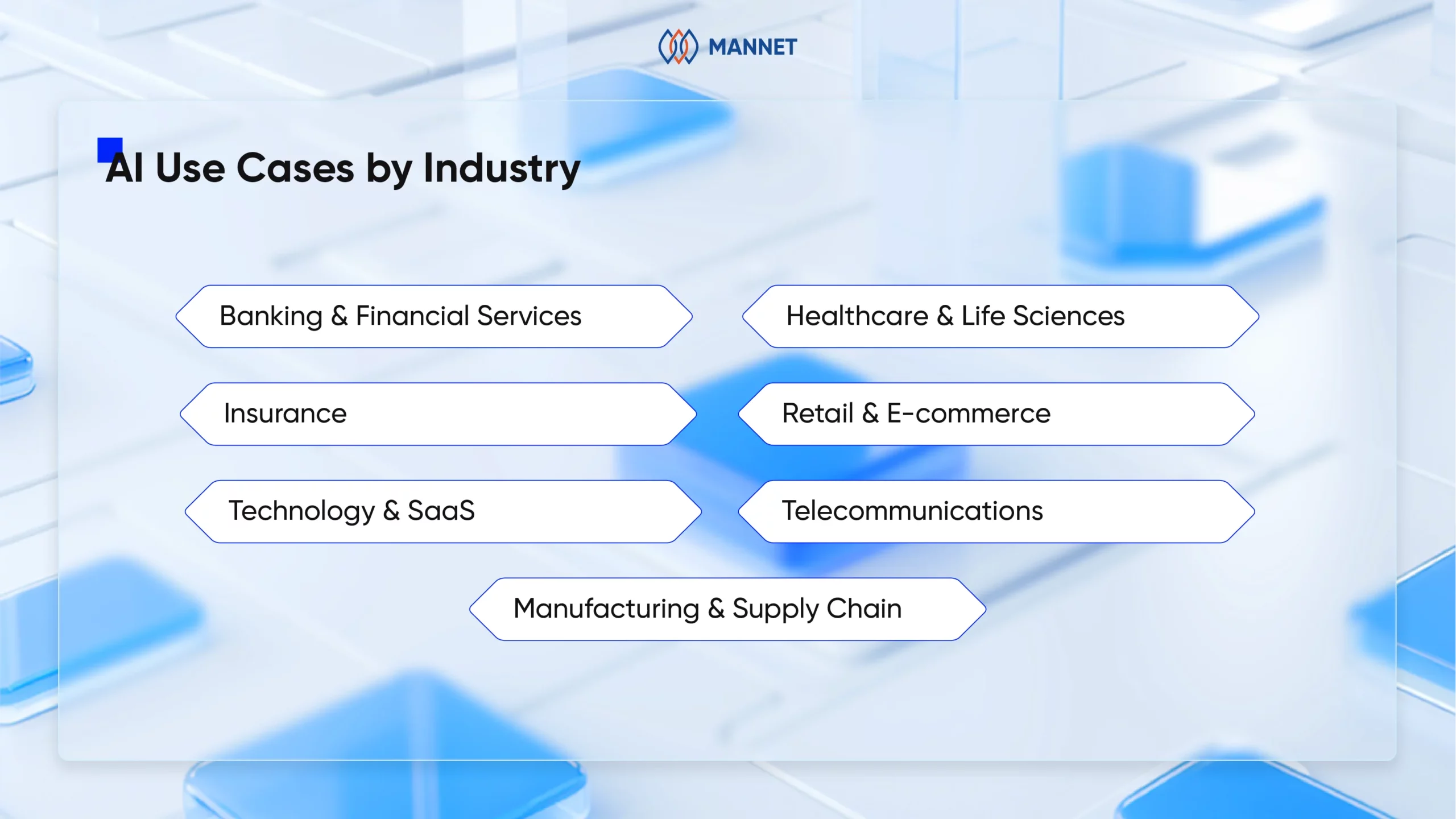
The table below highlights some of the most common AI outsourcing use cases across major industries and the AI talent typically required to deliver them.
| Industry | Business priorities | Representative AI use cases | Typical AI roles |
| Banking & Financial Services | Risk management, compliance, operational efficiency | Fraud detection, credit scoring, intelligent document processing, robo-advisory platforms | ML Engineers, Data Scientists, MLOps Engineers |
| Healthcare & Life Sciences | Better patient care, regulatory compliance, administrative efficiency | Medical imaging analysis, predictive health analytics, clinical documentation, revenue cycle automation | AI Engineers, NLP Engineers, Computer Vision Engineers |
| Insurance | Faster claims processing, fraud prevention, underwriting automation | Claims triage, AI underwriting, fraud analytics, document intelligence | ML Engineers, NLP Engineers, Data Engineers |
| Retail & E-commerce | Customer experience, personalization, inventory optimization | Recommendation engines, AI customer support, demand forecasting, pricing optimization | LLM Engineers, Data Scientists, AI Engineers |
| Technology & SaaS | Product innovation, engineering productivity | AI copilots, semantic search, AI-powered QA, intelligent support automation | GenAI Engineers, AI Architects, Full-stack AI Engineers |
| Telecommunications | Network reliability, customer support | Predictive maintenance, network optimization, conversational AI, customer analytics | ML Engineers, Data Engineers, AI Engineers |
| Manufacturing & Supply Chain | Operational efficiency, quality control | Computer vision inspection, predictive maintenance, logistics optimization, inventory forecasting | Computer Vision Engineers, MLOps Engineers, Data Engineers |
Four AI capabilities driving enterprise AI adoption
While AI use cases vary across industries, most enterprise AI initiatives can be grouped into four recurring capability areas. Understanding these capabilities helps organizations identify where AI can create the greatest business value and what type of AI talent is required to deliver it.
| AI capability | Most common industries |
| Intelligent document processing | Banking, Insurance, Healthcare, Real Estate |
| Predictive analytics | Financial Services, Manufacturing, Retail, Logistics |
| Conversational AI | Retail, SaaS, Telecom, Healthcare |
| AI-enabled products &operations | SaaS, Manufacturing, Logistics, Enterprise Software |
1. Intelligent document processing & workflow automation
Business objective: Eliminate repetitive manual work and improve operational efficiency.
Many organizations still rely on employees to process invoices, contracts, insurance claims, compliance documents, purchase orders, medical records, and other document-heavy workflows. These processes are often slow, labor-intensive, and vulnerable to human error.
AI-powered document processing combines OCR, Natural Language Processing (NLP), and Large Language Models (LLMs) to extract, classify, validate, and organize information from structured and unstructured documents. When integrated into enterprise workflows, these systems can automate approvals, trigger downstream actions, and significantly reduce processing time.
Representative use cases
- Invoice and accounts payable automation
- Contract analysis and compliance checks
- Insurance claims processing
- Medical documentation and coding
- Know Your Customer (KYC) verification
- HR document management
Typical AI roles
- NLP Engineers
- Machine Learning Engineers
- AI Engineers
- AI QA Specialists
Business outcomes
✓ Faster document processing
✓ Reduced operational costs
✓ Improved data accuracy
✓ Better regulatory compliance
2. Predictive analytics & intelligent decision-making
Business objective: Make faster, more accurate decisions using enterprise data.
Many organizations collect vast amounts of operational data but struggle to transform it into actionable insights. Predictive AI models help businesses anticipate future events rather than simply reporting historical performance.
These solutions combine machine learning, statistical modeling, and real-time data pipelines to forecast demand, detect fraud, assess risk, optimize pricing, and predict equipment failures before they occur.
Representative use cases
- Fraud detection
- Credit scoring
- Demand forecasting
- Predictive maintenance
- Customer churn prediction
- Recommendation engines
- Dynamic pricing
Typical AI roles
- Data Scientists
- ML Engineers
- Data Engineers
- MLOps Engineers
Business outcomes
✓ Better forecasting accuracy
✓ Reduced business risk
✓ Higher operational efficiency
✓ Faster data-driven decision-making
3. Conversational AI & customer experience
Business objective: Deliver faster, more personalized customer interactions at scale.
Advances in Generative AI have transformed customer engagement. Instead of relying solely on scripted chatbots, organizations are deploying AI assistants capable of understanding natural language, retrieving enterprise knowledge, and completing multi-step tasks.
These systems support customers, employees, and internal operations across industries, from answering product questions and scheduling appointments to assisting customer service teams and providing internal knowledge support.
Representative use cases
- AI chatbots
- AI agents
- Voice assistants
- Internal knowledge assistants
- Customer support automation
- Employee productivity copilots
Typical AI roles
- LLM Engineers
- Prompt Engineers
- Backend AI Engineers
- AI Solution Architects
Business outcomes
✓ 24/7 customer support
✓ Faster response times
✓ Lower service costs
✓ Improved customer satisfaction
4. AI-enabled products & intelligent operations
Business objective: Embed AI directly into products and core business operations.
For many organizations, AI is no longer an add-on feature – it is becoming a fundamental part of the product itself. Technology companies are integrating AI into software through copilots, semantic search, recommendation engines, and agentic workflows, while manufacturers and logistics providers are using AI to optimize production, monitor assets, and improve supply chain performance.
These initiatives often require cross-functional engineering teams capable of designing, deploying, and operating production-grade AI systems.
Representative use cases
- AI copilots
- Semantic search
- Computer vision inspection
- Predictive maintenance
- Supply chain optimization
- Workflow automation
- AI-powered quality assurance
Typical AI roles
- GenAI Engineers
- AI Architects
- Computer Vision Engineers
- MLOps Engineers
- Full-stack AI Engineers
Business outcomes
✓ Faster product innovation
✓ Improved operational efficiency
✓ Better user experiences
✓ Greater competitive differentiation
A common pattern across every industry
Although business priorities vary – from fraud detection in financial services to predictive maintenance in manufacturing – the underlying engineering challenges remain remarkably consistent. Organizations must prepare high-quality data, build and validate AI models, integrate them with existing systems, deploy them into production, and continuously monitor performance as business requirements evolve.
Delivering these initiatives rarely depends on a single AI specialist. Successful AI projects require cross-functional teams that combine AI engineers, machine learning experts, data engineers, MLOps specialists, software engineers, and domain experts. Building this capability entirely in-house can be both time-consuming and costly, particularly as demand for experienced AI talent continues to outpace supply.
To accelerate delivery while retaining full control over product architecture and intellectual property, many organizations extend their existing engineering teams through AI staff augmentation services. This model allows businesses to quickly onboard specialized AI talent that integrates into their internal workflows, development processes, and product roadmap, providing the flexibility to scale AI initiatives without the delays and long-term commitments of traditional hiring.
Which AI Outsourcing Model Fits Your Business?
Choosing to outsource AI talent is only the first decision. The next, and often more important, question is how to engage external expertise.
There is no one-size-fits-all outsourcing model. The right approach depends on your internal engineering capabilities, hiring timeline, desired level of control, and long-term business objectives. A startup building its first AI-powered product has very different needs from an enterprise scaling an established AI platform.
The four most common AI outsourcing models each solve a different business challenge.
| Model | Best for | Who manages the team? | Time to get started | Long-term ownership |
| Project-based AI development | Building a complete AI solution with limited internal AI expertise | Vendor | Medium | Vendor during delivery |
| AI staff augmentation | Scaling an existing engineering team with specialized AI talent | Client | Fast | Client |
| Recruitment (RPO) | Hiring permanent AI professionals | Client | Medium | Client |
| Employer of record (EOR) | Hiring AI talent in countries without a legal entity | Client | Fast | Client |
Although each model has its place, they differ significantly in terms of control, flexibility, scalability, and long-term talent strategy.
Project-based AI development
Project-based outsourcing is best suited for organizations that want a partner to take full responsibility for delivering a defined AI solution, from requirements gathering and model development to deployment and ongoing support.
This approach works well when internal AI capabilities are limited or when the objective is to deliver a specific business outcome rather than build an in-house AI function.
Best suited for:
- Building a proof of concept (PoC)
- Developing an AI application from scratch
- Delivering a fixed-scope AI project
- Organizations without dedicated AI leadership
Advantages
- End-to-end delivery
- Minimal internal resource requirements
- Predictable project scope
Considerations
- Less day-to-day technical control
- Knowledge transfer should be planned early
- Scope changes may increase delivery costs
AI staff augmentation
For organizations that already have an engineering team, AI staff augmentation is often the fastest way to expand delivery capacity.
Instead of outsourcing the project itself, companies integrate experienced AI engineers, machine learning specialists, or MLOps professionals directly into their existing teams. Internal leaders continue to own the architecture, priorities, and product roadmap, while the outsourcing partner handles sourcing, recruitment, payroll, and administrative management.
This model has become increasingly popular among enterprises adopting Generative AI because it combines rapid scalability with full technical ownership.
Best suited for:
- Scaling AI product development
- Accelerating GenAI initiatives
- Filling niche AI skill gaps
- Supporting existing engineering teams
Advantages
- Fast onboarding
- Full engineering control
- Flexible team scaling
- Lower hiring risk
Considerations
- Requires internal technical leadership
- Success depends on effective onboarding and collaboration
Why it matters: For organizations that already know what they want to build but lack the bandwidth to execute, staff augmentation often delivers the best balance of speed, flexibility, and long-term control.
Recruitment process outsourcing (RPO)
If AI capability is becoming a permanent competitive advantage rather than a short-term initiative, hiring full-time AI professionals may be the right investment.
Through Recruitment Process Outsourcing (RPO), a specialist recruitment partner manages sourcing, technical screening, employer branding, and hiring operations while successful candidates join your organization as permanent employees.
Best suited for:
- Building an internal AI Center of Excellence
- Long-term AI product organizations
- Scaling engineering teams sustainably
Advantages
- Permanent knowledge retention
- Strong cultural integration
- Long-term workforce planning
Considerations
- Longer hiring timelines
- Higher long-term employment costs
- Ongoing retention challenges
Employer of record (EOR)
Many global companies identify exceptional AI talent in countries where they have no legal entity. Establishing a local subsidiary simply to hire a small engineering team is often expensive and time-consuming.
An Employer of Record (EOR) removes this barrier by becoming the legal employer, handling payroll, tax, benefits, and local compliance while the engineers work exclusively for your organization.
Best suited for:
- Hiring AI talent internationally
- Expanding into Vietnam without setting up a legal entity
- Building distributed AI teams
Advantages
- Fast international hiring
- Full legal compliance
- Reduced administrative complexity
AI staff augmentation vs. recruitment vs. EOR: Which model fits?
| Model | Best for | Control level | Typical timeline | Commitment |
| Project-based outsourcing | A defined, one-off AI build | Lower – vendor owns delivery | Weeks to months | Project-length only |
| AI staff augmentation | Filling a skills or capacity gap on an existing team | High – you manage the work | 1-4 weeks to onboard | Flexible, scales up/down |
| AI recruitment / RPO | Building a permanent, long-term AI function | Full – direct hire | Weeks, depending on seniority | Permanent |
| EOR for AI hires | Hiring a specific candidate where you have no legal entity | Full – you direct the work | Days to a few weeks | Flexible, no entity required |
What Does AI Outsourcing Cost?
One of the most common questions organizations ask before outsourcing AI development is: “How much will it cost?” The answer depends on far more than hourly engineering rates.
AI outsourcing costs are influenced by:
- The type of AI expertise required;
- The project complexity;
- The engagement model
- The team size;
- The location of the engineering team.
For example, building a proof of concept with two machine learning engineers has a very different cost profile from scaling a production-grade AI platform supported by AI architects, MLOps engineers, and data engineers.
Rather than optimizing for the lowest hourly rate, successful organizations focus on achieving the best balance between engineering quality, speed, scalability, and long-term return on investment.
The table below summarizes the primary factors that influence AI outsourcing costs.
| Cost driver | Why it matters |
| AI roles required | Specialized roles such as AI Architects, GenAI Engineers, and MLOps Engineers typically command higher rates than general software engineers. |
| Project complexity | Fine-tuning foundation models or building production AI systems requires significantly more expertise than integrating off-the-shelf AI APIs. |
| Engagement model | Project-based outsourcing, staff augmentation, RPO, and EOR each have different pricing structures and cost implications. |
| Team size & duration | Larger or longer-term engagements generally increase overall investment but may reduce the average cost per engineer over time. |
| Location | Engineering rates, talent availability, and hiring competition vary considerably across global markets. |
For many organizations, the goal is not simply to reduce development costs but to maximize the value delivered by every AI hire. Choosing the right engagement model and sourcing strategy often has a greater impact on total project cost than hourly rates alone.
-> Want a detailed breakdown of AI outsourcing pricing? Read our guide to AI Outsourcing Cost: Pricing Models, Regional Rates & Cost Optimization to compare engagement models, understand regional cost differences, and estimate the investment required for your AI initiatives.
As we’ll explore in the next section, where you source AI talent is another major factor influencing both cost and delivery outcomes. This is one of the reasons why Vietnam has become an increasingly attractive destination for companies looking to scale AI engineering teams efficiently.
Common Risks of AI Outsourcing and How to Avoid Them
Like any strategic technology initiative, AI outsourcing comes with trade-offs. The most successful organizations are not those that avoid risk entirely, but those that anticipate potential challenges and put the right governance, processes, and talent strategy in place from the start.
The table below summarizes the most common risks associated with AI outsourcing and practical ways to mitigate them.
| Common risk | How to mitigate it |
| Hiring the wrong AI expertise | Clearly define the skills required (e.g., LLM engineering, MLOps, computer vision, or data engineering) and work with a partner capable of validating technical capabilities. |
| Poor integration with internal teams | Treat outsourced engineers as an extension of your product team, with shared tools, sprint ceremonies, documentation, and communication channels. |
| Data security and IP concerns | Establish robust NDAs, access controls, secure development environments, and clear ownership of code, models, and intellectual property before work begins. |
| Scaling too quickly or too slowly | Start with a focused team, validate outcomes, and expand capacity incrementally as business needs evolve. |
| Choosing a partner based on cost alone | Evaluate engineering quality, AI expertise, delivery processes, and long-term collaboration, not just hourly rates. |
While every organization faces different challenges, these risks are manageable with the right outsourcing strategy and governance model.
1. Hiring the wrong AI talent
Not all AI engineers have the same expertise. A team experienced in traditional machine learning may not be the right fit for building GenAI applications, while a strong data scientist may not have production MLOps experience.
Before engaging an outsourcing partner, define the business problem first, then identify the technical capabilities required to solve it. Matching the right specialists to the right initiative is often more important than simply expanding headcount.
2. Treating outsourced engineers as an external vendor
One of the most common reasons AI outsourcing initiatives underperform is organizational rather than technical. When external engineers work in isolation from product managers, designers, and internal developers, knowledge sharing slows, and delivery quality suffers.
Organizations that achieve the best results integrate outsourced AI specialists directly into their engineering workflows – using the same sprint planning, collaboration tools, code review processes, and technical standards as internal teams.
3. Underestimating data governance
AI systems are only as reliable as the data they are trained on and the environments in which they operate.
Before development begins, organizations should establish clear policies covering data access, security, compliance, model ownership, and intellectual property. This is particularly important in regulated industries such as financial services, healthcare, and insurance.
4. Scaling without a clear roadmap
AI initiatives often begin with a proof of concept but quickly expand as new opportunities emerge. Scaling too aggressively before validating business outcomes can increase costs without delivering meaningful value.
A phased approach, starting with a focused team and expanding as milestones are achieved, helps organizations balance speed with long-term sustainability.
5. Choosing price over long-term value
While cost is an important consideration, it should rarely be the primary decision factor.
The most successful AI outsourcing partnerships are built on engineering quality, communication, domain expertise, and the ability to scale over time. A lower hourly rate can quickly become more expensive if projects require extensive rework, onboarding, or management overhead.
For this reason, organizations should evaluate outsourcing partners thoroughly based on technical expertise, delivery maturity, talent quality, cultural fit, and cost.
Key takeaway
Most AI outsourcing challenges stem from planning and execution rather than the outsourcing model itself. By selecting the right technical expertise, integrating external engineers into internal workflows, and establishing strong governance from the outset, organizations can significantly reduce delivery risk while accelerating AI adoption.
If your team is looking to extend your engineering team with pre-vetted AI specialists, explore ManNet’s IT Staff Augmentation Services to see how global companies build scalable AI teams in Vietnam while maintaining full ownership of their products, codebase, and intellectual property.
How to Choose the Right AI Outsourcing Partner
Selecting an AI outsourcing partner is about more than comparing hourly rates or team size. The right partner should strengthen your team’s engineering capability, reduce delivery risk, and scale alongside your business.
As AI projects become increasingly complex, organizations should evaluate outsourcing providers across technical expertise, delivery maturity, talent quality, and long-term partnership potential.
The following framework can help guide your evaluation.
| Evaluation criteria | What to look for |
| Proven AI expertise | Demonstrated experience across AI/ML, Generative AI, data engineering, MLOps, and production AI deployment, with a proven track record of delivering enterprise AI solutions. |
| Access to specialized talent | The ability to source niche roles such as AI Engineers, ML Engineers, Data Scientists, MLOps Engineers, Prompt Engineers, and AI Architects as project needs evolve. |
| Flexible engagement models | Support for staff augmentation, dedicated teams, recruitment (RPO), or Employer of Record (EOR), allowing your sourcing strategy to adapt as AI initiatives mature. |
| Technical screening and hiring process | A rigorous technical vetting process that identifies AI professionals with the right combination of engineering expertise, business understanding, problem-solving ability, communication skills, and long-term team fit. |
| Delivery and collaboration practices | Experience working within Agile environments, distributed product teams, modern DevOps workflows, and enterprise collaboration tools. |
| Security and compliance | Clear processes for IP protection, data security, confidentiality, and compliance with relevant regulations. |
While every business has unique requirements, the strongest AI outsourcing partnerships typically share these characteristics.
Questions to ask before choosing a partner
Before committing to an outsourcing provider, it is worth asking a few practical questions:
- Have they successfully delivered AI projects or placed AI specialists with organizations similar to yours?
- Can they source niche AI roles beyond general software engineers?
- How do they technically assess AI candidates before presenting them?
- Can they scale your team up or down as project priorities change?
- How do they protect intellectual property, confidential data, and code ownership?
- What level of support do they provide after engineers are onboarded?
The answers to these questions often reveal far more about a partner’s capabilities than pricing alone.
Why Many Companies Choose ManNet
At ManNet, we believe successful AI outsourcing starts with the right engineering talent.
Rather than offering a one-size-fits-all delivery model, we help organizations choose the engagement approach that best fits their stage of AI adoption:
- IT Staff Augmentation for rapidly expanding existing engineering teams with pre-vetted AI specialists.
- IT Recruitment (RPO) for building long-term in-house AI capabilities.
- Employer of Record (EOR) for hiring AI professionals in Vietnam without establishing a local legal entity.
Our recruitment process combines deep technical screening, market knowledge, and access to Vietnam’s growing AI talent network, empowering global companies to scale engineering teams efficiently while maintaining full ownership of their products, architecture, and intellectual property.
-> Explore ManNet’s AI talent solutions to learn how we help organizations build high-performing AI teams through flexible staffing and recruitment models.
Key takeaway
The right AI outsourcing partner should do more than fill vacancies. They should help you access specialized expertise, integrate seamlessly with your engineering organization, and provide the flexibility to scale as your AI strategy evolves.
Choosing a partner with proven AI recruitment capability, strong technical assessment processes, and flexible engagement models can significantly reduce hiring risk while accelerating the delivery of AI initiatives.
FAQs about AI Outsourcing
Can AI outsourcing work for startups as well as enterprises?
Yes. AI outsourcing is suitable for organizations at every stage of growth. Startups often use it to access specialized AI expertise without the cost and time required to build an in-house team, while larger enterprises leverage outsourcing to accelerate delivery, fill niche skill gaps, or scale existing AI initiatives. The right engagement model depends on your business objectives, internal capabilities, and long-term hiring strategy.
What AI roles are most commonly outsourced?
Organizations typically outsource a wide range of AI and data roles, including:
- AI Engineers
- Machine Learning Engineers
- Data Scientists
- Data Engineers
- MLOps Engineers
- AI Architects
- Prompt Engineers
- AI QA Engineers
The optimal team composition depends on the complexity of your AI initiative. For example, a Generative AI application may require Prompt Engineers and AI Engineers, while a production-scale AI platform often requires Data Engineers and MLOps specialists to support deployment and ongoing operations.
Can outsourced AI engineers work as part of my internal team?
Absolutely. Under a staff augmentation model, outsourced AI professionals work as an extension of your engineering organization rather than as a separate delivery team. They typically use your existing development tools, sprint processes, communication platforms, and coding standards while collaborating closely with your product managers, designers, and software engineers.
This approach enables organizations to increase engineering capacity without sacrificing visibility, collaboration, or control over product development.
How long does it take to hire AI talent through an outsourcing partner?
The timeline depends on the seniority and specialization of the role, as well as the engagement model you choose. Compared with traditional recruitment, which can take several months for highly specialized AI positions, working with an established outsourcing partner often enables organizations to onboard qualified AI professionals much faster through access to pre-vetted talent networks.
For companies operating in fast-moving markets, reducing hiring time can be just as valuable as reducing hiring costs.
Who owns the intellectual property in an AI outsourcing engagement?
Intellectual property ownership should always be clearly defined before development begins. In most professional outsourcing engagements, the client retains ownership of the source code, AI models, documentation, and other project deliverables, while the outsourcing partner provides the engineering expertise needed to build and support the solution.
To minimize risk, organizations should establish clear contractual agreements covering IP ownership, confidentiality, data security, and access controls before onboarding any external team members.
Can I start with one AI engineer and scale my team later?
Yes. Many organizations begin with a single AI specialist or a small cross-functional team to validate a proof of concept before expanding their AI capability. Once priorities become clearer, additional AI engineers, data scientists, MLOps specialists, or QA engineers can be added incrementally as the project grows.
This phased approach allows businesses to control costs, reduce hiring risk, and scale engineering capacity based on measurable business outcomes rather than assumptions.
How ManNet Approaches AI Talent Sourcing for AI-Driven Organizations
Most enterprise tech buyers evaluating AI outsourcing in Vietnam focus on three core metrics: specialized technical skill, deployment speed, and financial risk mitigation.
Unlike traditional software development vendors competing for broad project budgets, ManNet operates as a pure talent architecture layer. The company’s core mission is to inject the precise engineering resources needed to accelerate development, whether those professionals operate within an in-house corporate team or alongside an external vendor.
Talent deployment velocity
Traditional recruitment cycles for specialized tech roles in Southeast Asia often exceed 45 days. ManNet compresses this pipeline via strict Service Level Agreements (SLAs):
- 4 Working Hours: Completion of comprehensive technical requirements analysis.
- 3-5 Business Days: Delivery of a curated, pre-vetted specialist shortlist.
- 7 Calendar Days: Deployment of a complete, cross-functional engineering team.
This velocity advantage directly prevents roadmaps from stalling and eliminates the heavy opportunity costs associated with vacant engineering seats.
Full-stack AI engineering bench
Deploying production-grade artificial intelligence requires a multi-disciplinary tech squad. ManNet provides instant access to a vetted network of 10,000+ IT professionals, allowing organizations to seamlessly:
- Hire machine learning engineers to architect and train complex neural networks.
- Deploy Data Engineers to clean raw databases and build secure pipelines.
- Embed MLOps Specialists to manage containerization, scaling, and real-time drift telemetry.
- Integrate QA Automation Engineers to validate system outputs before live deployment.
Flexible managed staffing models
ManNet offers agile engagement structures designed to scale smoothly alongside an organization’s specific technical maturity curve:
- IT recruitment & direct hire: Tailored for companies looking to permanently fill local technical roles without building an in-house recruitment pipeline from scratch.
- IT staff augmentation: Ideal for tech leaders needing to rapidly inject engineering capacity into specific sprints without increasing fixed headcount overhead.
- EOR & BOT subsidiary setup: A comprehensive, integrated blueprint covering local payroll, legal compliance, and operational setup for global enterprises building permanent offshore development centers in Vietnam.
Algorithmic vetting & risk mitigation
To protect software roadmaps from early candidate attrition and slow hiring cycles, ManNet provides a dual-layer safety net:
- Passive candidate sourcing: Utilizing AI-powered ATS infrastructure to mine GitHub and LinkedIn data, capturing high-performing passive talent unavailable on standard job boards.
- 60-day performance guarantee: Providing a complimentary candidate replacement or a 50% fee deduction if an embedded engineer fails to meet organizational performance standards within the first two months.
Final Verdict: Choosing the Right AI Engineering Strategy in Vietnam
There is no one-size-fits-all model for AI outsourcing in Vietnam. The optimal strategic choice depends entirely on how much ownership an organization requires over its technical infrastructure, product roadmap, and core intellectual property (IP).
The ManNet distinction: Why retain control?
For fast-moving tech organizations that refuse to lock themselves into rigid external vendor contracts or give up absolute ownership of their codebases, standard project-based outsourcing introduces unnecessary risks.
ManNet offers the ultimate hybrid approach. By separating execution capacity from headcount overhead, the company enables organizations to keep their core strategy in-house while instantly scaling up engineering velocity. Whether a business needs to hire machine learning engineers for a single project milestone, leverage flexible IT staff augmentation services for rapid development sprints, or utilize compliant Employer of Record (EOR) models to build a permanent tech hub in Vietnam, ManNet handles the operational heavy lifting under one roof.