Category: Uncategorized

AI Outsourcing: How to Access AI Talent, Cut Costs & Scale Faster

AI outsourcing is the practice of using external AI specialists, engineering teams, or service providers to build, deploy, and scale AI solutions. Companies typically use AI outsourcing to access scarce AI talent, accelerate project delivery, reduce hiring costs, and gain expertise that may not exist internally.

As demand for AI engineers, machine learning specialists, and GenAI experts continues to outpace supply, AI outsourcing has become a common strategy for organizations looking to move AI initiatives from experimentation to production without the delays of traditional hiring.

This guide explains how AI outsourcing works, the most common outsourcing models, which AI roles are frequently outsourced, key cost drivers, potential risks, and how to evaluate the right partner. It also explores why Vietnam is emerging as a leading destination for AI talent and outsourcing services.

Let’s dive in!

What is AI Outsourcing?

AI outsourcing is the practice of partnering with an external provider to access the expertise, talent, or delivery capacity needed to build, deploy, and scale AI solutions. Rather than relying solely on in-house hiring, organizations use outsourcing to accelerate AI initiatives, fill specialized skill gaps, and reduce the time and cost of building AI capabilities.

The term AI outsourcing is often used as a catch-all, but in practice it covers several distinct engagement models. Understanding the differences is essential because the right model depends on whether your priority is delivering an AI project, expanding engineering capacity, or building a long-term AI organization.

The most common AI outsourcing models include:

Model How it works Best for
Project-Based AI Development An outsourcing partner takes ownership of delivering a defined AI solution, from model development to deployment, based on an agreed scope, timeline, and outcome. Organizations that need end-to-end AI delivery but lack the internal resources or expertise to execute the project.
AI Staff Augmentation AI engineers, ML specialists, or MLOps experts join your existing team while remaining employed by an outsourcing partner. Your team retains technical ownership, while the partner manages sourcing, hiring, and administration. Companies that already have engineering leadership and need to scale AI delivery quickly.
AI Recruitment (RPO) A recruitment partner sources, evaluates, and places permanent AI professionals directly into your organization. Businesses building an in-house AI function for long-term growth.
Employer of Record (EOR) An EOR legally employs AI professionals in countries where your company has no local entity, handling payroll, tax, and compliance while they work exclusively for your team. Global companies hiring AI talent internationally without establishing a local subsidiary.

Beyond talent acquisition, organizations may also work with providers offering AI consulting to define AI strategy or managed AI services to operate, monitor, and continuously optimize production AI systems. These models often complement – not replace – talent-based outsourcing.

In reality, most enterprises combine multiple approaches. For example, a company may hire an AI Lead through RPO, expand delivery capacity with AI staff augmentation, and use an EOR to onboard specialized AI engineers in new markets. The best approach depends on your business goals, existing technical capabilities, and the level of control you want to maintain throughout the AI lifecycle.

Why Companies Are Outsourcing AI in 2026

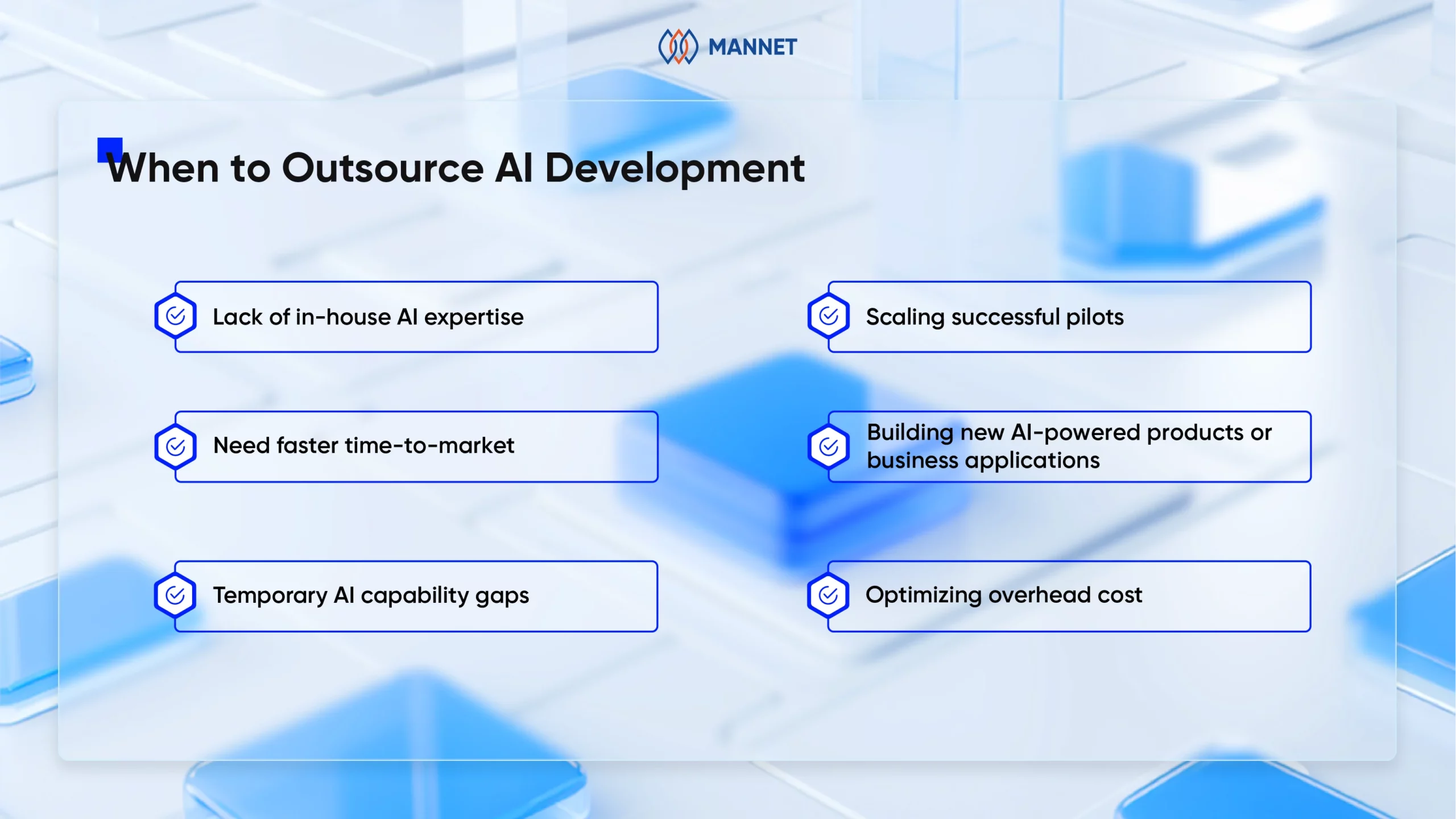
AI outsourcing has evolved from a cost-saving tactic into a strategic growth lever. As enterprise AI adoption accelerates, organizations face mounting pressure to access scarce expertise, reduce time-to-market, and scale AI capabilities without significantly expanding permanent headcount. Several market forces are driving this shift.
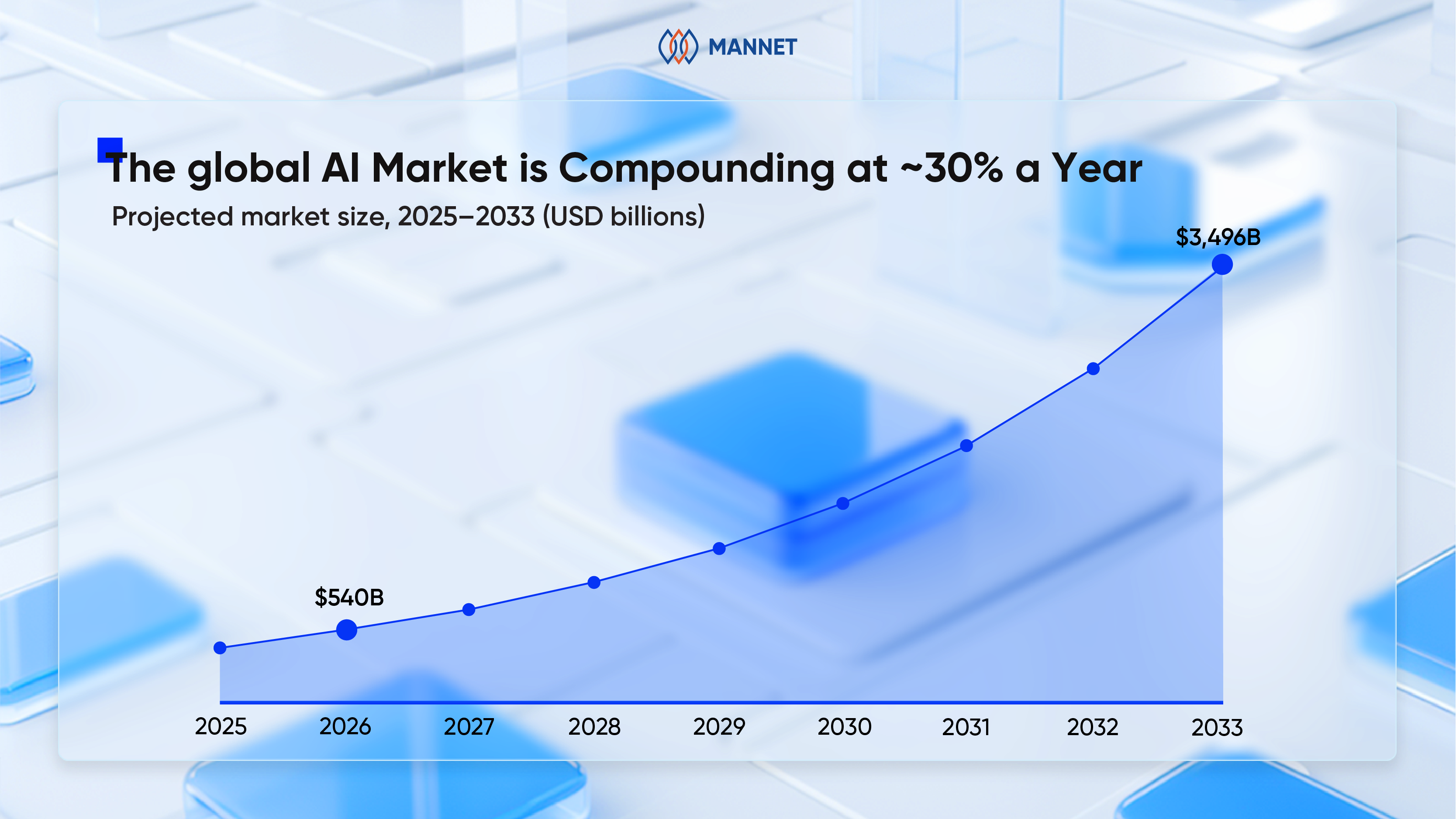
ai outsourcing data

Grand View Research, 2026 

1. The AI talent gap is slowing AI adoption

Demand for AI engineers, LLM specialists, MLOps professionals, and AI architects continues to outpace supply across most markets. According to Deloitte’s State of AI in the Enterprise 2026, the AI skills gap is now the single biggest barrier preventing organizations from integrating AI at scale. At the same time, Deloitte reports that 42% of organizations believe their AI strategy is highly prepared, yet far fewer feel ready in terms of talent, infrastructure, and operational capabilities – highlighting a widening execution gap rather than a strategy gap.
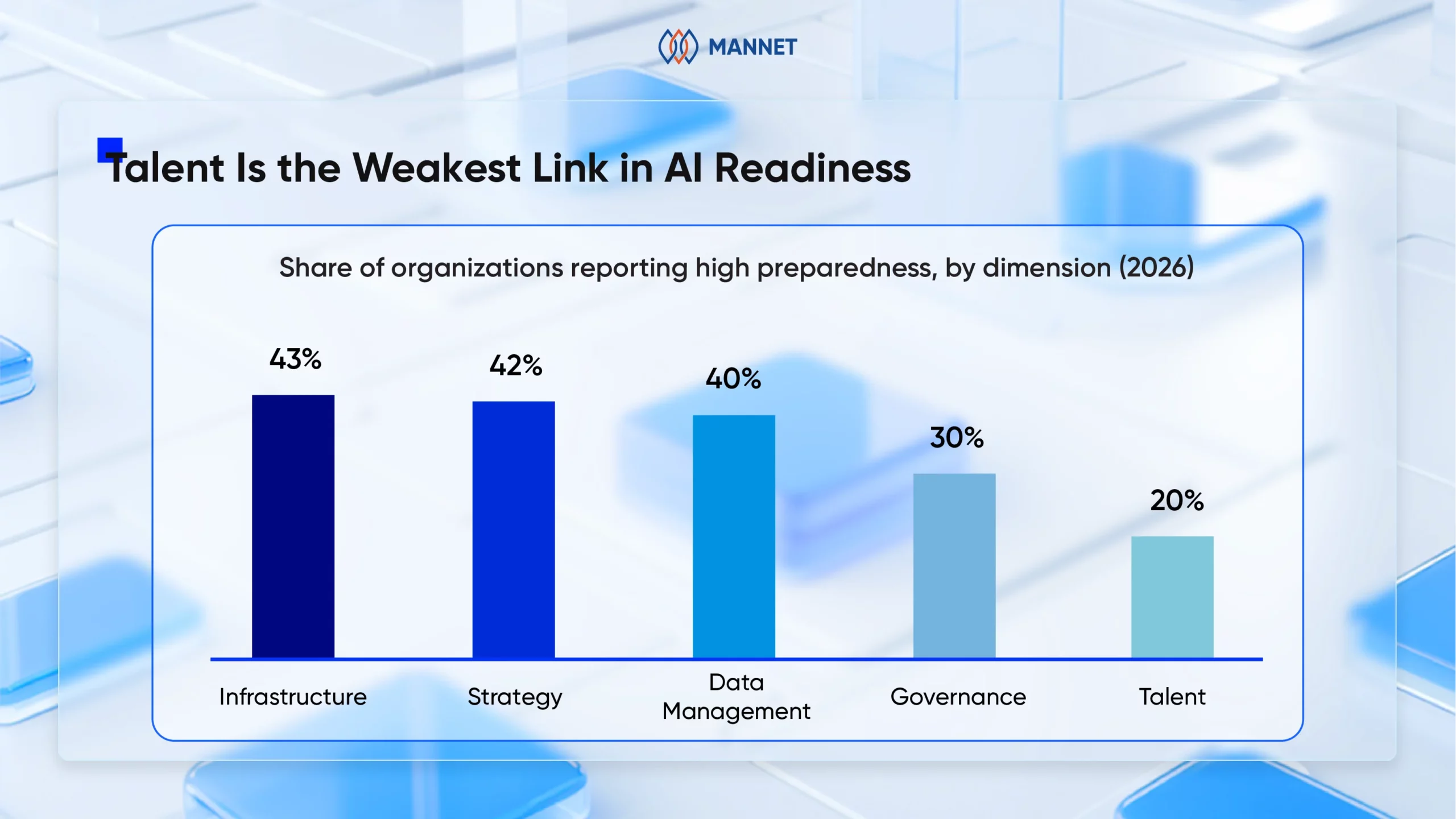
ai outsourcing data

(Source: Deloitte, State of AI in the Enterprise 2026).

For many businesses, AI outsourcing has become the fastest way to access specialized expertise without waiting months to recruit highly sought-after talent.

2. AI talent has become increasingly expensive

Experienced AI professionals command a significant premium over traditional software engineering roles, driven by intense competition for expertise in machine learning, GenAI, and AI infrastructure. Deloitte also notes that many organizations are unable to fill nearly half of AI-related positions, forcing companies to compete aggressively on compensation while delaying critical AI initiatives. (Source: Deloitte Tech Trends 2025).

Rather than absorbing these long-term hiring and retention costs upfront, many organizations use outsourcing to convert fixed talent investments into more flexible operating costs.

3. AI adoption is scaling faster than internal hiring

Enterprise AI has moved well beyond experimentation. Deloitte’s 2026 research found that worker access to AI increased by 50% during 2025, while the number of organizations with at least 40% of AI projects in production is expected to double within six months. Yet talent availability has not kept pace with deployment ambitions.
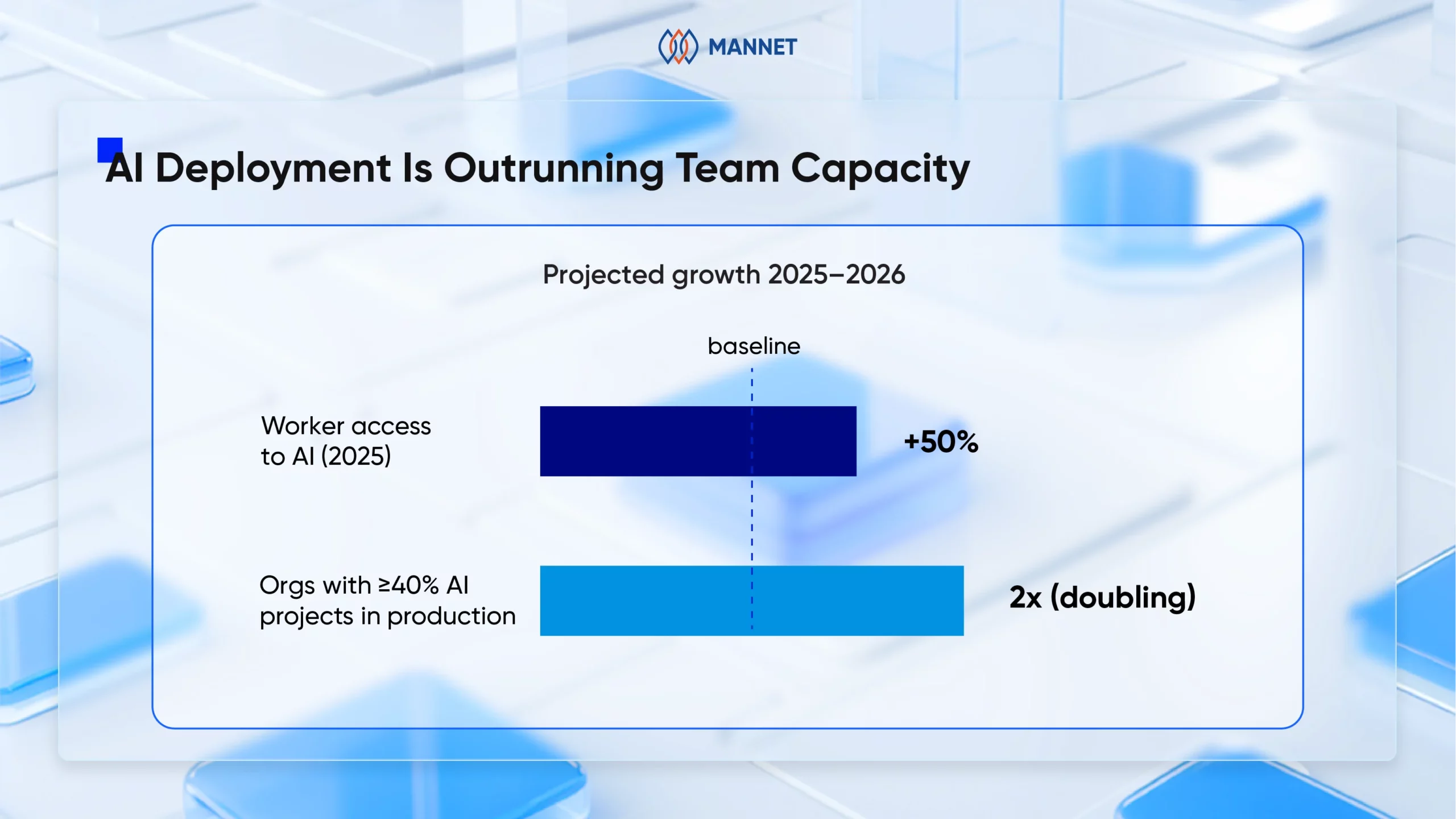
ai outsourcing data

(Source: Deloitte, State of AI in the Enterprise 2026).

For many organizations, the bottleneck is no longer deciding whether to invest in AI but finding the engineering capacity to deliver.

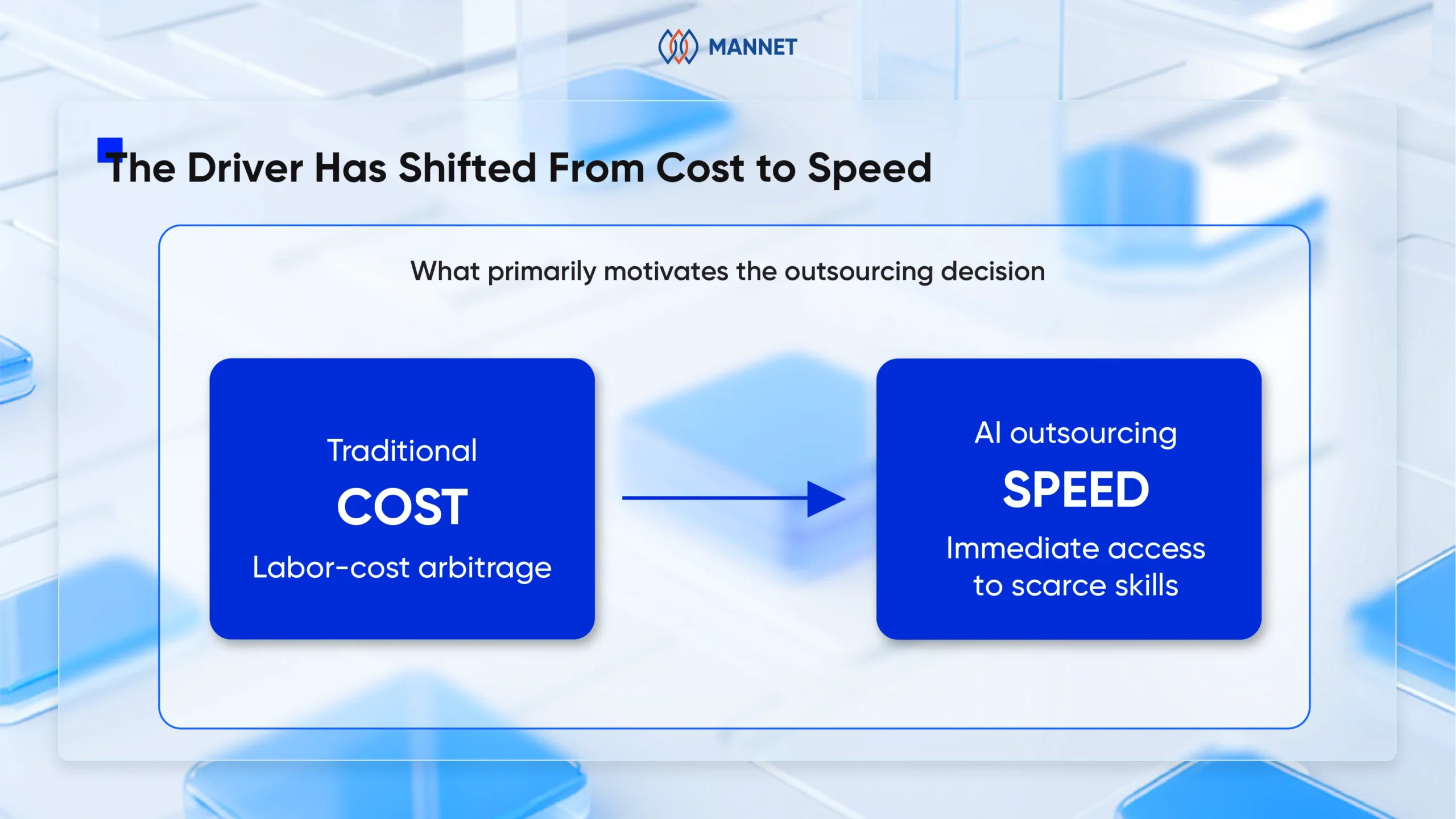
4. Speed has overtaken cost as the primary driver
ai outsourcing data

Traditional outsourcing was largely motivated by labor cost arbitrage. AI outsourcing is different. Today’s priority is accelerating execution by gaining immediate access to specialized AI capabilities that are difficult to build internally.

Instead of spending several hiring cycles assembling an AI team, companies can quickly onboard experienced AI engineers, data scientists, or MLOps specialists through staff augmentation or dedicated team models, allowing AI initiatives to move from concept to production much faster.

5. Organizations want flexibility while AI use cases continue to evolve

Despite growing investment, enterprise AI remains an evolving capability. Deloitte’s latest GenAI research found that more than two-thirds of organizations expect fewer than 30% of their current GenAI experiments to reach full-scale deployment in the near term, underscoring the importance of validating AI initiatives before committing to permanent organizational structures. (Source: Deloitte, State of Generative AI in the Enterprise Q4 2025).

AI outsourcing allows businesses to launch pilots, validate business value, and scale successful initiatives without taking on the long-term cost and organizational risk of hiring permanent teams too early.

Taken together, these trends explain why AI outsourcing has become a core workforce strategy rather than a tactical sourcing decision. The next step is determining which outsourcing model best fits your business objectives, technical maturity, and long-term AI roadmap.

AI Outsourcing Use Cases

AI outsourcing use cases by industry

AI outsourcing creates the greatest business value when applied to well-defined business problems rather than broad AI ambitions. Across industries, organizations are increasingly partnering with external AI teams to accelerate implementation, access specialized expertise, and validate AI initiatives before committing to long-term hiring.

While every industry has unique requirements, the most successful AI outsourcing engagements typically focus on high-volume, data-intensive processes where automation, prediction, or intelligent decision-making can deliver measurable business outcomes within months rather than years.
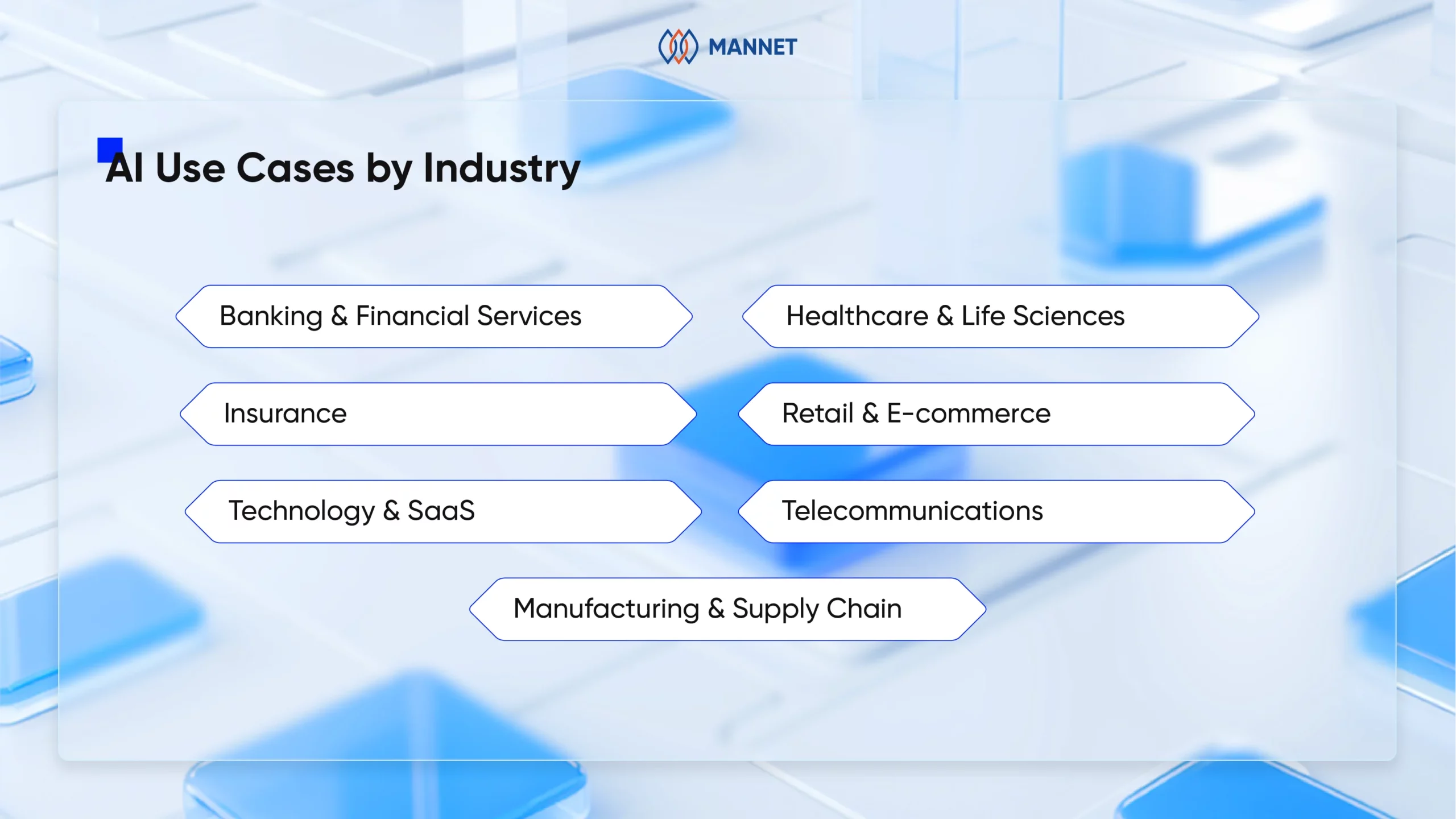
ai outsourcing use cases by industry

The table below highlights some of the most common AI outsourcing use cases across major industries and the AI talent typically required to deliver them.

Industry Business priorities Representative AI use cases Typical AI roles
Banking & Financial Services Risk management, compliance, operational efficiency Fraud detection, credit scoring, intelligent document processing, robo-advisory platforms ML Engineers, Data Scientists, MLOps Engineers
Healthcare & Life Sciences Better patient care, regulatory compliance, administrative efficiency Medical imaging analysis, predictive health analytics, clinical documentation, revenue cycle automation AI Engineers, NLP Engineers, Computer Vision Engineers
Insurance Faster claims processing, fraud prevention, underwriting automation Claims triage, AI underwriting, fraud analytics, document intelligence ML Engineers, NLP Engineers, Data Engineers
Retail & E-commerce Customer experience, personalization, inventory optimization Recommendation engines, AI customer support, demand forecasting, pricing optimization LLM Engineers, Data Scientists, AI Engineers
Technology & SaaS Product innovation, engineering productivity AI copilots, semantic search, AI-powered QA, intelligent support automation GenAI Engineers, AI Architects, Full-stack AI Engineers
Telecommunications Network reliability, customer support Predictive maintenance, network optimization, conversational AI, customer analytics ML Engineers, Data Engineers, AI Engineers
Manufacturing & Supply Chain Operational efficiency, quality control Computer vision inspection, predictive maintenance, logistics optimization, inventory forecasting Computer Vision Engineers, MLOps Engineers, Data Engineers

Four AI capabilities driving enterprise AI adoption

While AI use cases vary across industries, most enterprise AI initiatives can be grouped into four recurring capability areas. Understanding these capabilities helps organizations identify where AI can create the greatest business value and what type of AI talent is required to deliver it.

AI capability Most common industries
Intelligent document processing Banking, Insurance, Healthcare, Real Estate
Predictive analytics Financial Services, Manufacturing, Retail, Logistics
Conversational AI Retail, SaaS, Telecom, Healthcare
AI-enabled products &operations SaaS, Manufacturing, Logistics, Enterprise Software

1. Intelligent document processing & workflow automation

Business objective: Eliminate repetitive manual work and improve operational efficiency.

Many organizations still rely on employees to process invoices, contracts, insurance claims, compliance documents, purchase orders, medical records, and other document-heavy workflows. These processes are often slow, labor-intensive, and vulnerable to human error.

AI-powered document processing combines OCR, Natural Language Processing (NLP), and Large Language Models (LLMs) to extract, classify, validate, and organize information from structured and unstructured documents. When integrated into enterprise workflows, these systems can automate approvals, trigger downstream actions, and significantly reduce processing time.

Representative use cases

  • Invoice and accounts payable automation
  • Contract analysis and compliance checks
  • Insurance claims processing
  • Medical documentation and coding
  • Know Your Customer (KYC) verification
  • HR document management

Typical AI roles

  • NLP Engineers
  • Machine Learning Engineers
  • AI Engineers
  • AI QA Specialists

Business outcomes

✓ Faster document processing

✓ Reduced operational costs

✓ Improved data accuracy

✓ Better regulatory compliance

2. Predictive analytics & intelligent decision-making

Business objective: Make faster, more accurate decisions using enterprise data.

Many organizations collect vast amounts of operational data but struggle to transform it into actionable insights. Predictive AI models help businesses anticipate future events rather than simply reporting historical performance.

These solutions combine machine learning, statistical modeling, and real-time data pipelines to forecast demand, detect fraud, assess risk, optimize pricing, and predict equipment failures before they occur.

Representative use cases

  • Fraud detection
  • Credit scoring
  • Demand forecasting
  • Predictive maintenance
  • Customer churn prediction
  • Recommendation engines
  • Dynamic pricing

Typical AI roles

  • Data Scientists
  • ML Engineers
  • Data Engineers
  • MLOps Engineers

Business outcomes

✓ Better forecasting accuracy

✓ Reduced business risk

✓ Higher operational efficiency

✓ Faster data-driven decision-making

3. Conversational AI & customer experience

Business objective: Deliver faster, more personalized customer interactions at scale.

Advances in Generative AI have transformed customer engagement. Instead of relying solely on scripted chatbots, organizations are deploying AI assistants capable of understanding natural language, retrieving enterprise knowledge, and completing multi-step tasks.

These systems support customers, employees, and internal operations across industries, from answering product questions and scheduling appointments to assisting customer service teams and providing internal knowledge support.

Representative use cases

  • AI chatbots
  • AI agents
  • Voice assistants
  • Internal knowledge assistants
  • Customer support automation
  • Employee productivity copilots

Typical AI roles

  • LLM Engineers
  • Prompt Engineers
  • Backend AI Engineers
  • AI Solution Architects

Business outcomes

✓ 24/7 customer support

✓ Faster response times

✓ Lower service costs

✓ Improved customer satisfaction

4. AI-enabled products & intelligent operations

Business objective: Embed AI directly into products and core business operations.

For many organizations, AI is no longer an add-on feature – it is becoming a fundamental part of the product itself. Technology companies are integrating AI into software through copilots, semantic search, recommendation engines, and agentic workflows, while manufacturers and logistics providers are using AI to optimize production, monitor assets, and improve supply chain performance.

These initiatives often require cross-functional engineering teams capable of designing, deploying, and operating production-grade AI systems.

Representative use cases

  • AI copilots
  • Semantic search
  • Computer vision inspection
  • Predictive maintenance
  • Supply chain optimization
  • Workflow automation
  • AI-powered quality assurance

Typical AI roles

  • GenAI Engineers
  • AI Architects
  • Computer Vision Engineers
  • MLOps Engineers
  • Full-stack AI Engineers

Business outcomes

✓ Faster product innovation

✓ Improved operational efficiency

✓ Better user experiences

✓ Greater competitive differentiation

A common pattern across every industry

Although business priorities vary – from fraud detection in financial services to predictive maintenance in manufacturing – the underlying engineering challenges remain remarkably consistent. Organizations must prepare high-quality data, build and validate AI models, integrate them with existing systems, deploy them into production, and continuously monitor performance as business requirements evolve.

Delivering these initiatives rarely depends on a single AI specialist. Successful AI projects require cross-functional teams that combine AI engineers, machine learning experts, data engineers, MLOps specialists, software engineers, and domain experts. Building this capability entirely in-house can be both time-consuming and costly, particularly as demand for experienced AI talent continues to outpace supply.

To accelerate delivery while retaining full control over product architecture and intellectual property, many organizations extend their existing engineering teams through AI staff augmentation services. This model allows businesses to quickly onboard specialized AI talent that integrates into their internal workflows, development processes, and product roadmap, providing the flexibility to scale AI initiatives without the delays and long-term commitments of traditional hiring.

Which AI Outsourcing Model Fits Your Business?

Choosing to outsource AI talent is only the first decision. The next, and often more important, question is how to engage external expertise.

There is no one-size-fits-all outsourcing model. The right approach depends on your internal engineering capabilities, hiring timeline, desired level of control, and long-term business objectives. A startup building its first AI-powered product has very different needs from an enterprise scaling an established AI platform.

The four most common AI outsourcing models each solve a different business challenge.

Model Best for Who manages the team? Time to get started Long-term ownership
Project-based AI development Building a complete AI solution with limited internal AI expertise Vendor Medium Vendor during delivery
AI staff augmentation Scaling an existing engineering team with specialized AI talent Client Fast Client
Recruitment (RPO) Hiring permanent AI professionals Client Medium Client
Employer of record (EOR) Hiring AI talent in countries without a legal entity Client Fast Client

Although each model has its place, they differ significantly in terms of control, flexibility, scalability, and long-term talent strategy.

Project-based AI development

Project-based outsourcing is best suited for organizations that want a partner to take full responsibility for delivering a defined AI solution, from requirements gathering and model development to deployment and ongoing support.

This approach works well when internal AI capabilities are limited or when the objective is to deliver a specific business outcome rather than build an in-house AI function.

Best suited for:

  • Building a proof of concept (PoC)
  • Developing an AI application from scratch
  • Delivering a fixed-scope AI project
  • Organizations without dedicated AI leadership

Advantages

  • End-to-end delivery
  • Minimal internal resource requirements
  • Predictable project scope

Considerations

  • Less day-to-day technical control
  • Knowledge transfer should be planned early
  • Scope changes may increase delivery costs

AI staff augmentation

For organizations that already have an engineering team, AI staff augmentation is often the fastest way to expand delivery capacity.

Instead of outsourcing the project itself, companies integrate experienced AI engineers, machine learning specialists, or MLOps professionals directly into their existing teams. Internal leaders continue to own the architecture, priorities, and product roadmap, while the outsourcing partner handles sourcing, recruitment, payroll, and administrative management.

This model has become increasingly popular among enterprises adopting Generative AI because it combines rapid scalability with full technical ownership.

Best suited for:

  • Scaling AI product development
  • Accelerating GenAI initiatives
  • Filling niche AI skill gaps
  • Supporting existing engineering teams

Advantages

  • Fast onboarding
  • Full engineering control
  • Flexible team scaling
  • Lower hiring risk

Considerations

  • Requires internal technical leadership
  • Success depends on effective onboarding and collaboration

Why it matters: For organizations that already know what they want to build but lack the bandwidth to execute, staff augmentation often delivers the best balance of speed, flexibility, and long-term control.

Recruitment process outsourcing (RPO)

If AI capability is becoming a permanent competitive advantage rather than a short-term initiative, hiring full-time AI professionals may be the right investment.

Through Recruitment Process Outsourcing (RPO), a specialist recruitment partner manages sourcing, technical screening, employer branding, and hiring operations while successful candidates join your organization as permanent employees.

Best suited for:

  • Building an internal AI Center of Excellence
  • Long-term AI product organizations
  • Scaling engineering teams sustainably

Advantages

  • Permanent knowledge retention
  • Strong cultural integration
  • Long-term workforce planning

Considerations

  • Longer hiring timelines
  • Higher long-term employment costs
  • Ongoing retention challenges

Employer of record (EOR)

Many global companies identify exceptional AI talent in countries where they have no legal entity. Establishing a local subsidiary simply to hire a small engineering team is often expensive and time-consuming.

An Employer of Record (EOR) removes this barrier by becoming the legal employer, handling payroll, tax, benefits, and local compliance while the engineers work exclusively for your organization.

Best suited for:

  • Hiring AI talent internationally
  • Expanding into Vietnam without setting up a legal entity
  • Building distributed AI teams

Advantages

  • Fast international hiring
  • Full legal compliance
  • Reduced administrative complexity

AI staff augmentation vs. recruitment vs. EOR: Which model fits?

Model Best for Control level Typical timeline Commitment
Project-based outsourcing A defined, one-off AI build Lower – vendor owns delivery Weeks to months Project-length only
AI staff augmentation Filling a skills or capacity gap on an existing team High – you manage the work 1-4 weeks to onboard Flexible, scales up/down
AI recruitment / RPO Building a permanent, long-term AI function Full – direct hire Weeks, depending on seniority Permanent
EOR for AI hires Hiring a specific candidate where you have no legal entity Full – you direct the work Days to a few weeks Flexible, no entity required

What Does AI Outsourcing Cost?

One of the most common questions organizations ask before outsourcing AI development is: “How much will it cost?” The answer depends on far more than hourly engineering rates.

AI outsourcing costs are influenced by:

  • The type of AI expertise required;
  • The project complexity;
  • The engagement model
  • The team size;
  • The location of the engineering team.

For example, building a proof of concept with two machine learning engineers has a very different cost profile from scaling a production-grade AI platform supported by AI architects, MLOps engineers, and data engineers.

Rather than optimizing for the lowest hourly rate, successful organizations focus on achieving the best balance between engineering quality, speed, scalability, and long-term return on investment.

The table below summarizes the primary factors that influence AI outsourcing costs.

Cost driver Why it matters
AI roles required Specialized roles such as AI Architects, GenAI Engineers, and MLOps Engineers typically command higher rates than general software engineers.
Project complexity Fine-tuning foundation models or building production AI systems requires significantly more expertise than integrating off-the-shelf AI APIs.
Engagement model Project-based outsourcing, staff augmentation, RPO, and EOR each have different pricing structures and cost implications.
Team size & duration Larger or longer-term engagements generally increase overall investment but may reduce the average cost per engineer over time.
Location Engineering rates, talent availability, and hiring competition vary considerably across global markets.

For many organizations, the goal is not simply to reduce development costs but to maximize the value delivered by every AI hire. Choosing the right engagement model and sourcing strategy often has a greater impact on total project cost than hourly rates alone.

-> Want a detailed breakdown of AI outsourcing pricing? Read our guide to AI Outsourcing Cost: Pricing Models, Regional Rates & Cost Optimization to compare engagement models, understand regional cost differences, and estimate the investment required for your AI initiatives.

As we’ll explore in the next section, where you source AI talent is another major factor influencing both cost and delivery outcomes. This is one of the reasons why Vietnam has become an increasingly attractive destination for companies looking to scale AI engineering teams efficiently.

Common Risks of AI Outsourcing and How to Avoid Them

Like any strategic technology initiative, AI outsourcing comes with trade-offs. The most successful organizations are not those that avoid risk entirely, but those that anticipate potential challenges and put the right governance, processes, and talent strategy in place from the start.

The table below summarizes the most common risks associated with AI outsourcing and practical ways to mitigate them.

Common risk How to mitigate it
Hiring the wrong AI expertise Clearly define the skills required (e.g., LLM engineering, MLOps, computer vision, or data engineering) and work with a partner capable of validating technical capabilities.
Poor integration with internal teams Treat outsourced engineers as an extension of your product team, with shared tools, sprint ceremonies, documentation, and communication channels.
Data security and IP concerns Establish robust NDAs, access controls, secure development environments, and clear ownership of code, models, and intellectual property before work begins.
Scaling too quickly or too slowly Start with a focused team, validate outcomes, and expand capacity incrementally as business needs evolve.
Choosing a partner based on cost alone Evaluate engineering quality, AI expertise, delivery processes, and long-term collaboration, not just hourly rates.

While every organization faces different challenges, these risks are manageable with the right outsourcing strategy and governance model.

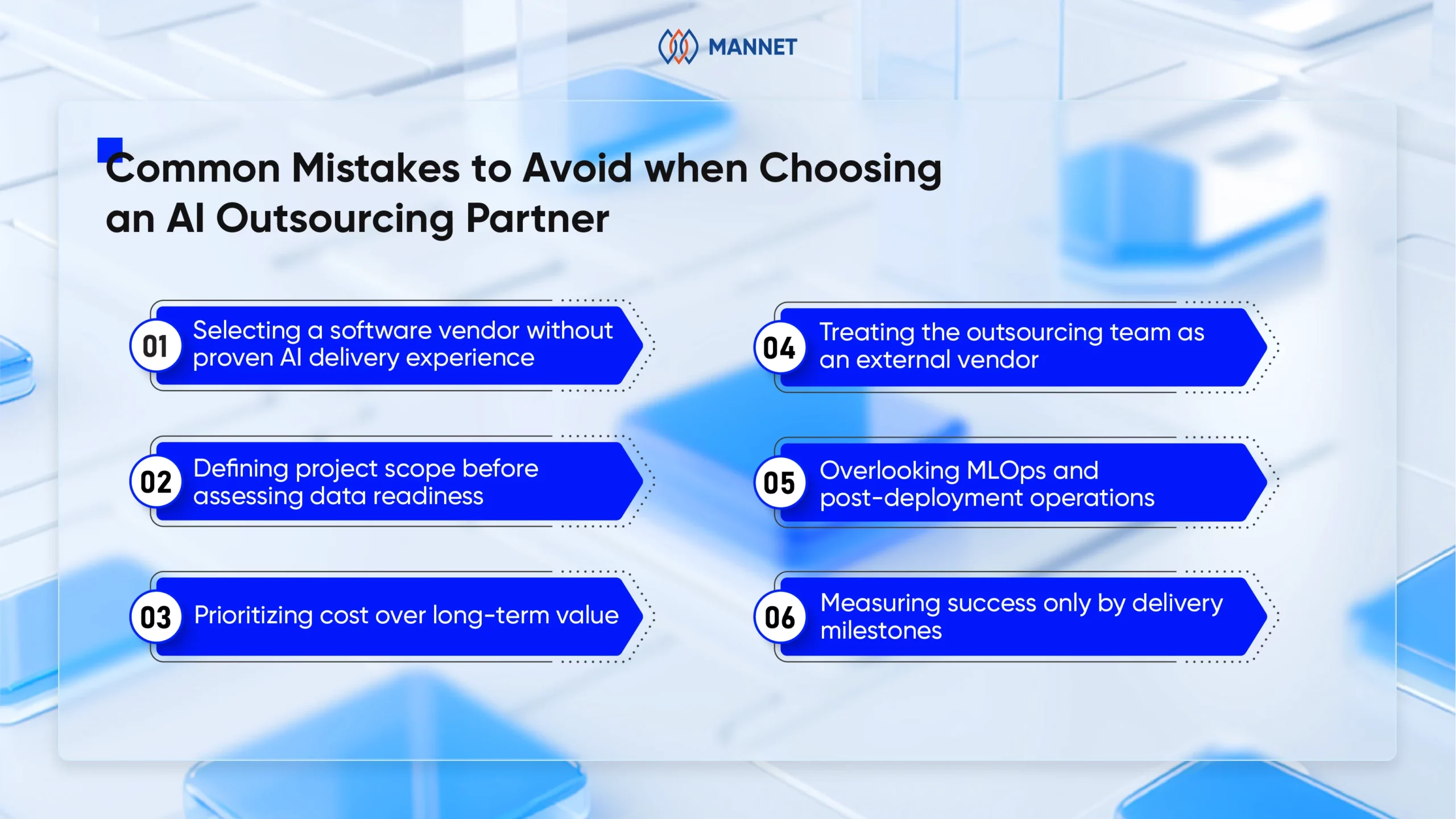
1. Hiring the wrong AI talent

Not all AI engineers have the same expertise. A team experienced in traditional machine learning may not be the right fit for building GenAI applications, while a strong data scientist may not have production MLOps experience.

Before engaging an outsourcing partner, define the business problem first, then identify the technical capabilities required to solve it. Matching the right specialists to the right initiative is often more important than simply expanding headcount.

2. Treating outsourced engineers as an external vendor

One of the most common reasons AI outsourcing initiatives underperform is organizational rather than technical. When external engineers work in isolation from product managers, designers, and internal developers, knowledge sharing slows, and delivery quality suffers.

Organizations that achieve the best results integrate outsourced AI specialists directly into their engineering workflows – using the same sprint planning, collaboration tools, code review processes, and technical standards as internal teams.

3. Underestimating data governance

AI systems are only as reliable as the data they are trained on and the environments in which they operate.

Before development begins, organizations should establish clear policies covering data access, security, compliance, model ownership, and intellectual property. This is particularly important in regulated industries such as financial services, healthcare, and insurance.

4. Scaling without a clear roadmap

AI initiatives often begin with a proof of concept but quickly expand as new opportunities emerge. Scaling too aggressively before validating business outcomes can increase costs without delivering meaningful value.

A phased approach, starting with a focused team and expanding as milestones are achieved, helps organizations balance speed with long-term sustainability.

5. Choosing price over long-term value

While cost is an important consideration, it should rarely be the primary decision factor.

The most successful AI outsourcing partnerships are built on engineering quality, communication, domain expertise, and the ability to scale over time. A lower hourly rate can quickly become more expensive if projects require extensive rework, onboarding, or management overhead.

For this reason, organizations should evaluate outsourcing partners thoroughly based on technical expertise, delivery maturity, talent quality, cultural fit, and cost.

Key takeaway

Most AI outsourcing challenges stem from planning and execution rather than the outsourcing model itself. By selecting the right technical expertise, integrating external engineers into internal workflows, and establishing strong governance from the outset, organizations can significantly reduce delivery risk while accelerating AI adoption.

If your team is looking to extend your engineering team with pre-vetted AI specialists, explore ManNet’s IT Staff Augmentation Services to see how global companies build scalable AI teams in Vietnam while maintaining full ownership of their products, codebase, and intellectual property.

How to Choose the Right AI Outsourcing Partner

Selecting an AI outsourcing partner is about more than comparing hourly rates or team size. The right partner should strengthen your team’s engineering capability, reduce delivery risk, and scale alongside your business.

As AI projects become increasingly complex, organizations should evaluate outsourcing providers across technical expertise, delivery maturity, talent quality, and long-term partnership potential.

The following framework can help guide your evaluation.

Evaluation criteria What to look for
Proven AI expertise Demonstrated experience across AI/ML, Generative AI, data engineering, MLOps, and production AI deployment, with a proven track record of delivering enterprise AI solutions.
Access to specialized talent The ability to source niche roles such as AI Engineers, ML Engineers, Data Scientists, MLOps Engineers, Prompt Engineers, and AI Architects as project needs evolve.
Flexible engagement models Support for staff augmentation, dedicated teams, recruitment (RPO), or Employer of Record (EOR), allowing your sourcing strategy to adapt as AI initiatives mature.
Technical screening and hiring process A rigorous technical vetting process that identifies AI professionals with the right combination of engineering expertise, business understanding, problem-solving ability, communication skills, and long-term team fit.
Delivery and collaboration practices Experience working within Agile environments, distributed product teams, modern DevOps workflows, and enterprise collaboration tools.
Security and compliance Clear processes for IP protection, data security, confidentiality, and compliance with relevant regulations.

While every business has unique requirements, the strongest AI outsourcing partnerships typically share these characteristics.

Questions to ask before choosing a partner

Before committing to an outsourcing provider, it is worth asking a few practical questions:

  • Have they successfully delivered AI projects or placed AI specialists with organizations similar to yours?
  • Can they source niche AI roles beyond general software engineers?
  • How do they technically assess AI candidates before presenting them?
  • Can they scale your team up or down as project priorities change?
  • How do they protect intellectual property, confidential data, and code ownership?
  • What level of support do they provide after engineers are onboarded?

The answers to these questions often reveal far more about a partner’s capabilities than pricing alone.

Why Many Companies Choose ManNet

At ManNet, we believe successful AI outsourcing starts with the right engineering talent.

Rather than offering a one-size-fits-all delivery model, we help organizations choose the engagement approach that best fits their stage of AI adoption:

  • IT Staff Augmentation for rapidly expanding existing engineering teams with pre-vetted AI specialists.
  • IT Recruitment (RPO) for building long-term in-house AI capabilities.
  • Employer of Record (EOR) for hiring AI professionals in Vietnam without establishing a local legal entity.

Our recruitment process combines deep technical screening, market knowledge, and access to Vietnam’s growing AI talent network, empowering global companies to scale engineering teams efficiently while maintaining full ownership of their products, architecture, and intellectual property.

-> Explore ManNet’s AI talent solutions to learn how we help organizations build high-performing AI teams through flexible staffing and recruitment models.

Key takeaway

The right AI outsourcing partner should do more than fill vacancies. They should help you access specialized expertise, integrate seamlessly with your engineering organization, and provide the flexibility to scale as your AI strategy evolves.

Choosing a partner with proven AI recruitment capability, strong technical assessment processes, and flexible engagement models can significantly reduce hiring risk while accelerating the delivery of AI initiatives.

FAQs about AI Outsourcing

Can AI outsourcing work for startups as well as enterprises?

Yes. AI outsourcing is suitable for organizations at every stage of growth. Startups often use it to access specialized AI expertise without the cost and time required to build an in-house team, while larger enterprises leverage outsourcing to accelerate delivery, fill niche skill gaps, or scale existing AI initiatives. The right engagement model depends on your business objectives, internal capabilities, and long-term hiring strategy.

What AI roles are most commonly outsourced?

Organizations typically outsource a wide range of AI and data roles, including:

  • AI Engineers
  • Machine Learning Engineers
  • Data Scientists
  • Data Engineers
  • MLOps Engineers
  • AI Architects
  • Prompt Engineers
  • AI QA Engineers

The optimal team composition depends on the complexity of your AI initiative. For example, a Generative AI application may require Prompt Engineers and AI Engineers, while a production-scale AI platform often requires Data Engineers and MLOps specialists to support deployment and ongoing operations.

Can outsourced AI engineers work as part of my internal team?

Absolutely. Under a staff augmentation model, outsourced AI professionals work as an extension of your engineering organization rather than as a separate delivery team. They typically use your existing development tools, sprint processes, communication platforms, and coding standards while collaborating closely with your product managers, designers, and software engineers.

This approach enables organizations to increase engineering capacity without sacrificing visibility, collaboration, or control over product development.

How long does it take to hire AI talent through an outsourcing partner?

The timeline depends on the seniority and specialization of the role, as well as the engagement model you choose. Compared with traditional recruitment, which can take several months for highly specialized AI positions, working with an established outsourcing partner often enables organizations to onboard qualified AI professionals much faster through access to pre-vetted talent networks.

For companies operating in fast-moving markets, reducing hiring time can be just as valuable as reducing hiring costs.

Who owns the intellectual property in an AI outsourcing engagement?

Intellectual property ownership should always be clearly defined before development begins. In most professional outsourcing engagements, the client retains ownership of the source code, AI models, documentation, and other project deliverables, while the outsourcing partner provides the engineering expertise needed to build and support the solution.

To minimize risk, organizations should establish clear contractual agreements covering IP ownership, confidentiality, data security, and access controls before onboarding any external team members.

Can I start with one AI engineer and scale my team later?

Yes. Many organizations begin with a single AI specialist or a small cross-functional team to validate a proof of concept before expanding their AI capability. Once priorities become clearer, additional AI engineers, data scientists, MLOps specialists, or QA engineers can be added incrementally as the project grows.

This phased approach allows businesses to control costs, reduce hiring risk, and scale engineering capacity based on measurable business outcomes rather than assumptions.

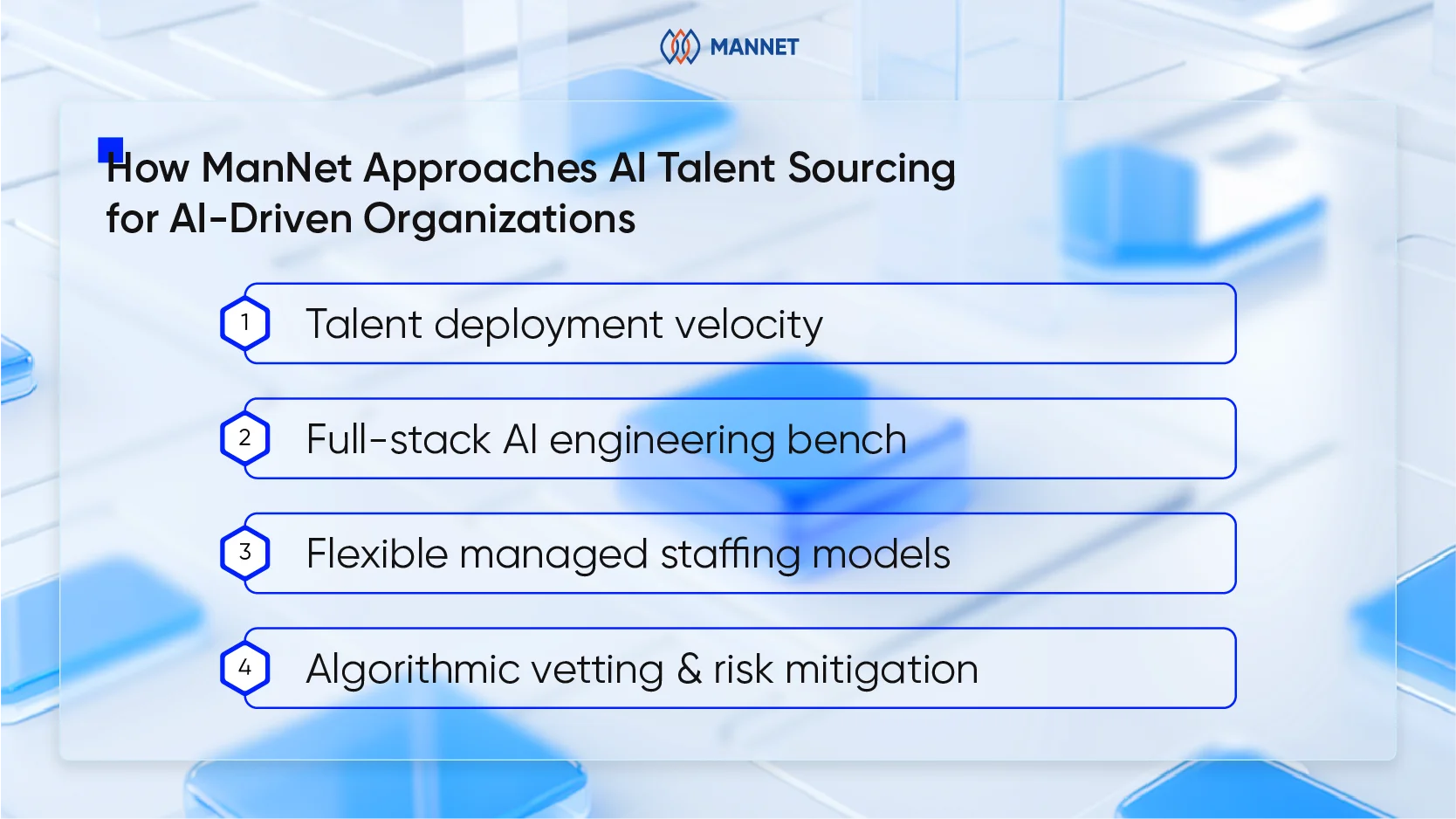
How ManNet Approaches AI Talent Sourcing for AI-Driven Organizations

Most enterprise tech buyers evaluating AI outsourcing in Vietnam focus on three core metrics: specialized technical skill, deployment speed, and financial risk mitigation.

Unlike traditional software development vendors competing for broad project budgets, ManNet operates as a pure talent architecture layer. The company’s core mission is to inject the precise engineering resources needed to accelerate development, whether those professionals operate within an in-house corporate team or alongside an external vendor.

Talent deployment velocity

Traditional recruitment cycles for specialized tech roles in Southeast Asia often exceed 45 days. ManNet compresses this pipeline via strict Service Level Agreements (SLAs):

  • 4 Working Hours: Completion of comprehensive technical requirements analysis.
  • 3-5 Business Days: Delivery of a curated, pre-vetted specialist shortlist.
  • 7 Calendar Days: Deployment of a complete, cross-functional engineering team.

This velocity advantage directly prevents roadmaps from stalling and eliminates the heavy opportunity costs associated with vacant engineering seats.

Full-stack AI engineering bench

Deploying production-grade artificial intelligence requires a multi-disciplinary tech squad. ManNet provides instant access to a vetted network of 10,000+ IT professionals, allowing organizations to seamlessly:

  • Hire machine learning engineers to architect and train complex neural networks.
  • Deploy Data Engineers to clean raw databases and build secure pipelines.
  • Embed MLOps Specialists to manage containerization, scaling, and real-time drift telemetry.
  • Integrate QA Automation Engineers to validate system outputs before live deployment.

Flexible managed staffing models

ManNet offers agile engagement structures designed to scale smoothly alongside an organization’s specific technical maturity curve:

  • IT recruitment & direct hire: Tailored for companies looking to permanently fill local technical roles without building an in-house recruitment pipeline from scratch.
  • IT staff augmentation: Ideal for tech leaders needing to rapidly inject engineering capacity into specific sprints without increasing fixed headcount overhead.
  • EOR & BOT subsidiary setup: A comprehensive, integrated blueprint covering local payroll, legal compliance, and operational setup for global enterprises building permanent offshore development centers in Vietnam.

Algorithmic vetting & risk mitigation

To protect software roadmaps from early candidate attrition and slow hiring cycles, ManNet provides a dual-layer safety net:

  • Passive candidate sourcing: Utilizing AI-powered ATS infrastructure to mine GitHub and LinkedIn data, capturing high-performing passive talent unavailable on standard job boards.
  • 60-day performance guarantee: Providing a complimentary candidate replacement or a 50% fee deduction if an embedded engineer fails to meet organizational performance standards within the first two months.

Final Verdict: Choosing the Right AI Engineering Strategy in Vietnam

There is no one-size-fits-all model for AI outsourcing in Vietnam. The optimal strategic choice depends entirely on how much ownership an organization requires over its technical infrastructure, product roadmap, and core intellectual property (IP).

The ManNet distinction: Why retain control?

For fast-moving tech organizations that refuse to lock themselves into rigid external vendor contracts or give up absolute ownership of their codebases, standard project-based outsourcing introduces unnecessary risks.

ManNet offers the ultimate hybrid approach. By separating execution capacity from headcount overhead, the company enables organizations to keep their core strategy in-house while instantly scaling up engineering velocity. Whether a business needs to hire machine learning engineers for a single project milestone, leverage flexible IT staff augmentation services for rapid development sprints, or utilize compliant Employer of Record (EOR) models to build a permanent tech hub in Vietnam, ManNet handles the operational heavy lifting under one roof.
ai outsourcing

How to Choose the Right AI Outsourcing Company

Knowing how to choose an AI outsourcing company has become a strategic priority as organizations accelerate AI adoption. According to McKinsey, 88% of organizations have adopted AI, yet only about one-third have successfully scaled it beyond the pilot stage. One of the biggest reasons is selecting the wrong delivery partner – many vendors claim AI expertise. Still, far fewer possess the technical depth required to build, deploy, and support production-ready AI systems.

This guide provides a practical framework for how to choose an AI outsourcing company, covering the evaluation criteria, technical capabilities, security and governance practices, and engagement models that matter most when assessing potential partners. Whether an enterprise is launching its first AI initiative or expanding an existing AI capability, these best practices can help reduce delivery risk and improve long-term project outcomes.

Let’s dive in!

How to Choose the Right AI Outsourcing Company

Selecting an AI outsourcing partner is fundamentally different from choosing a traditional software development vendor. The success of an AI initiative depends not only on engineering execution but also on data quality, model performance, deployment maturity, and the ability to improve AI systems after launch continuously.

Rather than evaluating vendors based solely on hourly rates or company size, enterprises should assess whether a partner can support the full AI lifecycle—from data preparation and model development to deployment, monitoring, and long-term optimization.

Looking for an overview of AI outsourcing models, costs, and delivery approaches? Read our complete guide to AI Outsourcing before comparing providers.

The following framework highlights the six areas that matter most when evaluating an AI outsourcing partner.

how to choose ai outsourcing company

Technical capability

Technical expertise is the foundation of every successful AI outsourcing engagement. While many software companies now advertise AI services, relatively few possess hands-on experience building production-grade AI systems.

When assessing technical capability, look beyond programming languages or framework logos. Instead, evaluate whether the partner has demonstrated expertise across the modern AI technology stack, including:

  • Machine Learning and Deep Learning
  • Generative AI and Large Language Models (LLMs)
  • Retrieval-Augmented Generation (RAG)
  • AI Agents and workflow automation
  • Computer Vision
  • Natural Language Processing (NLP)
  • Data Engineering
  • MLOps and model deployment
  • Cloud AI platforms (AWS, Azure, Google Cloud)

Questions to ask

  • Has the company deployed AI systems into production?
  • Can the engineering team explain architectural decisions and model trade-offs?
  • Does the team include specialists rather than generalist software engineers?

Red flags

  • AI expertise limited to chatbot demos or proofs of concept.
  • No evidence of production deployments.
  • Heavy reliance on third-party APIs without proprietary engineering capability.

AI portfolio

An AI portfolio provides one of the clearest indicators of a partner’s delivery capability. Technical presentations and service pages can describe what a company offers; completed AI projects demonstrate how that expertise performs under real business conditions.

The strongest portfolios consistently show three characteristics: production deployment, business relevance, and measurable outcomes. When reviewing an AI outsourcing company’s portfolio, look beyond the number of projects completed. Instead, evaluate the complexity of the use cases, the maturity of the solutions, and the business impact achieved.

What to evaluate

When reviewing case studies, consider the following questions:

  • Has the company deployed AI solutions into production environments?
  • Does the portfolio include projects across multiple AI domains, such as Generative AI, LLMs, computer vision, NLP, predictive analytics, or intelligent automation?
  • Are the business objectives, technical approach, and measurable outcomes clearly explained?
  • Does the company demonstrate experience maintaining and optimizing AI systems after deployment?

A portfolio should explain the business problem, the AI architecture, and the operational impact with equal clarity.

Evaluation checklist

Evaluation Area What to Look For
Production experience AI solutions deployed in live business environments with ongoing operational support.
Breadth of AI expertise Experience across multiple AI disciplines, including Generative AI, machine learning, NLP, computer vision, MLOps, and AI automation.
Industry relevance Case studies addressing business challenges similar to those faced by your organization.
Business outcomes Quantifiable improvements such as higher accuracy, shorter processing time, increased productivity, or lower operating costs.
Technical credibility Clear documentation of the solution architecture, technology stack, deployment approach, and integration strategy.
Client validation Public case studies, customer testimonials, or reference projects demonstrating successful delivery.

Red flags

The following signals often indicate limited AI delivery maturity:

  • Case studies focused exclusively on prototype applications or internal demonstrations.
  • Marketing materials describing AI capabilities without explaining implementation details.
  • No measurable business outcomes or customer references.
  • Limited evidence of post-deployment support, model monitoring, or continuous improvement.

Recommended practice

Ask vendors to walk through one production AI project from end to end, including the business problem, data pipeline, model selection, deployment architecture, post-launch monitoring, and measurable business results. A capable AI partner should be able to explain not only what was built, but also why specific technical decisions were made and how the solution created business value.

Industry expertise

AI systems are built around business processes, operational workflows, and domain-specific data. The same machine learning techniques can produce very different results depending on the industry’s regulations, terminology, data quality, and decision-making requirements.

A partner with relevant industry experience typically reaches production faster because less time is spent understanding business logic, defining data requirements, and validating model outputs. Familiarity with industry-specific regulations and operational constraints also reduces implementation risk throughout the project lifecycle.

What to evaluate

Industry expertise should be demonstrated through practical delivery experience rather than a list of sectors on a company’s website. During vendor evaluation, consider whether the partner can demonstrate:

  • Experience solving AI challenges similar to those faced by the organization.
  • Familiarity with industry-specific data structures, workflows, and terminology.
  • Knowledge of regulatory or compliance requirements relevant to the industry.
  • Case studies demonstrating measurable business outcomes in comparable operating environments.

The objective is not to find a partner that has worked with identical companies, but one that understands the operational context in which AI will be deployed.

Examples of industry-specific AI expertise

Industry Examples of AI applications
Financial services & insurance Fraud detection, credit risk modeling, intelligent document processing, claims automation
Healthcare & life sciences Clinical documentation, medical imaging, patient support, revenue cycle optimization
Manufacturing Predictive maintenance, visual quality inspection, production planning, demand forecasting
Retail & E-commerce Recommendation engines, customer segmentation, demand forecasting, conversational AI
Logistics & supply chain Route optimization, inventory forecasting, warehouse automation, supply chain analytics
SaaS & technology AI copilots, intelligent search, support automation, product analytics

Questions to ask during vendor evaluation

  • Which AI projects has the company delivered within the same or adjacent industries?
  • How did industry-specific requirements influence the AI solution design?
  • What business KPIs were used to measure project success?
  • Which compliance, security, or governance standards were addressed during implementation?

Red flags

Industry expertise may be limited if a vendor:

  • Presents generic AI capabilities without industry-specific case studies.
  • Cannot explain how business workflows influenced model design or deployment decisions.
  • Has little experience working with regulated environments where governance, security, or compliance play a critical role.
  • Focuses primarily on technical implementation while overlooking business adoption and operational integration.

Recommended practice

Industry expertise becomes increasingly important as AI initiatives move beyond experimentation. Projects involving proprietary data, customer-facing applications, or regulated environments often require engineering teams to work closely with business stakeholders, compliance teams, and domain specialists. Selecting a partner with experience in similar operating environments can significantly shorten the learning curve and improve the likelihood of successful deployment.

Data security & governance

AI projects often require access to an organization’s most valuable assets – customer information, proprietary datasets, internal documents, source code, and business processes. As AI models become increasingly integrated into core operations, data security and governance should be evaluated as strategic capabilities rather than compliance checklists.

An experienced AI outsourcing partner should demonstrate a structured approach to protecting data throughout the entire delivery lifecycle, from data access and model development to deployment and ongoing operations.

What to evaluate

Security practices should extend beyond signed NDAs. During vendor evaluation, consider whether the partner has established policies and technical controls covering:

  • Information security management (e.g., ISO 27001)
  • Compliance with applicable regulations such as GDPR, HIPAA, or industry-specific standards
  • Role-based access control (RBAC) and least-privilege access
  • Data encryption in transit and at rest
  • Secure development and deployment practices
  • Audit logging and activity monitoring
  • Intellectual property (IP) ownership and confidentiality agreements

For organizations developing AI with proprietary data, governance around model training data, prompts, generated outputs, and source code ownership should also be clearly defined before project delivery begins.

Questions to ask during vendor evaluation

  • Which security certifications and compliance standards does the company maintain?
  • How is customer data stored, accessed, and protected throughout the project?
  • Who owns the AI models, source code, prompts, and training data after delivery?
  • How are access permissions managed for distributed engineering teams?
  • What incident response procedures are in place in the event of a security breach?

Red flags

Security risks often become apparent long before implementation begins. Warning signs include:

  • No recognized information security certifications or documented security policies.
  • Unclear ownership of intellectual property, AI models, or project deliverables.
  • Limited visibility into access controls or data handling procedures.
  • Inability to explain how confidential data is isolated across different client projects.
  • Security documentation provided only after contract negotiations have started.

Recommended practice

For enterprise AI initiatives involving sensitive customer information or proprietary business data, request a security review early in the vendor selection process. Reviewing governance policies, security certifications, access control procedures, and contractual ownership terms before technical discussions helps identify potential risks while evaluation options remain open.

MLOps capability

Building an accurate AI model is only one stage of a successful AI initiative. Long-term business value depends on how well AI systems perform after deployment. As data evolves and user behavior changes, model accuracy can gradually decline without continuous monitoring, retraining, and operational governance.

An AI outsourcing partner should demonstrate capabilities that extend beyond model development to include the processes, infrastructure, and engineering practices required to deploy, monitor, and continuously improve AI systems in production.

What to evaluate

A mature MLOps capability should support the entire AI lifecycle, from deployment through continuous improvement. Key areas to evaluate include:

  • Automated model deployment and version control
  • CI/CD pipelines for machine learning workflows
  • Model monitoring and performance tracking
  • Data and model drift detection
  • Automated retraining pipelines
  • Rollback and recovery procedures
  • Integration with cloud platforms and existing DevOps environments

These capabilities help guarantee AI models remain accurate, reliable, and maintainable as business requirements, user behavior, and underlying data evolve.

Questions to ask during vendor evaluation

  • How are AI models deployed, updated, and versioned in production?
  • Which tools and processes support model monitoring and lifecycle management?
  • How does the team detect and respond to model or data drift?
  • What process governs model retraining, validation, and release?
  • How are new model versions tested before production deployment?

Red flags

Limited MLOps maturity often becomes apparent when a provider:

  • Focuses primarily on model development without explaining post-deployment operations.
  • Has no documented process for monitoring model performance over time.
  • Relies heavily on manual deployment and update workflows.
  • Cannot explain how models are retrained, versioned, or rolled back if performance deteriorates.

Recommended practice

Ask shortlisted vendors to explain how an AI model is managed six to twelve months after deployment. A mature partner should be able to describe the complete operational lifecycle, from deployment and monitoring to drift detection, retraining, and continuous optimization. This conversation often reveals more about delivery maturity than a technical architecture diagram alone.

Communication & collaboration

Even the strongest AI engineering team can struggle without structured collaboration. AI projects typically involve multiple stakeholders, including engineering, data, product, compliance, and business teams – making communication a critical factor in delivery quality and project velocity.

An effective AI outsourcing partner should establish clear communication processes, consistent reporting, and transparent project governance from the beginning of the engagement. This enables faster decision-making, reduces misunderstandings, and keeps development aligned with evolving business priorities.

What to evaluate

A well-defined collaboration model should include:

  • Dedicated project managers or technical leads responsible for day-to-day coordination.
  • Regular sprint planning, stand-ups, and review meetings to maintain delivery transparency.
  • Clear reporting on progress, risks, and milestones, supported by project management tools.
  • Documentation standards covering technical decisions, architecture, APIs, and deployment processes.
  • Working-hour overlap that enables timely communication across time zones.
  • Strong English communication skills, particularly for customer-facing engineers and technical leads.

These practices help ensure external engineers operate as an integrated extension of the internal team rather than a separate delivery unit.

Questions to ask during vendor evaluation

  • How are project updates, risks, and delivery milestones communicated?
  • Who serves as the primary technical and project management contact?
  • Which collaboration tools are used for project management, documentation, and communication?
  • How are technical decisions documented and shared across teams?
  • What level of time-zone overlap can be provided for ongoing collaboration?

Red flags

Communication challenges often emerge early in an engagement. Common warning signs include:

  • No clearly assigned project manager or technical lead.
  • Irregular reporting or limited visibility into project progress.
  • Heavy reliance on informal communication with little documentation.
  • Slow response times during the evaluation process.
  • Difficulty explaining technical concepts in a clear and structured manner.

Recommended practice

Pay close attention to the vendor evaluation process itself. The responsiveness, clarity of communication, quality of technical discussions, and consistency of follow-up during vendor selection often reflect how the team will collaborate once the project begins. A well-managed evaluation process is frequently a strong indicator of delivery discipline.

Scalability

AI initiatives rarely remain the same from start to finish. A project may begin with a proof of concept, expand into production deployment, and eventually require a larger multidisciplinary team to support ongoing development, monitoring, and optimization. An outsourcing partner should be able to scale alongside these changing requirements without disrupting delivery.

Scalability extends beyond increasing team size. It also includes the ability to add specialized expertise, adapt engagement models, and support different stages of the AI lifecycle as business priorities evolve.

What to evaluate

An AI outsourcing partner should demonstrate the ability to scale across both people and delivery models, including:

  • Rapid team expansion as project scope or delivery timelines increase.
  • Access to specialized AI talent, such as ML engineers, data engineers, MLOps specialists, AI architects, and AI QA engineers.
  • Flexible engagement models, including IT Staff Augmentation, Dedicated Teams, Recruitment (RPO), and Employer of Record (EOR).
  • Support for long-term collaboration, from initial discovery through production support and continuous improvement.
  • The ability to scale across multiple projects, business units, or geographic regions when required.

A partner with flexible delivery capabilities enables organizations to respond more effectively to changing priorities while avoiding the delays and costs associated with repeated hiring cycles.

Questions to ask during vendor evaluation

  • How quickly can additional AI engineers or specialists be onboarded?
  • Which AI roles can be provided as project requirements evolve?
  • Can the engagement model change as the project moves from pilot to production?
  • What processes support knowledge transfer and onboarding as the team grows?
  • Has the company successfully scaled AI teams for similar enterprise engagements?

Red flags

Scalability limitations often become visible when a provider:

  • Has a narrow talent pool with limited AI specialization.
  • Depends heavily on subcontractors to increase delivery capacity.
  • Offers only a single engagement model regardless of business needs.
  • Cannot provide a clear plan for scaling teams while maintaining delivery quality and knowledge continuity.

Recommended practice

Discuss the next phase of the project, not just the current scope. Ask prospective partners how they would support a scenario in which a three-person AI team expands to ten specialists, or a successful pilot evolves into a multi-year production program. The quality of that scaling strategy often reveals whether the partner is prepared for long-term collaboration rather than short-term project delivery.

Before making a final decision

Selecting an AI outsourcing partner is a long-term engineering decision, not simply a procurement exercise. The strongest candidates consistently demonstrate technical expertise, production AI experience, domain knowledge, security maturity, operational excellence, and the ability to scale alongside evolving business needs.

A structured evaluation framework helps enterprises compare providers against the criteria that have the greatest impact on delivery success, reducing the likelihood of costly rework, implementation delays, or vendor lock-in.

For organizations evaluating providers in Vietnam, our guide to the Top AI Outsourcing Companies in Vietnam compares leading vendors across AI capabilities, delivery models, industry expertise, enterprise readiness, and engagement strengths, helping technology leaders identify the most suitable partner for their AI strategy.

Structuring the Engagement for Success

Selecting a capable AI outsourcing partner establishes the foundation, but consistent delivery comes from a well-defined engagement model. Enterprise AI projects involve evolving business requirements, multiple stakeholder groups, and continuous technical refinement. A structured delivery approach provides the governance needed to maintain alignment, manage risk, and support predictable execution from initial discovery through long-term operations.

Although every AI initiative follows its own roadmap, successful engagements generally progress through three phases: validating the opportunity, building a production-ready solution, and enabling sustainable operations after deployment.

how to choose ai outsourcing company engagement structure

Phase 1. Discovery & proof of concept (PoC)

The Discovery phase establishes technical feasibility and business alignment before significant engineering resources are committed. This stage enables both parties to develop a shared understanding of the business challenge, the available data, the success criteria, and the delivery approach.

Typical activities include:

  • Defining business objectives and measurable success metrics.
  • Assessing data availability, quality, and readiness.
  • Identifying technical constraints and integration requirements.
  • Selecting an appropriate AI architecture and technology stack.
  • Developing a focused Proof of Concept (PoC) to validate key assumptions.

A successful PoC demonstrates whether the proposed solution can achieve the intended business outcome while providing the confidence required to move into production development.

Success indicators

  • Business objectives and KPIs are clearly defined.
  • Data quality supports reliable model development.
  • Technical feasibility has been validated through the PoC.
  • Stakeholders align on the implementation roadmap and investment priorities.

Recommended practice

Establish measurable evaluation criteria before PoC development begins. Clear success metrics help teams determine whether the initiative is ready for production, requires additional refinement, or should be redirected toward a different approach.

Phase 2. Production development

Following successful validation, the engagement shifts toward engineering a secure, scalable, and production-ready AI solution. The emphasis expands from model performance to operational reliability, system integration, governance, and user adoption.

This phase typically includes:

  • Developing production-grade AI models.
  • Building scalable data pipelines.
  • Integrating AI capabilities into existing applications and enterprise platforms.
  • Implementing MLOps pipelines for deployment, monitoring, and model lifecycle management.
  • Conducting quality assurance, performance testing, and security validation.
  • Optimizing system performance prior to production release.

Successful delivery depends on close collaboration between AI engineers, software developers, data engineers, MLOps specialists, QA engineers, product owners, and business stakeholders. Well-defined governance and communication processes help maintain alignment throughout iterative development.

Success indicators

  • AI solutions are successfully deployed into production environments.
  • Performance, scalability, and security requirements are achieved.
  • Monitoring and governance processes support ongoing operations.
  • Business teams begin realizing measurable operational or commercial value.

Practical tips

Clearly define ownership across engineering, product, and business teams before development accelerates. Well-established decision-making responsibilities reduce delivery delays, simplify change management, and improve collaboration throughout the project lifecycle.

Phase 3. Operational enablement & continuous improvement

Once an AI solution is deployed, the focus shifts toward operational excellence, long-term maintainability, and continuous improvement. As business requirements evolve and new data becomes available, AI systems require ongoing monitoring, optimization, and governance to sustain performance over time.

This phase combines knowledge transfer, operational readiness, and AI lifecycle management, enabling internal teams to confidently manage the solution while maintaining the flexibility to scale future initiatives.

Typical activities include:

  • Preparing comprehensive technical and operational documentation.
  • Conducting architecture walkthroughs and knowledge-sharing sessions.
  • Establishing monitoring, alerting, and incident response procedures.
  • Supporting model performance monitoring, drift detection, and retraining strategies.
  • Defining long-term ownership, governance, and support responsibilities.
  • Planning future enhancements, feature expansion, or team scaling as business needs evolve.

Whether an organization continues working with its outsourcing partner or gradually transitions ownership to internal teams, a structured operational model helps preserve engineering knowledge, reduce delivery risk, and support continuous business value.

Success indicators

  • Internal teams understand the solution architecture, operational workflows, and deployment processes.
  • Documentation is complete, current, and accessible.
  • Monitoring and governance processes support reliable day-to-day operations.
  • Ownership and support responsibilities are clearly defined across all stakeholders.
  • AI systems continue to evolve through regular optimization, retraining, and incremental enhancements.

Recommended practice

Plan operational readiness from the beginning of the engagement. Incorporating documentation, knowledge sharing, and collaborative engineering practices throughout the project creates a smoother transition to long-term operations while reducing dependency on individual team members.

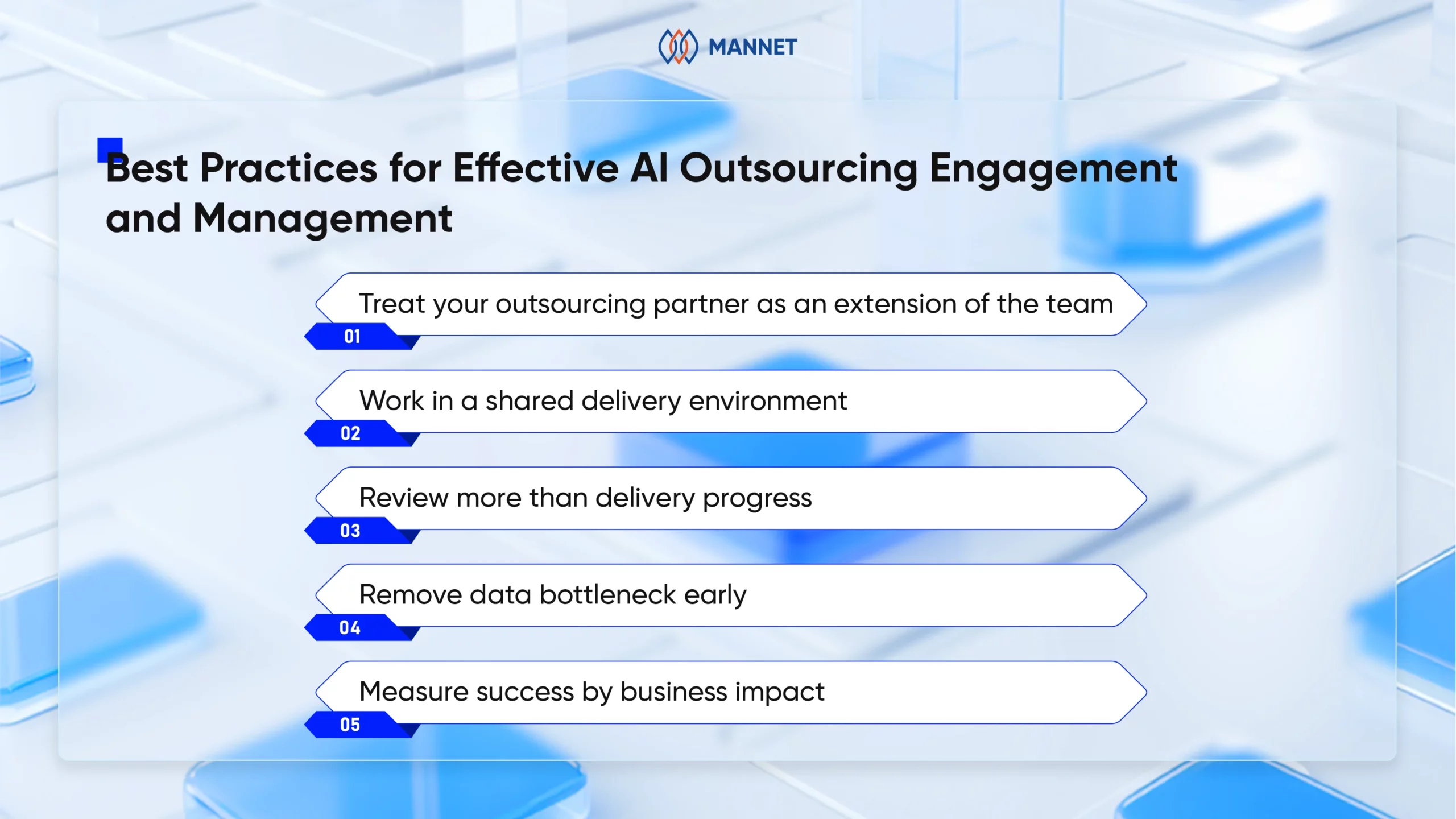
Best Practices for Effective AI Outsourcing Engagement and Management

Successful AI outsourcing extends beyond selecting the right partner and establishing a well-structured engagement model. Long-term outcomes are shaped by how internal and external teams collaborate throughout the delivery lifecycle. Organizations that consistently achieve successful AI implementations typically adopt operating practices that encourage transparency, shared ownership, and continuous alignment between business objectives and technical execution.

The following practices have become common among enterprises that successfully scale AI initiatives from pilot projects into production environments.

best practice how to choose ai outsourcing company

Treat your outsourcing partner as an extension of the team

The strongest AI outsourcing engagements operate as one integrated engineering organization with shared objectives, transparent communication, and collective ownership of delivery outcomes. External AI specialists should contribute to engineering discussions alongside internal teams instead of working as an isolated delivery function.

Embedding outsourced engineers into everyday workflows accelerates knowledge sharing, shortens feedback loops, and enables faster decision-making as business priorities evolve.

Teams that work as a unified organization typically achieve:

  • Faster engineering decisions through direct collaboration.
  • Greater knowledge sharing across internal and external teams.
  • Higher code quality through shared technical reviews.
  • Better continuity as projects scale or requirements change.

Recommended practices

  • Include outsourced engineers in sprint planning, backlog refinement, and retrospectives.
  • Invite them to architecture reviews and technical design discussions.
  • Define shared engineering goals and delivery KPIs across both teams.
  • Establish regular feedback sessions between internal leaders and external engineers.

Work in a shared delivery environment

Fragmented collaboration introduces unnecessary friction throughout the delivery lifecycle. Separate project management systems, documentation repositories, or communication channels often reduce visibility and slow decision-making.

A shared delivery environment creates a single source of truth for everyone involved, allowing engineering teams to collaborate more efficiently while maintaining transparency across the project.

A shared environment typically includes:

  • Project management(Jira, Azure DevOps, Linear)
  • Documentation(Confluence, Notion)
  • Source code repositories(GitHub, GitLab, Bitbucket)
  • Communication platforms(Slack, Microsoft Teams)
  • CI/CD pipelines and monitoring dashboards

Recommended practices

  • Use the same collaboration tools across internal and outsourced teams.
  • Maintain a single documentation repository for technical decisions.
  • Grant appropriate repository and dashboard access from the beginning of the engagement.
  • Standardize engineering workflows, coding guidelines, and release processes.

Review more than delivery progress

Sprint velocity and milestone completion provide useful delivery signals, but they represent only one dimension of an AI project’s health. Effective governance also evaluates technical performance, operational readiness, and business outcomes.

Executive reviews should regularly assess:

  • Model performance(accuracy, latency, drift)
  • Data quality and availability
  • Infrastructure stability
  • Security and compliance
  • User adoption and stakeholder feedback
  • Business KPIs and ROI

This broader perspective enables leadership teams to identify emerging risks early while ensuring technical execution remains aligned with business priorities.

Recommended practices

  • Schedule monthly governance reviews alongside sprint ceremonies.
  • Review business KPIs together with engineering metrics.
  • Track technical risks before they affect delivery timelines.
  • Adjust priorities based on evolving business objectives.

Remove data bottlenecks early

Many AI initiatives slow down long before model development begins. Data availability, quality, governance, and system integration frequently determine delivery speed more than algorithm selection.

Preparing data early helps engineering teams focus on solution development while reducing downstream delays.

Key areas to validate include:

  • Data availability
  • Data quality and consistency
  • Data ownership
  • Privacy and compliance requirements
  • Integration complexity

Recommended practices

  • Complete a structured data readiness assessment during Discovery.
  • Resolve data ownership questions before development begins.
  • Define governance and access policies early.
  • Prioritize production-quality datasets for model training.

Measure success by business impact

The value of AI outsourcing is ultimately measured through business outcomes. Technical excellence creates lasting impact when it contributes to operational efficiency, customer experience, revenue growth, or strategic decision-making.

Organizations should monitor a balanced set of technical and business indicators, including:

  • Productivity improvements
  • Cost reduction
  • Revenue growth
  • Customer satisfaction
  • Operational efficiency
  • Return on investment (ROI)

Aligning engineering metrics with business KPIs provides a clearer picture of long-term performance and helps guide future AI investment decisions.

Recommended practices

  • Define business KPIs before development begins.
  • Review business and engineering metrics together throughout the engagement.
  • Measure adoption alongside model performance.
  • Use outcomes to inform future AI roadmap decisions.

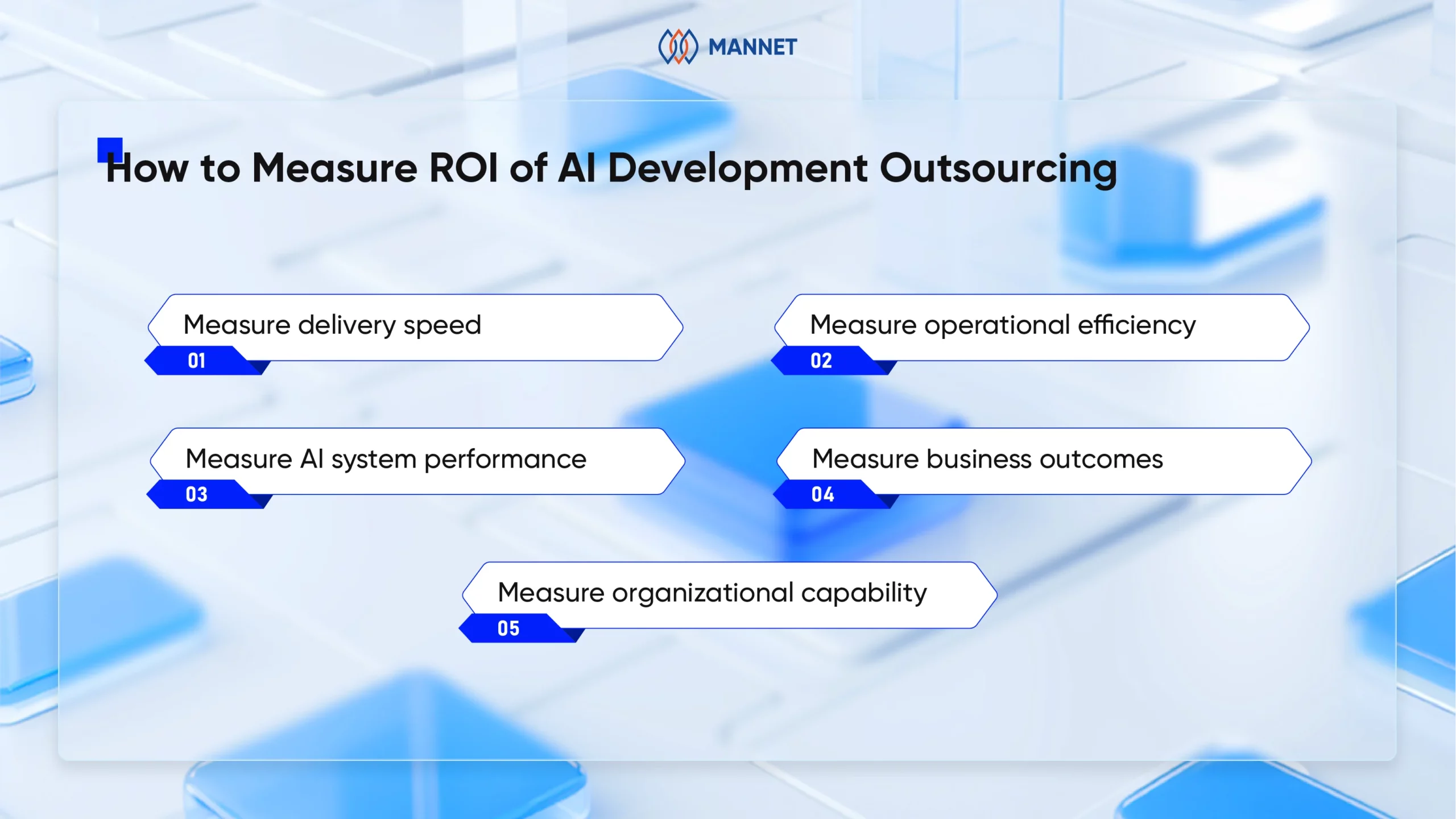
How to Measure ROI of AI Development Outsourcing

AI outsourcing delivers value across multiple dimensions, many of which extend beyond engineering productivity. While reduced development costs and faster hiring are common objectives, executive teams increasingly evaluate AI investments based on their contribution to business performance, operational efficiency, and long-term organizational capability.

Establishing ROI metrics before an engagement begins provides a common framework for business leaders, product owners, and engineering teams. It also enables organizations to measure progress consistently throughout the AI lifecycle instead of relying on delivery milestones alone.

A practical ROI framework typically combines five complementary perspectives.

measure roi of ai development outsourcing

Measure delivery speed

One of the most immediate benefits of AI outsourcing is accelerating access to specialized expertise. Instead of spending months recruiting scarce AI talent, organizations can rapidly expand engineering capacity and begin development sooner.

Key metrics include:

  • Time-to-hirefor AI specialists.
  • Time-to-project kickoff after resource approval.
  • Time-to-Proof of Concept (PoC).
  • Time-to-production deployment.
  • Release frequency for new AI capabilities.

Reducing delivery timelines enables organizations to validate ideas earlier, respond to market opportunities faster, and shorten the path from concept to business value.

Recommended practice

Benchmark project timelines before outsourcing begins and compare actual delivery performance against historical in-house projects wherever possible.

Measure operational efficiency

Many AI initiatives focus on improving internal processes by automating repetitive work, streamlining operations, or supporting employees with intelligent decision-making.

Typical performance indicators include:

  • Hours saved through automation.
  • Reduction in manual processing time.
  • Productivity improvements across business teams.
  • Lower operating costs.
  • Faster turnaround times for critical workflows.

These metrics help quantify efficiency gains while providing a clear baseline for future optimization initiatives.

Recommended practice

Measure operational performance before implementation to establish a reliable baseline. Comparing pre- and post-deployment metrics provides a more accurate view of AI’s contribution to business operations.

Measure AI system performance

Business value depends on AI systems performing reliably in production. Measuring technical performance helps ensure models continue meeting quality expectations as data, user behavior, and business requirements evolve.

Organizations commonly monitor:

  • Prediction accuracy.
  • Precision and recall.
  • Inference latency.
  • Model drift.
  • System availability and uptime.
  • Production incident rates.

These engineering metrics provide early signals when models require retraining, optimization, or infrastructure improvements.

Recommended practice

Review technical KPIs alongside business metrics instead of evaluating them independently. Strong model performance should translate into measurable business outcomes over time.

Measure business outcomes

AI initiatives ultimately support broader organizational goals. Measuring commercial and operational impact helps determine whether the investment contributes to strategic priorities.

Depending on the use case, organizations may track:

  • Revenue growth.
  • Customer satisfaction (CSAT or NPS).
  • Conversion rate improvements.
  • Reduced fraud losses or operational risk.
  • Customer retention.
  • Faster service delivery.
  • Employee satisfaction and adoption.

Business metrics provide the strongest evidence of long-term ROI and support future investment decisions across the AI portfolio.

Recommended practice

Define business KPIs during project planning and align them with executive reporting cycles so stakeholders can monitor value creation throughout the engagement.

Measure organizational capability

Successful AI outsourcing strengthens an organization’s ability to deliver future AI initiatives more efficiently. Beyond project-specific outcomes, many enterprises evaluate how outsourcing contributes to long-term capability building.

Useful indicators include:

  • Time required to launch subsequent AI initiatives.
  • Scalability of engineering capacity.
  • Growth in internal AI knowledge and technical maturity.
  • Effectiveness of knowledge transfer.
  • Ability to expand AI adoption across additional business functions.

Organizations that build reusable capabilities often achieve greater long-term returns than those measuring individual projects in isolation.

Recommended practice

Include capability-building objectives within the engagement plan, such as documentation standards, technical workshops, and structured knowledge transfer, to strengthen internal AI maturity over time.

A practical AI outsourcing ROI scorecard

Tracking a balanced combination of technical, operational, and business KPIs provides a more comprehensive view of AI outsourcing performance than relying on cost savings alone.

ROI dimension Representative KPIs
Delivery speed Time-to-hire, Time-to-PoC, Time-to-production, Release frequency
Operational efficiency Productivity gains, Hours saved, Cost reduction, Cycle time improvement
AI system performance Accuracy, Precision, Recall, Latency, Model drift, Uptime
Business outcomes Revenue growth, Conversion rate, Customer satisfaction, Risk reduction
Organizational capability Knowledge transfer, Team scalability, AI adoption, Internal capability growth

Organizations should select KPIs that reflect the objectives of each AI initiative rather than applying a single measurement framework across every project. For example, a customer service chatbot may prioritize resolution time and customer satisfaction, while a predictive maintenance solution may focus on equipment uptime and maintenance cost reduction.

Common Mistakes to Avoid when Choosing an AI Outsourcing Company

Choosing an AI outsourcing partner involves more than comparing technical capabilities or hourly rates. Many unsuccessful engagements can be traced back to decisions made before development even begins, during vendor selection, project planning, and governance design.

The following mistakes appear consistently across AI outsourcing engagements and often lead to longer delivery timelines, higher costs, and lower business value. Recognizing these risks early enables organizations to establish stronger partnerships and improve delivery outcomes from the outset.

common mistakes when choosing ai outsourcing company

Selecting a software vendor without proven AI delivery experience

Many software development companies now promote AI services, yet production AI requires capabilities that extend well beyond traditional application engineering. Expertise in machine learning, data engineering, MLOps, LLM deployment, and AI governance plays a significant role in determining whether an AI initiative successfully reaches production.

Potential impact

  • Longer experimentation cycles.
  • Technical rework during production.
  • Limited scalability.
  • Higher implementation risk.

How to avoid it

Evaluate evidence of production AI delivery, including deployed AI systems, engineering case studies, MLOps practices, and the technical backgrounds of delivery teams. A strong portfolio should demonstrate measurable business outcomes rather than prototype demonstrations alone.

Defining project scope before assessing data readiness

Organizations often invest significant effort into defining AI features while overlooking the condition of the underlying data. Data quality, accessibility, governance, and integration requirements frequently determine project timelines and model performance.

Potential impact

  • Delayed project delivery.
  • Reduced model accuracy.
  • Increased engineering effort.
  • Higher implementation costs.

How to avoid it

Include a structured data readiness assessment during Discovery. Confirm data availability, ownership, governance requirements, and integration complexity before committing to development timelines.

Prioritizing cost over long-term value

Lower hourly rates rarely translate into lower total project costs. Engineering quality, delivery efficiency, communication effectiveness, and operational maturity have a much greater influence on overall project success.

Potential impact

  • Higher maintenance costs.
  • Frequent rework.
  • Extended delivery schedules.
  • Lower return on investment.

How to avoid it

Evaluate providers using a balanced scorecard covering technical expertise, delivery maturity, communication, security, scalability, and long-term business value rather than pricing alone.

Treating the outsourcing team as an external vendor

AI initiatives depend on close collaboration between engineering, product, data, and business stakeholders. Limited communication and isolated delivery models often slow decision-making and reduce knowledge sharing.

Potential impact

  • Misaligned priorities.
  • Slower issue resolution.
  • Reduced engineering productivity.
  • Knowledge silos.

How to avoid it

Embed external engineers into existing engineering workflows, planning sessions, architecture discussions, and governance meetings to create a unified delivery organization.

Overlooking MLOps and post-deployment operations

Production deployment represents an important milestone, but long-term value depends on maintaining model performance after release. Monitoring, retraining, governance, and operational support should be planned from the beginning of the engagement.

Potential impact

  • Declining model performance.
  • Undetected model drift.
  • Increased operational risk.
  • Reduced business value over time.

How to avoid it

Assess the provider’s MLOps capabilities, including monitoring, automated deployment, model versioning, retraining workflows, and operational support processes before the engagement begins.

Measuring success only by delivery milestones

Completing development on schedule does not necessarily indicate project success. Executive teams ultimately evaluate AI initiatives based on measurable business outcomes.

Potential impact

  • Limited executive visibility.
  • Difficulty demonstrating ROI.
  • Misaligned investment priorities.
  • Reduced stakeholder confidence.

How to avoid it

Define business KPIs alongside technical metrics during project planning and review both throughout the engagement. Delivery progress, model performance, operational efficiency, and commercial outcomes should all contribute to project evaluation.

When to Outsource AI Development

AI outsourcing is most effective when it addresses a clearly defined business challenge rather than serving as a default resourcing strategy. While every organization’s AI roadmap is different, certain situations consistently benefit from external expertise, whether the priority is accelerating delivery, accessing specialized skills, or scaling successful initiatives.

Understanding these scenarios helps leadership teams determine when outsourcing can strengthen internal capabilities and create greater business value throughout the AI lifecycle.

when to outsource ai development

Lack of in-house AI expertise

Many organizations have mature software engineering teams but limited experience delivering production AI systems. Machine learning, Generative AI, MLOps, data engineering, and AI governance require specialized knowledge that differs significantly from traditional software development.

Developing these capabilities internally often involves substantial investment in recruitment, training, and experimentation. For organizations launching new AI initiatives, this learning curve can delay delivery and increase implementation risk.

AI outsourcing enables companies to supplement existing engineering teams with experienced specialists who bring established technical practices, production experience, and domain knowledge from previous AI implementations.

AI outsourcing is particularly valuable when projects require expertise in:

  • Machine Learning and Deep Learning
  • Generative AI and Large Language Models (LLMs)
  • Retrieval-Augmented Generation (RAG)
  • Data Engineering and Feature Engineering
  • MLOps and AI infrastructure
  • AI governance and model monitoring

Need faster time-to-market

For many organizations, the timing of an AI initiative is closely tied to business opportunity. Delays in assembling the right engineering team can postpone product launches, slow digital transformation programs, or allow competitors to establish an early advantage.

Recruiting experienced AI professionals often takes several months, particularly for senior or niche roles. AI outsourcing shortens this timeline by providing immediate access to engineering capacity that is already familiar with modern AI frameworks, cloud platforms, and production delivery practices.

Organizations commonly outsource AI development to accelerate:

  • Proof of Concept (PoC) delivery
  • Minimum Viable Product (MVP) development
  • Production AI implementation
  • AI feature releases within existing products
  • Enterprise AI transformation initiatives

When speed is a strategic priority, reducing team ramp-up time can be just as valuable as accelerating software development itself.

Temporary AI capability gaps

AI talent requirements often fluctuate throughout a project’s lifecycle. A team may need additional expertise during data preparation, model training, cloud deployment, or production rollout without requiring those resources permanently.

Rather than expanding long-term headcount for short-term demand, many organizations augment their internal teams with external AI specialists during critical delivery phases.

Typical situations include:

  • Supporting a high-priority product release
  • Implementing new AI technologies
  • Addressing short-term resource constraints
  • Providing specialist expertise for a specific workstream
  • Backfilling difficult-to-fill AI engineering roles

This flexible approach enables organizations to respond to changing project demands while maintaining strategic ownership of products, architecture, and technology decisions.

Scaling successful pilots

Proofs of Concept demonstrate technical feasibility, but enterprise adoption introduces an entirely different set of engineering challenges. Moving from a successful pilot to a production environment often requires stronger capabilities in infrastructure, security, monitoring, governance, integration, and operational support.

Many organizations discover that the team responsible for building a PoC does not necessarily possess the experience required to operate AI systems reliably at scale.

External AI engineering teams can help accelerate this transition by supporting:

  • Production-grade MLOps implementation
  • Cloud infrastructure and deployment automation
  • Enterprise system integration
  • Model monitoring and lifecycle management
  • Performance optimization and scalability

For organizations seeking to expand AI beyond experimentation, outsourcing can help bridge the gap between technical validation and sustainable production deployment.

Building new AI-powered products or business applications

AI is increasingly becoming a core component of digital products and enterprise software rather than a standalone innovation initiative. Whether developing AI copilots, intelligent document processing platforms, recommendation engines, or industry-specific business applications, organizations often need multidisciplinary expertise that extends beyond software engineering.

Successful AI product development typically combines expertise in machine learning, backend engineering, cloud infrastructure, data engineering, MLOps, user experience, and domain knowledge.

AI outsourcing allows organizations to assemble these capabilities more efficiently while allowing internal product teams to focus on roadmap execution, customer insights, and strategic product decisions.

Common examples include:

  • AI copilots and virtual assistants
  • Knowledge management and enterprise search platforms
  • Document intelligence solutions
  • Predictive analytics applications
  • Recommendation and personalization engines
  • Industry-specific AI software products

Optimizing overhead cost

Building an internal AI capability involves significantly more than hiring engineers. Recruitment, onboarding, technical training, infrastructure, management overhead, employee retention, and workforce planning all contribute to the total cost of ownership.

For organizations with evolving AI roadmaps, maintaining a permanently sized AI team may not always represent the most efficient use of resources. Outsourcing provides greater flexibility by allowing engineering capacity to scale alongside business demand while reducing fixed operational commitments.

Organizations frequently adopt outsourcing to:

  • Reduce recruitment and onboarding costs
  • Scale engineering teams according to project demand
  • Access specialized expertise without permanent hiring
  • Improve resource utilization across multiple initiatives
  • Increase budget predictability for AI programs

Evaluating AI investment through the lens of total cost of ownership (TCO) rather than salary alone provides a more accurate picture of long-term financial impact.

Key takeaway

The decision to outsource AI development should align with an organization’s business objectives, technical maturity, and delivery priorities. Companies often realize the greatest value when outsourcing provides capabilities that are difficult to build internally within the required timeframe, supports the transition from experimentation to production, or enables AI initiatives to scale without slowing broader business objectives.

As AI adoption continues to expand across industries, the most successful organizations increasingly combine internal strategic ownership with specialized external expertise, creating delivery models that balance speed, flexibility, and long-term capability building.

The Alternate Playbook: Retaining In-House Strategic Control with ManNet

For enterprises that prefer to retain full ownership of their proprietary codebases, core intellectual property (IP), and system architecture rather than offloading the entire execution lifecycle to a closed external vendor, project-based outsourcing may not be the optimal path.

ManNet’s specialized IT Staff Augmentation Services provide a highly flexible alternative. Instead of relinquishing control of the product roadmap, organizations can strategically inject the exact engineering resources required at each stage of the AI lifecycle:

  • Stuck on Stage 1 & 2? Inject a senior Data Scientist or Big Data Consultant through ManNet’s IT Recruitment Services and Executive Search solutions to audit corporate data landscapes, organize legacy structures, and build clean pipelines.
  • Ready for Stage 3? Instantly scale up the internal squad by choosing to hire AI & Machine Learning engineers from ManNet’s premium talent pool to code, train, and validate neural networks.
  • Prepping for Stage 4 & 5? Deploy specialized MLOps Engineers to build automated deployment pipelines and real-time monitoring infrastructure directly inside the organization’s native cloud environment using agile IT staff augmentation
  • Expanding Global Teams in Vietnam?Leverage ManNet’s Employer of Record (EOR) services and Build-Operate-Transfer (BOT) support to seamlessly manage local payroll, labor compliance, and offshore subsidiary setup under a unified provider.

Through this hybrid talent strategy, organizations secure elite Vietnamese technical velocity, optimize engineering budgets, and accelerate development speed while maintaining 100% internal control over their strategic technical assets.

How ManNet Approaches AI Talent Sourcing for AI-Driven Organizations

Most enterprise tech buyers evaluating AI outsourcing in Vietnam focus on three core metrics: specialized technical skill, deployment speed, and financial risk mitigation.

Unlike traditional software development vendors competing for broad project budgets, ManNet operates as a pure talent architecture layer. The company’s core mission is to inject the precise engineering resources needed to accelerate development, whether those professionals operate within an in-house corporate team or alongside an external vendor.

Talent deployment velocity

Traditional recruitment cycles for specialized tech roles in Southeast Asia often exceed 45 days. ManNet compresses this pipeline via strict Service Level Agreements (SLAs):

  • 4 Working Hours: Completion of comprehensive technical requirements analysis.
  • 3-5 Business Days: Delivery of a curated, pre-vetted specialist shortlist.
  • 7 Calendar Days: Deployment of a complete, cross-functional engineering team.

This velocity advantage directly prevents roadmaps from stalling and eliminates the heavy opportunity costs associated with vacant engineering seats.

Full-stack AI engineering bench

Deploying production-grade artificial intelligence requires a multi-disciplinary tech squad. ManNet provides instant access to a vetted network of 10,000+ IT professionals, allowing organizations to seamlessly:

  • Hire machine learning engineers to architect and train complex neural networks.
  • Deploy Data Engineers to clean raw databases and build secure pipelines.
  • Embed MLOps Specialists to manage containerization, scaling, and real-time drift telemetry.
  • Integrate QA Automation Engineers to validate system outputs before live deployment.

Flexible managed staffing models

ManNet offers agile engagement structures designed to scale smoothly alongside an organization’s specific technical maturity curve:

  • IT recruitment & direct hire: Tailored for companies looking to permanently fill local technical roles without building an in-house recruitment pipeline from scratch.
  • IT staff augmentation: Ideal for tech leaders needing to rapidly inject engineering capacity into specific sprints without increasing fixed headcount overhead.
  • EOR & BOT subsidiary setup: A comprehensive, integrated blueprint covering local payroll, legal compliance, and operational setup for global enterprises building permanent offshore development centers in Vietnam.

Algorithmic vetting & risk mitigation

To protect software roadmaps from early candidate attrition and slow hiring cycles, ManNet provides a dual-layer safety net:

  • Passive candidate sourcing: Utilizing AI-powered ATS infrastructure to mine GitHub and LinkedIn data, capturing high-performing passive talent unavailable on standard job boards.
  • 60-day performance guarantee: Providing a complimentary candidate replacement or a 50% fee deduction if an embedded engineer fails to meet organizational performance standards within the first two months.

FAQs About Choosing an AI Outsourcing Company

1. How long does it typically take to onboard an AI outsourcing team?

The onboarding timeline depends on the engagement model, project complexity, and required skill sets. For AI staff augmentation, experienced engineers can often join an existing team within a few weeks. Larger dedicated teams or project-based engagements may require additional time for discovery, technical alignment, and knowledge transfer before development begins.

2. What roles are typically included in an AI outsourcing team?

AI outsourcing teams vary by project, but they commonly include AI/ML Engineers, Data Engineers, MLOps Engineers, Backend Engineers, Cloud Engineers, QA Engineers, and Technical Project Managers. Enterprise initiatives may also involve Solution Architects, Data Scientists, AI Consultants, or Domain Experts depending on business requirements.

3. Can an AI outsourcing partner work with an existing in-house engineering team?

Yes. Many organizations adopt a hybrid delivery model where internal teams retain ownership of product strategy, architecture, and business priorities while external AI specialists contribute technical expertise and additional engineering capacity. This collaborative approach often accelerates delivery while preserving strategic control.

4. How can companies protect intellectual property (IP) when outsourcing AI development?

Protecting IP starts with clear contractual agreements covering ownership, confidentiality, and data governance. Organizations should also evaluate a partner’s security certifications, access controls, secure development practices, and compliance processes to ensure sensitive data, proprietary models, and source code remain protected throughout the engagement.

5. What engagement model is best for AI outsourcing projects?

The most suitable model depends on business objectives, internal capabilities, and project scope. AI staff augmentation is often ideal for extending existing engineering teams, dedicated development teams support long-term product development, while project-based outsourcing works well for clearly defined AI initiatives with fixed deliverables. Many organizations combine these models as their AI strategy evolves.

Final Verdict: Choosing the Right AI Outsourcing Company in Vietnam

There is no one-size-fits-all model for AI outsourcing in Vietnam. The optimal strategic choice depends entirely on how much ownership an organization requires over its technical infrastructure, product roadmap, and core intellectual property (IP).

The ManNet distinction: Why retain control?

For fast-moving tech organizations that refuse to lock themselves into rigid external vendor contracts or give up absolute ownership of their codebases, standard project-based outsourcing introduces unnecessary risks.

ManNet offers the ultimate hybrid approach. By separating execution capacity from headcount overhead, the company enables organizations to keep their core strategy in-house while instantly scaling up engineering velocity. Whether a business needs to hire machine learning engineers for a single project milestone, leverage flexible IT staff augmentation services for rapid development sprints, or utilize compliant Employer of Record (EOR) models to build a permanent tech hub in Vietnam, ManNet handles the operational heavy lifting under one roof.
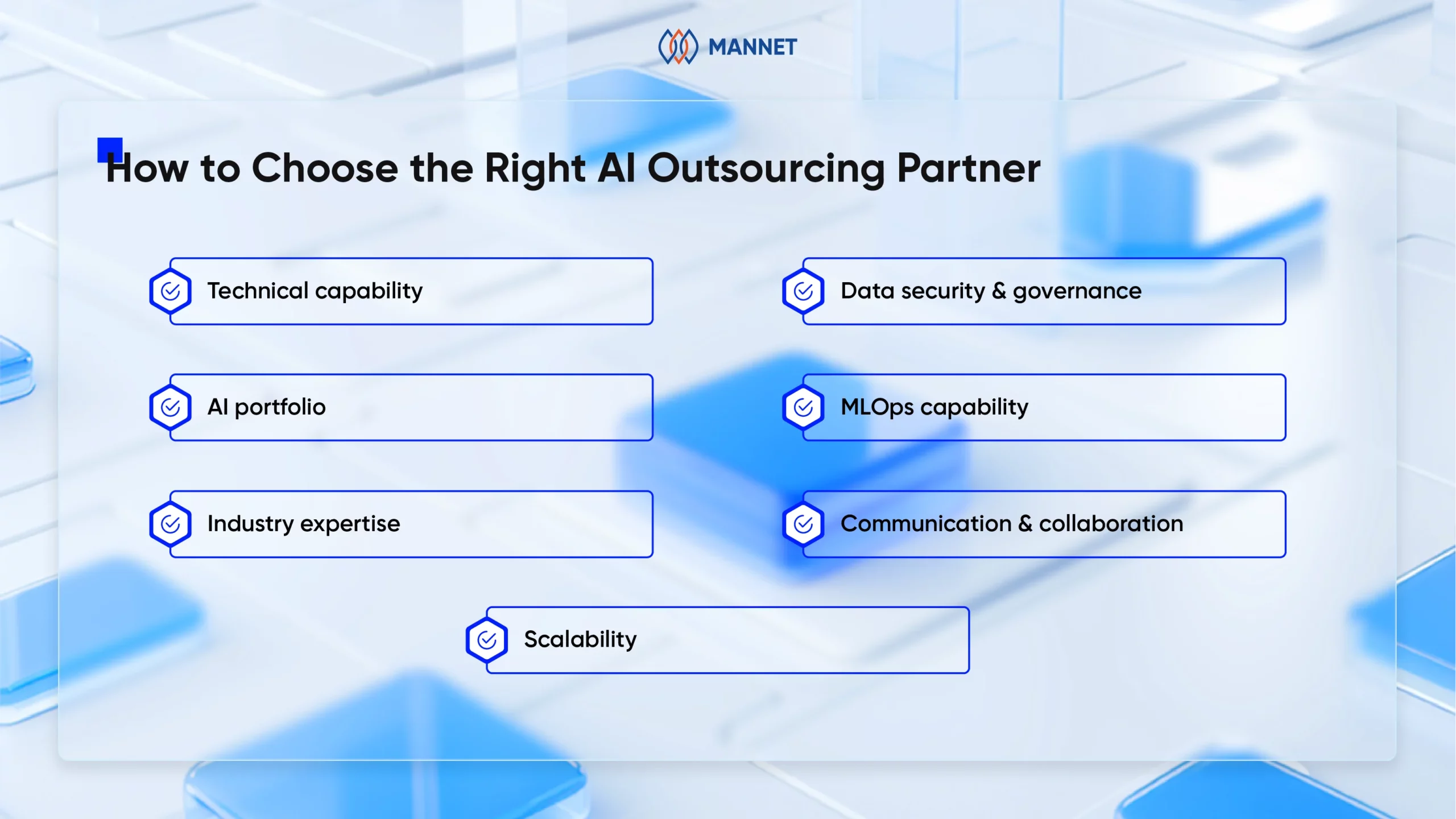
how to choose ai outsourcing company cta

EOR vs PEO: How to Choose the Right Workforce Model

Hiring across borders has become a strategic advantage, but it also introduces complex challenges around employment laws, payroll, tax compliance, and HR administration. To simplify global hiring, many organizations turn to either an Employer of Record (EOR) or a Professional Employer Organization (PEO).

While both support workforce management, they serve different business needs and legal structures. Choosing the wrong model can create unnecessary compliance risks and operational complexity.

This guide breaks down exactly how EOR vs PEO differ, when each model makes strategic sense, how to choose the right structure for where your business is headed, and which providers are leading the market in 2026 and beyond.

Let’s dive in!

Understanding the PEO Model: Your Co-Employer in the Domestic Arena

A Professional Employer Organization (PEO) functions as a co-employer. When you bring a PEO on board, you enter into a contractual co-employment arrangement: the PEO takes on administrative HR responsibilities while you retain full control over day-to-day operations, hiring decisions, and performance management.

Under this model, the PEO runs payroll under its own federal employer identification number, sponsors group health insurance and benefits, files employment taxes, and manages workers’ compensation. Because PEOs aggregate employees across multiple client companies, they can negotiate group-level rates on benefits that most small to mid-sized businesses simply can’t access independently.

The PEO model is particularly well-suited for organizations that:

  • Already hold a legal entity in the country or state where they’re hiring
  • Want to extend their HR capabilities without building a full in-house HR department
  • Are focused on domestic or regional hiring and long-term workforce development
  • Have between 5 and 150 employees and need a structured HR infrastructure at scale

According to the National Association of Professional Employer Organizations (NAPEO), businesses using PEOs grow 7 to 9% faster and experience 10 to 14% lower employee turnover than their peers. However, a PEO comes with one non-negotiable prerequisite: your business must be legally registered as an entity in the location where you want to hire.

Understanding the EOR Model: Your Legal Employer in Every New Market

An Employer of Record (EOR) takes the concept a step further and in an entirely different direction. Rather than sharing employment responsibilities, an EOR becomes the full legal employer of your workforce in jurisdictions where your business has no entity.

The EOR signs employment contracts directly with workers, processes payroll under its own local entity, handles statutory contributions and tax compliance, and assumes complete legal liability for employment-related obligations. Your organization retains operational control – you direct work, set goals, manage performance – but the EOR handles every layer of the formal employer-employee relationship in that jurisdiction.

This is the core of the EOR value proposition: you can hire in Germany, Vietnam, Brazil, or Singapore without establishing a local subsidiary, navigating foreign business registration, or waiting out the 2 to 4 months that entity setup typically requires. An EOR can have a fully compliant employee onboarded in as little as two days.

EOR services are typically the right fit for organizations that:

  • Want to hire internationally without setting up local entities
  • Are testing a new market before committing to a long-term operational footprint
  • Need to move quickly on a specific hire without the overhead of entity establishment
  • Operate distributed or remote-first teams across multiple countries simultaneously
  • Want to transfer compliance risk entirely to a specialist provider

EOR vs. PEO: A Side-by-Side Breakdown

The table below maps out how EOR and PEO compare across the dimensions that matter most in strategic workforce decisions:

Criteria PEO EOR Best for
Legal structure Co-employment Sole legal employer EOR: full liability transfer
Entity requirement Required Not required EOR: borderless hiring
Geographic scope Domestic/single country Global, multi-country EOR: international expansion
Compliance risk Shared with client Fully borne by EOR EOR: risk mitigation
Speed to hire Moderate Days (not months) EOR: rapid market entry
HR services depth Broad (benefits, wellness, L&D) Narrower but specialized PEO: domestic HR depth
Cost model 2–12% payroll or $40–$200/emp/mo $300–$800+/emp/mo PEO: cost-effective domestically
Ideal company size 5–150 employees Any size EOR: flexible at all stages
Employee benefits pool Large group access Statutory + market-based PEO: pooled domestic benefits
Transition flexibility Long-term commitment Can exit when the entity is set up EOR: market testing

EOR vs. PEO: Key Differences

eor vs peo key differences

Legal employer status: The defining line

This is the cornerstone distinction. With a PEO, your company remains the legal employer – the PEO co-employs your staff and shares administrative responsibility, but you retain legal standing and shared compliance liability. With an EOR, the provider steps in as the sole legal employer. Employment contracts are drawn up between the EOR and the worker. Legal risk is transferred, not shared.

Entity requirements: The expansion enabler

A PEO requires you to already have a registered legal entity in the country or state where you plan to hire. An EOR operates through its own local entities, meaning you can hire in a new market without first going through the costly, time-consuming process of business registration. Conversely, if your company already holds a functioning legal entity in a foreign market, it generally cannot use an EOR for local hires.

Geographic reach: Domestic depth vs. Global breadth

PEOs are optimized for domestic or single-country operations. Their strength lies in building a robust HR infrastructure within an established market. Some providers market themselves as ‘global PEOs,’ but if they still require entity setup before hiring, they are functioning in practice as a PEO, not an EOR. EORs, on the other hand, are architected for borderless hiring, leading providers operate across 150 to 200+ countries.

Compliance risk distribution

Under a co-employment (PEO) arrangement, your company and the PEO share liability. If a compliance issue surfaces, for example, a misclassification, a late tax filing, or a breach of local labor regulations, both parties carry exposure. With an EOR, liability shifts almost entirely to the provider. Because the EOR is the employer of record, it bears the weight of payroll accuracy, tax compliance, statutory benefits, and adherence to local employment law.

Speed and flexibility

Time-to-hire is where EORs decisively pull ahead. Setting up a legal entity abroad typically takes two to four months. An EOR, armed with its own in-country entities and compliance infrastructure, can onboard a new hire in days. This speed advantage makes EORs particularly attractive for IT and technology companies that need to move fast on talent, before a candidate accepts another offer or a competitor establishes a regional presence first.

Cost Comparison: Breaking Down the Price of Each Model

Surface-level pricing comparisons between EOR and PEO can be misleading. A monthly per-employee fee rarely tells the whole story. To make an informed financial decision, organizations need to account for direct fees, entity-related costs, and the cost of compliance risk, all of which behave very differently across the two models.

eor vs peo comparison factor

EOR pricing models

EOR providers generally use one of three pricing structures:

  • Fixed monthly fee per employee: The most common model, with fees typically ranging from $199 to $800+ per employee per month, depending on the country, seniority level, and provider. This structure offers predictable budgeting and is straightforward to model as teams scale.
  • Percentage of salary: Some EOR providers charge a percentage of the employee’s gross salary – typically between 10% and 20% – rather than a flat fee. This model can become expensive for senior or highly compensated hires.
  • Hybrid or tiered pricing: Certain platforms combine a lower base fee with add-ons for benefits administration, immigration support, or equity management, offering flexibility but requiring careful review of the total cost package.

For reference, leading EOR platforms in 2026 are priced roughly as follows: RemoFirst from $199/month, Multiplier from $400/month, Deel and Oyster from $599/month, Papaya Global from $650 to $800/month, and enterprise-grade providers like G-P and Velocity Global on custom quotes. These figures are per employee, per month, before statutory employer contributions, which the EOR also calculates and manages on your behalf.

PEO pricing models

PEO pricing typically takes one of two forms:

  • Percentage of payroll: Ranging from 2% to 12% of total payroll, this model scales with wage growth and headcount. It can become more expensive as salaries increase, though it often includes a broader suite of HR services at no additional cost.
  • Per-employee, per-month flat fee: Providers like Justworks offer flat pricing starting from $49 per employee per month – a model that simplifies budgeting and works well for smaller, fast-growing teams. ADP TotalSource prices at approximately 4% of payroll, while Insperity ranges from 5% to 9%, depending on the service tier selected.

PEO pricing looks attractively lower than EOR pricing until the full picture is accounted for.

Cost comparison factors

When organizations weigh up the real cost of each model, several factors shift the balance significantly:

Entity setup costs

Establishing a legal entity in a foreign country typically costs between $10,000 and $50,000 per market. And that’s before ongoing maintenance, local legal counsel, annual filings, and banking infrastructure. These costs are absent from the EOR model, since the provider’s entity absorbs them.

Entity maintenance overhead

Once established, a foreign entity carries continuous costs, such as local accountants, tax filings, regulatory reporting, registered agent fees, and compliance monitoring. For organizations with one to ten employees in a given country, these costs can easily dwarf the EOR’s monthly fee.

Speed-related costs

Every week that an entity’s setup delays a hire is a week of lost productivity. For IT companies filling specialist technical roles, the cost of a delayed hire, measured in project delays, contract penalties, or lost candidate momentum, often exceeds several months of EOR fees.

Compliance penalty risk

With a PEO, your organization retains partial liability for compliance errors. In jurisdictions with strict enforcement – as is increasingly the case across Europe, Latin America, and Southeast Asia – a single misclassification or payroll error can trigger penalties that far exceed the difference in service pricing.

Benefits of economies of scale

PEOs often provide access to pooled benefits packages at group rates, which can be genuinely lower than what a small company would secure independently. EOR benefits are typically statutory plus market-rate additions, which may or may not match pooled pricing depending on the country.

EOR vs PEO pricing: Comparison table

Cost Factor EOR PEO
Base fee per employee $300-$800+/month $40-$200/month or 2-12% of payroll
Entity setup cost None (provider’s entity) $10,000-$50,000+ per country if needed
Entity maintenance None Ongoing legal, tax, and admin costs
Speed to first payroll 2-5 business days 2-4 weeks (domestic) / months (new country)
Compliance penalty risk Absorbed by EOR Shared – client retains partial exposure
Benefits negotiation leverage Market-based, per country Group pooling – often lower domestic rates
True total cost (new country) Typically lower when entity avoided Higher once entity setup & maintenance factored in

EOR vs. PEO cost structure comparison. Entity-related costs can substantially alter the true cost of the PEO model in new markets.

Which model is more cost-effective?

The answer is context-dependent, but the logic is consistent: a PEO is more cost-effective when you already have a legal entity in the target market and are managing a domestically established team. An EOR is more cost-effective when entering a new market, testing a country before committing to a permanent presence, or hiring fewer than 10 to 15 employees in a jurisdiction where entity setup costs would be disproportionate.

Industry data supports this conclusion. When entity setup and maintenance costs are factored into the total cost of ownership, EOR services regularly come out as the more financially sound option for initial market entry – even with a higher monthly per-employee fee. Many organizations find that they break even against entity costs only once they reach 15 to 25 employees in a single country and are confident in a long-term local presence. Below that threshold, the EOR model almost always wins on a total-cost basis.

When to Use a PEO vs. When to Use an EOR

When a PEO makes strategic sense

The PEO model delivers maximum value under specific conditions. If your business is established, operating within one or two known markets, and looking to strengthen its domestic HR function without building an entire internal department, a PEO is likely the sharper tool.

  • You have a legal entity and an established workforce in the country of hire
  • You want Fortune 500-level benefits packages for a sub-150 headcount
  • You need a consistent HR infrastructure across multiple domestic states or regions
  • You’re focused on long-term workforce retention, employee development, and culture-building
  • You want to extend your internal HR capacity, not replace it

When an EOR makes strategic sense

The EOR model is purpose-built for a specific challenge: hiring where you don’t yet have a legal footprint.

  • You want to tap into a new country’s talent market without committing to a full entity setup
  • You need to onboard a specific hire quickly, in days, not months
  • You’re running a distributed or remote-first team across multiple countries
  • You want to test a new geographic market before making a long-term operational commitment
  • You need to transfer employment compliance risk entirely to a specialist provider
  • You’re scaling an IT or technology team across Asia-Pacific, Europe, or emerging markets

Transitioning Between EOR and PEO Models

Many companies don’t remain on a single model indefinitely. As business presence matures in a given market, the workforce model that made sense at entry may not be the right fit for the long term. Understanding how and when to transition between EOR and PEO is an important part of a comprehensive global HR strategy.

Why companies transition from EOR to PEO

The most common transition direction is from EOR to PEO, and it typically happens for one of three reasons:

Why Companies Transition from EOR to PEO

Scale threshold reached

Once a company crosses approximately 10 to 15 employees in a single country and has confidence in its long-term market commitment, the economics often shift in favor of establishing a local entity and moving to a PEO arrangement. At this headcount, the monthly EOR fee per employee begins to exceed the amortized cost of entity maintenance.

Desire for deeper domestic HR integration

As local teams grow, companies frequently want more comprehensive HR services – for example, workforce planning, local benefits customization, employee development programs, and culture-building initiatives – that PEOs are better positioned to deliver than EOR providers.

Local entity already established

Once a company sets up its own legal entity in a country (often to access local contracts, open bank accounts, or satisfy client requirements), the rationale for an EOR largely disappears. At that point, a PEO becomes a more natural co-employer partner.

The reverse transition – from PEO to EOR – is less common but occurs when companies expand globally beyond markets where they hold entities. Organizations already running a domestic PEO often layer in an EOR for their international hires, arriving at the hybrid model discussed later in this guide.

The transition process

Switching between EOR and PEO models is operationally manageable when planned carefully. Industry data suggests that a well-executed transition typically takes two to four weeks end-to-end. The key steps involve:

eor vs peo the transition process

Reviewing and exiting existing HR agreements

Whether transitioning away from an EOR or a PEO, the outgoing arrangement must be formally terminated with appropriate notice periods and clearance of outstanding payroll and benefit obligations.

Guaranteeing employment documentation continuity

All employment contracts, benefit enrollments, and statutory documentation must be transferred or reissued under the new provider’s structure. Employees should receive clear communication throughout to minimize disruption to their day-to-day experience.

Coordinating payroll cutover

The timing of the payroll transition requires careful coordination to avoid gaps in payment or duplicate deductions. Payroll continuity, including maintaining wage base calculations for tax purposes, must be preserved across the changeover.

Legal entity setup (if transitioning to a PEO)

If the transition involves establishing a new local entity, this process must be completed before the PEO arrangement can go live. Working with a specialist who can manage entity formation in parallel with the EOR wind-down significantly compresses the overall timeline.

When implemented well, transitions are largely seamless from the employee’s perspective. In many cases, the change is experienced positively – as an improvement in benefits access, HR service quality, or platform usability – rather than as a source of disruption.

The Hybrid Approach: When One Model Isn’t Enough

Many mature organizations find that neither model alone covers their full workforce footprint. It’s increasingly common for businesses to run a PEO for their domestic workforce and an EOR for international hires simultaneously. This hybrid approach allows companies to benefit from the PEO’s domestic HR depth – richer benefits, stronger cultural integration, broader employee wellness programs – while leveraging the EOR’s global reach to hire compliantly in markets where they don’t hold entities.

As organizations grow and establish entities in previously foreign markets, they can transition workers from an EOR arrangement to their own local entity or a domestic PEO – a natural evolution that the best providers are designed to support without friction.

Relevance for IT Talent Acquisition and Staff Augmentation

For technology companies and IT-focused organizations, the EOR vs. PEO decision carries added significance. The global competition for skilled developers, data engineers, cybersecurity professionals, and cloud architects is intense – and the best candidates don’t always sit in the same jurisdiction as your headquarters.

IT staffing firms and companies engaged in staff augmentation need an employment infrastructure that can keep pace with the talent market. When a client urgently needs a senior backend engineer onboarded in Poland or a DevOps specialist brought on in the Philippines, a two-month entity setup process is a non-starter. An EOR bridges that gap, enabling talent-first decisions without compliance second-guessing.

At the same time, organizations building domestic IT teams at scale benefit from the PEO’s ability to offer competitive benefits packages, thereby leveling the playing field against larger employers. The key is matching the employment model to the operational reality: EOR for fast, compliant global hiring; PEO for optimized domestic workforce management; and a hybrid structure when both are needed simultaneously.

Top EOR Providers in Vietnam

Vietnam has emerged as one of Southeast Asia’s most compelling hiring destinations – particularly for technology, manufacturing, and business services talent. With FDI into Vietnam reaching $36.6 billion in 2024 (a 32% year-on-year increase), demand for compliant, entity-free hiring solutions has grown sharply. EOR pricing in Vietnam typically ranges from $250 to $599 per employee per month, depending on the provider’s model and service scope.

For a deeper dive into provider comparisons, local pricing benchmarks, and what to look for when evaluating an EOR partner specifically for the Vietnamese market, refer to ManNet’s full resource: Best Employer of Record (EOR) Companies in Vietnam | 2026 Updated.

EOR vs PEO: Choosing the Right Model (Decision Framework)

Rather than defaulting to one model based on familiarity, organizations benefit from working through a structured set of questions:

Do you have a registered legal entity in the country where you plan to hire?

If yes, consider a PEO. If not, an EOR is the appropriate route.

Are you hiring in one market or across multiple countries simultaneously?

Multi-country expansion strongly favors an EOR.

How much compliance risk are you willing to retain?

If full liability transfer is a priority, choose an EOR. If shared responsibility is acceptable, a PEO may suffice.

How quickly do you need the hire in place?

For time-sensitive onboarding, EOR wins decisively on speed.

What is your long-term footprint strategy?

If you plan to establish a permanent entity, consider starting with an EOR and transitioning once the entity is active. If your market presence is established and indefinite, a PEO provides more durable HR depth.

What are your headcount projections in the target market?

Under 10 to 15 employees: EOR typically wins on total cost. Above 15 employees with long-term commitment: entity + PEO usually becomes more economical.

FAQs About EOR vs PEO

1. Can a company switch from an EOR to a PEO later?

Yes. Many companies begin with an EOR when entering a new market and transition to a PEO after establishing a local legal entity. The timing depends on hiring volume, long-term expansion plans, and operational requirements.

2. Is an EOR or PEO better for hiring remote employees internationally?

For companies without a legal entity in the target country, an Employer of Record (EOR) is generally the more suitable option because it can legally employ workers on the company’s behalf. A PEO typically requires the company to already have a registered local entity.

3. Who owns the employment relationship under an EOR and a PEO?

With an EOR, the provider is the legal employer while the client company manages the employee’s day-to-day responsibilities. Under a PEO model, employment responsibilities are shared through a co-employment arrangement, and the client company remains the legal employer.

4. What types of companies benefit most from EOR services?

EOR services are commonly used by startups, scale-ups, and multinational companies that want to hire employees quickly in new markets without establishing a local legal entity. They are particularly valuable for testing new markets, building distributed teams, and accelerating international expansion.

5. How do I choose the right EOR or PEO provider?

Evaluate providers based on their geographic coverage, compliance expertise, payroll accuracy, employee support, pricing transparency, security standards, and experience supporting companies of similar size and industry. The best provider should align with both current hiring needs and long-term global workforce strategy.

Final Verdict: Why Choose ManNet as Your Organization’s Recruiting Agency

At ManNet, we turn hiring into a strategic lever for growth. With deep expertise across IT recruitment, staff augmentation, and HR consulting, we help businesses make the right workforce decisions from the start, especially when navigating EOR vs. PEO.

From entering Vietnam without a legal entity to scaling teams under pressure, we design employment models that balance speed, compliance, and long-term sustainability. Our strength lies in combining local regulatory insight with a clear understanding of your business and talent strategy.

Whether your company is making the first hire or building for scale, ManNet supports the decisions that define how your organization grows – and how fast it gets there.

Explore more: https://www.mannet.tech/eor-services-in-vietnam/

eor vs peo

Top 12 AI Outsourcing Companies in Vietnam | 2026 Updated

Vietnam has quietly turned into one of the most credible destinations in Asia for AI outsourcing. The country now ranks among the world’s leading markets for offshore services, its IT outsourcing industry continues to grow at a double-digit pace, and its engineering workforce has evolved beyond general software delivery into specialized expertise in machine learning, computer vision, and generative AI.

For international businesses, that shift raises a practical question: which of the many AI outsourcing companies in Vietnam is actually worth a serious look, and how do you distinguish a genuine AI specialist from a software vendor that simply added “AI” to its service list?

This 2026 guide compares the top AI outsourcing companies in Vietnam, what they specialize in, who they serve best, and how to choose the right engagement model for your company’s AI initiatives.

Let’s dive in!

Selection Method for Leading AI Outsourcing Companies in Vietnam in 2026

The providers featured in this list were evaluated against the factors that most directly determine whether an AI outsourcing engagement in Vietnam actually delivers results.

  • AI expertise over general IT capabilities: Priority was given to companies with proven delivery experience in machine learning, NLP, computer vision, MLOps, and generative AI, rather than vendors that list AI as one of many generic services.
  • Engineering capabilities and technical infrastructure: We assessed the depth of AI engineering teams, dedicated AI labs or R&D capabilities, and expertise with modern AI technologies, including LLM APIs, vector databases, and cloud ML platforms.
  • Proven delivery track record: Evaluation considered documented AI projects, client portfolio, industry experience, and third-party credibility signals such as Clutch and GoodFirms reviews.
  • Flexible engagement models: Preference was given to providers that support multiple delivery models, including end-to-end AI development, project-based delivery, dedicated teams, and staff augmentation, to accommodate different business needs.
  • Security, compliance, and data governance: Because AI projects often involve sensitive data, we prioritized providers with mature security practices, recognized compliance standards, and experience serving regulated industries.
  • AI talent strength: Finally, we considered each company’s ability to attract, develop, and retain AI engineers in Vietnam’s highly competitive talent market, where experienced AI specialists remain in limited supply.

Top 12 AI Outsourcing Companies in Vietnam (2026)

1. ManNet – Human Network

Overview

ManNet occupies a highly unique position on this list compared to every other entry. While the majority of AI outsourcing firms in Vietnam operate as project-based, end-to-end vendors, where organizations hand over a project brief and receive a finished system, ManNet serves as the critical talent architecture layer across the technology ecosystem. Instead of competing as a software development house, the company specializes in sourcing, vetting, and embedding top-tier machine learning engineers, data scientists, MLOps specialists, and AI-capable developers. These engineering resources directly power in-house corporate labs and high-scale outsourced initiatives alike.

As a specialized subsidiary of LTS Group (established in 2016), ManNet focuses exclusively on IT and AI talent acquisition, managed staffing, and workforce expansion for international enterprises building advanced engineering capabilities in Vietnam. For organizations that demand absolute ownership of their AI roadmap, proprietary codebases, and architectural decisions – but require immediate, high-velocity execution capacity – this strategic distinction is paramount.

Why ManNet stands out

  • The talent infrastructure: Rather than executing one-off projects, ManNet builds the underlying team infrastructure, enabling enterprise clients to maintain full technical control and eliminate long-term vendor lock-in.
  • Ecosystem leverage: Backed by LTS Group’s robust technology ecosystem, ManNet has immediate access to deeply vetted, global-ready tech talent pools.
  • Flexible workforce scaling: Organizations can scale their AI engineering squads up or down via agile staff augmentation or build dedicated delivery centers tailored to dynamic development sprints.

Key information

Core services

ManNet provides an end-to-end talent and operational infrastructure designed for agile international scaling:

  • AI & IT staff augmentation: Deploying on-demand technical resources directly into existing client workflows.
  • IT recruitment & executive search: Dedicated talent acquisition for high-tier engineering, data science, and leadership roles.
  • Employer of record (EOR) services: Seamless local employment and payroll management without the immediate need for a local legal entity.
  • HR consulting & workforce expansion: Strategic guidance on market entry, labor compliance, and talent retention.
  • Build-operate-transfer (BOT) support: Assisting global enterprises in establishing, scaling, and eventually transferring ownership of dedicated offshore development centers.

Key strengths & operational metrics

  • The talent ecosystem: Immediate access to a rigorously vetted network of 10,000+ IT professionals specializing in high-demand domains, including Backend, AI/ML, Data Engineering, DevOps, and Quality Assurance (QA) from mid-level to niche expert tiers.
  • Rapid deployment SLAs: Comprehensive requirements analysis completed within 4 working hours, with personalized specialist shortlists delivered in 3-5 business days, and complete dedicated team deployment achieved within 7 days.
  • Risk mitigation guarantee: A robust 60-day replacement guarantee guaranteeing a complimentary profile replacement or a 50% fee deduction if an embedded engineer fails to align with performance expectations within the initial two months.
  • Next-gen sourcing infrastructure: Utilization of AI-powered Applicant Tracking Systems (ATS) and specialized GitHub/LinkedIn data mining to identify, engage, and secure passive, hard-to-reach AI talent.
  • Comprehensive lifecycle delivery: A unified provider covering the entire talent pipeline, allowing organizations to seamlessly hire software developers and QA engineers while anchoring full compliance and localized administrative support under one roof.
  • Global credibility integration: Backed by the cross-border footprint of LTS Group, leveraging international networks across Japan, the United States, and South Korea to ensure compliance and global delivery standards.

Ideal use cases & strategic fit

ManNet serves as the primary operational partner for specific organizational milestones:

  • In-house team expansion: Designed for enterprises that prioritize absolute ownership of their AI strategy, architecture, and Intellectual Property (IP) over project-based outsourcing, but lack immediate execution capacity.
  • Vendor augmentation: Ideal for companies already engaged with an AI vendor that require immediate, specialized ML or data engineering talent to fill sudden capability gaps.
  • Market entry optimization: Tailored for international organizations entering the Vietnamese tech hub for the first time, requiring an integrated partner to manage recruitment, EOR, and localized HR operations.
  • Velocity acceleration: Built for leadership teams that require rapid AI hiring velocity and cannot afford the multi-month timelines associated with building local recruitment capabilities from scratch.

Best for

Organizations that demand strategic control over their AI roadmap and intellectual property, but require fast, compliant, and highly reliable access to vetted Vietnamese engineering talent, whether through agile staff augmentation, direct-hire placement, or full subsidiary setup.

2. FPT Software

Overview

FPT Software stands as Vietnam’s largest IT services corporation by both revenue and headcount, maintaining an extensive global footprint across more than 30 countries. As the flagship subsidiary of FPT Corporation, the company operates FPT.AI as its dedicated artificial intelligence division. This specialized branch engineers enterprise-grade solutions in conversational AI, computer vision, intelligent document processing (IDP), and robotic process automation (RPA), while actively deploying advanced agentic AI architectures and large language model (LLM) integrations for Fortune 500 clients. To anchor its technical leadership, the organization has established a dedicated AI Research Hub, leveraging hundreds of in-house AI specialists and PhD-level researchers as part of its long-term infrastructure investment.

Key Information

Core services

FPT Software delivers end-to-end, project-based technology solutions and enterprise modernization blueprints:

  • End-to-end AI & machine learning development: Custom engineering of AI systems, predictive analytics models, and advanced machine learning algorithms from conceptual design to production.
  • Generative AI & LLM integration: Architecting and tuning large language models (LLMs) and agentic AI systems tailored for enterprise workflows and secure knowledge bases.
  • Conversational AI & intelligent automation: Deploying production-ready virtual assistants, smart chatbots, and robotic process automation (RPA) to streamline corporate operations.
  • Digital transformation & legacy modernization: Full-scale migration of legacy infrastructures to modern cloud architectures, data platforms, and secure enterprise ecosystems.
  • Managed IT services & global delivery: Offering fully outsourced IT maintenance, application management, and global support desk operations around the clock.

Key strengths & operational metrics

  • Unmatched delivery scale: Seamless global execution capabilities backed by an extensive offshore and nearshore delivery network spanning Japan, the United States, Europe, and the APAC region.
  • Proprietary AI product suite: A mature, production-ready ecosystem via FPT.AI, delivering high-accuracy conversational interfaces, speech recognition, and advanced document automation workflows.
  • Global market recognition: Consistently recognized in prestigious industry assessments, including IDC MarketScape and Gartner, for its robust AI-enabled services and execution reliability.
  • Deep domain expertise: Extensive legacy experience in managing complex technical integrations across heavily regulated sectors, including Telecommunications, Banking & Financial Services (BFSI), Automotive, Manufacturing, and Healthcare.

Ideal use cases & strategic fit

FPT Software serves as the primary operational partner for specific organizational milestones:

  • End-to-end system development: Designed for enterprises looking to outsource entire complex AI systems, where the vendor owns the product delivery from initial brief to deployment and maintenance.
  • Global digital transformation: Tailored for multinational corporations requiring a vendor with massive infrastructure to handle multi-year migration, modernization, and automation blueprints.
  • Cross-border resource consolidation: Built for leadership teams that need a single, highly certified partner capable of deploying large, multi-disciplinary tech squads across various international time zones simultaneously.

Best for

Large global enterprises and conglomerates that require a single, globally scaled technology partner capable of architecting, implementing, and running highly complex, multi-year AI initiatives and comprehensive digital transformation programs.

3. TMA Solutions

Overview

TMA Solutions stands as one of Vietnam’s longest-running and most established software engineering corporations. Founded in 1997, the company operates with a large-scale workforce of thousands of engineers across a global office network spanning Vietnam, Canada, the United States, Australia, Japan, and Germany. Anchored by nearly a decade of dedicated internal R&D, the organization commands a specialized AI Center and an innovative AI Agent Factory. These divisions house hundreds of AI engineers who design and deploy production-grade solutions in generative AI, autonomous agentic AI architectures, computer vision, and advanced predictive analytics. TMA’s enterprise delivery is structurally backed by ten specialized technology centers across the corporate group.

Key information

Core services

TMA Solutions provides comprehensive, engineering-focused software outsourcing and vertical-specific AI integration:

  • Generative AI & autonomous agent deployment: Constructing production-ready AI agents and custom large language model (LLM) ecosystems tailored via the TMA AI Agent Factory.
  • Predictive analytics & computer vision: Engineering machine learning models for predictive forecasting, predictive maintenance, complex object recognition, and real-time video analytics.
  • Full-cycle software engineering & outsourcing: Delivering end-to-end product development, application modernization, and system integration across diverse technology stacks.
  • Enterprise tech center setup: Establishing dedicated offshore development centers (ODCs) backed by specialized technology focus areas (e.g., IoT, Automotive, Cloud).
  • Data engineering & BI solutions: Designing scalable data pipelines, data warehouses, and business intelligence reporting architectures for large enterprise operations.

Key strengths & operational metrics

  • Pre-built AI infrastructure: Accelerating time-to-market with a catalog of 100+ pre-built AI solutions and components developed within the AI Agent Factory.
  • Three decades of legacy: An exceptional 29-year operational history characterized by deep institutional stability and highly sustained, multi-year enterprise client partnerships.
  • Deep regulated domain expertise: Superior engineering depth within highly complex, compliance-heavy verticals, including Telecommunications, Healthcare, FinTech, and Automotive systems.
  • Elite quality certifications: Operating under highly rigorous international standards, including CMMI Level 5 compliance and ISO 27001 information security management systems.

Ideal use cases & strategic fit

TMA Solutions serves as the primary operational partner for specific organizational milestones:

  • Accelerated AI prototyping: Designed for enterprises looking to leverage pre-existing, mature AI frameworks and blueprints to rapidly launch enterprise-grade AI applications.
  • High-compliance software engineering: Tailored for organizations in heavily regulated industries that mandate the highest level of software process maturity (CMMI Level 5) and security adherence.
  • Long-term capital upgrades: Built for leadership teams requiring a stable, financially robust offshore partner capable of sustaining large engineering operations over decades.

Best for

Enterprise buyers in telecommunications, healthcare, fintech, and other highly regulated industries that require a long-established technology partner with verified domain depth, extreme process maturity, and large-scale global delivery capacity.

4. KMS Technology

Overview

KMS Technology operates as a prominent US – and Vietnam-based technology corporation engineered around a distinct product-centric mindset rather than a traditional project-staffing model. Maintaining state-of-the-art software development hubs in Ho Chi Minh City and Da Nang, the organization anchors its AI capabilities around end-to-end, AI-native product engineering. Instead of treating artificial intelligence as a superficial, bolt-on feature, KMS specializes in embedding intelligent architectures directly into the core fabric of software applications. With a robust track record serving international clients across FinTech, Healthcare, and SaaS verticals, the company pairs its AI implementation with legacy strengths in high-velocity software testing and quality engineering.

Key information

  • Headquarters: Atlanta, USA (Vietnam Delivery Centers in Ho Chi Minh City and Da Nang)
  • Website: kms-technology.com

Core services

KMS Technology delivers specialized AI-native engineering and product modernization solutions:

  • AI-native product engineering: Designing and constructing specialized software architectures built from the ground up to support and scale artificial intelligence workloads.
  • SaaS solution modernization: Infusing advanced AI/ML capabilities, automated decision-making engines, and predictive features into enterprise SaaS platforms.
  • Next-gen software testing & quality engineering: Utilizing AI-driven automation frameworks, continuous testing pipelines, and rigid QA protocols to ensure application reliability.
  • FinTech & health tech architecture development: Building secure, compliant, and data-intensive software products tailored to standard industry regulations.
  • Product strategy & consulting: Partnering with leadership teams to define minimum viable products (MVPs), software roadmaps, and technical scale architectures.

Key strengths & operational metrics

  • SaaS product mindset: Exceptionally suited for growth-oriented companies building high-scale Commercial SaaS products rather than simple, static internal automation tools.
  • Unified engineering & QA discipline: Superior synergy between high-end AI development and enterprise-grade software testing, ensuring production-ready code with minimal technical debt.
  • Dual-market leadership structure: Seamless operational alignment combining US-based strategic management and compliance with the deep engineering velocity of Vietnam’s top tech talent.
  • Domain security architecture: Mature experience in handling data-sensitive, tightly regulated integrations within the global financial and medical sectors.

Ideal use cases & strategic fit

KMS Technology serves as the primary operational partner for specific organizational milestones:

  • Commercial SaaS scaling: Designed for software companies needing to quickly integrate AI modules into their commercial platforms without disrupting existing user bases.
  • High-stakes quality assurance: Tailored for technical teams requiring a vendor that can take full responsibility for complex code testing, automated compliance, and systemic validation.
  • US-compliant offshoring: Built for North American leadership teams that demand localized account management, synchronous communication, and absolute compliance with Western business standards.

Best for

Software product firms and SaaS companies that require a sophisticated AI development partner capable of blending rigorous engineering mechanics and strict QA disciplines directly into the AI deployment layer.

5. Rikkeisoft

Overview

Rikkeisoft, established in 2012, has architected one of Vietnam’s most visible and dedicated AI practices through its specialized R&D subsidiary, Rikkei AI. Operating with a substantial engineering workforce, the corporation holds an exceptionally dominant position in the Japanese technology outsourcing sector while steadily expanding its North American footprint. Rikkeisoft layers advanced artificial intelligence competencies, including generative AI, computer vision, and specialized voice recognition technologies – directly on top of its extensive core IT outsourcing, Business Process Outsourcing (BPO), and digital transformation infrastructures. The organization serves as a trusted modernization partner for premier Vietnamese conglomerates and national enterprises, including Viettel, VNPT, and Vingroup.

Key information

Core services

Rikkeisoft delivers applied AI solutions alongside large-scale software engineering and operational framework support:

  • Applied AI research & development: Engineering custom algorithms, specialized computer vision systems, and autonomous industrial AI applications developed through Rikkei AI.
  • Voice AI & language processing: Designing high-accuracy speech synthesis and localized natural language processing (NLP) models optimized for enterprise communication channels.
  • Generative AI implementation: Deploying corporate large language model (LLM) integrations, automated data extraction tools, and cognitive workplace assistants.
  • Full-scale software outsourcing: Delivering comprehensive web, mobile, and cloud application development backed by massive offshore production delivery capacity.
  • Business process outsourcing (BPO): Integrating smart automation and data management frameworks into high-volume corporate backend workflows.

Key strengths & operational metrics

  • Dedicated AI R&D core: Unlike generalist development shops, the organization possesses a specialized tech ecosystem division (Rikkei AI) purely focused on custom AI product engineering and innovation.
  • Elite Japan-market alignment: Deep institutional alignment, language fluency, and culturally synchronized delivery models tailored perfectly to the strict standards of the Japanese corporate market.
  • Multimodal technology coverage: Balanced expertise across text, vision, and voice AI domains, enabling comprehensive omnichannel solutions for enterprise buyers.
  • Agile, cost-efficient delivery: A highly competitive, optimized resource allocation structure that consistently yields fast-turnaround deployment cycles without sacrificing software stability.

Ideal use cases & strategic fit

Rikkeisoft serves as the primary operational partner for specific organizational milestones:

  • Japan-centric cross-border initiatives: Designed for organizations operating within or entering the Japanese economic sphere that require high-caliber, bilingual software engineering talent.
  • Multimodal solution engineering: Tailored for enterprises needing an AI partner capable of handling combined audio, visual, and textual data layers under a unified architecture.
  • Legacy system automation: Built for large-scale operations looking to inject smart AI automation into heavy legacy setups and high-volume business processes.

Best for

Companies, particularly those with a strategic focus on the Japanese market, demand an AI engineering partner that is structurally backed by a dedicated R&D subsidiary rather than a generalist IT development team treating AI as a secondary business line.

6. NTQ Solution

Overview

NTQ Solution, initiated in 2011 by five visionary founders, has evolved into a formidable global IT service provider and digital transformation partner. Headquartered in Hanoi, the corporation maintains a robust multi-national presence with strategically positioned branches in Japan, South Korea, Germany, Hong Kong, and the United States. NTQ Solution systematically anchors its engineering capabilities around the intersection of artificial intelligence, machine learning, the Internet of Things (IoT), and global SAP services. Operating across more than 20 countries, the company is highly recognized for its holistic methodology: embedding advanced AI capabilities and intelligent automation frameworks directly into comprehensive enterprise digitization blueprints rather than positioning artificial intelligence as an isolated, standalone offering.

Key information

Core services

NTQ Solution provides integrated digital transformation, smart automation, and enterprise ecosystem modernization:

  • Enterprise AI & machine learning integration: Injecting cognitive algorithms and predictive automation modules into complex, pre-existing corporate software architectures.
  • IoT & intelligent edge development: Building smart, interconnected hardware-software networks that leverage embedded AI to process real-time data at the edge.
  • SAP consulting & modernization: Optimizing enterprise resource planning (ERP) workflows by layering artificial intelligence onto standard SAP deployments.
  • Full-cycle digital transformation: Architecting comprehensive legacy modernization plans, cloud migrations, and cloud-native application development.
  • Cross-border application engineering: Developing high-availability web, mobile, and enterprise platforms tailored to diverse global market compliance standards.

Key strengths & operational metrics

  • Global delivery footprint: Seamless project execution and localized support across key international tech hubs, including Japan, South Korea, Western Europe, and North America.
  • Synergistic technology deployment: Exceptional capability to blend AI and machine learning with complex IoT and legacy enterprise systems under a single, unified architecture.
  • Proven enterprise reliability: A highly sustainable corporate track record backed by a portfolio of 760+ successfully delivered projects and trusted relationships with 350+ global enterprises.
  • Multi-language engineering depth: Strong technical command and cultural literacy required to execute complex, cross-border software initiatives requiring multi-language delivery.

Ideal use cases & strategic fit

NTQ Solution serves as the primary operational partner for specific organizational milestones:

  • AI-Infused industrial IoT: Designed for manufacturing, logistics, or infrastructure firms that require a vendor capable of connecting physical IoT devices with smart AI backend analytics.
  • Intelligent ERP modernization: Tailored for corporations seeking to upgrade their operational efficiency by embedding machine learning into their core SAP or internal data ecosystems.
  • Global ecosystem engineering: Built for enterprise leadership teams requiring a vendor with certified regional branches to maintain synchronous collaboration across multiple continents.

Best for

Medium to large enterprises executing broad digital transformation initiatives that require specialized AI capabilities smoothly woven into a larger SAP, IoT, or complex enterprise software program.

7. Savvycom

Overview

Savvycom, established in 2009 and headquartered in Hanoi, has strategically engineered its brand identity as a dedicated “AI-driven solution partner” rather than a generalist software outsourcing vendor. With over a decade and a half of operational delivery experience, the corporation is recognized as one of Vietnam’s premier digital technology companies.

Savvycom systematically applies advanced artificial intelligence across corporate automation, data analytics, and intelligent decision-support frameworks. Operating primarily within the Banking, Financial Services & Insurance (BFSI), Healthcare, Logistics, and Construction verticals, the company is highly regarded for its consultative, solution-led methodology – architecting technological roadmaps that originate from core business challenges rather than rigid, pre-defined technical specifications.

Key information

Core services

Savvycom delivers consultative AI implementation and domain-specific software ecosystem development:

  • Consultative AI strategy & architecture: Partnering with enterprise leadership to identify, evaluate, and design high-impact AI use cases aligned with core business objectives.
  • Intelligent data analytics & business intelligence: Engineering data science models and cognitive analytics platforms to drive predictive insights and automated decision-making.
  • FinTech & BFSI software engineering: Developing highly secure, compliant, and AI-infused digital banking, micro-finance, and algorithmic financial applications.
  • Smart logistics & construction automation: Constructing custom supply chain optimization algorithms, fleet tracking infrastructure, and AI-driven resource planning tools.
  • Custom enterprise application modernization: Upgrading legacy internal corporate platforms into scalable, cloud-native, and automated digital systems.

Key strengths & operational metrics

  • Pre-engineered AI frameworks: Accelerating project delivery and optimizing budgets via a mature catalog of 50+ AI-ready solution templates and pre-built operational modules.
  • High senior engineering ratio: Maintaining superior software delivery quality, with nearly 50% of the technical workforce composed of senior-level developers and technical architects.
  • Solution-led consultative model: Utilizing a sophisticated discovery process that guides non-technical enterprise buyers through the entire AI integration lifecycle from strategy to deployment.
  • Multi-vertical project footprint: A highly diversified and proven deployment portfolio across tightly regulated industries, demonstrating versatile engineering adaptable to complex sector rules.

Ideal use cases & strategic fit

Savvycom serves as the primary operational partner for specific organizational milestones:

  • Strategic AI discovery & prototyping: Designed for growing businesses requiring deep consulting to map out their data landscapes and validate AI use cases before investing in full-scale builds.
  • High-seniority resource sourcing: Tailored for organizations looking for a vendor with a high density of senior engineering talent to handle complex software system integrations without basic execution errors.
  • FinTech & supply chain optimization: Built for enterprise tech leaders in finance or logistics seeking an established partner with specialized experience in data security, predictive workflows, and automated compliance.

Best for

Mid-market organizations and rapidly growing businesses that require a highly consultative, solution-led partner capable of defining the right AI business case and technical architecture before committing capital to a complete system build.

8. Saigon Technology

Overview

Saigon Technology stands as an elite, ISO-certified software engineering corporation based in Ho Chi Minh City, maintaining a strong market reputation built on an unyielding adherence to Agile methodology. With over a decade of operational delivery experience and a workforce of several hundred highly skilled engineers distributed across multiple advanced development centers, the company has smoothly scaled its core software practice.

Today, it stands as a premier hub for custom artificial intelligence implementation, high-tier data analytics, and machine learning model integration. Serving an international clientele across North America, Europe, Australia, and Asia, Saigon Technology is recognized as a Microsoft Gold Partner, backed by strict compliance with world-class international standards for quality and information security.

Key information

Core services

Saigon Technology provides Agile-driven, enterprise-grade AI integration and dedicated software product development:

  • Custom AI & machine learning integration: Engineering bespoke predictive modeling, natural language processing (NLP), and neural network integrations into existing application ecosystems.
  • Agile software product engineering: Designing and scaling high-availability cloud-native, web, and mobile software applications from concept to production.
  • Big data & advanced analytics architecture: Constructing robust data pipelines, analytics engines, and business intelligence frameworks to process complex data layers.
  • Dedicated agile software teams: Providing single-client, cross-functional engineering squads tailored to seamlessly align with internal client development processes.
  • Cloud & DevOps modernization: Optimizing infrastructure efficiency, CI/CD automation, and secure enterprise migrations as an official Microsoft Gold Partner.

Key strengths & operational metrics

  • Rigorous agile governance: Exceptional delivery discipline powered by dedicated, single-client engineering teams that guarantee transparent sprint cycles, high adaptability, and absolute code clarity.
  • Microsoft Gold & Multi-ISO certification: Operating with verified compliance under ISO/IEC 27001 (Information Security Management) and ISO 9001 (Quality Management) global standards, alongside direct Microsoft engineering validation.
  • Mature custom engineering layer: AI implementation is not run as an isolated experiment but is structurally integrated into a mature, battle-tested software engineering framework.
  • High-transparency communication: Consistently cited in international client feedback for elite technical communication, seamless time-zone synchronization, and reliable product delivery.

Ideal use cases & strategic fit

Saigon Technology serves as the primary operational partner for specific organizational milestones:

  • High-process AI application builds: Designed for businesses requiring AI features built with the exact same architectural rigor, security standards, and process controls as mission-critical enterprise software.
  • Dedicated team co-sourcing: Tailored for international CTOs wanting a dedicated, long-term offshore software engineering squad that easily syncs with internal Scrum or Kanban workflows.
  • Regulated market software delivery: Built for enterprise leadership teams in Western markets that mandate strict data security governance, compliance with Western compliance models, and certified vendor security frameworks.

Best for

International businesses and enterprise tech buyers that demand AI capability delivered with the exact same rigor, predictability, and process discipline as a highly mature, custom software development engagement.

9. Axon Active

Overview

Axon Active operates as a premium, Swiss-owned software engineering corporation maintaining an extensive delivery infrastructure across Ho Chi Minh City, Da Nang, and Can Tho, alongside its corporate group headquarters in Lucerne, Switzerland. The company’s unique operational model seamlessly pairs Western European project management governance with the high-velocity technical capabilities of Vietnam’s engineering talent. This highly synchronized structure provides international clients with deep offshore cost efficiencies while eliminating the operational friction typically associated with cross-border development.

Axon Active’s specialized artificial intelligence practice centers on high-impact applied machine learning, including intelligent recommendation engines and advanced predictive analytics – delivered through a highly disciplined, sprint-based Agile methodology.

Key information

Core services

Axon Active delivers European-standard Agile software development and compliance-conscious AI integrations:

  • Applied machine learning & recommendation systems: Engineering custom predictive modeling algorithms, content recommendation architectures, and behavior analytics engines.
  • Agile software engineering (dedicated teams): Constructing fully cross-functional offshore development centers (ODCs) tailored to serve as long-term, direct extensions of client teams.
  • Compliance-driven data engineering: Designing robust data pipelines and processing frameworks that adhere to strict international data privacy and residency requirements.
  • Enterprise mobile & cloud application development: Crafting high-availability, scalable software products optimized for modern enterprise cloud environments.
  • Scrum-based agile consulting: Assisting international organizations in adopting, scaling, and optimizing mature Agile methodologies across their development workflows.

Key strengths & operational metrics

  • Swiss-standard project governance: Direct European leadership and project management principles integrated across all Vietnamese offshore delivery centers, ensuring total alignment with Western business standards.
  • Audit-ready AI implementation: Advanced AI-augmented development practices anchored by explicit technical governance, ensuring absolute transparency, traceability, and code auditability.
  • Deep GDPR & data privacy expertise: Exceptional structural familiarity with GDPR regulations and tight compliance models, critical for AI systems processing sensitive or personally identifiable information (PII).
  • Premium technical credentials: Long-standing status as a Microsoft Gold Partner combined with strict adherence to ISO 27001 information security management systems.

Ideal use cases & strategic fit

Axon Active serves as the primary operational partner for specific organizational milestones:

  • Euro-centric offshore development: Designed for European enterprises, specifically within the DACH region (Germany, Austria, Switzerland), that require synchronous, localized account management paired with offshore delivery.
  • Regulated market data processing: Tailored for organizations building AI tools within high-compliance frameworks where security audits, data segregation, and European privacy laws are mandatory.
  • Long-term agile team scaling: Built for engineering leaders who want a highly stable partner to establish dedicated software squads that operate under pure, uncompromised Scrum frameworks.

Best for

European corporations and compliance-focused enterprises that require highly secure, GDPR-conscious AI system development structurally managed under a reliable, Western-style project management framework.

10. Techvify

Overview

Techvify stands as one of the most dynamic and fast-growing entrants on this list. Founded in 2018, the corporation has rapidly scaled into a self-described “AI-powered enterprise engineering partner,” strategically reinvesting a substantial share of its gross profit directly back into internal AI research and development. Techvify systematically constructs its core service offerings around custom AI models, corporate copilots, and autonomous AI agents, seamlessly blending these technologies with enterprise cloud architectures, data engineering pipelines, and IoT ecosystems.

Operating with high-caliber delivery teams in Hanoi and Da Nang, alongside a dedicated regional office in Japan, Techvify differentiates itself by embedding highly specialized, AI-augmented engineering squads directly alongside client staff to accelerate product delivery while maintaining absolute quality governance.

Key information

  • Headquarters: Hanoi, Vietnam (with regional offices in Japan and delivery centers across Vietnam)
  • Website: techvify-software.com 

Core services

Techvify delivers AI-first engineering solutions and integrated, high-velocity technology deployment:

  • Custom AI model & agent development: Engineering bespoke machine learning models, domain-specific corporate copilots, and autonomous agentic AI workflows tailored for enterprise productivity.
  • AI-augmented engineering teams: Deploying integrated, cross-functional developer squads equipped with cutting-edge AI development tools to boost sprint velocity.
  • Enterprise cloud & data engineering: Designing scalable cloud infrastructures, modern data warehouses, and secure data orchestration pipelines to power advanced analytics engines.
  • Next-gen IoT system integration: Constructing smart, interconnected IoT networks backed by intelligent backend data processing and automation layers.
  • Full-cycle custom software engineering: Providing end-to-end web, mobile, and enterprise architecture development optimized for high-growth tech ecosystems.

Key strengths & operational metrics

  • AI-first corporate strategy: A clear, modern positioning anchored by continuous, aggressive reinvestment into applied AI research, ensuring early adoption of emerging software engineering paradigms.
  • Native AI service lines: Unlike legacy software firms that treat artificial intelligence as an incremental add-on, Techvify treats custom LLM configurations and autonomous agents as native core service lines.
  • Rigorous international compliance: Strict data handling, storage, and processing practices built to align with global regulatory frameworks, including GDPR, HIPAA, and ISO standards.
  • High-velocity engineering bench: A rapidly expanding, agile technical workforce with a deep cultural focus on technology adoption, rapid onboarding, and fast-turnaround sprint execution.

Ideal use cases & strategic fit

Techvify serves as the primary operational partner for specific organizational milestones:

  • Direct roadmap acceleration: Designed for fast-moving businesses that need to seamlessly inject a highly capable, AI-proficient technical squad into an existing product development pipeline.
  • HIPAA/GDPR-compliant AI builds: Tailored for organizations in the healthcare, finance, or international SaaS sectors that require strict, certified compliance parameters for training data and custom LLM deployments.
  • Emerging tech adoption sprints: Built for tech leaders looking to rapidly build prototypes, custom AI copilots, or specialized automated workflows using the latest industry frameworks.

Best for

Fast-moving enterprises and agile technology organizations that want to embed an AI-augmented engineering team directly into their existing product roadmap, rather than handing off a standalone project to an isolated external vendor.

How AI Outsourcing Works in Vietnam: A Strategic Step-by-Step Framework

how ai outsourcing works in Vietnam

While operational workflows adapt to the selected engagement model, a mature AI outsourcing lifecycle in Vietnam systematically unfolds across five clear-cut architectural stages.

For enterprise tech buyers and engineering leaders, understanding these micro-steps is critical to ensuring project predictability, managing cloud budgets, and preventing technical debt.

Stage 1: Use case definition & feasibility scoping

This initial phase isolates the core business bottleneck and audits the organization’s existing data infrastructure before writing any production code. Skipping this diagnostic phase is the primary reason why entry-level AI initiatives stall during late-stage development.

Step 1.1: Business logic mapping

Aligning strategic organizational goals with concrete machine learning capabilities. This involves converting a high-level business objective, such as “reducing customer churn”, into an automated predictive churn scoring model with defined performance benchmarks.

Step 1.2: Data maturity audit

Assisting technical teams in assessing historical logging, data volume, accessibility, and feature richness. This step verifies whether the internal data pipeline contains enough quality variables to effectively train a high-accuracy model.

Step 1.3: ROI & compute cost modeling

Estimating upfront engineering development capital against long-term operational computing costs (such as cloud infrastructure fees and GPU tokens) to calculate the true lifecycle ROI of the AI asset.

Technical output for stage 1:

  • A finalized Product Requirement Document (PRD),
  • A verified technical feasibility report,
  • A signed-off project roadmap.

Stage 2: Data preparation & infrastructure architecture planning

Because AI systems are entirely dependent on the quality of the data feeding them, this stage establishes the data pipeline, sanitization protocols, and the primary cloud infrastructure layout.

Step 2.1: Data ingestion & sanitization

Extracting raw data pools from disparate siloed corporate databases, removing duplicates, handling missing values, and executing secure data labeling workflows.

Step 2.2: Infrastructure mapping

Selecting the optimal target deployment environment, whether AWS, Google Cloud Platform (GCP), Microsoft Azure, or a Hybrid Cloud setup, and mapping out secure API connection points.

Step 2.3: Security & compliance setup

Structuring role-based data access control and encryption protocols to ensure the training data environments strictly align with global regulations like GDPR or HIPAA.

Technical output for stage 2: 

  • A cleaned, structured, production-ready training dataset,
  • An approved cloud architecture schematic.

Stage 3: Model development & iterative training lifecycle

Unlike traditional, deterministic software engineering, AI and machine learning development is fundamentally probabilistic. It relies on a continuous loop of testing, validation, and architectural refinement.

Step 3.1: Baseline model selection

Evaluating and testing pre-trained open-source frameworks (such as Llama or BERT) versus architecting custom neural network topologies tailored to the company’s specific proprietary data.

Step 3.2: Hyperparameter tuning

Running iterative training cycles on the processed dataset while constantly adjusting internal mathematical configurations to boost model accuracy and reduce classification errors.

Step 3.3: Bias & error mitigation

Validating the trained model against isolated test data pools to eliminate overfitting, ensure generalizability, and verify equitable automated decision-making.

Technical output for stage 3:

  • A trained, high-accuracy machine learning model weight repository,
  • Validated technical performance metrics.

Stage 4: Production deployment & MLOps infrastructure integration

Migrating a machine learning model out of an experimental research sandbox into a live production system requires strict engineering governance to handle real-world user traffic and high-concurrency requests.

Step 4.1: Model containerization

Packaging the trained model, software dependencies, and code runtimes into lightweight containers using tools like Docker, then orchestrating servers via Kubernetes for automated microservice scaling.

Step 4.2: CI/CD pipeline automation

Setting up automated Continuous Integration and Continuous Deployment (CI/CD) pipelines specifically tailored to handle automated machine learning testing and deployment scripts.

Step 4.3: Real-time drift monitoring

Deploying telemetry and data observability tools to actively watch for “data drift” or “concept drift” – which occurs when real-world user behavior shifts away from what the model was originally trained on.

Technical Output for Stage 4:

A live, scalable API endpoint running in the corporate production environment backed by automated system telemetry logging.

Stage 5: Continuous optimization & lifecycle support

Enterprise AI assets are highly dynamic. They require continuous post-launch maintenance, tuning, and monitoring to protect model accuracy and drive compounding business value over time.

Step 5.1: Feedback loop integration

Establishing automated engineering pipelines that continuously capture production edge-cases, anomalous inputs, and user feedback, feeding them safely back into the secure data storage layer.

Step 5.2: Periodic model retraining

Scheduling regular automated model updates and training intervals using the newly acquired real-world production data to actively combat natural model performance degradation.

Step 5.3: Feature set expansion

Layering new functionalities, connecting additional enterprise data streams, or integrating newly released foundational models into the architecture as the business scales.

Technical output for stage 5: 

A self-improving, secure enterprise AI engine that continuously adapts to changing market inputs and customer behavior.

The Alternate Playbook: Retaining In-House Strategic Control with ManNet

For enterprises that prefer to retain full ownership of their proprietary codebases, core intellectual property (IP), and system architecture rather than offloading the entire execution lifecycle to a closed external vendor, project-based outsourcing may not be the optimal path.

ManNet’s specialized IT Staff Augmentation Services provide a highly flexible alternative. Instead of relinquishing control of the product roadmap, organizations can strategically inject the exact engineering resources required at each stage of the AI lifecycle:

  • Stuck on Stage 1 & 2? Inject a senior Data Scientist or Big Data Consultant through ManNet’s IT Recruitment Services and Executive Search solutions to audit corporate data landscapes, organize legacy structures, and build clean pipelines.
  • Ready for Stage 3? Instantly scale up the internal squad by choosing to hire AI & Machine Learning engineers from ManNet’s premium talent pool to code, train, and validate neural networks.
  • Prepping for Stage 4 & 5? Deploy specialized MLOps Engineers to build automated deployment pipelines and real-time monitoring infrastructure directly inside the organization’s native cloud environment using agile IT staff augmentation
  • Expanding Global Teams in Vietnam?Leverage ManNet’s Employer of Record (EOR) services and Build-Operate-Transfer (BOT) support to seamlessly manage local payroll, labor compliance, and offshore subsidiary setup under a unified provider.

Through this hybrid talent strategy, organizations secure elite Vietnamese technical velocity, optimize engineering budgets, and accelerate development speed while maintaining 100% internal control over their strategic technical assets.

How ManNet Approaches AI Talent Sourcing for AI-Driven Organizations

Most enterprise tech buyers evaluating AI outsourcing in Vietnam focus on three core metrics: specialized technical skill, deployment speed, and financial risk mitigation.

Unlike traditional software development vendors competing for broad project budgets, ManNet operates as a pure talent architecture layer. The company’s core mission is to inject the precise engineering resources needed to accelerate development, whether those professionals operate within an in-house corporate team or alongside an external vendor.

ManNet ai outsourcing companies

1. Talent deployment velocity

Traditional recruitment cycles for specialized tech roles in Southeast Asia often exceed 45 days. ManNet compresses this pipeline via strict Service Level Agreements (SLAs):

  • 4 Working Hours: Completion of comprehensive technical requirements analysis.
  • 3-5 Business Days: Delivery of a curated, pre-vetted specialist shortlist.
  • 7 Calendar Days: Deployment of a complete, cross-functional engineering team.

This velocity advantage directly prevents roadmaps from stalling and eliminates the heavy opportunity costs associated with vacant engineering seats.

2. Full-stack AI engineering bench

Deploying production-grade artificial intelligence requires a multi-disciplinary tech squad. ManNet provides instant access to a vetted network of 10,000+ IT professionals, allowing organizations to seamlessly:

  • Hire machine learning engineers to architect and train complex neural networks.
  • Deploy Data Engineers to clean raw databases and build secure pipelines.
  • Embed MLOps Specialists to manage containerization, scaling, and real-time drift telemetry.
  • Integrate QA Automation Engineers to validate system outputs before live deployment.

3. Flexible managed staffing models

ManNet offers agile engagement structures designed to scale smoothly alongside an organization’s specific technical maturity curve:

  • IT recruitment & direct hire: Tailored for companies looking to permanently fill local technical roles without building an in-house recruitment pipeline from scratch.
  • IT staff augmentation: Ideal for tech leaders needing to rapidly inject engineering capacity into specific sprints without increasing fixed headcount overhead.
  • EOR & BOT subsidiary setup: A comprehensive, integrated blueprint covering local payroll, legal compliance, and operational setup for global enterprises building permanent offshore development centers in Vietnam.

4. Algorithmic vetting & risk mitigation

To protect software roadmaps from early candidate attrition and slow hiring cycles, ManNet provides a dual-layer safety net:

  • Passive candidate sourcing: Utilizing AI-powered ATS infrastructure to mine GitHub and LinkedIn data, capturing high-performing passive talent unavailable on standard job boards.
  • 60-day performance guarantee: Providing a complimentary candidate replacement or a 50% fee deduction if an embedded engineer fails to meet organizational performance standards within the first two months.

Frequently Asked Questions about AI Outsourcing Companies

What’s the difference between hiring an AI outsourcing company and using AI staff augmentation?

An AI outsourcing company typically takes ownership of a defined project: you hand off requirements, and the vendor manages design, development, and delivery end-to-end. AI staff augmentation brings individual vetted AI engineers or data scientists directly onto your own team, working inside your existing tools and reporting lines while you retain full control over architecture, IP, and direction. Project outsourcing suits one-off builds with clear scope; staff augmentation suits companies that want to build lasting in-house AI capability.

How much does AI outsourcing in Vietnam typically cost?

Pricing varies widely depending on scope, seniority, and engagement model, but Vietnamese AI talent generally costs a fraction of equivalent talent in North America or Western Europe without a proportional drop in quality. Project-based work is usually quoted per scope or sprint, while staff augmentation is typically priced as a monthly rate per engineer or a percentage-based placement fee for direct hires.

Is Vietnam only useful for cost savings, or is the AI talent genuinely strong?

Cost is a real factor, but it’s increasingly not the primary reason companies choose Vietnam. The country’s growing university pipeline in data science and AI, government investment in digital infrastructure, and two decades of software delivery experience now extending into machine learning, computer vision, and generative AI have made technical quality a genuine differentiator, not just a price advantage.

How do I know if a vendor’s “AI capability” is real or just marketing?

Ask for specifics: named AI projects (not just generic case studies), the technologies actually used (TensorFlow, PyTorch, specific LLM APIs, vector databases), and how the team handles data readiness and model iteration. A vendor that can only speak in generalities about “leveraging AI” across “various industries” without concrete examples is a signal to dig deeper before committing.

Should I outsource the whole AI project or just augment my team?

It depends on how much long-term ownership you want. If you’re testing a single use case with no internal AI capability yet, project-based outsourcing gets you a working result faster. If AI is going to be a core, ongoing part of your product or operations, staff augmentation usually pays off over time because the talent and institutional knowledge stay with you instead of resetting with every new vendor contract.

What should I check before signing a contract with an AI outsourcing company in Vietnam?

At minimum: data security practices and relevant compliance experience (GDPR, HIPAA, or Vietnam’s new AI Law where relevant), clear contractual ownership of code, models, and data once the engagement ends, the vendor’s actual vetting process for the engineers assigned to your project, and references from clients with a similar use case to yours.

Final Verdict: Choosing the Right AI Engineering Strategy in Vietnam

There is no one-size-fits-all model for AI outsourcing in Vietnam. The optimal strategic choice depends entirely on how much ownership an organization requires over its technical infrastructure, product roadmap, and core intellectual property (IP).

  • Choose ManNet if your priority is to retain full ownership of your products while scaling AI engineering capacity quickly. Through flexible IT Staff Augmentation, IT Recruitment (RPO), and Employer of Record (EOR) services, ManNet empowers organizations to access pre-vetted AI engineers, machine learning specialists, data engineers, and MLOps professionals who integrate directly into existing teams – without the overhead of traditional hiring or the loss of strategic control.
  • Choose FPT Software or TMA Solutions if the business requires a massive, globally scaled, enterprise-grade vendor to completely take over and run highly complex, multi-year, end-to-end digital transformation projects.
  • Choose KMS Technology or Rikkeisoft if the organization is building commercial SaaS platforms or requires an engineering partner backed by a highly dedicated, standalone AI research and development (R&D) subsidiary.
  • Choose NTQ Solution or Savvycom if the leadership team needs a deeply consultative, solution-led partner to weave specialized AI capabilities directly into existing enterprise systems like SAP, IoT, or custom cloud setups.

The ManNet distinction: Why retain control?

For fast-moving tech organizations that refuse to lock themselves into rigid external vendor contracts or give up absolute ownership of their codebases, standard project-based outsourcing introduces unnecessary risks.

ManNet offers the ultimate hybrid approach. By separating execution capacity from headcount overhead, the company enables organizations to keep their core strategy in-house while instantly scaling up engineering velocity. Whether a business needs to hire machine learning engineers for a single project milestone, leverage flexible IT staff augmentation services for rapid development sprints, or utilize compliant Employer of Record (EOR) models to build a permanent tech hub in Vietnam, ManNet handles the operational heavy lifting under one roof.
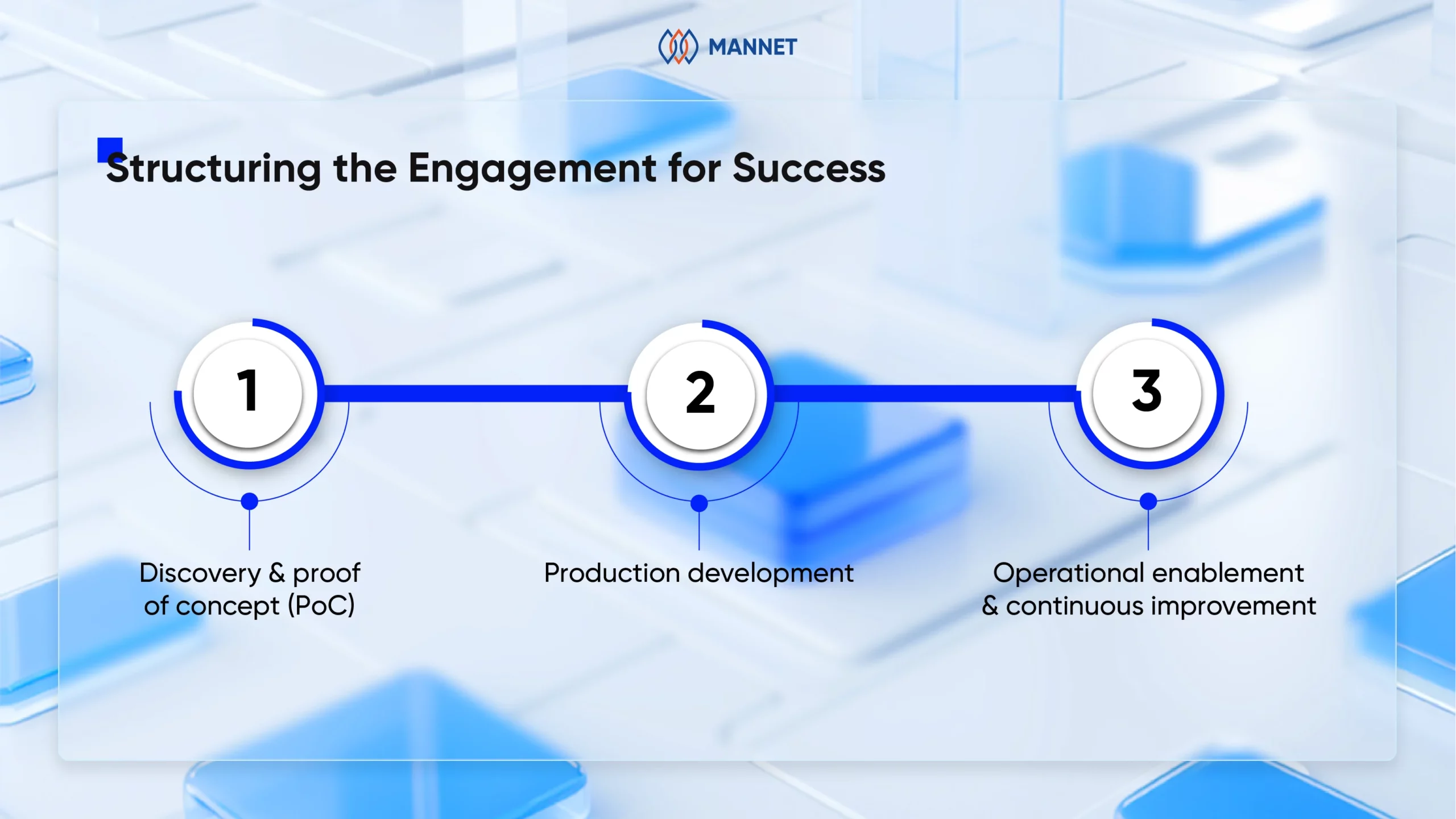
ai outsourcing companies ManNet services

Forward Deployed Engineer (FDE)? Roles, Skills & Demand

What is FDE, and why are more enterprise technology companies building teams around this role?

As AI adoption moves from experimentation to implementation, organizations are discovering that technical success depends on more than great products alone. They need engineers who can bridge customer needs, business workflows, and software delivery. This demand has fueled the rise of the Forward Deployed Engineer (FDE) – a role that sits at the intersection of engineering, product, and client engagement.

In this guide, we’ll explore what an FDE does, how the role differs from traditional engineering positions, and why it is becoming an increasingly important talent priority for companies scaling AI and enterprise software solutions.

Let’s dive in!

What Is a Forward Deployed Engineer?

A Forward Deployed Engineer (FDE) is a software engineer who works directly with customers to implement, customize, and operationalize complex technology solutions in production environments.

Unlike traditional engineering roles that focus primarily on building products, FDEs are responsible for ensuring those products deliver measurable value in real-world business contexts. They sit at the intersection of software engineering, customer delivery, and product development, helping bridge the gap between what a product can do and what customers need it to achieve.

As AI and enterprise software deployments become increasingly complex, the FDE role has emerged as a critical link between technology vendors and their customers.

The core mission of an FDE

At its core, the mission of a Forward Deployed Engineer is simple: help customers achieve outcomes, not just deploy software.

Enterprise customers rarely operate in ideal conditions. They often have fragmented data systems, legacy infrastructure, complex business processes, and unique operational requirements that cannot be solved through standard product features alone.

FDEs work directly within these environments to:

  • Understand business and technical requirements
  • Design implementation approaches
  • Build integrations and custom workflows
  • Resolve deployment challenges
  • Accelerate adoption and time-to-value

Rather than treating implementation as a post-sales handoff, FDEs become active participants in the customer’s success journey.

How FDEs differ from traditional software engineers

Traditional software engineers primarily focus on developing scalable products for a broad user base. Their success is often measured by code quality, system performance, product velocity, and feature delivery.

FDEs operate much closer to the customer.

While they still write production-grade code, their responsibilities extend beyond engineering execution. They must understand customer workflows, identify operational constraints, communicate with stakeholders, and adapt solutions to specific business contexts.

In practice, an FDE may spend one part of the week debugging an integration issue and another part meeting with customer executives to understand why adoption is lagging.

The role requires both technical depth and business awareness – a combination that is relatively uncommon in traditional engineering organizations.

Why the role became essential in the AI era

The rise of AI has fundamentally changed the implementation challenge.

In traditional SaaS environments, software could often be deployed using standardized onboarding processes. AI systems are different. Their effectiveness depends heavily on data quality, workflow integration, user behavior, governance requirements, and ongoing iteration.

As a result, many organizations have discovered that building AI products is only part of the equation. Real value comes from successfully embedding those products into day-to-day operations.

This is where FDEs create disproportionate impact.

By working directly with customers, they help close the gap between AI capabilities and business outcomes, turning prototypes into production systems and experimentation into measurable ROI.

The three worlds an FDE must navigate

Successful FDEs operate across three domains simultaneously:

Software engineering
Building integrations, writing code, troubleshooting systems, and ensuring technical reliability.

Customer delivery
Working directly with client stakeholders, understanding requirements, managing expectations, and driving adoption.

Product development
Identifying recurring customer challenges and translating them into product improvements that benefit future deployments.

This combination is what makes the role so valuable and so difficult to hire for.

Organizations are not simply looking for engineers who can code. They need professionals who can understand customers, solve ambiguous problems, and deliver business outcomes while maintaining strong technical credibility.

Where Did the FDE Role Come From?

The Forward Deployed Engineer (FDE) model originated at Palantir, but the forces that created it are now shaping the entire enterprise technology industry.

Why Palantir created the FDE model

In the early 2010s, Palantir faced a challenge that many enterprise software companies still struggle with today: customers were buying powerful technology, but deploying it successfully was an entirely different problem.

Unlike traditional SaaS vendors, Palantir worked with government agencies, defense organizations, financial institutions, and large industrial enterprises. These environments were defined by strict compliance requirements, fragmented data ecosystems, legacy infrastructure, and highly specialized operational workflows.

In many cases, the technology itself was not the primary obstacle. The challenge was implementation.

To bridge that gap, Palantir embedded engineers directly into customer environments. Rather than serving as external consultants, these engineers became accountable for delivering real-world outcomes, such as configuring systems, solving integration challenges, adapting workflows, and ensuring customers could derive value from the platform.

This became the foundation of the Forward Deployed Engineer model.

Why the model worked

The approach created a feedback loop that benefited both customers and the product organization.

Customers gained direct access to highly technical problem-solvers who could rapidly address deployment challenges and accelerate adoption.

At the same time, FDEs provided product teams with firsthand visibility into how customers actually used the software. Instead of relying on feature requests or support tickets, engineering teams received insights directly from real-world deployments.

As a result, product improvements were informed by operational reality rather than assumptions.

This ability to connect customer outcomes with product evolution became one of the defining advantages of the model.

Why FDEs are no longer just a Palantir concept

What began as a specialized role at Palantir has since expanded across the enterprise software and AI ecosystem.

Companies such as OpenAI, Anthropic, Databricks, Scale AI, and many emerging AI startups now employ variations of the FDE model because they face a similar challenge: helping customers operationalize increasingly complex technology.

Modern AI deployments rarely succeed through self-service onboarding alone. They require workflow redesign, data integration, model customization, governance considerations, and close collaboration with stakeholders across the business.

As technology becomes more powerful and implementation becomes more complex, the need for engineers who can operate between product teams and customers continues to grow.

The rise of the FDE ultimately reflects a broader shift in enterprise technology: competitive advantage is no longer created solely by building great products. It increasingly depends on how effectively those products are deployed, adopted, and translated into business outcomes.

Why Demand for FDEs Is Growing

The growing demand for Forward Deployed Engineers is not simply a hiring trend. It reflects a broader shift in how enterprise software and AI products are built, deployed, and adopted.

Several market forces are making the role increasingly valuable.

AI products are harder to operationalize

Traditional SaaS products could often be deployed through standardized onboarding processes and configuration workflows.

AI systems are different. Their effectiveness depends on data quality, workflow integration, governance requirements, user adoption, and continuous iteration. Even when the underlying technology performs well, many organizations struggle to translate AI capabilities into measurable business outcomes.

As a result, implementation has become a strategic challenge rather than a technical afterthought.

FDEs help bridge this gap by working directly with customers to adapt solutions, resolve deployment obstacles, and accelerate time-to-value.

Enterprise customers expect outcomes, not features

The enterprise buying process has changed significantly.

Customers are no longer evaluating software solely on product capabilities. They are increasingly evaluating vendors based on their ability to deliver business outcomes.

For AI companies in particular, proving ROI has become a critical competitive differentiator.

This creates demand for engineers who can engage directly with customers, understand operational requirements, and ensure successful implementation beyond the initial sale.

In many organizations, FDEs have become the technical bridge between customer success, product, and engineering teams.

Product teams need faster customer feedback loops

One of the most valuable aspects of the FDE model is the quality of insight it generates.

Traditional product organizations often rely on support tickets, feature requests, surveys, or account managers to understand customer needs. While useful, these channels can create distance between product teams and real-world usage.

FDEs eliminate that distance.

By working directly inside customer environments, they gain firsthand visibility into implementation challenges, workflow bottlenecks, and unmet needs. These insights often lead to product improvements that benefit the broader customer base.

In this way, FDEs contribute not only to customer success but also to product strategy and innovation.

AI companies are adopting a services-led growth model

Many leading AI companies are discovering that product-led growth alone is insufficient for complex enterprise deployments.

Increasingly, growth depends on helping customers successfully implement and operationalize the technology.

This has given rise to what some industry observers describe as a services-led growth model, where customer-facing technical talent plays a critical role in driving adoption, expansion, and retention.

FDEs are a natural fit for this environment because they combine engineering expertise with customer-facing problem-solving.

As AI systems become more powerful and enterprise deployments become more complex, the value of engineers who can operate effectively across both domains is likely to continue growing.

What Does a Forward Deployed Engineer Actually Do?

While responsibilities vary by company, most Forward Deployed Engineers operate across four core areas: customer discovery, solution delivery, technical implementation, and product feedback.

Their role extends far beyond writing code. They are responsible for translating customer needs into working solutions while helping the organization learn from every deployment.

Understand customer workflows and business requirements

FDEs typically begin by immersing themselves in the customer’s environment.

Rather than relying solely on requirements documents or stakeholder interviews, they work directly with end users, operational teams, and decision-makers to understand how processes actually function in practice.

This often involves:

  • Mapping existing workflows
  • Identifying operational bottlenecks
  • Understanding data availability and quality
  • Evaluating technical constraints
  • Prioritizing high-impact use cases

The objective is not simply to gather requirements, but to uncover opportunities where technology can create measurable business value.

Design and validate solutions

Once requirements are understood, FDEs help define what success looks like and determine whether a proposed solution can realistically achieve it.

This phase often includes:

  • Technical feasibility assessments
  • Solution architecture design
  • Proof-of-concept development
  • AI model evaluation and testing
  • Success metric definition

For AI deployments in particular, validation is critical. Customer expectations, available data, and system realities frequently differ from initial assumptions. FDEs help bridge these gaps before significant resources are committed.

Build and deploy production solutions

Implementation is where FDEs differ most from traditional consultants.

Rather than handing recommendations back to the customer, they remain directly involved in execution.

Typical responsibilities include:

  • Writing production-grade code
  • Building APIs and integrations
  • Configuring infrastructure
  • Resolving deployment issues
  • Troubleshooting data pipelines
  • Optimizing performance and reliability

Their focus is on delivering solutions that function effectively within the customer’s actual operating environment, not just in controlled test scenarios.

Drive adoption and business outcomes

Successful deployment does not automatically translate into business value.

FDEs often work closely with customer stakeholders to ensure solutions are adopted, workflows are adjusted where necessary, and expected outcomes are achieved.

This may involve:

  • Supporting rollout initiatives
  • Training key users
  • Monitoring performance metrics
  • Identifying adoption barriers
  • Iterating based on user feedback

The goal is not simply to launch a solution, but to help customers realize measurable ROI.

Feed customer insights back into the product

One of the most strategic aspects of the role is the feedback loop it creates between customers and product teams.

Because FDEs operate closest to real-world deployments, they often identify recurring challenges, missing capabilities, and emerging use cases before anyone else in the organization.

These insights help:

  • Improve product functionality
  • Prioritize roadmap decisions
  • Identify new market opportunities
  • Reduce implementation friction for future customers

In many organizations, FDEs serve as a critical bridge between engineering, product, and customer teams, qualifying that lessons learned in the field directly influence how the product evolves.

What does a typical week look like?

A typical week for an FDE is highly varied.

They may spend part of their time meeting with customer stakeholders, part of their time building integrations or debugging production systems, and part collaborating internally with product, engineering, and research teams.

The common thread is ownership. Unlike many technical roles that focus on a single function, FDEs are accountable for helping customers move from technical capability to business outcome.

The Skills That Define High-Performing FDEs

The challenge of hiring Forward Deployed Engineers is not finding great engineers.

It is finding professionals who can simultaneously operate as engineers, problem-solvers, customer advisors, and product partners.

Many organizations discover that strong technical talent alone is not enough. The most effective FDEs combine multiple skill sets that are typically distributed across separate roles.

Technical depth and engineering versatility

At its foundation, the FDE role remains an engineering role.

FDEs are expected to write production-grade code, troubleshoot complex systems, and build solutions that can operate reliably in real-world environments.

Depending on the organization, this may include:

  • Full-stack software development
  • API design and integration
  • Cloud infrastructure (AWS, Azure, or GCP)
  • Data engineering and pipeline development
  • System architecture and scalability
  • AI and machine learning implementation

Unlike many customer-facing technical roles, FDEs are not simply advising on solutions. They are responsible for building and deploying them.

Problem solving in ambiguous environments

One of the defining characteristics of high-performing FDEs is their ability to operate effectively with incomplete information.

Customer environments rarely resemble the assumptions made during product development. Data may be inconsistent, processes may be undocumented, and stakeholder requirements may evolve throughout a project.

Successful FDEs excel at:

  • Rapidly diagnosing root causes
  • Identifying hidden constraints
  • Navigating uncertainty
  • Prioritizing high-impact opportunities
  • Converting complex problems into actionable solutions

This ability to create clarity from ambiguity is often what separates exceptional FDEs from strong software engineers.

Customer engagement and communication

FDEs spend a significant portion of their time working directly with customers.

As a result, technical expertise must be complemented by strong interpersonal and communication skills.

Top performers can:

  • Translate technical concepts into business language
  • Facilitate workshops and discovery sessions
  • Align stakeholders around priorities
  • Manage expectations during implementation
  • Build trust with both technical and non-technical audiences

In practice, an FDE may discuss system architecture with a CTO in one meeting and operational workflows with business users in the next.

The ability to move seamlessly between those conversations is critical.

Ownership and outcome orientation

Traditional engineering roles are often measured by technical outputs.

FDEs are measured by outcomes.

They are expected to take responsibility for the entire customer journey, from discovery and implementation to deployment and adoption.

This requires:

  • Strong project ownership
  • Bias toward execution
  • Comfort with accountability
  • Cross-functional collaboration
  • A willingness to solve problems outside a defined job scope

Many organizations describe their best FDEs as having a founder mindset: they focus relentlessly on achieving results rather than completing tasks.

AI and systems thinking

As AI adoption accelerates, modern FDEs increasingly need to understand how intelligent systems are deployed and integrated into business workflows.

Beyond technical AI knowledge, this requires systems thinking – the ability to understand how data, people, processes, and technology interact.

Leading FDEs are often involved in:

  • AI application deployment
  • Retrieval-augmented generation (RAG) systems
  • Agent workflows and orchestration
  • Model evaluation and optimization
  • Human-in-the-loop processes
  • AI governance and risk management

Their role is not simply to deploy AI, but to ensure it creates value within the broader operational environment.

Business acumen and industry awareness

The strongest FDEs understand that technology decisions are ultimately business decisions.

They can connect technical implementation to strategic objectives such as operational efficiency, revenue growth, risk reduction, or customer experience improvement.

This becomes especially important in highly regulated industries such as:

  • Financial services
  • Healthcare
  • Manufacturing
  • Energy
  • Government and defense

Understanding industry constraints, compliance requirements, and organizational dynamics often determines whether a deployment succeeds or fails.

Why FDE talent is difficult to hire

Each of these capabilities is valuable on its own.

The challenge is that FDEs are expected to combine all of them.

Organizations are effectively searching for professionals who can think like engineers, communicate like consultants, solve problems like product leaders, and execute like operators.

That combination remains relatively rare, which is one of the primary reasons demand for experienced FDE talent continues to outpace supply.

FDE vs. Other Technical Roles

Many organizations already have customer-facing technical roles. Understanding where FDEs are genuinely different, and where the boundaries blur, matters before committing to hiring for or building this function.

FDE vs. Solutions Engineer (SE) / Solutions Architect (SA)

Solutions Engineers and Architects are primarily pre-sales. Their role is to demonstrate what a product can do: build proofs of concept, run demos, scope implementations. They rarely write production-grade code inside a customer’s live environment. Once the deal closes, they typically move on.

FDEs pick up where SAs leave off, and go significantly further. They operate post-sale, writing real code, building actual integrations, and working in the customer’s production environment with real data. They also work with more ambiguity and own the outcome.

FDE vs. Customer Success Engineer (CSE)

Customer Success Engineers guide customers through onboarding and adoption. They excel at configuration, enablement, and technical guidance. What they do not do is extend the product itself, write production code for the customer, or fill gaps in the product’s current capabilities.

The distinction, simply put: CSEs work within what the product currently supports. FDEs extend it to fit what the customer actually needs.

FDE vs. Implementation Consultant

Implementation Consultants are skilled project managers and advisors. They manage timelines, stakeholder alignment, and configurations. When they hit a technical wall- a missing API endpoint, a data migration that the product cannot handle natively- they escalate to engineering.

FDEs eliminate that dependency by solving the technical problems themselves. They are the ones who remove the wall, not the ones who document it.

The core distinction across all comparisons: Traditional customer-facing technical roles work around the product. FDEs work inside it, and contribute back to it.

When Should a Company Hire Forward Deployed Engineers?

Not every technology company needs a dedicated Forward Deployed Engineering function.

Companies with highly standardized products, self-service onboarding, and minimal implementation complexity can often scale successfully through traditional engineering, customer success, and solutions architecture teams.

However, as products become more complex and customer environments become more diverse, organizations often encounter a point where existing teams struggle to bridge the gap between product capabilities and customer outcomes.

That is typically where FDEs create the most value.

Enterprise deployments require significant customization

The strongest signal that a company may need FDEs is when customer deployments repeatedly require work beyond standard product functionality.

This often includes:

  • Complex integrations with legacy systems
  • Custom workflows and business logic
  • Data transformation and migration challenges
  • Industry-specific compliance requirements
  • Unique infrastructure constraints

In these environments, implementation becomes an engineering problem rather than a configuration exercise.

If customer-facing teams frequently rely on core engineering resources to unblock deployments, an FDE function can provide a more scalable solution.

Customers are buying outcomes, not software

As enterprise technology markets mature, customers increasingly evaluate vendors based on business outcomes rather than product features.

They are not purchasing a platform simply because it has advanced capabilities. They are investing because they expect measurable improvements in efficiency, revenue, risk reduction, or decision-making.

When customers require significant guidance to achieve those outcomes, organizations often benefit from engineers who can work directly within customer environments and help operationalize the technology.

This is especially common in AI, data, cybersecurity, and enterprise platform companies.

Product adoption is slower than expected

A successful deployment does not automatically translate into successful adoption.

Many organizations discover that customers purchase their product, complete implementation, and still struggle to integrate it into daily workflows.

Common warning signs include:

  • Low product utilization after launch
  • Long time-to-value
  • Repeated onboarding delays
  • Frequent support escalations
  • Difficulty expanding accounts after initial deployment

FDEs can help address these issues by identifying operational barriers, redesigning workflows, and ensuring solutions align with how customers actually work.

Product and engineering teams lack customer visibility

As organizations scale, product teams often become increasingly disconnected from customer reality.

Feedback reaches engineering through multiple layers of account managers, support teams, implementation specialists, and customer success managers. By the time insights reach the product organization, important context is often lost.

FDEs create a direct feedback loop between customers and engineering.

Because they operate within live customer environments, they can identify recurring pain points, implementation bottlenecks, and unmet needs long before those issues appear in support tickets or roadmap discussions.

For many high-growth software companies, this feedback loop becomes a strategic advantage.

AI initiatives are moving beyond the pilot stage

This is perhaps the most important use case today.

Many organizations have successfully built AI prototypes, proofs of concept, and internal demonstrations. Far fewer have successfully deployed AI systems at scale.

The challenge is rarely the model itself.

Instead, organizations struggle with:

  • Data readiness
  • Workflow integration
  • Governance and compliance
  • User adoption
  • System reliability
  • Change management

FDEs help bridge the gap between technical capability and operational reality.

By working directly with customers and stakeholders, they assure AI solutions are not only deployed, but also embedded into business processes where they can generate measurable value.

Challenges of Building an FDE Function

While the benefits of Forward Deployed Engineering are significant, the model introduces operational challenges that organizations must actively manage.

Balancing customization and product scalability

FDEs often solve highly specific customer problems. Without clear governance, organizations can accumulate one-off customizations that increase technical debt and complicate future product development.

The most effective teams establish clear criteria for what should be productized versus what should remain customer-specific.

Preventing organizational dependency

As FDEs become known for solving difficult problems, internal teams may begin routing every technical challenge to them.

Without clearly defined engagement models, FDE teams risk becoming bottlenecks rather than force multipliers.

Hiring and retaining hybrid talent

The combination of engineering depth, business understanding, communication skills, and customer-facing confidence remains difficult to find.

This talent scarcity is one of the primary reasons demand for experienced FDEs continues to exceed supply.

Measuring success effectively

Traditional engineering metrics do not fully capture FDE impact.

Organizations must evaluate outcomes such as deployment success, customer adoption, implementation velocity, expansion revenue, and product feedback contributions alongside technical performance.

Frequently Asked Questions about FDE

What is the difference between a Forward Deployed Engineer and a Software Engineer?

While software engineers primarily focus on building and maintaining products, Forward Deployed Engineers work directly with customers to implement, customize, and operationalize those products in real-world environments. FDEs combine engineering expertise with customer-facing problem-solving and are often responsible for ensuring deployments achieve measurable business outcomes.

Are Forward Deployed Engineers only used by AI companies?

No. Although demand for FDEs has grown significantly with the rise of enterprise AI, the role originated in enterprise software long before the AI boom. Any organization that deploys complex technology solutions, particularly in industries such as finance, healthcare, manufacturing, or defense, may benefit from FDE capabilities.

When should a company hire a Forward Deployed Engineer?

Organizations should consider hiring FDEs when customer implementations require substantial engineering involvement, product adoption depends on hands-on technical support, or post-sales teams frequently encounter challenges that standard onboarding and implementation processes cannot address.

What skills are most important for a successful FDE?

High-performing FDEs typically combine strong software engineering capabilities with customer communication skills, business problem-solving ability, and a high degree of ownership. As AI adoption increases, familiarity with AI systems, data workflows, and enterprise integration challenges is becoming increasingly valuable.

Why are Forward Deployed Engineers in high demand?

As enterprise software and AI solutions become more complex, companies need technical talent that can bridge the gap between product capabilities and customer outcomes. FDEs help accelerate implementation, improve adoption, and provide direct feedback that informs product development, making them a strategic asset for many technology organizations.

Final Verdict

The FDE model is gaining traction because it solves a problem that has always existed in enterprise software – the gap between what a product promises in a demo and what it can actually deliver in production. As products become more AI-driven and more integration-heavy, that gap widens. FDEs are the engineering layer built to close it.

For organizations scaling enterprise software or AI solutions, FDEs can play a critical role in accelerating implementation, improving adoption, and creating stronger feedback loops between customers and product teams.

Organizations looking to hire FDEs or similar customer-facing technical talent can leverage ManNet’s IT Recruitment Services and IT Staff Augmentation Services to access experienced engineering professionals more efficiently.


Recruitment Strategies: 15 Ways to Scale Tech Teams Effectively

Hiring top tech talent in 2026 is no longer a sourcing challenge but a competition for speed, precision, and candidate engagement. Research shows that roughly 70% of the global workforce consists of passive candidates who are not actively applying for jobs (LinkedIn), meaning the best engineers, cloud specialists, and technology leaders are often beyond the reach of traditional job postings.

To compete in this market, organizations need recruitment strategies that go beyond posting vacancies and waiting for applications. In this guide, we explore 15 proven recruitment strategies that help IT leaders and talent acquisition teams attract stronger candidates, reduce hiring delays, and build high-performing tech teams at scale.

Let’s dive in!

1. Execute a Precision Technical Skills Gap Audit

Many hiring initiatives fail before sourcing even begins due to unclear role requirements.

Before launching recruitment efforts, organizations should assess their current technical capabilities against business priorities and product roadmap goals. A structured skills gap audit helps hiring teams identify exactly which capabilities are missing, where they are needed, and how they should be acquired.

Recommended actions

recruitment strategies - execute a precision technical skills gap audit

  • Assess engineering capabilities across teams, projects, and critical technology domains.
  • Align hiring priorities with 6-18 month business and product objectives.
  • Categorize roles by business impact, distinguishing critical leadership positions from scale-supporting roles.
  • Determine whether gaps should be addressed through permanent hiring, internal mobility, upskilling, or external talent augmentation.

Why it matters

Without a clear understanding of existing capabilities and future talent requirements, recruitment quickly becomes reactive. Recruiters spend valuable time refining role definitions, hiring managers struggle to align expectations, and candidate pipelines become filled with profiles that do not match business needs.

A well-executed skills gap audit creates a stronger hiring strategy from the outset, helping organizations prioritize investments, improve hiring accuracy, and build teams that support long-term growth rather than short-term headcount targets.

For companies entering new markets or expanding operations internationally, structured HR consultation and workforce planning can help ensure hiring decisions reflect local talent availability, compensation benchmarks, and regulatory considerations from the beginning.

2. Architect Proactive Talent Pipelines

One of the biggest mistakes in technology hiring is treating recruitment as a reactive process.

By the time a critical role is approved, the strongest candidates are often already engaged elsewhere. Organizations that consistently hire top talent build relationships before demand arises, creating a pipeline of qualified professionals who are already familiar with the company, its technology environment, and its growth ambitions.

Implementation framework

recruitment strategies - architect proactive talent pipelines

  • Engage technical communities through engineering events, webinars, open-source initiatives, and industry partnerships.
  • Maintain a structured talent database segmented by technology stack, seniority level, and hiring readiness.
  • Reconnect with high-potential candidates from previous hiring cycles who may be a fit for future opportunities.
  • Create talent communities where prospective candidates can stay informed about company updates, technical projects, and upcoming roles.

Why it matters

Reactive hiring often forces organizations into lengthy sourcing cycles, increased recruitment costs, and greater competition for a limited pool of qualified talent. In contrast, proactive talent pipelines shorten time-to-hire and improve candidate quality by ensuring relationships are already established before a hiring need emerges.

When a critical position opens, whether a Cloud Architect, AI Engineer, or Engineering Manager, the goal should not be to start searching. It should be to activate a network that has already been built.

For companies scaling across multiple locations or specialized technology domains, partnering with an experienced IT recruitment provider can help establish and maintain these talent pipelines more efficiently and at greater scale.

3. Engineer Precise, Outcome-Based Job Descriptions

A job description is often the first interaction a candidate has with your organization. For technical professionals, it can strongly influence whether they apply, explore further, or move on.

Yet many companies continue to rely on generic templates packed with lengthy requirement lists, vague expectations, and corporate buzzwords. Instead of attracting qualified talent, these job descriptions often discourage the very candidates they are designed to reach.

Best practices for high-performing job descriptions

  • Use clear, standardized job titles that reflect how candidates actually search for roles.
  • Distinguish essential skills from preferred qualifications to avoid unnecessarily shrinking the talent pool.
  • Clearly communicate the technologies, tools, and working environment candidates can expect.
  • Focus on measurable outcomes and expectations for the first 90 to 180 days rather than listing responsibilities alone.
  • Keep formatting concise, scannable, and mobile-friendly to improve the candidate experience.

Why it matters

The strongest candidates evaluate opportunities as carefully as employers evaluate candidates. A well-crafted job description helps them quickly understand the role, assess fit, and envision their potential impact within the organization.

Beyond improving application quality, optimized job descriptions also increase visibility across job boards and search engines. By incorporating relevant role-specific keywords and candidate-friendly language, organizations can expand their reach and attract more qualified talent without increasing recruitment spend.

4. Build a Strong Engineering Employer Brand

In competitive technology markets, attracting top talent requires more than offering competitive compensation. Candidates increasingly evaluate employers long before they enter a hiring process, researching company culture, technical challenges, leadership credibility, and employee experiences before deciding whether to engage.

For experienced engineers in particular, an employer brand is most effective when it reflects the realities of the engineering organization, apart from the broader corporate brand.

Implementation framework

recruitment strategies - build a strong engineering employer brand

  • Clearly communicate your technology stack, engineering practices, and approach to software development.
  • Highlight opportunities for technical ownership, innovation, and decision-making autonomy.
  • Showcase challenging projects, modern technologies, and the business impact of engineering work.
  • Demonstrate career growth opportunities through mentorship, learning programs, and leadership pathways.
  • Feature authentic stories from engineers, architects, and technical leaders across the organization.

Why it matters

The strongest candidates are evaluating your company just as carefully as you are evaluating them. Before responding to outreach or submitting an application, they often seek evidence that the organization provides meaningful technical challenges, a supportive engineering culture, and opportunities for long-term growth.

Organizations that invest in a credible engineering employer brand are better positioned to attract passive candidates, improve candidate engagement, and strengthen hiring outcomes over time. Content created by engineering leaders, technical case studies, and employee success stories can be particularly effective because they provide the authenticity and transparency that experienced professionals value.

Ultimately, employer branding is not a marketing exercise but a strategic recruitment asset that influences who enters your talent pipeline and how quickly critical roles can be filled.

5. Deploy a Multi-Channel Talent Sourcing Strategy

Relying on a single sourcing channel is no longer enough to compete for top technology talent.

Today’s candidates discover opportunities across a wide range of platforms, from professional networks and technical communities to social media and specialized job boards. Organizations that consistently attract high-quality talent adopt a multi-channel sourcing strategy that reaches candidates where they already spend their time.

Channel Best used for
LinkedIn Senior roles, management, structured InMail campaigns
GitHub / Stack Overflow profiles Specialized engineering talent; verify skills before first contact
Facebook & Instagram Employer brand storytelling, broader reach, and younger talent
Niche tech communities (Slack, Discord, local dev forums) Highly specialized, community-embedded technical profiles
Job boards (Indeed, tech-specific platforms) Volume sourcing; optimize listings for discoverability

Key actions

  • Use professional networks such as LinkedIn to engage experienced professionals and leadership-level candidates.
  • Leverage technical platforms and developer communities to identify candidates with specialized skills and relevant project experience.
  • Invest in employer branding across social media channels to increase visibility and strengthen candidate engagement.
  • Participate in industry groups, technical forums, and community events to build relationships with passive talent.
  • Optimize job advertisements for both job board visibility and search engine discoverability.

Why it matters

Different talent segments engage with different channels. While some candidates actively search job boards, many experienced professionals are more likely to respond through professional networks, technical communities, or referrals from trusted peers.

A diversified sourcing strategy expands access to talent pools that traditional recruiting methods often miss. It also reduces dependency on any single channel, improving recruitment resilience and helping organizations adapt to changing candidate behaviors.

The most effective organizations combine long-term employer brand building with targeted sourcing efforts. Together, these approaches increase visibility, strengthen candidate trust, and create a more sustainable pipeline of qualified technology talent.

6. Proactively Engage Passive Tech Talent

70% of the global tech workforce isn’t browsing job boards. The engineers you most want to hire are already delivering value somewhere else. (LinkedIn’s Global Talent Trends)

The professionals capable of the highest business impact are rarely applying. They must be systematically identified, intelligently approached, and carefully converted.

Sourcing framework:

recruitment strategies - proactively engage passive tech talent

  • Build hyper-specific candidate personas: primary tech stack, career trajectory, compensation drivers, and typical pain points in their current role
  • Execute precision Boolean search queries on LinkedIn Recruiter and other platforms to intercept profiles before they become active candidates
  • Reach out through InMail, professional communities, industry events, and warm referrals– cold outreach works when it’s relevant and respectful
  • Build a continuous sourcing cadence– don’t source only when roles go live; build relationships in advance

What to say when you reach out:

  • Reference their specific background; make the connection between their trajectory and the opportunity explicit
  • Respect brevity – senior engineers receive a lot of outreach; get to the point quickly
  • Frame the role as a natural next step, not a generic pitch
  • Make the next step obvious and low-friction

When internal sourcing teams hit capacity limits or lack local network depth, particularly in markets like Vietnam, specialized partners like ManNet’s IT Recruitment provide immediate, confidential access to pre-vetted local engineering pools.

7. Build a High-Performing Employee Referral Program

Your employees can be one of your most effective talent acquisition channels, especially in technology hiring.

Referred candidates often move through hiring processes faster, integrate into teams more smoothly, and demonstrate stronger long-term retention. Existing employees understand both the technical requirements of a role and the realities of working within the organization, making them uniquely positioned to identify strong-fit candidates.

How to strengthen your referral program

  • Offer meaningful incentives: Align referral rewards with role seniority, business impact, and hiring difficulty.
  • Reduce friction: Make the referral process simple, intuitive, and easy to complete.
  • Maintain visibility: Keep employees informed throughout the hiring process to encourage ongoing participation.
  • Recognize contributors: Celebrate successful referrals through internal communications and recognition programs.
  • Encourage team involvement: Create opportunities for candidates to connect with future teammates through informal conversations and team introductions.

Pro tip

Referral programs rarely succeed on incentives alone. Regular reminders, success stories, and periodic recognition initiatives help keep referrals top of mind and sustain participation over time.

8. Institutionalize Skills-Based Tech Hiring

Hire for capability, not credentials.

In technology hiring, academic background and years of experience do not always predict job performance. Many of today’s strongest engineers have built their expertise through hands-on projects, open-source contributions, bootcamps, certifications, or non-traditional career paths.

Organizations that prioritize demonstrated skills over formal credentials can access a broader talent pool and identify high-potential candidates who may be overlooked by traditional screening methods.

How to implement skills-based hiring

recruitment strategies - institutionalize skills-based tech hiring

  • Use technical assessments to evaluate role-specific skills consistently across candidates.
  • Incorporate practical coding challenges or take-home assignments that reflect real-world work.
  • Include live problem-solving exercises to assess collaboration, communication, and technical thinking.
  • Structure interviews around competencies and measurable past achievements rather than credentials alone.
  • Adopt standardized evaluation criteria to improve consistency and reduce bias in hiring decisions.

Pro tip

Start by reviewing your job descriptions. Prioritize the skills, outcomes, and capabilities required for success in the role, while removing unnecessary degree requirements or rigid experience thresholds. This simple change can significantly expand access to qualified technology talent.

9. Unlock Workforce Elasticity Through IT Staff Augmentation

Not every hiring need requires a permanent employee.

As technology projects become more dynamic, organizations need workforce strategies that balance long-term capability building with the flexibility to scale resources up or down as business demands change. Relying exclusively on permanent hiring can create delays when project timelines move faster than recruitment cycles.

recruitment strategies - unlock workforce elasticity through IT staff augmentation

When augmentation wins over permanent hiring:

  • Projects require niche expertise in areas such as AI, Data Engineering, Cloud, Cybersecurity, or emerging technologies.
  • Delivery timelines cannot accommodate traditional hiring cycles.
  • Additional capacity is needed while permanent recruitment is still in progress.
  • Organizations want to scale engineering resources quickly without committing to long-term headcount expansion.

IT Staff Augmentation bypasses traditional recruitment drag, eliminates overhead costs tied to permanent local payroll, and allows teams to scale up or down in direct response to real-time development cycles. For organizations actively scaling engineering capacity – including hiring software developers or QA engineers – augmentation provides a structural speed advantage that permanent-only hiring cannot match.

10. Augment Sourcing with AI and Predictive Analytics

AI-powered recruitment tools are now standard in high-performing talent acquisition functions. Organizations deploying them thoughtfully gain measurable edges in sourcing speed, screening accuracy, and candidate engagement. Those treating AI as a replacement for recruiter judgment tend to get the tradeoffs backwards.

High-ROI AI allocations in tech recruiting:

recruitment strategies - high-ROI AI allocations in tech recruiting

  • Resume parsing and early filtering: surface matching profiles faster; reduce unconscious bias at initial stages
  • Automated scheduling coordination: eliminate back-and-forth calendar management entirely
  • Personalized outreach at scale: maintain a human tone across high-volume candidate communications
  • Predictive turnover analytics: identify early signals of flight risk among current high-performers before a gap opens

According to SHRM’s 2025 data, 51% of organizations already use AI in recruitment, most commonly for JD generation (66%) and resume screening (44%).

The enterprise TA dashboard – metrics every team must be tracking:

  • Time-to-Fill
  • Time-to-Hire
  • Source-of-Hire ROI
  • Offer Acceptance Rate
  • Quality-of-Hire
  • First-Year Retention

Each metric tells a different story. Time-to-fill reveals pipeline depth. Offer acceptance rate signals EVP strength. First-year retention is the ultimate verdict on whether the entire process is working. For a deeper breakdown of how these connect, ManNet’s Recruitment Funnel Playbook maps each KPI to its corresponding funnel stage.

11. Refine the Candidate Experience Into a Brand Asset

Every interaction in your hiring process, from the job listing to the final debrief, shapes how candidates perceive your organization. For senior tech talent with multiple offers on the table, a poor experience doesn’t just cost you a hire. It costs you referrals, online reputation, and future pipeline quality.

The data is unambiguous:

  • 66%of tech professionals say a positive, transparent interview loop directly influenced their decision to sign an offer
  • 26%have actively walked away from disorganized or opaque evaluation processes
  • Leading friction points: unclear communication, inconsistent timelines, and interviews with no structured evaluation criteria

Actionable fixes that move the needle immediately:

  • Simplify the apply flow: audit your own application process end-to-end; every unnecessary step increases drop-off
  • Set communication SLAs: candidates should never be left in silence; establish explicit follow-up windows at each stage
  • Structure your technical interview loop: candidates should know what’s being assessed and why; interviewers should evaluate against consistent rubrics
  • Deliver timely feedback: even a brief, respectful rejection sent promptly leaves a lasting positive impression
  • Survey candidates post-process: rejected and hired; the signal from both groups is invaluable for continuous improvement

Candidates who don’t receive an offer but walk away feeling respected are more likely to reapply, refer colleagues, and speak positively about your organization. Every touchpoint is a branding moment.

12. Re-Engage Historical Pipelines and Corporate Alumni

Your talent database is one of the most underutilized assets in recruitment.

Many organizations invest significant time and resources in building candidate pipelines, only to restart sourcing from scratch whenever a new vacancy opens. In reality, past candidates who were once strong contenders may now have new skills, different career goals, or greater openness to new opportunities.

Re-engaging historical talent pipelines

  • Tag and categorize high-potential candidates within your ATS, particularly those who progressed to later interview stages.
  • Review previous finalist and runner-up candidates before launching external sourcing campaigns.
  • Personalize outreach by referencing prior interactions and clearly explaining why the new opportunity may be relevant.
  • Maintain periodic communication with promising candidates to keep relationships active over time.

Activating alumni networks

Former employees can also be a valuable source of future talent. Many organizations have successfully rehired “boomerang employees” who return with additional skills, broader industry experience, and a deeper understanding of the business.

To maintain strong alumni relationships:

  • Create alumni communities through LinkedIn groups, newsletters, or professional networking channels.
  • Share company updates, career opportunities, and industry insights with former employees.
  • Invest in positive offboarding experiences that leave the door open for future collaboration.
  • Host occasional alumni events to strengthen long-term engagement and professional connections.

13. Diversify Sourcing Channels and Build Strategic Campus Partnerships

Over-reliance on a single sourcing channel is a single point of failure in your talent supply chain.

High-performing talent acquisition functions run multiple channels simultaneously – continuously measuring performance and reallocating effort toward what converts.

Sourcing channels:

Channel Strength Best for
LinkedIn Professional reach, InMail Senior roles, passive outreach
Job boards (Indeed, tech-specific) Volume Mid-level, active candidates
Employee referrals Highest quality-of-hire All levels
GitHub / Stack Overflow Technical signal Specialized engineering
Campus partnerships Early pipeline Entry-level, graduate hires
Staff augmentation partners Speed + pre-vetting Urgent, niche, or scaled tech hiring

Elevating campus recruitment beyond transactional career fairs:

  • Sponsor deep technical research or capstone projects at universities with relevant CS/IT programs
  • Embed senior engineers as guest lecturers to build genuine brand equity among students before they enter the open market
  • Create structured internship-to-permanent pathways that convert top emerging talent before competitors see them
  • Build a dedicated graduate landing page showcasing growth trajectories, mentorship, and technical culture

For organizations scaling engineering capacity rapidly – including permanent hires, contract resources, and dedicated offshore teams – IT Staff Augmentation provides the channel agility to meet demand without depending on any single sourcing stream.

14. Standardize the Recruiter-Hiring Manager Partnership

Misalignment between TA and hiring managers is one of the primary drivers of hiring drag and candidate drop-off.

When these two parties are out of sync, the consequences cascade: unclear briefs lead to wasted sourcing cycles, slow feedback windows lose candidates to faster-moving competitors, and inconsistent evaluation criteria produce unpredictable hiring outcomes.

The partnership charter – ground rules that eliminate friction:

  • Mandate a formal kick-off alignment sync before any role goes live: lock down the non-negotiables, define what “great” looks like, and document it
  • Set explicit SLA windows: hiring managers must submit interview feedback within 24-48 hours; candidates are evaluating you on this timeline too
  • Establish a weekly data review cadence: track active roles, funnel metrics, and market feedback; adjust sourcing parameters when compensation or availability drifts from initial projections
  • Share market intelligence openly: if the role spec is unrealistic or below-market compensation is causing offer declines, surface this in week one, not week six
  • Recognize joint wins: when a hire works out, acknowledge it as shared ownership; this builds the partnership’s credibility and sustains the collaboration over time

When this relationship is optimized, everything downstream becomes more efficient: briefs are sharper, screening is more targeted, offers move faster, and hiring decisions carry genuine confidence.

15. Merge Onboarding Into the Full Talent Acquisition Lifecycle

The recruitment process concludes when the employee successfully integrates and delivers outcomes.

Research shows 86% of new hires determine their long-term commitment within the first six months. A structurally weak onboarding experience doesn’t just risk early attrition, it actively destroys the ROI of every sourcing hour, interviewer hour, and offer negotiation that preceded it.

The pre-onboarding phase (offer acceptance → Day 1):

  • Send proactive, personalized welcome communications immediately after signing
  • Provision equipment, system access, and tool credentials before the first day – eliminate the “nothing works on Day 1” experience entirely
  • Share a structured first-week agenda so new hires arrive with clarity, not anxiety

The 30/60/90-day success roadmap:

  • Set graduated, measurable milestones– what does success look like at each stage? Define it explicitly, not generically
  • Schedule regular manager check-ins(not ad hoc) to surface concerns before they become flight risks
  • Implement a peer buddy framework– pair new hires with an internal mentor to accelerate cultural integration and reduce the overwhelm of a new environment

For organizations operating distributed teams or engaging talent through IT Staff Augmentation or IT Recruitment Services, onboarding complexity multiplies across time zones, legal frameworks, and engagement models. Qualifying a consistent, genuinely integrative experience – regardless of location – requires deliberate design, not improvisation.

Summary: Turning Recruitment Strategy into Hiring Results

The gap between knowing these strategies and executing them consistently is where most organizations lose ground. Organizations that consistently attract and retain top technology talent tend to share four characteristics:

recruitment strategies - turning recruitment strategy into hiring results

Prioritize clarity before sourcing

Define hiring needs, success criteria, and skill requirements before launching recruitment efforts. Clear hiring objectives lead to stronger candidate pipelines and better hiring outcomes.

Invest in long-term talent infrastructure

Talent pipelines, employer branding, referral programs, and skills-based hiring frameworks require time to build, but they deliver compounding value over time.

Treat candidate experience as a strategic asset

Every interaction shapes how candidates perceive your organization. Transparency, responsiveness, and professionalism can significantly influence hiring success and employer reputation.

Leverage the right talent acquisition model

Not every hiring challenge should be solved the same way. Depending on business needs, organizations may benefit from a combination of direct hiring, staff augmentation, workforce consulting, and recruitment outsourcing strategies.

In specialized markets – particularly IT talent in emerging hubs like Vietnam – the most valuable hiring decision is often recognizing when internal sourcing capacity has reached its ceiling. Whether the need is targeted direct placement through IT Recruitment Services, immediate scale through IT Staff Augmentation, or foundational infrastructure through HR Consultation & Set-up, the right external partnership compresses timelines that would otherwise take years to build internally.

Frequently Asked Questions about Recruitment Strategies

What are the most effective recruitment strategies for hiring tech talent in 2026?

The most effective recruitment strategies include skills-based hiring, proactive talent pipeline development, employee referral programs, employer branding, multi-channel sourcing, AI-assisted recruitment, and structured candidate experience management. Organizations that combine multiple strategies typically achieve better hiring outcomes than those relying solely on job postings.

How can companies attract passive technology candidates?

Attracting passive candidates requires proactive sourcing, personalized outreach, strong employer branding, and consistent engagement through professional communities, industry events, and talent networks. Building relationships before a role becomes available is often more effective than recruiting only when vacancies arise.

What is the difference between IT recruitment and IT staff augmentation?

IT recruitment focuses on hiring permanent employees for long-term organizational needs, while IT staff augmentation provides access to external technical talent for project-based or short-term capacity requirements. Many organizations use both approaches as part of a broader workforce strategy.

How can organizations reduce time-to-hire for technical roles?

Companies can shorten hiring timelines by maintaining active talent pipelines, leveraging employee referrals, simplifying interview processes, re-engaging previous candidates, and using recruitment technology to automate administrative tasks such as sourcing and scheduling.

When should a company consider Recruitment Process Outsourcing (RPO)?

RPO is often a good fit when organizations need to scale hiring quickly, improve recruitment efficiency, access specialized sourcing expertise, or build a more structured recruitment function without significantly expanding internal talent acquisition teams.

Final Verdict

Technology recruitment has become a strategic business function rather than a purely operational HR activity. As competition for skilled talent continues to intensify, organizations that rely on reactive hiring approaches will increasingly struggle to meet growth objectives.

The most successful companies build recruitment capabilities that scale with the business: developing strong employer brands, nurturing talent communities, engaging passive candidates, embracing skills-based hiring, and continuously optimizing their hiring processes through data and technology.

While no single strategy guarantees hiring success, the organizations that consistently apply these principles are better positioned to attract, hire, and retain the talent needed to drive innovation and long-term growth.

For organizations looking to strengthen their technology hiring capabilities, exploring specialized solutions such as ManNet’s IT Recruitment Services, IT Staff Augmentation, and Recruitment Process Outsourcing (RPO) can provide additional flexibility and access to highly competitive talent markets.

recruitment strategies

6 Best IT Staff Augmentation Companies in Vietnam for Startups

When your startup’s runway is measured in months, hiring decisions carry real weight. IT staff augmentation companies for startups offer a faster path: engineers who plug in and deliver without the drag of a permanent hire.

Vietnam has become one of the region’s most compelling choices. ICT exports exceeded $130 billion in 2023 (Vietnam MIC), backed by over 530,000 IT professionals and a fast-maturing ecosystem of specialist staffing providers.

This guide breaks down what startup-ready augmentation actually looks like, how to separate good providers from great ones, and which Vietnamese companies are worth evaluating in 2026.

Let’s dive in!

What Makes an Augmentation Provider Genuinely Startup-Ready?

Not all IT staff augmentation companies are built for startups. Many are optimised for large enterprise programmes with stable requirements, long procurement cycles, and multi-year engagement horizons. Startups need something different: speed, flexibility, and a partner who understands the rhythm of agile product development under capital constraints.

Use the following criteria as your evaluation checklist when assessing any Vietnam-based provider:

Time to start. Anything longer than four weeks negates the agility argument. A startup-ready partner should present shortlisted candidates within three to five working days and have engineers embedded within two to three weeks.

Pricing transparency. Flat monthly rates covering talent, hardware, HR administration, and compliance are the clearest structure. Hidden surcharges, ambiguous uplift fees, and lock-in clauses erode the financial advantage of augmentation before a single sprint has run.

Seniority depth. Ask for the provider’s actual distribution of junior, mid-level, and senior talent by role. High seniority mix, credible screening pass rates, and internationally benchmarked certifications are the signals that separate strong providers from bulk-staffing shops.

Retention rate. High churn among augmented engineers is a hidden tax. Every developer who exits mid-engagement takes domain context with them. Look for providers with annual retention above 90% and ask specifically about average tenure on client engagements.

Operational scope. Does the vendor handle equipment provisioning, local labour law compliance, social insurance, and performance support? Or do those tasks silently bounce back to you? For early-stage startups without a dedicated HR function, a full-service provider absorbing these responsibilities is worth a premium.

Replacement guarantees. A 60-day probationary replacement guarantee – where the vendor commits to sourcing an alternative at no additional cost if the placed engineer doesn’t meet requirements – is the industry-standard minimum to expect from any credible provider.

Selection Method

The providers featured in this list were evaluated based on the criteria that most directly impact augmentation success for growth-stage startups in Vietnam, particularly international companies building or extending technical teams.

  • Speed to first candidate: Time from signed brief to shortlist presented
  • Seniority and screening depth: Actual talent distribution, technical validation processes, and certification track record
  • Startup engagement model: Flexibility on contract terms, team size, scaling up/down, and minimum commitment periods
  • Operational scope: Whether the provider covers HR admin, compliance, equipment, and local labour law, or passes those tasks back to the client
  • Language and communication quality: English, Japanese, and Korean proficiency across candidates and account management teams
  • Replacement guarantee and risk protection: Contractual commitments on probation guarantees and replacement processes
  • Relevant client track record: Evidence of successful engagements with companies at similar growth stages or in similar technical domains

Top IT Staff Augmentation Companies in Vietnam for Startups (2026)

1. ManNet – IT Talent Augmentation & Recruitment Specialist

it staff augmentation for startups in vietnam - mannet

Overview

ManNet is a Vietnam-based IT talent solutions company specializing in IT staff augmentation, technology recruitment, Employer of Record (EOR), and workforce consulting services. As a member of the LTS Group ecosystem, ManNet leverages access to a broader network of software engineering, testing, AI, and digital transformation expertise while maintaining a dedicated focus on helping global companies build, scale, and manage technology teams in Vietnam.

Unlike traditional software outsourcing providers that offer staffing as an extension of development services, ManNet operates as a specialized talent partner focused entirely on sourcing, deploying, and retaining high-quality technology professionals. This enables startups and growing companies to access vetted IT talent while minimizing recruitment complexity, HR overhead, and local compliance risks.

Headquarters: Hanoi, Vietnam
Website: https://mannet.tech
Parent ecosystem: LTS Group (Vietnam, Japan, South Korea, United States)
Talent focus: Software Engineering, QA & Testing, Cloud, AI, Data, DevOps, Project Management, and Business Analysis

Core services

Key strengths for startups

Talent-specialized delivery model

While many competitors originate from software outsourcing, ManNet’s core business is talent acquisition and workforce solutions. This specialization enables deeper sourcing capabilities, stronger candidate networks, and recruitment processes designed specifically around technical hiring challenges rather than project delivery requirements.

Access to the broader LTS Group ecosystem

As part of the LTS Group, ManNet benefits from an ecosystem that includes software development, quality assurance, AI, digital engineering, and business process services. This provides startups with access to technical expertise and market insights that extend beyond traditional recruitment firms while maintaining ManNet’s dedicated talent focus.

Flexible workforce scaling

Startups can rapidly scale engineering capacity through staff augmentation, contract hiring, dedicated teams, or hybrid workforce models. This flexibility is particularly valuable for companies operating under changing product roadmaps, funding milestones, and evolving hiring requirements.

Employer of Record (EOR) capabilities

International startups can legally hire and manage Vietnamese talent without establishing a local entity. ManNet handles employment contracts, payroll, tax obligations, social insurance, and labor law compliance, allowing founders to enter the Vietnam market with significantly lower operational complexity.

Comprehensive HR and compliance support

Beyond sourcing talent, ManNet provides onboarding, payroll administration, HR operations, employment compliance, and workforce management services. This creates a single point of accountability for both talent acquisition and workforce administration.

Strong international hiring expertise

The company supports organizations across Japan, South Korea, North America, Europe, and Southeast Asia, with experience sourcing professionals who possess both technical capabilities and international communication skills. This is particularly important for distributed teams operating across multiple time zones and cultural environments.

Multi-disciplinary technology talent pool

ManNet supports hiring across software development, QA engineering, automation testing, cloud engineering, DevOps, AI/ML, business analysis, project management, and technical leadership roles. This breadth enables startups to build complete product teams rather than filling isolated positions.

Startup-specific fit

ManNet is particularly well-suited for startups and growth-stage companies that need to build technology teams quickly without investing heavily in internal recruitment infrastructure or local HR operations.

Its combination of staff augmentation, recruitment, EOR, payroll, and workforce consulting services enables founders to move from hiring need to productive team member with minimal operational burden. This is especially valuable for international startups entering Vietnam for the first time, where employment regulations, payroll requirements, and talent acquisition processes can create unexpected complexity.

For startups seeking to establish a long-term presence in Vietnam, ManNet can also support workforce expansion strategies, dedicated team formation, and local employment infrastructure without requiring immediate legal entity setup.

Best For

International startups, scale-ups, and technology companies seeking a dedicated talent partner for IT staff augmentation, recruitment, EOR, and workforce management in Vietnam—particularly organizations that want fast access to vetted engineering talent while outsourcing HR administration, payroll, and compliance responsibilities.

2. Kyanon Digital

it staff augmentation for startups in vietnam - kyanon

Overview

Kyanon Digital is a Vietnam-based digital transformation and software engineering company that helps organizations design, build, and scale digital products through consulting, technology development, and data-driven innovation. Founded in 2012, Kyanon has established itself as one of Vietnam’s leading digital transformation firms, serving enterprises and high-growth companies across Southeast Asia, Australia, and international markets. The company combines strategy, design, engineering, data, and AI expertise to support organizations throughout their digital transformation journey.

Headquarters: Ho Chi Minh City, Vietnam
Website: https://kyanon.digital/
Founded: 2012
Team size: 500+ technology professionals

Core services

  • IT Staff Augmentation
  • Dedicated Development Teams
  • Custom Software Development
  • Digital Transformation Consulting
  • Product Discovery & Product Development
  • Data & AI Solutions
  • Cloud & DevOps Services
  • UX/UI Design
  • Enterprise Application Development
  • Technology Modernization & Integration

Key strengths for startups

End-to-end digital product expertise

Unlike firms focused purely on engineering resources, Kyanon combines business consulting, product strategy, UX/UI design, software engineering, and delivery management. This enables startups to access expertise across the entire product lifecycle—from concept validation through scaling and optimization.

Strong digital transformation and consulting capabilities

Kyanon’s consulting-led approach can be particularly valuable for startups navigating platform modernization, operational scaling, or digital product expansion. The company emphasizes solving business challenges through technology rather than simply providing engineering capacity.

Cross-functional delivery teams

One of Kyanon’s strongest differentiators is its ability to assemble multidisciplinary teams spanning software engineers, product designers, QA specialists, DevOps engineers, business analysts, data engineers, and AI specialists. This makes them well-suited for startups whose requirements extend beyond pure software development.

Data and AI capabilities

The company has expanded significantly into Data & AI services, helping organizations leverage analytics, machine learning, automation, and intelligent digital experiences. For startups building data-driven products or AI-enabled features, this provides access to capabilities beyond traditional software development.

Recognized digital transformation track record

Kyanon has received multiple industry recognitions from VINASA for digital transformation excellence, providing external validation of its delivery quality and innovation capabilities. This can be particularly reassuring for startups selecting a long-term technology partner.

Enterprise-grade delivery standards

The company maintains ISO 9001 and ISO 27001 certifications, reflecting mature quality management and information security processes. These credentials can be especially important for startups operating in fintech, healthcare, education, or other data-sensitive industries.

Startup-specific fit

Kyanon is particularly well-suited for startups and scale-ups that need more than additional engineering capacity. Their strength lies in supporting companies through product development, digital transformation, platform modernization, and AI adoption initiatives that require a combination of strategy, design, engineering, and delivery expertise. Startups building complex digital products or preparing for rapid growth may benefit from Kyanon’s ability to provide integrated, cross-functional teams rather than individual technical resources.

Best for

APAC-based startups seeking a full-service digital product and technology partner, particularly those requiring software engineers, product designers, DevOps specialists, data professionals, AI engineers, or dedicated cross-functional teams capable of supporting both product development and broader digital transformation initiatives.

3. Groove Technology

it staff augmentation for startups in vietnam - groove

Overview

Groove Technology is an Australian-founded software outsourcing company with its primary delivery operations based in Vietnam. Since 2016, the company has helped organizations across Australia, Europe, and the Asia-Pacific scale software development through dedicated engineering teams and staff augmentation services. Groove positions itself around a “Software Outsourcing Simplified” philosophy, focusing on transparency, flexibility, and long-term partnerships that reduce the complexity often associated with offshore development.

Headquarters: Ho Chi Minh City, Vietnam (Australian-founded company)
Website: https://groovetechnology.com/
Founded: 2016
Team size: 230+ technology professionals
Track record: 120+ projects delivered and 97% client retention rate

Core services

  • IT Staff Augmentation
  • Dedicated Development Teams
  • Custom Software Development
  • Web Application Development
  • Mobile Application Development
  • AI & Machine Learning Solutions
  • Data Analytics & Business Intelligence
  • ERP & CRM Development
  • DevOps & Cloud Engineering
  • Software Testing & QA Services

Key strengths for startups

Exceptional client and employee retention

One of Groove’s strongest differentiators is its focus on long-term engagement stability. The company reports a 97% client retention rate and a 93% employee retention rate, helping startups avoid one of the most common challenges in outsourced development: team turnover and knowledge loss during critical growth phases.

Deep expertise in staff augmentation and dedicated teams

Unlike providers that position augmentation as a secondary offering, Groove has built its business around flexible resource models. Startups can engage individual engineers, specialized experts, or fully dedicated development teams depending on their stage of growth and technical requirements.

Strong presence in Australian and European markets

Founded by an Australian leadership team and serving clients across Australia, New Zealand, the UK, and Europe, Groove has extensive experience working within Western business environments. This can reduce communication friction and improve alignment for startups operating in those markets.

Broad product engineering capabilities

Groove supports a wide range of digital products, including SaaS platforms, e-commerce solutions, ERP and CRM systems, mobile applications, data platforms, and IoT solutions. This breadth allows startups to access multiple technical skill sets through a single delivery partner.

Flexible delivery methodologies

The company emphasizes tailoring delivery processes to each client’s needs, drawing from Agile, Scrum, Kanban, DevOps, SAFe, Lean, and XP methodologies. This flexibility can be valuable for startups whose product roadmap and priorities evolve rapidly.

Startup-specific fit

Groove Technology is particularly well-suited for startups that need reliable engineering capacity while maintaining flexibility in team structure. Their combination of staff augmentation, dedicated teams, mature delivery processes, and strong retention metrics makes them a compelling option for companies seeking long-term development support rather than short-term contractor placements.

Best for

Startups and scale-ups seeking software engineers, QA specialists, DevOps engineers, UI/UX designers, business analysts, or dedicated development teams—particularly organizations serving Australian, New Zealand, UK, or European markets that value long-term team continuity, transparent engagement models, and scalable software delivery.

4. KMS Technology

it staff augmentation for startups in vietnam - kms

Overview

KMS Technology is a global software engineering and technology consulting company that helps organizations build, modernize, and scale high-impact digital products. Founded in 2009, KMS has evolved from a trusted software development and quality engineering partner into an AI-native engineering company that combines product development expertise, AI capabilities, data engineering, and consulting services. The company operates across Vietnam, the United States, Mexico, and Poland, serving clients ranging from high-growth technology companies to large enterprises across healthcare, financial services, manufacturing, and logistics.

Headquarters: Atlanta, Georgia, USA (with major delivery centers in Vietnam)
Website: https://kms-technology.com/
Founded: 2009
Global team: 1,100+ professionals across 5 international offices

Core services

  • IT Staff Augmentation & Dedicated Engineering Teams
  • AI Consulting & Generative AI Solutions
  • AI-Native Product Engineering
  • Data Engineering & Analytics
  • Cloud & DevOps Services
  • Application Modernization
  • Quality Engineering & Test Automation
  • Systems Integration
  • Technology Advisory & Technical Consulting

Key strengths for startups

AI-native engineering capabilities
Unlike traditional outsourcing providers, KMS has embedded AI into both its service offerings and delivery model. The company helps startups move beyond AI experimentation through AI consulting, agentic workflow development, GenAI integration, and AI-powered product features. This makes KMS particularly relevant for startups building AI-enabled products or accelerating internal AI adoption.

End-to-end product development expertise
KMS combines product strategy, engineering, QA, DevOps, and data capabilities under one roof. Startups can access cross-functional teams capable of supporting the full product lifecycle – from technical assessments and architecture planning to product launch and scaling.
Strong quality engineering heritage
While KMS has expanded significantly into AI and consulting, it remains highly respected for its quality engineering and test automation expertise. This provides startups with mature QA practices that can improve release confidence and product reliability as they scale.

Enterprise-grade technical consulting
KMS offers technology due diligence, architecture assessments, modernization roadmaps, and product strategy consulting. For venture-backed startups preparing for rapid growth, these capabilities can help reduce technical debt and support long-term scalability.

Global delivery with startup agility
With delivery centers across Vietnam and international operations in the US, Mexico, and Poland, KMS provides startups access to scalable engineering talent while maintaining experience working with global product teams and distributed organizations.

Startup-specific fit

KMS is particularly valuable for startups that have moved beyond the MVP stage and need a strategic engineering partner capable of supporting product scaling, platform modernization, AI adoption, or data-driven product development. Their blend of engineering depth, AI expertise, and consulting capabilities makes them well-suited for growth-stage startups that require more than traditional staff augmentation.

Best for

Startups seeking AI engineers, software engineers, data engineers, cloud specialists, DevOps talent, or dedicated product engineering teams, particularly companies building AI-enabled products, modernizing legacy platforms, or scaling complex software systems for growth.

5. Eastgate Software

it staff augmentation for startups in vietnam - eastgate

Overview

Eastgate Software is a Vietnam-based software engineering company specializing in enterprise-grade software development, AI-powered solutions, and dedicated engineering teams. Founded in 2014, the company combines German engineering standards with Vietnam’s high-performance talent pool to help organizations build, modernize, and scale complex software systems. Eastgate serves clients across Europe, North America, and Asia-Pacific, with particular expertise in mission-critical infrastructure, FinTech, manufacturing, and enterprise digital transformation.

Headquarters: Hanoi, Vietnam

Website: https://eastgate-software.com/ 
Global offices: Hanoi, Aachen (Germany), Tokyo (Japan)
Founded: 2014
Team size: 200+ in-house engineers

Core services

  • IT Staff Augmentation & Dedicated Engineering Teams
  • Product Engineering & Custom Software Development
  • AI & Intelligent Automation Solutions
  • Enterprise Platform Modernization
  • Cloud-Native Development & DevSecOps
  • Embedded & Mission-Critical Systems Engineering
  • Quality Assurance & Testing
  • Technology Consulting & Solution Architecture

Key strengths for startups

German engineering standards with startup agility
Eastgate’s core positioning centers on German engineering principles of precision, accountability, and long-term system reliability. This is particularly attractive for startups building products where scalability, security, and maintainability matter as much as speed of delivery.

Strong AI and product engineering capabilities
Unlike many traditional augmentation providers, Eastgate has invested heavily in AI-native development, including GenAI applications, machine learning systems, AI agents, computer vision, and intelligent automation. This makes them relevant for startups building AI-enabled products rather than simply hiring software developers.

Proven experience in mission-critical software
One of Eastgate’s strongest differentiators is its long-standing work with organizations such as Siemens Mobility and Yunex Traffic. Experience delivering software for transportation infrastructure and other mission-critical environments brings a level of engineering discipline that many startups struggle to develop internally.

Senior-led, in-house engineering teams
Eastgate emphasizes that its engineering workforce is fully in-house rather than subcontracted. Combined with a senior-heavy team structure and strong architectural leadership from founders with deep industry experience, this can reduce onboarding time and improve execution quality for growing startups.

Cross-border delivery model for European and Japanese markets
With consulting and client-facing teams in Germany and Japan, Eastgate helps bridge cultural, communication, and project governance gaps that often create friction in offshore engagements. This is especially valuable for startups operating in European or Japanese markets.

Startup-specific fit

Eastgate is particularly well-suited for startups that have progressed beyond the MVP stage and need experienced engineering teams to scale complex products, modernize platforms, implement AI capabilities, or support enterprise-grade software requirements. Their combination of AI expertise, product engineering capabilities, and European-quality delivery standards makes them a strong fit for growth-stage startups with ambitious technical roadmaps.

Best for

Growth-stage startups and scale-ups seeking software engineers, AI/ML specialists, cloud engineers, DevOps talent, or dedicated product engineering teams, particularly companies serving regulated industries, building AI-powered products, or requiring enterprise-grade engineering quality aligned with European standards.

6. Sosene Software

it staff augmentation for startups in vietnam - sosene

Overview

Sosene Software is a Vietnam-based software development and IT consulting company that helps organizations build, scale, and maintain digital products through software outsourcing, dedicated development teams, and technology consulting services. Founded in 2020, the company focuses on delivering tailored software solutions while emphasizing long-term client partnerships, transparent communication, and business-oriented technology strategies. Sosene serves both domestic and international clients across industries, including fintech, education, and enterprise services.

Headquarters: Ho Chi Minh City, Vietnam
Founded: 2020
Website: https://sosenesoftware.com/

Core services

  • IT Staff Augmentation & Dedicated Development Teams
  • Custom Software Development
  • Web Application Development
  • Mobile Application Development
  • Cloud Services
  • IT Consulting
  • Cybersecurity Services
  • Software Outsourcing & Offshore Development Centers

Key strengths for startups

Long-term partnership mindset

Rather than positioning itself as a transactional staffing provider, Sosene emphasizes long-term technology partnerships. Their delivery model is built around understanding a client’s business objectives and evolving alongside changing product and operational needs. This can be particularly valuable for startups seeking continuity rather than short-term project support.

Dedicated team and offshore development expertise

Sosene offers dedicated development teams that function as an extension of the client’s organization. For startups looking to expand engineering capacity without building a large in-house team, this provides a flexible and cost-efficient scaling model.

Business-oriented consulting approach

A recurring theme across Sosene’s messaging is combining technical execution with business understanding. The company positions itself as a technology advisor capable of helping clients align software investments with broader business goals, rather than simply delivering code.

Strong focus on communication and delivery processes

Sosene highlights structured delivery frameworks, communication efficiency, and client-centric service as core differentiators. For startups with lean management teams, clear communication and predictable execution can significantly reduce project oversight requirements.

Recognition in app development and modernization

The company has received recognition from Clutch and The Manifest for software development, app modernization, and Flutter development services, providing external validation of its delivery capabilities.

Startup-specific fit

Sosene is particularly well-suited for startups seeking a smaller, relationship-driven engineering partner that can provide dedicated developers, outsourced product development, or long-term engineering support. The company may be especially attractive to early-stage and growth-stage startups that need reliable development capacity without the complexity and cost of establishing a large internal engineering organization.

Best for

Startups looking for dedicated software engineers, offshore development teams, web and mobile development talent, or a long-term software development partner that combines engineering execution with technology consulting and business-focused support.

How to Structure a Successful Engagement with a Vietnam-Based Staff Augmentation Partner

Selecting the right provider is only the first step. Long-term success depends on how effectively you integrate augmented engineers into your existing workflows, culture, and delivery processes. The most successful engagements share several common practices.

How to Structure a Successful Engagement with a Vietnam-Based Staff Augmentation Partner

Provide a clear technical context from day one

A well-defined project brief significantly reduces ramp-up time. Share details about your technology stack, development workflows, deployment environment, coding standards, and collaboration tools early in the engagement. The more context engineers receive upfront, the faster they can contribute meaningful value.

Establish a structured onboarding plan

Even highly experienced engineers need time to understand your product, codebase, and team dynamics. Create clear onboarding milestones for the first 30, 60, and 90 days, with defined expectations around learning objectives, sprint participation, and ownership responsibilities. A structured onboarding process accelerates productivity and reduces early-stage friction.

Create consistent communication rhythms

Distributed teams perform best when collaboration expectations are clearly defined. Establish dedicated overlap hours for standups, sprint planning, reviews, and key decision-making discussions. Outside of those windows, rely on asynchronous communication to maximize flexibility without sacrificing alignment.

Measure performance early and continuously

Track delivery outcomes from the beginning of the engagement. Metrics such as sprint velocity, code quality, defect rates, and team retention provide valuable insight into engagement health. Regular performance reviews help identify potential issues before they impact delivery timelines.

Retain strategic ownership in-house

Augmented engineers can make valuable technical contributions, but product vision, architecture direction, and long-term technology strategy should remain under internal leadership. Maintaining ownership of core decisions helps preserve institutional knowledge while ensuring continuity as business priorities evolve.

Staff Augmentation vs. IT Recruitment: Which Model Is Right for Your Startup?

One of the most common questions startup leaders face is whether to hire permanent employees or engage augmented talent. The right choice depends less on company size and more on your business objectives, hiring timeline, and growth stage.

When staff augmentation makes sense

Staff augmentation is often the better option when speed and flexibility are critical. It allows startups to quickly access specialized expertise without the time and cost associated with full-time hiring.

This model is particularly effective when:

  • You need additional capacity for a specific project, product launch, or short-term initiative.
  • Technical requirements may evolve as the business grows.
  • You want to validate a role or skill set before creating a permanent position.
  • Accelerating delivery is a higher priority than long-term workforce expansion.
  • Budget constraints make permanent hiring difficult in the near term.

When permanent recruitment is the better choice

Permanent hiring is typically the preferred approach for roles that are central to the company’s long-term success. These positions often require deep institutional knowledge, strong cultural alignment, and ongoing ownership of strategic initiatives.

Consider permanent recruitment when:

  • The role supports a core business capability that will remain critical over time.
  • Long-term team development and culture building are key priorities.
  • The position involves significant ownership of product strategy, architecture, or leadership responsibilities.
  • Security, compliance, or intellectual property considerations require a fully embedded internal team member.

Why many startups use both

In practice, many high-growth startups combine both models. Staff augmentation provides immediate access to talent and accelerates product delivery, while permanent recruitment gradually builds internal capabilities and leadership depth.

This hybrid approach enables startups to remain agile in the short term without compromising long-term organizational growth. By leveraging augmentation for execution and permanent hiring for strategic roles, companies can scale more efficiently while maintaining control over their core business functions.

For startups entering Vietnam or scaling local operations, hiring is only one part of the challenge. Establishing the right employment structure, onboarding processes, payroll systems, and compliance framework is equally important for sustainable growth. In these situations, services such as ManNet’s HR Consultation & Set-up can help founders and leadership teams build a compliant, scalable HR foundation while expanding their workforce with confidence.

Common Pitfalls When Scaling Through Staff Augmentation

Even with the right partner, staff augmentation can fall short if execution is overlooked. The most common mistakes are surprisingly consistent.

Common Pitfalls When Scaling Through Staff Augmentation

Treating augmented engineers as outsiders

The most effective augmented engineers are integrated into the team, not managed as external resources. Including them in sprint reviews, product discussions, and team communications improves collaboration, accelerates knowledge sharing, and leads to stronger delivery outcomes.

Prioritizing cost over capability

Choosing the lowest-cost option often creates higher costs later. Focus on proven expertise, relevant experience, and validated seniority rather than headline rates alone. A highly capable engineer typically delivers greater value than multiple underqualified hires.

Overlooking compliance and IP protection

Before engagement begins, ensure contracts clearly address intellectual property ownership, confidentiality obligations, and data security requirements. This is particularly important for startups operating in regulated industries or handling sensitive customer information.

Failing to plan for knowledge transfer

Successful engagements include a clear transition strategy from the start. Well-documented code, organized repositories, and structured knowledge-sharing processes help preserve institutional knowledge and ensure continuity as team structures evolve.

Frequently Asked Questions about IT Staff Augmentation Companies for Startups in Vietnam

How quickly can a startup hire engineers through IT staff augmentation?

Most IT staff augmentation companies can provide pre-vetted candidates within a few days, with engineers typically joining projects within one to four weeks, depending on the required skill set and seniority level.

Is IT staff augmentation more cost-effective than hiring full-time employees?

For many startups, yes. Staff augmentation eliminates recruitment costs, employee benefits, and long-term employment commitments while providing access to experienced talent on a flexible basis.

What types of roles can be filled through staff augmentation?

Startups commonly augment their teams with software engineers, AI and machine learning specialists, DevOps engineers, QA testers, data engineers, product designers, and technical project managers.

How do I choose the right IT staff augmentation company in Vietnam?

Look for providers with proven technical screening processes, relevant industry experience, transparent communication practices, strong client references, and flexible engagement models that align with your growth plans.

Can augmented engineers work as part of my existing development team?

Yes. In most engagements, augmented engineers integrate directly into your workflows, communication channels, and sprint cycles, operating as an extension of your internal team while remaining employed by the augmentation provider.

Final Verdict

Vietnam’s IT talent market has matured to the point where startups can genuinely access world-class engineering capability without world-class hiring budgets. The IT staff augmentation companies operating here, from pure talent specialists like ManNet to technology-delivery partners like Kyanon Digital, collectively represent a strategic resource for any startup building or extending its technical team in 2026.

The most important factors are not which provider you choose, but matching the engagement model to your actual needs, setting up the collaboration properly from day one, and treating your augmented team members as genuine extensions of your core team. Do those three things, and the productivity gains, cost advantages, and talent quality that Vietnam’s market offers will compound quickly into a measurable competitive edge.

For startups exploring what the right setup looks like in practice, ManNet’s IT staff augmentation service page – alongside options for hiring software developers and hiring QA engineers on specific tracks – is a direct starting point. With 25+ years of IT recruitment history in Vietnam and a client base spanning global enterprises and growth-stage companies across 15+ countries, ManNet brings both the market depth and the operational agility that startups specifically require.

it staff augmentation companies for startups in vietnam

Top 12 Offshore RPO Companies in Vietnam | 2026 Updated

Vietnam has become one of Asia’s fastest-growing offshore hiring destinations, driven by rising foreign investment, a rapidly expanding tech workforce, and increasing global demand for engineering talent. At the same time, talent shortages and hiring complexity are pushing international companies to rethink how they scale recruitment operations locally.

As offshore Recruitment Process Outsourcing (RPO) adoption accelerates, choosing the right partner has become a strategic decision, particularly for organizations building technology teams or expanding into Vietnam for the first time.

This updated 2026 guide highlights the top offshore RPO companies in Vietnam, comparing their strengths, areas of specialization, and ideal use cases to help global employers make more informed hiring decisions.

Let’s dive in!

Selection Method for Leading Offshore RPO Companies in Vietnam in 2026

The providers featured in this list were evaluated based on the factors that most directly impact offshore hiring success in Vietnam, especially for international companies building technology and digital teams.

  • Industry and technical specialization: Priority was given to providers with proven experience in IT, engineering, and digital recruitment, alongside the ability to support broader business functions where relevant.
  • Vietnam market expertise: Assessment focused on each provider’s understanding of Vietnam’s key talent hubs, salary benchmarks, hiring competition, and candidate behavior across Hanoi, Ho Chi Minh City, and Da Nang.
  • Recruitment operations and technology: Providers were evaluated on the maturity of their recruitment processes, including sourcing capability, ATS infrastructure, reporting transparency, screening quality, and use of AI-enabled recruitment workflows.
  • Scalability and engagement flexibility: Ability to deliver full-cycle RPO, hybrid/modular RPO, project-based RPO, and staff augmentation – adapting the model to the client’s actual situation rather than imposing a standard package.
  • Compliance and local hiring support: Given Vietnam’s evolving labor and regulatory environment, providers with strong local compliance expertise, HR operational capability, and support for EOR or market-entry structures were prioritized.
  • Reputation and delivery track record: Finally, providers were assessed based on client credibility signals, such as case studies, market reputation, certifications, long-term partnerships, and demonstrated recruitment outcomes.

Top 12 Offshore RPO Companies in Vietnam (2026) 

1. ManNet – Human Network

ManNet offshore rpo

Overview

ManNet is a Vietnam-based offshore RPO and IT recruitment provider specializing in technology hiring for international companies. As a subsidiary of LTS Group, the company focuses exclusively on IT recruitment, staff augmentation, and workforce expansion solutions for organizations building engineering capability in Vietnam.

ManNet positions itself as a technology-focused talent partner, supporting end-to-end hiring across software engineering, AI, cloud, DevOps, QA, cybersecurity, and technology leadership roles. The company also provides Employer of Record (EOR), subsidiary setup, and Build-Operate-Transfer (BOT) support for businesses establishing long-term operations in Vietnam.

With delivery teams across four branches in Vietnam, ManNet combines local market expertise with AI-enabled recruitment operations and a vetted network of more than 10,000 technology professionals.

Headquarters: Hanoi, Vietnam

Website: https://www.mannet.tech/

Core services

  • Offshore Recruitment Process Outsourcing (RPO)
  • IT recruitment and executive search
  • IT staff augmentation
  • Employer of Record (EOR) services
  • HR consulting and workforce expansion support
  • Build-Operate-Transfer (BOT) setup support

Key strengths

  • Part of LTS Group(est. 2016) with subsidiaries in Japan, USA, and South Korea – bringing cross-border delivery credibility and international client alignment
  • 10,000+ vetted IT professionals across developers, AI engineers, DevOps, QA, and tech leads spanning junior to expert seniority levels
  • AI-powered ATS and CRM automation, video interviews, and LinkedIn/GitHub sourcing infrastructure for bias-reduced, faster shortlisting
  • Requirements analysis in 4 hours; individual specialist shortlists in 3–5 business days; full team delivery in 7 days
  • 500+ engineers placed; 16 loyal clients across 4 continents with zero early churn
  • 60-day replacement guarantee: free replacement or 50% refund if a placed candidate does not meet expectations within the first 60 days
  • Full-cycle IT recruitment RPO, IT staff augmentation, and HR consultation and subsidiary setup – including Build-Operate-Transfer (BOT) arrangements – under one roof
  • Dedicated capability pages for hiring software developers and hiring QA engineers
  • EOR services in Vietnam allow international clients to employ locally before establishing a legal entity
  • Compliance infrastructure: local labor law mastery, NDAs, VPN, data loss prevention, and biometric security protocols

Idea use cases

ManNet is best suited for:

  • Companies building offshore engineering teams in Vietnam
  • Organizations scaling AI, cloud, SaaS, or product engineering capability
  • International businesses entering the Vietnam market for the first time
  • Employers requiring combined recruitment, EOR, and operational setup support
  • Technology teams needing faster hiring velocity for specialized engineering roles

Key clients

International technology companies, product businesses, and digital-first organizations from the US, Europe, Japan, and South Korea seeking to build engineering teams or establish technology capability in Vietnam.

Proven results

Japanese client case study: 5 hires (full-stack developers and tech leads) in 8 weeks – 40% faster than the client’s previous time-to-hire baseline, zero offer rejections, and 100% 6-month retention rate. See ManNet’s portfolio for further case documentation.

Customer feedback

Clients cite ManNet’s technical recruiter literacy – engaging meaningfully with engineering hiring managers rather than relaying requirements at a distance – as a key differentiator. Speed from intake to shortlist, transparency throughout the pipeline, and the confidence that comes from a 60-day guarantee are consistently cited as operational strengths.

Awards & recognition

  • Subsidiary of LTS Group – a fast-growing IT outsourcing leader recognized and trusted across the USA, Japan, and South Korea
  • Consistent client retention across 4 continents with a track record of beating industry-standard hiring timelines

Pricing

Flexible engagement models: full-cycle RPO retainer, project-based RPO, staff augmentation, and EOR arrangements. Structured to reflect Vietnam’s cost advantages relative to equivalent recruitment infrastructure in Western markets.

Best for

International technology companies and digital-first businesses seeking an IT-specialist offshore RPO partner with AI-powered screening, guaranteed delivery timelines, EOR capability, and end-to-end support from recruitment through to subsidiary setup and BOT in Vietnam.

2. Talentnet

Talentnet offshore rpo

General information

Talentnet is Vietnam’s most recognized local HR outsourcing provider, delivering full-scope solutions including RPO, payroll, compliance, and talent acquisition for over 150 foreign and local firms. With 15+ years of operational expertise, Talentnet blends international standards with deep local market insight to serve multinationals across manufacturing, technology, retail, and banking – achieving 100% punctuality, accuracy, and legal compliance commitments across client engagements. The firm manages payrolls covering up to 30,000 employees for client organizations and has pioneered the Vietnam HR Awards, reinforcing its institutional position in the country’s HR ecosystem.

Talentnet’s RPO offering is built around its extensive candidate databases, professional networks, and on-site dedicated teams – assuring rapid access to quality talent for urgent and high-volume needs. Its particular strength is compliance-integrated RPO: workforce planning, sourcing, screening, and onboarding delivered within a framework of full Vietnamese labor law and social insurance adherence.

Website: talentnetgroup.com

Headquarters: Ho Chi Minh City, Vietnam

Key strengths

  • 15+ years serving 150+ clients, including Fortune 500 organizations across manufacturing, technology, retail, and banking
  • Payroll management capacity covering up to 30,000-employee organizations with a zero-disruption track record
  • Full-cycle RPO for technical and high-skill roles with documented 25% reduction in client HR time and task load
  • 100% legal compliance on all placement and payroll engagements; 24/7 advisory support
  • Vietnam HR Awards pioneer – active role in shaping country-level HR best practice standards
  • Documented case study: 10,000 social insurance books transferred during client transition with zero complaints and sustained stability maintained over 9 years

Key clients

Fortune 500 multinationals, FDI manufacturers, and large domestic Vietnamese enterprises across technology, FMCG, banking, and professional services sectors.

Customer feedback

Clients consistently highlight Talentnet’s compliance depth, responsiveness to regulatory complexity, and stability across long-term engagements. The firm’s client retention over multi-year periods reflects the depth of operational trust built through consistent delivery.

Awards & recognition

  • HR Vendor of the Year 2025– second consecutive year
  • Gold: Best HR Outsourcing Partner(2024); Bronze: Best RPO Partner (2024)
  • ADP Payroll Partner Excellence Award(2023)
  • Vietnam Excellent Brand(2013); HCMC Excellent Entrepreneur (CEO, multiple years)

Pricing

Flexible – project-based or retainer RPO pricing, with payroll and compliance services structured independently or as a bundled package.

Best for

International companies entering Vietnam for the first time, or organizations that need compliance-integrated RPO – particularly where Vietnamese labor law adherence, payroll accuracy, and long-term HR partnership stability matter as much as recruitment speed.

3. ManpowerGroup Vietnam

Manpower offhosre rpo

General information

ManpowerGroup Vietnam, established in 2008 as the first 100% foreign-invested HR firm licensed to operate in Vietnam, brings over 75 years of global workforce experience and more than 16 years of Vietnam-specific market execution to its RPO offering. As part of the world’s largest RPO organization – recognized by Everest Group, ManpowerGroup Vietnam delivers full-cycle, project-based, and hybrid RPO models across manufacturing, technology, finance, petrochemicals, and professional services. The firm operates with white-labeled candidate interactions to maintain employer brand consistency, anchors delivery to fill rate KPI commitments, and maintains licensed compliance with Vietnam’s Ministry of Labor, Invalids, and Social Affairs.

Website: manpower.com.vn

Headquarters: Hanoi and Ho Chi Minh City, Vietnam

Key strengths

  • Pioneer status: First 100% foreign-invested recruitment agency licensed in Vietnam -foundational regulatory expertise and institutional credibility built over 16+ years
  • Full-cycle RPO, Project RPO, and hybrid RPO models with explicit fill rate KPI commitments
  • White-labeled candidate interactions to protect and amplify the client’s employer brand throughout the hiring process
  • Data and analytics-driven talent decisions aligned to the client’s long-term workforce planning strategy
  • Documented case study: 50 engineering positions filled on time through targeted outreach and a dedicated on-site recruitment team for a manufacturing client
  • Exclusive partnerships with major industrial clients, including Cooler Master, Long Son Petrochemicals, Nghi Son Petrochemicals, and Prudential Vietnam
  • Strong multi-sector coverage: manufacturing, IT/telecom, finance, insurance, pharma, FMCG, and hospitality

Key clients

Multinational corporations across manufacturing, technology, FMCG, financial services, and petrochemicals, including recognized global brands operating in Vietnam and across the ASEAN region.

Customer feedback

Clients highlight ManpowerGroup Vietnam’s structured recruitment processes, employer branding capability, and ability to manage high-volume campaigns without compromising candidate quality. The firm’s in-depth cultural alignment consultations prior to campaign launch reduce mismatched placements and improve early-tenure retention.

Awards & recognition

  • World’s Most Ethical Companies– named for the 15th consecutive time in 2024 (Ethisphere Institute)
  • “50 Companies That Changed the World” honoree
  • #1 globally for RPO delivery – Everest Group ranking (multiple years)
  • Recognized for diversity, inclusion, and best-in-class practices for women and people with disabilities

Pricing

Customized to engagement scope, volume, and industry. Variable cost structure replacing fixed in-house infrastructure costs.

Best for

Large enterprises and multinationals requiring high-volume RPO across manufacturing, industrial, professional services, and technology sectors, particularly those that need strong employer brand management, fill rate accountability, and proven performance at scale.

4. Robert Walters Vietnam

robert walters offshore rpo

General information

Robert Walters Vietnam, established in 2011 in Ho Chi Minh City, is a specialist professional recruitment and RPO firm drawing on 40 years of global experience and 25 years of Southeast Asia presence to deliver precise mid-to-executive placements. The firm excels in accounting and finance, IT and technology, HR, marketing, supply chain, legal, and engineering – with a particularly consultative, relationship-led model that prioritizes passive senior candidate access over application volume. Robert Walters publishes the widely referenced Vietnam Salary Survey annually, making it a genuine market intelligence resource for HR leaders across the country and not simply a transactional provider.

Website: robertwalters.com.vn

Headquarters: Ho Chi Minh City, Vietnam (Hanoi office also active)

Key strengths

40 years global recruitment expertise; 25 years across Southeast Asia; 11+ years in Vietnam

  • Specialist mid-to-executive RPO – particularly strong at senior-level placements where passive candidate access is critical, and quality outweighs volume
  • Consultative engagement model: builds relationships to secure transformational hires rather than processing applications
  • Publishes the Robert Walters Vietnam Salary Survey– market-leading compensation intelligence used annually by HR and finance leaders across the country
  • Strong sector depth: finance, IT leadership, supply chain, HR, legal, and general management
  • Access to a global talent network across Robert Walters’ 30+ country presence – relevant for roles requiring international candidate exposure
  • Flexible RPO solutions designed to grow and evolve as client hiring needs change over time

Key clients

Blue-chip multinationals, large domestic Vietnamese enterprises, and high-growth companies seeking senior leaders, specialist professionals, and mid-level technical staff across commercial sectors.

Customer feedback

Clients consistently recognize Robert Walters Vietnam for the caliber and seniority of candidates surfaced, the rigor of the consultative process, and the accuracy of market intelligence provided throughout. Most frequently referenced as a strategic partner for leadership and specialist hiring rather than high-volume campaigns.

Awards & recognition

  • Part of the Robert Walters Group – global operations across 30+ countries
  • Vietnam Salary Survey recognized as the country’s market-standard compensation benchmark reference
  • Consistent presence in Vietnam HR awards and employer recognition programs

Pricing

Specialist recruitment retainer, RPO program pricing, or project-based arrangements – reflecting the premium quality positioning of a firm focused on senior and mid-level professional placements.

Best for

Organizations hiring mid-to-senior professionals across specialist functions – finance, technology leadership, supply chain, HR, and legal, where passive candidate access, market intelligence, and consultative engagement quality take priority over high-volume throughput.

5. Faro Vietnam

faro offshore rpo

General information

Faro Vietnam, established in 2006 as part of Japan’s Outsourcing Inc. Group (founded 1981) – one of Japan’s most respected HR service organizations, has accumulated 18+ years of Vietnam-specific HR execution for foreign-invested enterprises. Backed by a global network spanning 17 countries, Faro delivers recruitment, payroll outsourcing, staffing, and compliance solutions with the operational precision associated with Japanese corporate standards: confidentiality as a core principle, high-security technology infrastructure, and deep familiarity with Vietnamese regulatory complexity as it specifically affects FDI companies and representative offices. Faro operates dual offices in Hanoi (Handi Resco Tower) and Ho Chi Minh City (Saigon Finance Center) for nationwide coverage.

Website: farovietnam.com.vn

Headquarters: Ho Chi Minh City and Hanoi, Vietnam

Key strengths

  • 18+ years of Vietnam market operation as part of Japan’s Outsourcing Inc. Group – one of Japan’s most recognized HR organizations since 1981
  • Global HR and legal resource access across 17 countries allows cross-border talent and compliance support for multinationals with regional mandates
  • Particular depth in serving FDI firms and representative offices, navigating Vietnam’s regulatory environment for the first time
  • High-security operational infrastructure: international audits, confidentiality protocols, and dedicated client data protection systems
  • Full HR spectrum: executive search, payroll administration, staffing, compliance, and representative office setup support
  • Added-value beyond contract scope: dedicated consultants providing ongoing guidance on regulatory changes and market shifts

Key clients

Japanese-owned enterprises, FDI manufacturers, and international companies establishing representative offices or expanding operations across Vietnam.

Customer feedback

Clients highlight Faro Vietnam’s combination of Japanese operational precision, genuine local regulatory expertise, and the responsiveness of dedicated consultants as its primary differentiator. Particularly valued by Japanese-owned and Japan-linked businesses where cultural alignment and confidentiality standards are baseline expectations.

Awards & recognition

  • Recognized as a leading reputable HR provider in Vietnam for 18+ consecutive years
  • Part of Outsourcing Inc. Group – a top-tier Japanese HR organization recognized since 1981
  • Consistent client satisfaction ratings across FDI-focused HR outsourcing categories

Pricing

Flexible project-based or retainer RPO pricing; payroll and compliance services structured separately or as a consolidated package for FDI market-entry clients.

Best For

Japanese-owned enterprises, Japanese-market clients, and FDI companies establishing their first Vietnamese presence – where Japanese operational standards, regulatory compliance depth, and confidentiality infrastructure are as important as recruitment speed.

6. Adecco Vietnam

Adecco offshore rpo

General information

Adecco Vietnam, part of the Fortune Global 500 Adecco Group – the world’s largest HR solutions provider with 5,500+ offices across 60 countries and over 50 years of global operational history – brings unmatched scale and technology investment to its Vietnam market delivery. Operating in Vietnam with offices in Ho Chi Minh City, Adecco serves as a 360° HR solutions provider combining recruitment, RPO, contract staffing, payroll outsourcing, and HR consulting within a single operational framework. The firm has built a strong presence across manufacturing, technology, FMCG, logistics, and financial services, and holds certification as a Great Place to Work – an internal culture signal that translates directly into recruiter engagement quality and retention.

Website: adecco.com/en-vn

Headquarters: Ho Chi Minh City, Vietnam

Key Strengths

  • Part of the Fortune Global 500 Adecco Group– access to the world’s largest proprietary HR talent database and global sourcing infrastructure
  • 360° HR solutions: RPO, contract staffing, payroll outsourcing, and HR consulting under a single operational provider
  • Advanced recruitment technology and AI-powered database sourcing for wide-reach, high-volume candidate identification
  • Serves 550+ clients across manufacturing, technology, FMCG, logistics, and financial services in Vietnam
  • Manages 5,000+ monthly payroll transactions with strict confidentiality and documented accuracy
  • Certified as Great Place to Work in Vietnam
  • Consistent compliance rigor across Vietnamese labor law, payroll regulation, and data governance

Key clients

Multinational corporations, large domestic enterprises, and FDI companies across manufacturing, technology, consumer goods, logistics, and financial services.

Customer feedback

Adecco Vietnam is consistently recognized for operational reliability, compliance depth, and the breadth of industries it serves effectively. Clients with complex, multi-function HR needs note the value of consolidating recruitment, payroll, and compliance under a single provider rather than managing multiple specialist vendors.

Awards & recognition

  • Fortune Global 500parent company – global recognition as the world’s largest HR solutions provider
  • Certified as Great Place to Work in Vietnam
  • Recognized among Vietnam’s leading HR service providers across multiple industry publications and rankings

Pricing

Variable cost structure aligned to service scope – RPO pricing, payroll outsourcing fees, and HR consulting retainers structured separately or as a consolidated package.

Best for

Large enterprises and multinationals requiring a full-service HR outsourcing partner with proven payroll management, Fortune 500-level technology infrastructure, and broad industry coverage – where RPO needs to sit alongside payroll and compliance delivery under a single provider.

7. Michael Page Vietnam

Michael Page offshore rpo

General information

Michael Page Vietnam, launched in 2011 as part of the global PageGroup, with over 50 years of specialist recruitment heritage across 37 countries, has carved out a distinctive position in Vietnam’s talent market through vertical-specialist teams dedicated to specific functions rather than generalist recruiters covering the full hiring landscape. The firm focuses on mid-to-senior executive placements across finance, IT, HR, marketing, supply chain, and sales – with recruiters who specialize in a single domain delivering meaningfully faster, higher-quality shortlists than generalist teams can produce.

Based in Ho Chi Minh City, Michael Page serves organizations scaling across banking, technology, and manufacturing amid Vietnam’s sustained growth trajectory.

Website: michaelpage.com.vn

Headquarters: Ho Chi Minh City, Vietnam

Key strengths

  • Vertical-specialist team structure: Dedicated domain recruiters for finance, IT, HR, marketing, supply chain, and sales – delivering faster, more qualified shortlists for senior-level roles
  • 50+ years of global PageGroup expertise applied to the Vietnam market execution across 37 countries
  • Particularly strong for CTO, Product Director, and senior IT leadership placements where functional depth of assessment matters
  • Full understanding of company culture, employer value proposition, and market positioning that empowers hiring conversations that go beyond CV matching
  • Documented client outcomes: consistently fills 15+ senior roles rapidly in banking, technology, and corporate restructuring contexts
  • Professional onboarding process from resume review through to placement, with retention focus built into the methodology

Key clients

Multinational corporations, large domestic Vietnamese enterprises, and high-growth companies that require senior and specialist talent in finance, technology, marketing, supply chain, and general management.

Customer feedback

Client feedback consistently highlights Michael Page Vietnam’s specialist knowledge depth, responsiveness, and the quality of market intelligence and salary bench-marking provided alongside candidate shortlists. Described as “exceptional consulting, deep insights, reliable matches” by clients across multiple verticals, with high satisfaction for senior IT and finance placements in particular.

Awards & recognition

  • Top Recruitment Agency for senior talent – recognized by VietnamDoneRight and reco-vn IT recruitment rankings
  • Google-verified 5-star client reviews for professionalism and results
  • Part of PageGroup – a global specialist recruitment leader with 50+ years of operational heritage

Pricing

Specialist search and RPO pricing – reflects the premium positioning of a vertical-specialist, mid-to-senior-focused model rather than a volume recruitment structure.

Best for

Organizations requiring niche technical or specialist RPO for mid-to-senior professional and leadership roles across technology, finance, supply chain, and marketing, where recruiter domain expertise and passive candidate access matter more than campaign throughput.

8. PERSOLKELLY Vietnam

persol kelly offshore rpo

General information

PERSOLKELLY Vietnam, formerly operating as First Alliances and now ranking among Vietnam’s largest HR agencies with over 25 years of market presence, delivers end-to-end workforce solutions including recruitment, RPO, payroll outsourcing, staffing, and HR consulting. As a joint venture between PERSOL Holdings (Japan) and Kelly Services, PERSOLKELLY operates across 45+ offices in 13 APAC markets, serving 98% of Fortune 100 companies regionally and supported by 190+ specialist consultants across HCMC and Hanoi. The firm has placed over 59,000 positions across the Asia-Pacific region, and its combination of Japanese operational discipline, regional network scale, and Vietnam-specific market knowledge makes it a strong option for multinational organizations with cross-border hiring mandates.

Website: persolvietnam.com

Headquarters: Ho Chi Minh City and Hanoi, Vietnam

Key strengths

  • 25+ years of Vietnam market presence– formerly First Alliances, now operating under the PERSOLKELLY brand with full APAC network integration
  • 45+ offices across 13 APAC markets; serves 98% of Fortune 100 companies regionally
  • 190+ specialist consultants across Ho Chi Minh City and Hanoi with deep sector-specific expertise
  • Over 59,000 positions placed across the Asia-Pacific region – a scale indicator with direct relevance to delivery confidence
  • Sector specialization: accounting and finance, IT and telecom, industrial and supply chain, construction, and healthcare
  • Japanese corporate culture alignment and PERSOL Group operational standards – particularly suited to Japanese-owned businesses and the Japan-Vietnam corridor hiring
  • Integrated portfolio: RPO + payroll outsourcing + HR advisory + managed services under one regional provider
  • Extensive APAC talent database enabling cross-border candidate identification across regional markets

Key clients

Fortune 100 multinationals, Japanese-owned enterprises, and large organizations across Vietnam and the APAC region with complex, multi-market workforce needs.

Customer feedback

Clients describe PERSOLKELLY Vietnam’s service as “efficient, reliable, and beyond expectations”, with particular praise for proactive regulatory updates and labor law insights that improve hiring decision quality. High client retention reflects the depth of operational integration between the firm and its long-term enterprise partners.

Awards & recognition

  • Part of PERSOLKELLY – one of the largest HR solution providers across the Asia-Pacific region
  • PERSOL Holdings is one of Japan’s most recognized HR organizations
  • Operational compliance across 13 APAC markets with ISO-aligned quality and security standards at the group level

Pricing

Customized to engagement scope, headcount volume, and geographic complexity. Regional cross-market packages available for clients with APAC-wide hiring mandates.

Best for

Multinational corporations, Japanese-owned businesses, and enterprises requiring integrated RPO with pan-APAC reach, particularly where cross-border candidate access, Fortune-100-grade service standards, and consolidated HR service delivery across multiple markets are required.

9. Navigos Group (VietnamWorks & Navigos Search)

navigos search offshore rpo

General information

Navigos Group is Vietnam’s largest and most established recruitment ecosystem, built on two complementary brands: VietnamWorks – the country’s biggest online job portal with over 3.1 million monthly visits and the largest professional candidate database in Vietnam – and Navigos Search, a specialist executive search firm covering mid-to-senior roles across every major sector. Operating for over 20 years in Vietnam, and backed since 2013 by en-japan Inc. – one of Japan’s leading HR services groups with operations across the Asia-Pacific, Americas, and Europe – Navigos Group brings an unrivalled combination of local candidate reach, sector-specialist search capability, and technology-enabled talent intelligence. The group’s RPO offering through Navigos Search gives clients the ability to tap a dedicated RPO team with deep domain expertise, backed by the largest proprietary candidate database in the Vietnamese market.

Website: navigossearch.com

Headquarters: Ho Chi Minh City, Vietnam (Hanoi and Da Nang offices also active)

Key strengths

  • Vietnam’s largest recruitment ecosystem– VietnamWorks + Navigos Search + Upzi operating as complementary brands under one group
  • 1 million+ monthly visits to VietnamWorks, the largest proprietary candidate database of Vietnamese professionals in the market
  • 20+ years of Vietnam-specific recruitment operation– institutional market knowledge and candidate relationships that no new entrant can replicate
  • Backed by en-japan Inc.– provides access to global HR technology, research, and international best practices from one of Japan’s most recognized HR organizations
  • Dedicated RPO team within Navigos Search with documented specialization in retained and contingent search, RPO, and project-based recruitment programs
  • Sector specialist teams for IT, banking and finance, insurance, manufacturing, garment, FMCG, and professional services – each managed by domain-focused consultants
  • Covers Hanoi, Ho Chi Minh City, and Da Nang – comprehensive nationwide talent reach
  • Publishes the Talent Guide – Vietnam Labor Market Report(annual) and regular market insights reports, positioning it as a primary reference for compensation and hiring trend intelligence

Key clients

Multinational corporations, large domestic Vietnamese enterprises, and foreign-invested businesses across banking and finance, technology, insurance, manufacturing, and professional services. Prudential Vietnam Assurance is among publicly referenced RPO clients.

Customer feedback

“With your sincere effort and deep knowledge of the Insurance and Finance sector, you help us to find the best employee to run our business… I look forward to continuing our relationship with the RPO Team and the entire Navigos Search team for years to come.”

– Prudential Vietnam Assurance.

Clients across sectors consistently highlight Navigos’s ability to surface niche talent even for highly specific role profiles, and the depth of its candidate relationships across Vietnam’s professional talent community.

Awards & recognition

  • Vietnam’s #1 recruitment ecosystem by candidate database scale and monthly portal reach
  • Multiple international awards for VietnamWorks, including recognition for community development initiatives
  • en-japan Inc. group affiliation – internationally validated HR methodology and technology standards

Pricing

Flexible – RPO retainer, project-based, and contingent search arrangements. Database-scale advantage enables faster sourcing cycles at competitive pricing relative to pure headhunting firms.

Best for

Organizations requiring a broad candidate reach across the full Vietnamese professional market, particularly where sourcing from active candidates at scale, accessing Vietnam’s largest talent database, or hiring across multiple functions and seniority levels simultaneously are priorities.

10. JT1 – IT Recruitment Firm

jt1 offshore rpo

General information

JT1 is a Vietnam-based IT-specialist recruitment firm with over a decade of operation, positioning itself explicitly as an AI-powered, data-driven tech recruitment platform for global companies building engineering teams in Vietnam and Southeast Asia. JT1’s focus is unambiguously narrow: software engineers, project managers, technical leads, CTOs, and specialist digital professionals – sourced through a combination of proprietary internal database, direct community engagement in Vietnam’s developer ecosystem, and AI-assisted matching. The firm covers both permanent placement and offshore staffing models, operates across onshore, offshore, and remote engagement formats.

Website: jt1.vn

Headquarters: Ho Chi Minh City, Vietnam

Key strengths

  • Pure IT recruitment specialist– software engineering, DevOps, QA, project management, technical leadership, and CTO-level search across Vietnam and Southeast Asia
  • AI/data-driven recruitment platform combining technology matching with human recruitment expertise – reduces time-to-hire and improves candidate precision for technical roles
  • An internal developer database with active community engagement in Vietnam’s IT ecosystem permits access to candidates who do not appear on standard job boards
  • Pre-interview screening before CV submission: candidates are assessed at JT1’s office before being presented to clients, ensuring a meaningfully higher signal-to-noise ratio in shortlists
  • Two-week post-hire support is included as standard with cultural integration guidance for candidates placed in Singapore or other cross-border roles
  • Onshore, offshore, and remote engagement models for maximum flexibility across client operating models
  • 95%+ positive reviews on Clutch.co from verified enterprise and SME clients across Singapore, Europe, and Asia-Pacific
  • Competitive pricing: minimum project size from USD 1,000; average hourly rates USD 25-49– strong value positioning relative to global IT recruitment alternatives
  • Published the Vietnam IT Workforce Analysis guide (Q4 2025) – used as a market reference for city-by-city talent pool sizing and salary benchmarking

Key clients

International software companies, tech-forward enterprises, and Singapore-headquartered organizations sourcing Vietnam-based engineering talent.

Reference clients include 2359 Media (Singapore), among others, with publicly verified Clutch reviews (it holds over 95% positive feedback from verified clients).

Customer feedback

“The candidates coming from JT1 have excellent attitudes, and their English proficiency is acceptable… Vietnam is a preferred location for sourcing developers since it’s close geographically and culturally, and English proficiency here is quite good. JT1 has an internal database, and they’re also in touch with the development community.”

– Country Manager, 2359 Media (Singapore).

Multiple clients cite JT1’s proactive attitude, meticulous attention to detail, and ability to meet project deadlines in a competitive talent environment.

Awards & recognition

  • Top-rated IT Recruitment Firm on Clutch.co – 95%+ positive verified review rate
  • Recognized by Techreviewer as a leading tech recruitment agency in Vietnam
  • Consistent ranking in the Vietnam IT recruitment category on independent review platforms

Pricing

Competitive and transparent – minimum project from USD 1,000; hourly rates USD 25-49. Project outcomes (total investment) documented in client reviews on Clutch.co.

Best for

Technology companies and international businesses seeking a pure IT recruitment specialist with AI-assisted matching, pre-screened developer shortlists, and a strong independent review record – particularly suited to Singapore-based and Asia-Pacific-focused organizations sourcing Vietnam engineering talent.

11. CGP Vietnam (Cornerstone Global Partners)

cgp vietnam offshore rpo

General information

CGP Vietnam, the Vietnam arm of Cornerstone Global Partners (CGP Group) – one of Asia’s largest recruitment solutions and HR technology platforms- brings a distinctive combination of Asia-centric regional reach and Vietnam-specific execution to its RPO offering.

Founded in 2012, CGP Group operates across 20+ offices worldwide, spanning Vietnam, China, Singapore, Hong Kong, Japan, Thailand, the Middle East, New Zealand, and the United States, with 700+ team members globally and network presence in 40 further countries.

CGP Vietnam’s recruitment model covers mid-to-senior level placements across a broad spread of sectors – IT, accounting and finance, consumer, financial services, healthcare, industrial and engineering, HR, and sales and marketing – with RPO structured as a core service alongside executive search, contracting, talent mapping, and HR outsourcing. The firm publishes the annual Vietnam & Southeast Asia Salary Trends report, adding market intelligence capability to its operational recruitment services.

Website: cgpvietnam.com

Headquarters: Ho Chi Minh City, Vietnam (WeWork E.Town Central, Doan Van Bo)

Key strengths

  • Part of CGP Group– one of Asia’s largest recruitment and HR technology platforms with 20+ offices globally and 700+ team members
  • 100,000+ pre-screened mid-to-senior level candidates in the CGP Vietnam database
  • 5,000+ successful placements globally across the CGP network – a documented delivery track record at scale
  • 10+ years of Vietnam-specific industry expertise with 9+ areas of specialization and a team of seasoned local recruiters
  • Full RPO service suite: talent mapping and advisory, permanent recruitment, executive search, contracting, and HR outsourcing under one engagement framework
  • Particularly well-positioned for clients simultaneously entering Vietnam and other APAC markets, since the group’s multi-country footprint empowers coordinated regional talent strategies
  • Publishes the Vietnam & Southeast Asia Salary Trends 2026report – comprehensive market intelligence on compensation and hiring practices across sectors
  • Proprietary AI-enabled O2O (Online-to-Offline) recruitment platform, multiple industry awards for best innovation in recruitment at the group level
  • Covers IT, accounting and finance, consumer, financial services, healthcare, industrial and engineering, HR, legal, management, and supply chain

Key clients

Multinational corporations and domestic Vietnamese enterprises entering or expanding in Vietnam and APAC, spanning financial services, IT, consumer goods, industrial, healthcare, and professional services.

Customer feedback

Clients highlight CGP Vietnam’s combination of Asia-regional insight and Vietnam-specific market knowledge as a differentiator for organizations managing talent strategies across multiple APAC markets simultaneously. The firm’s talent mapping and salary benchmarking capability is noted as a strategic resource alongside the operational recruitment service.

Awards & recognition

  • CGP Group – multiple industry and government awards, including Best Executive Search Firm, Best Recruitment Firm, and Best Innovation in Recruitment(AI-enabled O2O platform)
  • Network presence across 40+ countries through global partner affiliations

Pricing

Tailored RPO retainer and project-based pricing. Talent mapping and advisory services available independently or as part of a broader RPO engagement.

Best for

Organizations requiring mid-to-senior RPO with regional APAC coordination capability, talent mapping intelligence, and AI-enabled platform support, particularly suited to companies entering Vietnam as part of a broader Asia expansion strategy.

12. HRchannels

hrchannels offshore rpo

General information

HRchannels is a Vietnam-headquartered HR outsourcing and recruitment firm with over 16 years of operation, built around a proprietary recruitment platform – HRchannels.com – that has accumulated a database of over 2 million senior-level candidates across Vietnam.

The firm differentiates through two proprietary assets:

  • Their candidate database scale (the largest for senior-level Vietnamese professionals among domestic providers);
  • Their SuperHunt AI-powered recruitment system, which automates candidate identification, shortlisting, and matching for complex professional and executive roles.

HRchannels operates as a full-service HR outsourcing partner, combining recruitment, payroll, PEO/EOR, and corporate compliance services – making it a practical single-vendor option for international companies that need to establish a people infrastructure in Vietnam quickly and efficiently without managing multiple specialist providers.

Website: hrchannels.com

Headquarters: Vietnam (Hanoi and Ho Chi Minh City)

Key strengths

  • 16+ years of experience in HR outsourcing – one of Vietnam’s longest-tenured domestic RPO providers
  • 2 million+ senior-level candidates in the proprietary HRchannels.com database – the largest scale for a domestic Vietnamese recruitment platform targeting professional and executive talent
  • SuperHuntAI-powered recruitment system – automated candidate identification, shortlisting, and matching for professional and senior-level roles, reducing manual screening time and improving targeting precision
  • Proprietary screening methodology: 13-factor candidate assessment framework applied to every shortlist, with daily progress reports delivered through the TalentBold IAS recruitment software
  • Integrated full-service HR outsourcing: recruitment + payroll management + PIT + PEO/EOR + corporate compliance + workspace administration under a single provider
  • Particularly suited to international companies establishing a first Vietnamese presence – PEO/EOR capability allows employment before entity setup is complete
  • Daily candidate pipeline reporting to clients – transparent, real-time visibility into recruitment progress

Key clients

International companies establishing a Vietnamese presence, SMEs seeking a full-service HR outsourcing partner, and organizations requiring combined recruitment, payroll, and compliance delivery without managing multiple vendors.

Customer feedback

Clients highlight HRchannels’ combination of database depth, AI-powered screening efficiency, and the operational convenience of consolidated HR outsourcing as its primary differentiator. The 13-factor assessment framework is noted as delivering more consistent candidate quality than standard CV-matching approaches.

Awards & recognition

  • Recognized as a leading headhunter agency in Vietnam, cited by Talentnet’s Top HR Agencies rankings
  • 16+ years of continuous Vietnam market operation – a longevity signal among domestic providers

Pricing

Flexible – RPO and headhunting fees structured per placement or on retainer; payroll, PEO/EOR, and compliance services available as standalone or bundled packages.

Best for

International companies establishing a first Vietnamese presence who need consolidated recruitment, payroll, PEO/EOR, and compliance under one provider, and organizations seeking a domestic RPO partner with AI-powered screening and the largest senior-candidate database among Vietnam-headquartered firms.

How Offshore RPO Works in Vietnam: Step-by-Step

While delivery models vary by provider, a mature offshore RPO engagement in Vietnam typically follows six core stages:

how top rpo companies work

1. Workforce discovery and hiring alignment

The process begins with a detailed discovery phase between the RPO partner, hiring managers, and HR stakeholders. This includes aligning on workforce planning, role requirements, technical capabilities, hiring priorities, compensation benchmarks, and team culture.

In Vietnam’s highly competitive technology market, speed and clarity at this stage are critical. Well-structured intake processes allow sourcing teams to activate quickly while minimizing downstream hiring misalignment.

At ManNet, requirement analysis is completed within four working hours, so sourcing activity begins almost immediately rather than being held up by lengthy intake processes.

2. Talent mapping and sourcing strategy

Once hiring requirements are defined, the RPO partner develops a localized sourcing strategy tailored to the Vietnam talent market. This typically combines active sourcing channels, such as LinkedIn, job platforms, and targeted outreach, with passive talent networks, referral ecosystems, and pre-qualified candidate databases.

For international employers unfamiliar with Vietnam’s recruitment landscape, local sourcing expertise becomes a significant advantage, particularly for specialized engineering, AI, cloud, and bilingual technology roles.

3. Candidate screening and evaluation

Beyond CV collection, offshore RPO providers apply structured screening frameworks to assess both technical capability and organizational fit. Depending on the role, this may include recruiter screening, competency-based interviews, technical validation, language assessment, and behavioral evaluation.

This layered qualification process helps reduce interview fatigue for hiring teams while improving overall candidate quality and hiring efficiency.

4. Interview coordination and hiring operations

The offshore RPO team manages end-to-end recruitment operations, including interview scheduling, stakeholder coordination, candidate communication, and pipeline tracking.

For global companies hiring in Vietnam, this operational support is particularly valuable when coordinating across time zones, distributed teams, and multiple hiring stakeholders. Shared reporting dashboards and ATS visibility also help maintain transparency throughout the hiring process.

5. Offer management and local hiring support

Once final candidates are selected, the RPO provider supports offer management, negotiation, hiring documentation, and onboarding coordination.

In some offshore hiring models, this may also extend to Employer of Record (EOR) support, allowing international companies to hire talent in Vietnam compliantly without immediately establishing a local legal entity.

ManNet’s HR consultation and subsidiary setup services extend this support further for companies at the market-entry stage.

6. Post-hire support and process optimization

Leading offshore RPO partnerships continue beyond candidate placement. Ongoing performance tracking, retention monitoring, hiring analytics, and process refinement help improve recruitment outcomes over time.

As hiring volumes scale, this continuous optimization approach enables organizations to build more predictable, data-driven recruitment operations while adapting to changing workforce needs in Vietnam’s fast-moving talent market.

Why Vietnam Has Become a Strategic Offshore Talent Market 

Vietnam’s rise as an offshore RPO hub is not a single-factor story. It is driven by a convergence of talent density, cost economics, government policy, and market infrastructure that few other Southeast Asian markets can match simultaneously.

top rpo companies vietnam

Cost-efficient access to technical talent

Vietnam remains significantly more cost-competitive than North America, Europe, and regional hubs such as Singapore. Mid-level software engineers in Hanoi and Ho Chi Minh City typically earn between USD 1,500-2,800 per month, while senior engineering talent ranges from USD 2,800-4,500+ depending on specialization and experience (VietnamDevs, 2026). Offshore development rates can also deliver cost savings of up to 70% compared to equivalent US-based hiring models without materially compromising delivery quality (Dirox, 2025).

Expanding technology talent ecosystem

Vietnam’s technology workforce continues to scale rapidly. The country now has approximately 560,000 software developers and around 1.5 million ICT professionals overall (VTI, 2025), with an additional 55,000–60,000 IT graduates entering the workforce annually (Statista / TopDev, 2025).

Major technology hubs such as Hanoi and Ho Chi Minh City have developed strong ecosystems for software engineering, cloud, AI, fintech, and digital product development (JT1, 2025).

This momentum is reflected in market growth, with Vietnam’s IT services market projected to grow from USD 2.37 billion in 2025 to USD 4.39 billion by 2031 (Mordor Intelligence, 2026), underscoring sustained global demand for Vietnamese engineering capability (Ken Research, 2026).

Greater hiring agility and scalability

Offshore RPO empowers organizations to scale recruitment operations in line with business demand without maintaining extensive in-house hiring infrastructure. This flexibility is particularly valuable for companies managing rapid growth, product expansion, regional market entry, or project-based hiring spikes (Invest Vietnam Blog, 2025).

Local compliance and market navigation

Vietnam’s employment landscape requires careful navigation across labor contracts, social insurance, tax obligations, foreign worker regulations, and evolving data compliance requirements. Experienced RPO providers bring localized market expertise that helps international employers reduce compliance risk while improving hiring execution (Invest Vietnam Blog, 2025).

At the same time, continued government support for the digital economy and foreign investment has further strengthened Vietnam’s positioning as a long-term offshore talent destination (Dirox, 2025).

FAQs about Offshore RPO Companies in Vietnam

What is the main difference between RPO and in-house recruitment? 

The core difference lies in the operating structure. In-house recruitment builds permanent internal hiring capability, while RPO (Recruitment Process Outsourcing) provides scalable external recruitment infrastructure that can expand or contract based on hiring demand.

In-house teams offer stronger organisational proximity and cultural familiarity. RPO provides greater scalability, specialised sourcing capability, and process efficiency, particularly for high-volume or specialist hiring.

Is RPO only suitable for large enterprises? 

No. While large enterprises frequently use RPO for complex hiring operations, mid-sized and fast-growing companies increasingly adopt RPO to access recruitment infrastructure they cannot efficiently build internally.

This is especially relevant in Vietnam’s IT sector, where hiring demand often outpaces internal TA capacity.

When does RPO become more cost-effective than in-house hiring? 

RPO becomes financially advantageous when hiring volume, hiring complexity, or recruitment volatility increases beyond what an internal team can manage efficiently.

This typically happens when companies:

  • Scale rapidly
  • Hire multiple specialist roles simultaneously
  • Experience high agency dependency
  • Struggle with prolonged time-to-fill
  • Need continuous hiring without continuously expanding internal TA headcount

The financial impact usually comes not only from lower recruitment cost per hire, but from reduced hiring delays and improved quality of hire.

Does outsourcing recruitment reduce employers’ control over their brand? 

Not necessarily. In mature RPO models, the provider operates under the client’s employer brand, hiring framework, and communication standards.

The organisation retains strategic ownership of hiring decisions, workforce priorities, and employer positioning, while the RPO provider manages operational execution.

How does RPO improve hiring speed? 

RPO providers typically improve hiring speed through two advantages:

  • Continuously maintained talent pipelines
  • Standardised recruitment operations

Instead of starting sourcing only after a role opens, RPO providers proactively engage candidate communities and maintain pre-qualified pipelines. Combined with structured workflows and dedicated coordination, this significantly reduces hiring delays.

Is RPO suitable for specialist IT hiring in Vietnam? 

Yes – particularly for roles where candidate availability is limited, and hiring competition is intense.

Vietnam’s technology market is increasingly driven by demand for experienced engineers, cloud specialists, AI/ML talent, cybersecurity professionals, and senior technical leadership. In these segments, speed, sourcing reach, and access to passive candidates often determine hiring success.

How ManNet Approaches RPO for IT-Driven Organizations in Vietnam

Understanding the models is one thing. Getting the hire done correctly, within timeline, within budget, in a market where 76% of companies report difficulty finding qualified IT candidates, is another entirely.

ManNet is a subsidiary of LTS Group (est. 2016), a Vietnam-based IT outsourcing ecosystem with offices in Vietnam, Japan, the US, and South Korea. Unlike generalist HR providers that have adapted their services to include IT, ManNet was built from within the technology ecosystem, which changes what “IT recruitment” actually means in practice.

Transparent RPO pricing structure

ManNet’s placement fee is 20–22% of annual gross remuneration per position – a performance-linked, percentage-of-salary model with no hidden pass-throughs. Every inclusion is documented before engagement begins.

Component ManNet terms
Placement fee 20–22% of annual gross remuneration
Guarantee period 60 days from the start of probation
If the candidate fails within the guarantee Free replacement OR 50% fee deduction
Pricing transparency All inclusions/exclusions documented pre-engagement

No volume minimums are engineered to inflate costs during slow hiring periods. No ambiguity on replacement terms. This is what transparent RPO pricing looks like when it’s operationally enforced, not just stated in a proposal.

Speed that affects the cost equation

Industry average time-to-hire for IT roles: 41 days. ManNet’s process: shortlist within 3–5 working days, top candidates delivered within 7.

That 34-day gap is a direct cost input. Every week, a senior backend developer, cloud architect, or AI engineer role sits open, carrying a vacancy cost measured in delayed deliverables, team overload, and lost business momentum. Faster fill time compresses that exposure significantly and improves the effective ROI of every placement fee paid.

Candidate depth that drives offer acceptance

A placement fee means nothing if the candidate exits within 90 days or the offer is declined. ManNet’s network of 10,000+ IT candidates, spanning backend, frontend, full-stack, mobile, QA, DevOps, AI/ML, data engineering, and security across Junior to Specialist/Expert levels, is built on passive candidate pipelines, not reactive job board sourcing.

Hard-to-reach profiles and passive talent are specifically within ManNet’s sourcing scope. This directly affects offer acceptance rates and 60-day retention – the two post-placement metrics that determine whether an RPO engagement actually delivers on its cost-per-hire promise.

Service scope that matches your hiring stage

The right RPO pricing model depends on where your organization is in its Vietnam hiring journey. ManNet’s service scope maps to that progression:

  • Talent Acquisition (Headhunting / RPO)– for companies with defined IT hiring needs, urgent or hard-to-fill positions, or organizations without in-house TA capability
  • IT Staff Augmentation– for teams scaling fast on specific projects without the overhead of permanent headcount
  • End-to-end Subsidiary Setup– for foreign companies entering Vietnam that need recruitment, team management, compliance, and payroll handled as a single integrated service before transferring full ownership

Each tier has different pricing logic, and a credible RPO partner should help you identify which model fits your current stage, rather than defaulting to the most comprehensive (and most expensive) option regardless of context.

The real question is not how much RPO costs in Vietnam, but what your current hiring approach is actually costing your business in delayed delivery, bad hires, and management overhead, and whether a specialist partnership with aligned incentives closes that gap more efficiently than what you’re doing now.

Whether you’re scaling AI-capable teams, refining your hiring model, or building execution capacity beyond individual roles, ManNet brings the market insight and operational discipline to turn hiring from a cost center into a driver of delivery.

A Summary of RPO vs In-house Recruitment in Vietnam

RPO and in-house recruitment solve different business problems.

In-house teams provide stronger cultural alignment and organisational proximity, making them effective for stable hiring environments and strategically sensitive roles. RPO, meanwhile, is designed for scalability, speed, and specialised talent acquisition, especially in competitive markets such as Vietnam’s IT sector.

As hiring demand becomes more volatile and technical talent harder to secure, recruitment capability increasingly impacts business execution itself. The companies that scale successfully will be those with hiring models capable of adapting as fast as the market changes.
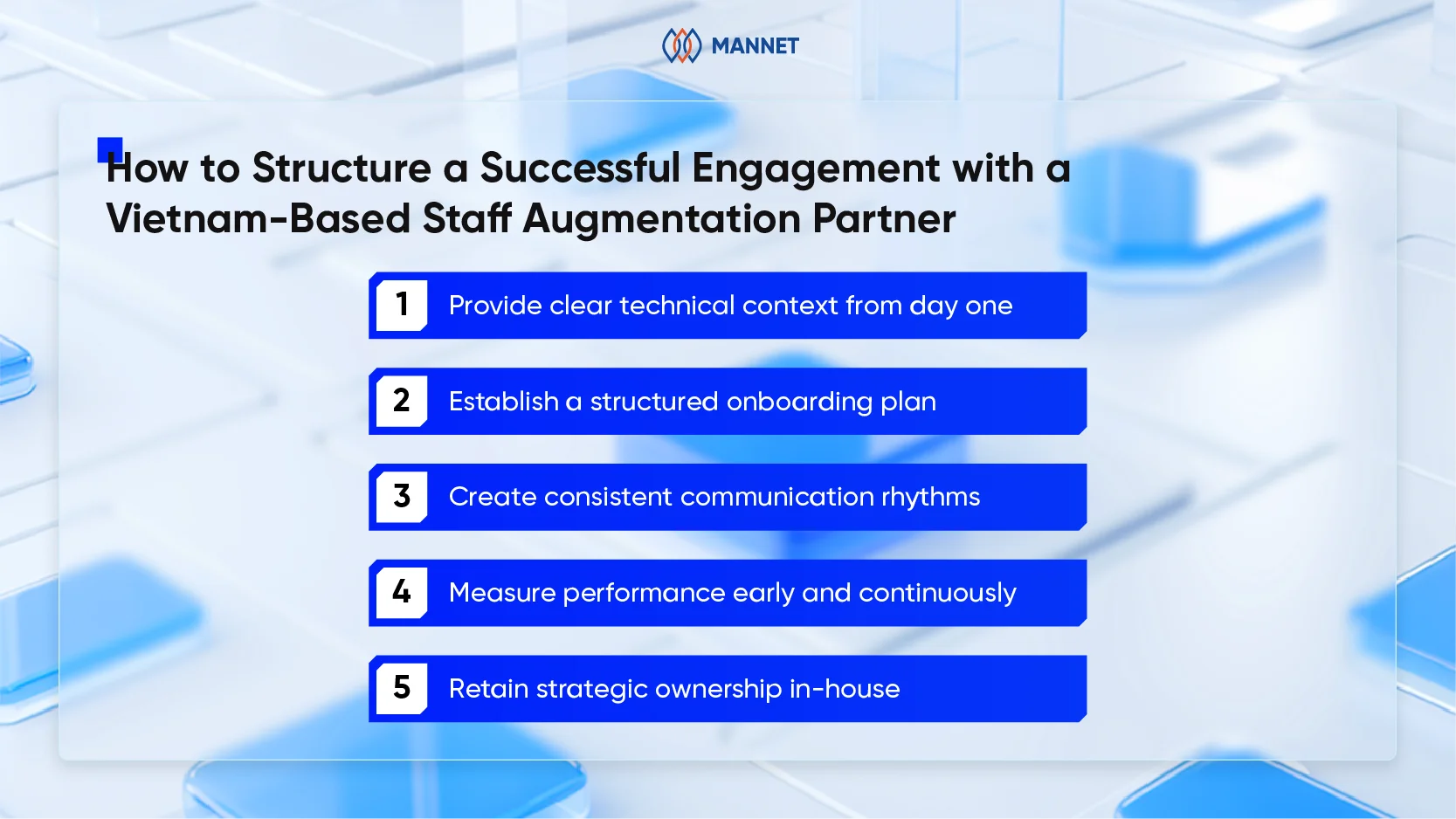
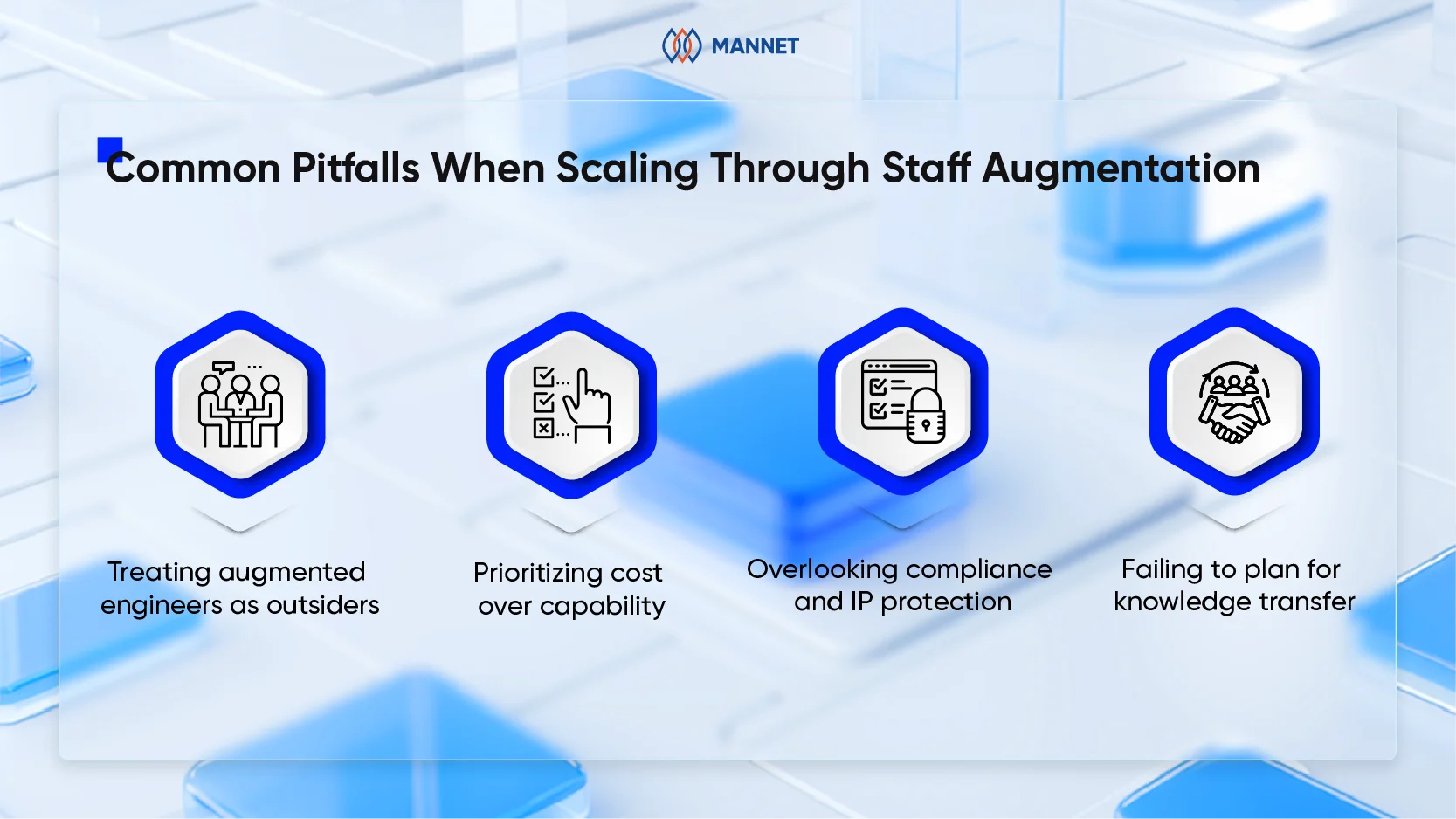
For many organisations, the strongest approach is not to choose one model over the other, but to combine strategic in-house ownership with the scalability and operational reach of RPO.

top rpo companies

Best Payroll Companies in Vietnam | 2026 Updated

As Vietnam continues to cement its position as a strategic hub for technology, manufacturing, and professional services in Southeast Asia, the demands of payroll compliance have grown in parallel. Fast-evolving labor regulations, region-based minimum wages, and mandatory social insurance contributions have elevated payroll from a routine administrative task to a core operational function that directly influences regulatory compliance, employee trust, and business scalability.

For international companies, particularly those scaling engineering teams, digital hubs, or shared service centers, a capable outsourced payroll partner helps reduce compliance exposure, maintain operational continuity, and allow leadership teams to stay focused on growth.

This 2026-updated guide delivers an enterprise-focused analysis of the best payroll companies in Vietnam, helping organizations assess providers based on compliance depth, execution reliability, scalability, and long-term workforce alignment.

Let’s dive in!

Criteria for Selecting the Best Payroll Provider in Vietnam (2026)

Selecting a payroll provider in Vietnam requires more than comparing price lists or service catalogs. The most reliable providers combine regulatory expertise, operational maturity, and an ability to support evolving workforce models.

1. Local compliance expertise

Vietnam’s payroll framework is governed by the Labor Code, Social Insurance Law, and periodic circulars issued by the Ministry of Labor, Invalids, and Social Affairs (MOLISA). A top-tier payroll provider must demonstrate:

  • Deep understanding of statutory payroll components
  • Accurate calculation of social, health, and unemployment insurance
  • Timely updates aligned with regulatory changes

2. Data accuracy and risk management

Payroll errors can result in penalties, audits, and employee dissatisfaction. Strong providers implement multi-layer verification, audit trails, and risk controls to ensure payroll accuracy at scale.

3. Scalability and workforce flexibility

As companies move from small teams to hundreds of employees, payroll systems must scale seamlessly. Providers that support hybrid models, direct employment, staff augmentation, or Employer of Record (EOR), offer greater long-term flexibility.

4. Integration with HR and talent operations

Payroll no longer operates in isolation. Leading providers integrate payroll with onboarding, benefits administration, tax reporting, and HR advisory services to reduce fragmentation.

5. Transparency and governance

Clear service scope, predictable pricing models, and defined accountability are essential, especially for regional or global enterprises managing Vietnam from overseas.

Top 10 Payroll Companies in Vietnam (2026)

1. ManNet – End-to-end payroll & workforce enablement partner

General information

ManNet is a Vietnam-based HR and workforce solutions provider delivering end-to-end payroll services as part of an integrated suite of talent solutions, including Employer of Record (EOR), IT recruitment, staff augmentation, HR consultation, and subsidiary setup advisory. Rather than offering payroll as a standalone function, ManNet embeds payroll execution into a broader workforce governance model designed to support global organizations building compliant, scalable teams in Vietnam.

ManNet’s payroll services are tailored for enterprises and fast-scaling businesses in technology, digital services, and professional sectors. The company’s approach emphasizes not only accurate processing but also compliance, transparency, and alignment with broader HR and workforce strategy.

Website: https://www.mannet.tech/
Headquarters: Hanoi, Vietnam

Scope of payroll services:

ManNet’s payroll offering covers the entire payroll lifecycle:

  • Payroll calculation and processing
    Monthly salary computation aligned with the Vietnam Labor Code, covering gross-to-net calculations, allowances, bonuses, overtime, and statutory deductions.
  • Personal Income Tax (PIT) administration
    Accurate PIT calculation, withholding, filing, and annual tax finalization, handled by local tax specialists to minimize audit and penalty risks.
  • Statutory insurance management
    Full administration of social, health, and unemployment insurance contributions, including employee registration, contribution tracking, and authority reporting.
  • Local banking and payment execution
    Payroll disbursement through compliant Vietnamese banking channels, ensuring timeliness, traceability, and regulatory alignment.
  • Payroll reporting and documentation
    Clear monthly payroll reports, cost breakdowns, and compliance documentation suitable for finance, HR, and regional HQ review.

Key strengths:

  • Payroll as an integrated employment function

ManNet embeds payroll into a broader employment and HR compliance framework, tightly aligned with contracts, benefits, insurance, and workforce changes – reducing fragmentation, rework, and compliance gaps.

  • Vietnam-native execution, not offshore processing

Payroll is handled entirely by Vietnam-based specialists working directly with local authorities and institutions, enabling faster issue resolution, clearer regulatory interpretation, and resilience to policy changes.

  • Designed for IT and high-skill workforces

ManNet is purpose-designed for technology and professional workforces, supporting complex compensation structures, probation cycles, project allowances, and rapid team scaling.

  • Seamless alignment with EOR and HR advisory

Payroll operates as part of a single end-to-end workflow alongside EOR and HR services, ensuring smooth onboarding, clean offboarding, and consistent handling of employment changes.

  • Enterprise-grade risk management

Processes are designed to prevent compliance issues, covering insurance contributions, tax filings, contract alignment, and classification, protecting both employer risk exposure and employee trust.

Key clients:

Global enterprises, scaleups, and innovative startups across technology, software development, digital services, and professional consulting, building teams in Vietnam from individual contributors to full delivery squads.

Pricing:

Global enterprises, scaleups, and innovative startups across technology, software development, digital services, and professional consulting, building teams in Vietnam from individual contributors to full delivery squads.

Best for:

ManNet’s payroll services are particularly well-suited for:

  • International companies running engineering hubs or tech delivery teams in Vietnam
  • Organizations transitioning from contractors to compliant local employment
  • Enterprises that require high transparency and audit-ready payroll governance
  • Companies planning a long-term presence in Vietnam, with or without immediate entity setup

Learn more about ManNet’s integrated payroll services and workforce enablement approach: https://www.mannet.tech/

2. Talentnet

General information

Talentnet Corporation, headquartered in Ho Chi Minh City, Vietnam, is a leading HR and payroll outsourcing firm serving local and multinational companies across Vietnam. With over 1,000 clients and more than 500,000 payslips processed annually, Talentnet offers comprehensive payroll, personal income tax (PIT), compulsory insurance, and HR compliance services, supported by a cloud‑based HR/payroll SaaS platform.

Website: https://www.talentnetgroup.com/vn/our-services/payroll-services

Headquarters: Ho Chi Minh City, Vietnam (with offices in Hanoi, Da Nang, Can Tho, Singapore, and Cambodia)

Key strengths

  • End‑to‑end payroll & benefits: Full payroll processing, PIT management (monthly/quarterly/annual filings, finalization), compulsory insurance (social, health, unemployment), and labour authority reporting in one integrated service.
  • Modern SaaS HR/payroll platform: Cloud‑based system with core HR, payroll, and self‑service portal (e‑pay slips, time & attendance, leave/OT management), accessible via web and mobile apps.
  • Deep local compliance & HR advisory: Regular updates on labour law, tax, and social insurance; support for M&A, restructuring, internal labour rules, and employment contracts.
  • Expat & global mobility services: Work permits, residence cards, initial tax registration, and integrated payroll/tax for expatriates, plus support for inbound/outbound global payroll systems.
  • Strong security & data protection: Internationally certified security systems to protect sensitive payroll and employee data, minimizing risk of leaks and breaches.

Measurable benefits for enterprises

  • Reduces HR administrative workload by up to 25%, freeing HR teams for strategic work.
  • Improves accuracy and compliance, minimizing errors, audits, and penalties.
  • Enables real‑time, customizable reporting for better workforce and cost decisions.
  • Scales reliably for large organizations (500,000+ payslips processed annually).

Key clients

  • Over 1,000 clients in Vietnam, including multinational corporations, joint ventures, and large domestic enterprises across FMCG, manufacturing, retail, hospitality, and financial services.
  • Notable clients include global brands such as adidas, which use Talentnet for local payroll, tax, and compliance.

Pricing model

  • Customized enterprise pricing: Fees are tailored based on company size (number of employees), scope of services (payroll only vs. end‑to‑end payroll + PIT + insurance + advisory), and complexity (e.g., expat support).
  • Typical models include per‑employee‑per‑month (PEPM) fees for core payroll, with additional charges for add‑on services (time & attendance, leave/OT, compliance advisory).
  • Special offers: Discounted “payroll health check” packages (e.g., 15% off for compliance reviews) for initial assessment.

Best for

  • Multinational corporations and large joint ventures with complex payroll structures and significant expatriate workforces.
  • Medium to large Vietnamese enterprises seeking to professionalize HR operations and outsource payroll end‑to‑end.
  • Companies are prioritizing high compliance standards, data security, and strategic HR support over low‑cost, transactional providers.
  • Businesses entering or expanding in Vietnam that need a trusted local partner for payroll, tax, insurance, and labour law compliance.

3. PwC Vietnam

General information

PwC Vietnam’s People Services team offers end‑to‑end outsourced payroll and payroll advisory services for both global and Vietnamese employers. As part of the PwC global network (157 countries, 200,000+ professionals), PwC Vietnam combines deep local expertise in Vietnamese labour law, personal income tax (PIT), and social/health/unemployment insurance (SHUI) with the credibility and resources of a Big Four firm.

Website:

Headquarters:

  • Vietnam: Ho Chi Minh City (Saigon Tower, 29 Lê Duẩn, District 1) and Hanoi
  • Global: PwC International Limited, Malta (with a global payroll practice in 100+ countries)

Key strengths

  • Big Four credibility & global reach:
    PwC’s global payroll and tax network provides a trusted, internationally recognized partner for multinationals, with consistent standards and the ability to support cross‑border payroll and mobility.​
  • End‑to‑end outsourced payroll:
    Full payroll processing for local and expatriate employees, including salary/bonus calculation, payslip generation, payroll reconciliation, and payments via trust account, with support for multiple pay runs and schedules.​
  • Integrated tax & compliance expertise:
    Seamless access to PwC’s tax, legal, and HR teams for employment tax, corporate tax, equity & reward, and HR operations, ensuring payroll is aligned with broader tax and compliance strategy.​
  • Strong local compliance focus:
    Deep understanding of Vietnamese labour law, PIT, and SHUI regulations, with specialists who handle tax code registration, monthly/quarterly PIT returns, PIT finalization, and monthly SHUI reports and claims.​
  • Scalable solution for all sizes:
    Services are designed to be a cost‑effective, scalable alternative to an in‑house payroll department, suitable for start‑ups with a single employee up to large organizations with complex payroll structures.​

Key clients

  • PwC Vietnam serves a wide range of clients, including:
    • Multinational corporations and foreign investors in Vietnam.
    • Large Vietnamese enterprises, joint stock companies, and state‑owned enterprises.
    • Financial institutions and other regulated industries that require high compliance standards.​
  • As a leading Big Four firm in Vietnam, PwC is a preferred partner for companies that prioritize brand reputation, regulatory compliance, and integrated professional services.​

Pricing model

  • Customized enterprise pricing:
    Fees are tailored based on the number of employees, complexity of payroll (e.g., multiple pay runs, expatriates, variable pay structures), and scope of services (outsourced payroll only vs. combined with tax and HR advisory).​
  • Typical models include:
    • Per‑employee‑per‑month (PEPM) fees for core outsourced payroll processing.
    • Project‑based or retainer fees for payroll advisory, compliance reviews, and system implementation support.​
  • Pricing is quoted after a detailed assessment of the client’s payroll structure and requirements, ensuring alignment with budget and strategic goals.​

Best for

  • Multinational corporations and foreign investors in Vietnam that need a Big Four‑backed, highly compliant payroll partner.
  • Large Vietnamese enterprises and state‑owned companies seeking to outsource complex payroll and SHUI obligations.
  • Start‑ups and growing businesses without an established in‑house payroll function, looking for a scalable, cost‑effective alternative.
  • Companies that value integrated support from tax, legal, and HR advisory teams alongside payroll processing.

4. ManPower Vietnam

General information

Manpower Vietnam, part of ManpowerGroup, is a leading workforce solutions provider in Vietnam, offering payroll services as a core component of its HR and staffing portfolio. Its payroll offering is designed to handle the full monthly cycle for local and foreign employers, including salary calculation, payslip generation, personal income tax (PIT), social/health/unemployment insurance (SHUI), and annual tax finalization, with a strong focus on compliance and employee support.

Website: https://www.manpower.com.vn/en/for-employers/our-solutions/payroll-services

Headquarters: Ho Chi Minh City, Vietnam (with operations in Hanoi and other major cities)

Key strengths

  • Payroll + EOR for foreign companies:
    Manpower’s key differentiator is its ability to provide Employer of Record (EOR) payroll services for foreign companies without a local legal entity, enabling them to hire and pay employees in Vietnam in full compliance with local law.​
  • Integrated with staffing & workforce solutions:
    Payroll is tightly bundled with permanent recruitment, temporary staffing, and workforce outsourcing, making it ideal for companies that want a single provider for hiring, payroll, and workforce management.​
  • Strong local compliance & employee support:
    Deep, up‑to‑date knowledge of Vietnamese payroll laws and regulations, with a professional team that handles employee queries on salary, tax, and insurance, reducing HR’s administrative burden.​
  • Simple, full‑cycle payroll management:
    End‑to‑end payroll processing (salary, payslips, PIT, SHUI, tax finalization) in a straightforward, easy‑to‑manage model, ideal for companies that prefer a simple, reliable solution over complex SaaS platforms.​
  • Transparent, percentage‑based pricing:
    Fees are typically based on a percentage of the employee’s annual salary, with clear, upfront quotes and no hidden costs, making budgeting simple and predictable.​

Key clients

  • Manpower Vietnam serves a wide range of clients across major industries, including manufacturing, FMCG, retail, logistics, and services.​
  • Among its clients are some of the world’s most recognized global brands, which rely on Manpower for compliant payroll, staffing, and workforce management in Vietnam.​

Pricing model

  • Transparent, percentage‑based pricing:
    Fees are typically structured as a percentage of the employee’s annual salary, with clear, upfront quotes and no hidden costs.​
  • Flexible packages:
    Clients can choose a full payroll package or a tailored solution (e.g., payroll only, payroll + EOR, payroll + staffing), with pricing adjusted to scope and complexity.​

Best for

  • Foreign companies without a local legal entity that need EOR payroll services to hire and pay employees in Vietnam.
  • SMEs and growing businesses that want a simple, compliant, and cost‑effective payroll outsourcing solution.
  • Companies already using or considering Manpower for staffing, recruitment, or workforce outsourcing and want to bundle payroll with those services.
  • Employers that prioritize strong local compliance, employee support, and a straightforward, full‑cycle payroll process over highly customized SaaS platforms.

5. HR2B

General information

HR2B (Talent Recruitment JSC) is a Vietnamese HR consulting and outsourcing company with over 20 years of experience, headquartered in Ho Chi Minh City. It specializes in payroll outsourcing, staffing, and executive search, serving both domestic and foreign enterprises in Vietnam. HR2B positions itself as a strategic HR partner that combines the accuracy of an accounting firm with the HR focus of an in‑house HR department.

Website: https://www.hr2b.com/service/payroll-outsourcing/

Headquarters: Ho Chi Minh City, Vietnam (with offices in Hanoi and Da Nang)

Key strengths

  • Vietnam‑only, deep local expertise:
    HR2B is a purely Vietnam‑focused provider (not part of a global network), which allows it to offer highly tailored, market‑specific payroll and HR advice that reflects real local practice, not just legal text.​
  • Payroll + HR advisory in one model:
    Unlike pure payroll processors, HR2B explicitly combines payroll accuracy with HR advisory on common employee relations and payroll issues, giving clients actionable, fact‑based guidance on how to handle disputes, bonuses, and policies.​
  • High accuracy & timeliness track record:
    HR2B highlights a 99.95% payroll accuracy rate and 99.98% timeliness rate across 500,000+ payroll transactions, positioning itself as a highly reliable, process‑driven provider for companies that prioritize error‑free, on‑time payments.​
  • Strong HR integration (staffing + payroll):
    Payroll is tightly linked with HR2B’s staffing and executive search services, making it a natural choice for companies that want to outsource both hiring and payroll under one local partner, especially for mid‑to‑senior roles.​
  • Dedicated, responsive local team:
    HR2B emphasizes a dedicated payroll team (20+ specialists) and strong customer service, with quick response times and a clear escalation process to fix issues fast, which is valued by clients with complex or sensitive payroll needs.​

Key clients

  • HR2B serves more than 40 clients nationwide, including large corporations and foreign enterprises operating in Vietnam.​
  • Its client base includes both Vietnamese enterprises and foreign companies (e.g., Swinburne University was its first payroll client), particularly those that prefer a local, Vietnam‑only HR and payroll partner.​

Pricing model

  • Custom, project‑based pricing:
    Fees are tailored to the number of employees, complexity of payroll, and scope of services (e.g., payroll only vs. payroll & HR advisory), with no public fixed tariff.​
  • Flexible packages:
    Clients can choose a standard payroll outsourcing package or a more customized solution that includes additional HR support, depending on their needs and budget.​

Best for

  • Vietnamese enterprises and foreign companies in Vietnam that prefer a local, Vietnam‑only HR and payroll partner with deep market knowledge.
  • Companies that want payroll combined with practical HR advisory on employee relations, bonuses, and policies, not just transactional processing.
  • Businesses that prioritize high accuracy, on‑time payments, and a responsive local team over a global brand or multi‑country platform.
  • Organizations already using or considering HR2B for staffing or executive search and want to bundle payroll with those services.

6. Faro Vietnam

General information

Faro Vietnam (Faro Recruitment Vietnam JSC) is a professional HR services provider founded in 2006, headquartered in Hanoi with operations in Ho Chi Minh City. It offers payroll outsourcing, HR outsourcing, staffing, and executive search, positioning itself as a compliance‑driven partner for foreign and local enterprises in Vietnam.

Website: https://www.farovietnam.com.vn/services/payroll-outsourcing

Headquarters: Hanoi, Vietnam (with presence in Ho Chi Minh City)

Key strengths

  • Compliance‑first payroll model:
    Faro’s core differentiator is its strict focus on legal compliance in every payroll process, ensuring that salary calculations, tax filings, and social insurance contributions fully adhere to Vietnamese labour and tax regulations, which is especially valuable for risk‑averse foreign companies and joint ventures.​
  • Bilingual (English/Vietnamese) support:
    The team provides strong bilingual support for payroll and HR matters, making it easier for foreign HR managers and finance teams to understand and control payroll processes without language barriers.​
  • Synergy between payroll and executive search:
    Payroll is closely integrated with Faro’s executive search and recruitment services, allowing clients to outsource both high‑level hiring and payroll under one trusted local partner, which improves consistency and reduces coordination overhead.​
  • Dedicated HR compliance consulting:
    Beyond transactional payroll, Faro offers HR compliance consulting, helping clients manage complex labour regulations, social insurance declarations, and internal HR processes, turning payroll into a strategic compliance function.​
  • High accuracy and confidentiality:
    Faro emphasizes meticulous accuracy in salary calculations and strong confidentiality of payroll data, appealing to companies that handle sensitive compensation structures and expatriate packages.​

Key clients

  • Faro Vietnam serves a mix of foreign companies, joint ventures, and local enterprises across various industries, particularly those that value a compliance‑driven, bilingual HR and payroll partner.​
  • Its client base includes companies that use Faro for both executive search and payroll outsourcing, leveraging the synergy between hiring and payroll management.​

Pricing model

  • Custom, project‑based pricing:
    Fees are tailored to the number of employees, complexity of payroll (e.g., expatriates, variable pay), and scope of services (payroll only vs. payroll & HR compliance consulting), with no public fixed tariff.​
  • Flexible packages:
    Clients can choose a standard payroll outsourcing package or a more customized solution that includes additional HR and compliance support, depending on their needs and budget.​

Best for

  • Foreign companies and joint ventures in Vietnam that prioritize strict legal compliance and risk mitigation in payroll and HR.
  • Companies that need strong bilingual (English/Vietnamese) support for payroll and HR matters, especially when managing expatriate and local staff.
  • Organizations already using or considering Faro for executive search and recruitment, and want to bundle payroll with those services.
  • Businesses that value high accuracy, confidentiality, and a dedicated compliance‑focused HR/payroll partner over a global multi‑country platform.

7. NIC

General information

NIC Global Sourcing JSC (NICVN) is a leading HR outsourcing company in Vietnam, founded in 2002 as one of the first professional HR services providers in the country. It offers comprehensive payroll outsourcing, staffing, executive search, mass recruitment, and HR advisory services, positioning itself as a one‑stop HR partner for local and multinational companies.

Website: https://nicvn.com

Headquarters: Hanoi, Vietnam (with offices in Ho Chi Minh City and other major cities)

Key strengths

  • Long‑standing local HR & payroll expertise:
    NICVN is one of Vietnam’s earliest HR outsourcing firms, with 20+ years of experience serving local companies, multinationals, and FDI enterprises, giving it deep institutional knowledge of Vietnamese HR and payroll practices.​
  • Integrated HR/payroll + staffing model:
    Its core differentiator is the tight integration of payroll with staffing, executive search, mass recruitment, and hourly labor services, allowing clients to manage hiring, payroll, and workforce operations under one local partner.​
  • Large‑scale, tailored HR solutions:
    NICVN offers highly customized HR and payroll packages designed around each client’s size and needs, from short‑term assignments to full‑time HR outsourcing, rather than a one‑size‑fits‑all product.​
  • Strong expatriate & representative office support:
    Beyond payroll, NICVN provides legal support for representative offices and expatriates, including work permits, residence cards, and related compliance, making it a practical choice for foreign companies setting up in Vietnam.​
  • Focus on compliance and risk reduction:
    The company emphasizes strict adherence to Vietnamese labour, tax, and social insurance regulations, helping clients avoid penalties, errors, and disputes in payroll and HR processes.​

Key clients

  • NICVN serves a broad client base across Vietnam, including local enterprises, multinational corporations, and FDI companies in various industries.​
  • Its network includes both domestic firms and foreign representative offices that rely on NICVN for integrated HR, payroll, and expatriate legal support.​

Pricing model

  • Custom, tailored pricing:
    Fees are structured around the client’s specific needs (number of employees, scope of services, complexity of payroll), with no public fixed tariff.​
  • Flexible packages:
    Clients can choose from different service bundles (e.g., payroll only, payroll + staffing, full HR outsourcing) depending on their requirements and budget.​

Best for

  • Companies that want a single, long‑established Vietnamese HR/payroll partner with strong local experience and a broad service portfolio.
  • Businesses that need payroll tightly integrated with staffing, mass recruitment, or executive search under one provider.
  • Foreign companies and representative offices in Vietnam that also require expatriate legal support and representative office services, alongside payroll.
  • Organizations that prefer a tailored, relationship‑driven HR/payroll model over a standardized, purely transactional solution.

8. ADP

General information

ADP is a global HCM and payroll provider with over 75 years of experience, serving more than 1.1 million clients worldwide. In Vietnam, ADP does not operate a standalone local payroll entity but delivers payroll and HR services through partnerships and its global platforms, enabling companies to manage Vietnamese employees as part of a broader regional or global workforce.

Website: https://www.adp.com

Headquarters: Roseland, New Jersey, USA (with global operations in 140+ countries, including Vietnam via partners)

Key strengths

  • Global HCM platform with local depth:
    ADP’s main differentiator is its integrated, scalable HCM platform (e.g., ADP Celergo) that allows multinationals to manage payroll, HR, time, tax, and benefits for Vietnamese employees within a single global system, while still meeting local compliance requirements.​
  • Deep local market insights & salary benchmarking:
    Through its Mercer partnership and local data, ADP provides access to detailed salary surveys and market insights for Vietnam, enabling companies to design competitive compensation structures and make data‑driven HR decisions.​
  • End‑to‑end payroll outsourcing & compliance:
    ADP offers fully managed payroll outsourcing, handling wage calculation, tax withholding, statutory reporting, and payments, while ensuring compliance with Vietnamese labour, tax, and social insurance regulations.​
  • Unified technology & integration:
    ADP’s platform seamlessly integrates payroll with HR, talent, time, and benefits administration, giving HR and finance teams a single source of truth and advanced reporting for workforce analytics.​
  • Scalability for large and complex organizations:
    The solution is designed for large businesses and multinationals with complex workforce structures, multiple pay runs, and a need for consistent processes across countries.​

Key clients

  • ADP serves a wide range of multinational corporations and large enterprises globally, including many that operate in Vietnam as part of their Asia‑Pacific or global footprint.​
  • Its clients in the region typically include large MNCs that use ADP’s global HCM platform to manage payroll and HR for their Vietnamese employees alongside other markets.​

Pricing model

  • Custom, enterprise‑grade pricing:
    Fees are tailored to the number of employees, complexity of payroll, scope of services (payroll only vs. full HCM), and level of outsourcing (managed vs. fully outsourced), with no public fixed tariff.​
  • Flexible models:
    Clients can choose from different models (e.g., payroll processing, managed payroll, full outsourcing) depending on how much control they want to retain and their integration needs.​

Best for

  • Multinational corporations and large enterprises that want a unified, global HCM platform with payroll for Vietnam integrated into a broader regional or global system.
  • Companies that value deep local market insights, salary benchmarking, and data‑driven compensation design alongside payroll execution.
  • Organizations with complex workforce structures, multiple pay runs, and a need for scalable, compliant payroll and HR processes across multiple countries.
  • Businesses that prefer a global, technology‑led HCM provider over a purely local payroll processor.

Best Practices for Outsourcing Your Company’s Payroll

Outsourcing payroll in Vietnam brings clear operational and compliance benefits, but success depends on how you structure the partnership and govern the relationship with your payroll provider. Below are best practices that leading organizations use to ensure their outsourced payroll operations are efficient, compliant, and strategically aligned.

1. Start with a clear “why”

Before choosing a provider, define your main goals:

  • Compliance & risk reduction: Avoid fines for incorrect PIT, SHUI, or late filings.
  • Time & cost savings: Reduce HR/finance workload and avoid building a full in‑house payroll team.
  • Scalability: Support rapid hiring or market entry without changing internal processes.
  • Data security & control: Protect sensitive payroll data with a secure, auditable system.

Your “why” will shape the type of provider (EOR vs. pure payroll outsourcing) and the level of service you need.

2. Choose the right outsourcing model

In Vietnam, there are three main models:

  • Pure payroll outsourcing
    You keep the employment contract; the provider handles salary calculation, PIT, SHUI, payslips, and government reporting.
    → Best for: Companies with a local legal entity that want to keep direct control over employment but outsource the transactional work.
  • Employer of Record (EOR) / Payroll as EOR
    The provider becomes the legal employer; they hire, pay, and manage compliance for your employees.
    → Best for: Foreign companies without a local entity, or those entering Vietnam quickly and avoiding entity setup.
  • Hybrid (HR + payroll outsourcing)
    Payroll is bundled with staffing, recruitment, or full HR outsourcing.
    → Best for: Companies that want one partner for hiring, payroll, and HR operations.

3. Define your scope and requirements

Be specific about what you expect the provider to manage:

  • Core payroll:
    • Salary, bonuses, allowances, overtime, deductions.
    • Payslip generation and distribution (digital + paper if needed).
  • Tax & insurance:
    • Personal income tax (PIT) calculation, monthly/quarterly reporting, and annual finalization.
    • Social, health, and unemployment insurance (SHUI) declarations and claims.
  • Compliance & reporting:
    • Monthly SHUI reports, annual unemployment insurance report, semi‑annual foreign employee reports, and labour authority filings.
  • Technology & access:
    • Web/mobile portal for HR and employees (payslips, leave, attendance).
    • Integration with your existing HRIS, time & attendance, or ERP system.
  • Support & SLAs:
    • Response time for queries, error correction process, and escalation path.

A clear scope prevents misunderstandings and ensures the provider can deliver what you actually need.

4. Evaluate providers on 5 key criteria

When comparing payroll providers, focus on:

Local compliance expertise

    • Deep knowledge of Vietnam’s Labour Code, PIT, SHUI, and recent changes (e.g., trade union contributions, minimum wage, digital health insurance).
    • Proven experience with foreign employees (work permits, residence cards, tax finalization before departure).

Track record & stability

    • Years in the Vietnam market, number of clients, and client references (especially in your industry).
    • Stable ownership and financial health (avoid providers that are too small or new).

Technology & security

    • Modern, secure SaaS platform with role‑based access, audit trails, and data encryption.
    • Support for e‑payslips, e‑reports, and integration with your systems.

Service model fit

    • Does their model match your needs (EOR vs. payroll outsourcing vs. HR + payroll)?
    • Are they flexible enough to handle your pay frequency, employee types (local/expat), and special cases (bonuses, commissions, part‑time)?

Support quality

    • Bilingual (English/Vietnamese) support for HR and finance teams.
    • Clear SLAs for payroll accuracy, timeliness, and issue resolution.

5. Prepare your internal processes

Before going live, align your internal side:

  • Standardize employee data
    • Define a clear template for salary, allowances, contracts, and personal information.
    • Ensure data is complete and up to date (ID, tax code, dependents, insurance status).
  • Align HR, finance, and legal
    • Get buy‑in from HR (data input), finance (budgeting, payments), and legal (contract structure, EOR vs. local entity).
    • Define who is responsible for approvals, changes, and sign‑offs.
  • Set up a governance model
    • Assign a payroll owner and a backup.
    • Establish a monthly review process (reconciliation, error analysis, compliance checks).

6. Run a pilot before full rollout

Start with a small group (e.g., one department or location) to test:

  • Data accuracy and timeliness.
  • Payslip clarity and employee experience.
  • Compliance with PIT, SHUI, and reporting.
  • Provider responsiveness and issue resolution.

Use the pilot to refine your data process, SLAs, and internal controls before scaling to the entire workforce.

7. Monitor performance and compliance

Once live, track key metrics:

  • Accuracy:
    • Payroll error rate (incorrect salary, tax, or insurance).
    • Number of corrections and employee complaints.
  • Timeliness:
    • On‑time payment rate.
    • On‑time submission of PIT, SHUI, and government reports.
  • Compliance:
    • Audit readiness (can the provider quickly provide all payroll and tax records?).
    • Updates on regulatory changes (minimum wage, tax rates, insurance caps).

Review these metrics regularly with the provider and adjust the contract or processes as needed.

8. Plan for growth and changes

Payroll outsourcing is not a one‑time project. Plan for:

  • Headcount growth: Ensure the provider can scale with your hiring plans.
  • Market expansion: If entering new provinces or countries, check if the provider can support multi‑location or multi‑country payroll.
  • System changes: When upgrading your HRIS or ERP, involve the payroll provider early to ensure smooth integration.

FAQs about Best Payroll Companies in Vietnam

1. What is the main difference between a payroll outsourcing provider and an Employer of Record (EOR)?

A payroll outsourcing provider handles salary, tax, and insurance for employees you directly employ, while an EOR becomes the legal employer, allowing foreign companies to hire in Vietnam without setting up a local entity.

2. How do I choose the right payroll company for my business size?

For SMEs and startups, look for simple, transparent pricing and strong local compliance; for large multinationals, prioritize global integration, advanced HR tech, and deep tax/insurance expertise.

3. Are payroll services in Vietnam secure and compliant with local laws?

Yes, reputable providers follow Vietnamese labour, tax, and social insurance regulations, use secure systems, and provide audit-ready records, but it’s important to verify their track record and data protection practices.

4. Can payroll providers handle both local and expatriate employees?

Most top providers support both, including work permits, residence cards, PIT, and SHUI for expats, but always confirm their experience with foreign employees and tax finalization before departure.

5. How much does payroll outsourcing typically cost in Vietnam?

Pricing varies: it can be a fixed fee per employee per month or a percentage of salary, depending on scope (payroll only vs. full EOR), company size, and complexity (e.g., expats, multi-location).

Partner with a Best-in-Class Payroll Provider in Vietnam

The leading payroll companies reviewed in this guide reflect the breadth and maturity of Vietnam’s payroll outsourcing market in 2026. From global firms with standardized delivery models to local providers with deep regulatory expertise, each brings distinct strengths, whether in enterprise-scale processing, compliance advisory, technology enablement, or sector-specific execution.

By concentrating specifically on Vietnamese employers and international companies operating in Vietnam, ManNet addresses the core priorities of modern organizations: accurate and compliant payroll execution, seamless handling of statutory insurance and personal income tax, secure and modern payroll infrastructure, and responsive bilingual support that explains regulatory requirements in clear, practical business language.

Instead of coordinating multiple vendors for payroll, tax, and HR administration, companies can rely on a single partner with a strong understanding of both the day-to-day realities of payroll execution in Vietnam and the long-term people strategy behind workforce growth.

To learn how ManNet delivers end-to-end, compliant payroll services tailored for Vietnam, contact us!

UncategorizedUncategorizedUncategorizedUncategorizedUncategorizedUncategorizedUncategorizedUncategorizedUncategorizedUncategorized

Best RPO Companies in Vietnam | 2026 Updated

Vietnam is rapidly emerging as one of Southeast Asia’s most competitive talent markets, driven by sustained economic growth, rising foreign investment, and strong demand for skilled professionals, especially in technology, manufacturing, and professional services. According to Vietnam’s General Statistics Office, the national labour force surpassed 53 million workers in 2025, while demand for mid- to high-skill roles continues to outpace supply in key sectors.

In this environment, many organisations are finding that traditional, in-house recruitment models struggle to keep up with hiring volumes, speed requirements, and market complexity. As a result, Recruitment Process Outsourcing (RPO) is increasingly adopted as a scalable, performance-driven approach to talent acquisition. RPO allows companies to streamline hiring operations, access specialised recruitment expertise, and build consistent talent pipelines without expanding internal HR teams.

This 2026-updated guide explores the top RPO companies in Vietnam, focusing on providers with proven local execution, industry expertise, and the ability to support enterprise-level hiring strategies.

Let’s dive in!

Criteria for Selecting the Best RPO Provider in Vietnam (2026)

To identify Vietnam’s most credible RPO providers, we applied a focused evaluation framework grounded in the practical hiring challenges of international and high-growth companies. The assessment prioritizes execution capability, local market depth, and the ability to deliver sustained hiring outcomes at scale.

1. RPO scope & delivery model

Leading RPO companies offer end-to-end recruitment support, from workforce planning and sourcing strategy to interview coordination and onboarding alignment. Providers that operate as an extension of in-house TA teams consistently deliver better hiring outcomes than transactional vendors.

2. Local market & compliance expertise

Vietnam-specific hiring knowledge is critical. Top providers demonstrate a deep understanding of local labor practices, role benchmarking, and regulatory considerations, particularly for IT, engineering, and professional roles.

3. Talent access & industry focus

Strong RPO partners maintain active talent networks and specialization in key hiring domains. Providers with proven experience in technology and high-skill recruitment are better equipped to deliver quality at scale.

4. Data, process & hiring intelligence

High-performing RPO firms use structured processes, recruitment analytics, and performance tracking to improve time-to-hire, candidate quality, and pipeline visibility continuously.

5. Scalability & flexibility

The ability to scale hiring up or down – across roles, locations, or project phases – is essential. Enterprise-ready RPO companies support both rapid expansion and controlled hiring without service degradation.

6. Service quality & stakeholder experience

Clear communication, dedicated account management, and consistent candidate experience directly impact employer brand and hiring efficiency.

7. Commercial transparency & value

Beyond pricing, top RPO providers deliver measurable value through reduced hiring timelines, optimized internal workload, and sustained recruitment performance.

Top 10 RPO Companies in Vietnam (2026)

1. ManNet – Human Network

ManNet, a Vietnam-based subsidiary of LTS Group, leads as a Recruitment Process Outsourcing (RPO) provider, specializing in helping international companies build and scale high-skill IT and engineering teams. ManNet delivers end-to-end talent execution, from headhunting and staff augmentation to full subsidiary setups, aligned with long-term workforce strategies and local market realities. With on-the-ground teams across 4 branches, it connects global clients to 10,000+ IT pros, qualifying fast, compliant hires in competitive sectors such as software, AI, and professional services.​

ManNet’s edge lies in embedding directly into clients’ operations, owning the full lifecycle from requirements analysis (in 4 hours) to onboarding, using AI-powered ATS, LinkedIn/GitHub sourcing, and Vietnam-native expertise. It tackles IT talent shortages – where 76% of firms struggle and hires average 41 days – by delivering top talent in 3-5 days or full teams in 7, with seamless integration to EOR, payroll, and compliance. This makes ManNet ideal for engineering hubs, delivery centers, and market entry in Vietnam.

Website: https://www.mannet.tech/it-recruitment-services/

Why ManNet stands out

  • Fast growth & scale: Part of LTS Group (est. 2016) with subsidiaries in Japan, USA, South Korea; 500 engineers placed, 16 loyal clients across 4 continents.​
  • Vast, specialized pool: 10,000+ candidates in IT roles (developers, AI engineers, DevOps), seniorities (junior to expert), domains (BFSI, e-commerce, healthcare).​
  • Tech-driven RPO: AI matching, ATS/CRM automation, video interviews for bias-free processes; full-cycle from scoping to handover.​
  • Proven results: Japanese client case – 5 hires (full-stack devs, tech leads) in 8 weeks, 40% faster time-to-hire, zero rejections, 6-month retention.​
  • Strong guarantees: 60-day policy (free replacements or 50% refund); scalable from specialists to full teams.​
  • Compliance & security: Local labor mastery, NDAs, VPN, data loss prevention, and biometrics.​

Core services

  • Full-cycle RPO & talent acquisition: Workforce planning, sourcing/screening (headhunting/RPO), interviews, offers, onboarding.​
  • IT staff augmentation: On-demand boosts for software, testing, AI, and cloud roles without hiring hassles.​
  • End-to-end subsidiary setup: Recruitment, management, payroll, compliance, and IP transfer in Vietnam.​
  • Project-based scalable RPO: For tech hubs, delivery centers, CV services, employer branding, and market insights.​
  • Tech platforms: ATS, AI tools, job boards (LinkedIn, GitHub), CRM (HubSpot), video (Zoom).​

Awards & recognition

  • LTS Group’s subsidiary: Fast-growing IT outsourcing leader with QA roots, trusted in the USA/Japan/Korea.​
  • Client portfolio: 16 partners globally; beats industry hiring delays with high-quality, rapid placements.​
  • RPO excellence: Vietnam-native execution for consistent quality, acceptance rates, and scalable capacity.​

2. Talentnet

Talentnet leads Vietnam’s premier HR outsourcing companies, delivering full-scope solutions including RPO, payroll, compliance, and talent acquisition for over 150 foreign and local firms. With 15+ years of expertise, it blends international standards with local insights to serve multinationals across manufacturing, tech, retail, and banking, achieving 100% punctuality, accuracy, and legal compliance. Ideal for companies scaling operations in Vietnam, Talentnet manages end-to-end HR to minimize risks and focus on core business.​

Talentnet leverages extensive candidate databases, professional networks, and on-site teams, ensuring quick access to quality talent for urgent, high-volume needs. It excels in RPO by handling workforce planning, sourcing, screening, and onboarding, reducing internal workloads while upholding employer branding and Vietnam-specific compliance.

Website: https://www.talentnetgroup.com/vn/our-services/hr-outsourcing-services/rpo-recruitment-process-outsourcing

Why Talentnet stands out

  • Longevity & scale: 15+ years serving 150+ clients like Fortune 500s; handles 30,000-employee payrolls with zero disruptions.​
  • Talent access: Vast databases for IT, engineering, and finance roles; high acceptance rates via benchmarks and cultural fit.​
  • Proven compliance: 100% legal adherence, 24/7 support; digitized records, tax verification in case studies.​
  • Efficiency gains: Saves 25% HR time/tasks; seamless transitions like 10,000 social insurance books issued.​
  • Tech integration: Payroll software excellence; RPO for scalable hiring without vendor dependency.​
  • Client results: Zero complaints in transitions, sustained stability over 9 years for multinationals.​

Core services

  • Full-cycle RPO: Sourcing, screening, interviews, offers, and onboarding for technical/high-skill roles.​
  • Payroll outsourcing: Processing, tax filing, compliance, and digital transformation with 100% accuracy.​
  • Talent acquisition: Volume hiring via networks; executive search and staffing.​
  • HR compliance & advisory: Labor relations, expat support, documentation standardization.​
  • Employer branding: Market insights, Vietnam HR Awards pioneer for strategy elevation.​

Awards & recognition

  • HR Vendor of the Year (2025, second consecutive).​
  • Gold Best HR Outsourcing Partner, Bronze Best RPO Partner (2024).​
  • ADP Payroll Partner Excellence (2023); Vietnam Excellent Brand (2013).​
  • HCMC Excellent Entrepreneur (CEO, multiple years); Top HR Outsourcing lists.

3. Manpower

ManpowerGroup Vietnam, established in 2008 as the first 100% foreign-invested HR firm, leads in workforce solutions, including RPO, staffing, and outsourcing for industries like IT, banking, FMCG, and manufacturing. Backed by 75+ years of global expertise, it provides customized recruitment, compliance, and talent strategies to multinationals and scaling locals, ensuring flexible, ethical scaling in Vietnam. With offices in Hanoi and HCMC, it excels in connecting clients to high-quality talent amid market demands.​

ManpowerGroup’s edge is its comprehensive solutions, from permanent recruitment and RPO to payroll outsourcing and employee leasing, delivered with deep Vietnam labor code knowledge and government partnerships for seamless compliance. It addresses staffing challenges for SMEs and startups via temporary/project staffing, executive search, and HR consulting, minimizing headcount risks while boosting agility. This makes it ideal for tech expansions, seasonal peaks, and ethical, data-driven hiring.​

Website: https://www.manpower.com.vn/en/for-employers/our-solutions/high-volume-recruitment

Why ManpowerGroup stands out

  • Global-local strength: 75 years worldwide, Vietnam pioneer since 2008; serves diverse sectors with proven SME/startup support.​
  • Ethical leadership: World’s Most Ethical Company (15th time 2024, 14th prior); ISO-aligned compliance excellence.​
  • Flexible talent access: Vast networks for IT/telecom, finance, hospitality; headhunting for seniors/executives.​
  • Compliance mastery: Licensed by the Ministry of Labor; handles taxes, insurance, and audits with a zero-disruption track record.​
  • Scalable models: RPO for expansions, leasing for peaks; reduces costs, navigates regulations via case-proven expertise.​
  • Client impact: High reviews for reliability; transforms HR from burden to growth enabler.​

Core services

  • Recruitment Process Outsourcing (RPO): Full lifecycle for volume/tech hires, executive retained search.​
  • Staffing & outsourcing: Temporary leasing, payroll processing with accuracy/confidentiality.​
  • Permanent recruitment: Data-driven sourcing for permanent roles across industries.​
  • HR compliance & consulting: Labor code advisory, training, performance systems for SMEs.​
  • Workforce planning: Roadmaps, comp/benefits, culture development.​

Awards & recognition

  • World’s Most Ethical Companies (15 consecutive years as of 2024).​
  • Top 10 Vietnam HR Outsourcing (ranked by industry lists).​
  • Recognized for diversity/inclusion; best place for women/disability.​
  • 50 Companies That Changed the World honoree.​

4. Robert Walters Vietnam

Robert Walters Vietnam leads specialist recruitment agencies, excelling in mid-to-executive placements across accounting, finance, IT, HR, marketing, and supply chain for top multinationals. Established in 2011 in Ho Chi Minh City, the firm leverages 40 years of global expertise to connect Vietnam’s leading employers with high-caliber professionals amid rapid economic growth. With a bespoke approach, it delivers tailored headhunting and RPO, fostering growth for businesses and careers in Vietnam’s dynamic market.​

The company’s edge lies in deep local insights paired with a vast network, qualifying precise matches for specialized roles where speed, cultural fit, and market intelligence drive success. Robert Walters outperforms in Vietnam’s recovering economy, with 6.4% GDP growth in 2024, by navigating talent shortages in tech transformation and supply chain via personalized storytelling and holistic advisory. This positions it as the premier partner for organizations scaling in HCMC, emphasizing genuine relationships over transactional hiring.​

Website: https://www.robertwalters.com.vn/our-services/recruitment-process-outsourcing.html

Why Robert Walters stands out

  • Proven longevity: 11+ years in Vietnam, 40 global years; connects top firms with pros in banking, tech, healthcare.​
  • Specialist expertise: Deep focus on finance, HR, sales, procurement; mid-senior/executive headhunting with high success rates.​
  • Market mastery: Insights on Vietnam’s supply chain hub status, hiring acceleration in manufacturing/tech.​
  • Bespoke service: Listens to stories/aspirations for perfect fits; value-added ESG/market intelligence.​
  • Network scale: SEA presence 25 years; offices at The Metropolitan, HCMC, for seamless teamwork.​
  • Client impact: Stories of career elevation, industry switches; boosts employer growth via talent alignment.​

Core services

  • Executive & specialist recruitment: Headhunting for accounting, banking, tech transformation, HR, and marketing.​
  • RPO & talent advisory: Full-cycle outsourcing, market mapping, and workforce planning for expansions.​
  • Permanent placement: Mid-to-senior roles in supply chain, sales, and project management.​
  • Market intelligence: Salary benchmarks, hiring trends, ESG support for strategic decisions.​
  • Sectors: Finance, legal, engineering, healthcare, and general management.​

Awards & recognition

  • 40-Year Global Leader: Specialist in 30+ countries for recruitment excellence.​
  • Vietnam Market Pioneer: 11+ years as HCMC’s top headhunter per industry presence.​
  • Recognized for relationships: Builds trust via stories; SEA footprint 25 years.

5. Faro

Faro Vietnam, established in 2006 as part of Japan’s Outsourcing Inc. group, leads HR service providers for foreign-invested enterprises, offering recruitment, payroll outsourcing, staffing, and compliance solutions. With 18+ years of serving international corporations, it delivers tailored HR execution across Hanoi and Ho Chi Minh City offices, backed by global networks in 17 countries for efficient Vietnam market navigation. Ideal for FDI firms, Faro ensures seamless operations amid regulatory complexities.​

Faro differentiates in comprehensive, beyond-scope support with high-security systems, deep local legislation knowledge, and flexible solutions for recruitment, payroll, and compliance. It addresses Vietnam’s HR challenges for SMEs/FDI via executive search, staffing flexibility, and precise labor management, ultimately maximizing Japanese precision for confidentiality and client satisfaction. This positions Faro as a trusted partner for sustainable business amid talent and compliance demands.​

Website: https://www.farovietnam.com.vn/services/talent-acquisition

Why Faro stands out

  • Proven track record: 18 years as a top reputable provider; professional team with Vietnam market mastery since 2006.​
  • Global backing: Faro Recruitment Group (Outsourcing Inc. since 1981); taps 17-country resources for HR/legal expertise.​
  • Full HR spectrum: Executive search, payroll admin, staffing, compliance tailored to FDI needs.​
  • Security & integrity: High-tech systems with international audits; confidentiality as core principle.​
  • Client-centric: Added-value support beyond contracts; high satisfaction via dedicated consultants.​
  • Dual locations: Hanoi (Handi Resco) and HCMC (Saigon Finance Center) for nationwide coverage.​

Core services

  • Executive search & selection: Targeted recruitment for leadership and specialist roles.​
  • Payroll administration: Accurate processing, social insurance, compliant outsourcing.​
  • Staffing solutions: Flexible leasing for operational needs, cost optimization.​
  • HR compliance: Labor law advisory, contracts, and regulations for FDI smoothness.​
  • Representative office support: Setup, admin, legal for foreign expansions.​

Awards & recognition

  • Leading Reputable HR Provider: Recognized for 18 years of premier quality in Vietnam.​
  • Japanese Outsourcing Excellence: Backed by Outsourcing Inc., top in Japan since 1981.​
  • Client Trusted Partner: High satisfaction via comprehensive, flexible solutions.

6. Addeco Vietnam

Adecco Vietnam, a joint venture of the world’s largest HR solutions provider since entering in 2015, excels in staffing, RPO, permanent placement, and outsourcing for large-scale enterprises across IT, finance, manufacturing, and more. Drawing on Adecco Group’s 50+ years of global expertise and vast networks, it taps extensive databases and cutting-edge tech to source top talent for Vietnam’s high-volume hiring needs. With offices in Ho Chi Minh City, Adecco delivers scalable workforce solutions, allowing multinationals to grow efficiently amid talent competition.​

Adecco boasts unmatched global-local reach, combining innovative HR tools with regional focus to provide quick, high-quality placements while ensuring compliance and client customization. It outperforms by handling massive talent demands for bigger firms, harnessing advanced sourcing for urgent roles, and offering end-to-end services from temporary staffing to consulting, ideal for scaling operations without internal HR burdens.​

Website: https://www.adecco.com/en-vn/employers/perm#rpo

Why Adecco Vietnam stands out

  • Global powerhouse: Part of Fortune Global 500, Adecco Group with 5,500+ offices worldwide; unmatched talent pool access.​
  • Tech-forward: Latest innovations in recruitment, databases for wider sourcing; high-volume efficiency for enterprises.​
  • Proven scale: Serves leading employers in HR, banking, and engineering; flexible for temp-to-perm transitions.​
  • Employee perks: Timely pay, full insurance, English environment, flexible hours, training opportunities.​
  • Client reliability: Clear career paths, professional culture, strong reviews for management and growth.​
  • Vietnam expertise: Tailored for the local market; high satisfaction in professional, dynamic settings.​

Core services

  • Recruitment Process Outsourcing (RPO): Full lifecycle for large-volume tech/finance hires.​
  • Temporary & permanent staffing: Global databases for urgent, scalable needs across sectors.​
  • Payroll & outsourcing: Accurate processing with compliance support.​
  • Executive placement: Specialized consulting for leadership roles.​
  • HR solutions: Outplacement, training, and market insights via the Adecco network.​

Awards & recognition

  • World’s Leading HR Provider: Adecco Group Fortune Global 500 status.​
  • Top Vietnam Staffing Firm: Ranked for global network and tech innovation.​
  • Employee-Endorsed: High marks for professional environment, benefits, development.​

7. Michael Page Vietnam

Michael Page Vietnam stands out among specialist recruitment agencies, focusing on mid-to-senior executive placements in finance, IT, HR, marketing, supply chain, and sales for leading multinationals. Launched in 2011, it draws on 50+ years of global PageGroup expertise to deliver precise headhunting and RPO, matching Vietnam’s top talent with dynamic roles amid 6.4% GDP growth. With an HCMC base, it serves organizations scaling in banking, tech, and manufacturing through specialized teams and market insights.​

Michael Page provides unmatched specialization, with recruiters dedicated to verticals like sales or finance for faster, qualified shortlists and sustainable fits. It outperforms generalists by understanding company culture, providing market advice, and securing high retention via professional processes from resume scan to onboarding. This approach suits firms needing CTOs, Product Directors, or specialists without recruitment overhead.​

Website: https://www.michaelpage.com.vn/

Why Michael Page stands out

  • Specialization speed: Vertical-focused teams deliver shortlists quicker; excels in senior IT/finance hires.​
  • Client testimonials: “Exceptional consulting, deep insights, reliable matches” for sustainable solutions.​
  • Market leadership: Top for expert recruitment per Vietnam reviews; high success in expansions.​
  • Personalized service: Responsive communication, cultural alignment, valuable advice based on real data.​
  • Proven results: Fills 15+ roles swiftly; strong in banking/tech restructurings with retention focus.​
  • Network depth: Global backing for Vietnam’s talent wars; transparent, caring candidate journeys.​

Core services

  • Executive headhunting: Retained search for C-suite, directors in finance, IT, sales.​
  • Specialist recruitment: Permanent/contract for HR, marketing, procurement, and engineering.​
  • RPO & project outsourcing: Full-cycle for volume needs, market mapping.​
  • Temporary/Interim: Flexible placements across sectors.​
  • Market intelligence: Salary guides, hiring trends, ESG advisory.​

Awards & recognition

  • Top Recruitment Agency: Ranked #1 for senior talent by VietnamDoneRight, reco-vn IT lists.​
  • Client Excellence: Google 5-star reviews for professionalism and results.​
  • Global Leader: PageGroup heritage; Vietnam pioneer for 15+ years.

8. Persolkelly Vietnam

PERSOLKELLY Vietnam, formerly First Alliances and founded over 25 years ago, ranks among Vietnam’s largest HR agencies, delivering end-to-end workforce solutions including recruitment, payroll outsourcing, staffing, and consulting. As a joint venture between PERSOL Holdings (Japan) and Kelly Services, it operates 45+ offices across 13 APAC markets, serving 98% of Fortune 100 companies with specialized expertise in IT, finance, manufacturing, and more. With 190+ consultants in HCMC and Hanoi, it enables seamless scaling for multinationals via holistic HR execution.

Why Persolkelly stands out

  • Extensive experience: 25+ years as top provider; placed 59,000+ positions regionally with Fortune 100 trust.​
  • Specialized sectors: Accounting/finance, IT/telecom, industrial/supply chain, construction, healthcare; Japan/Korea focus.​
  • Client testimonials: “Efficient, reliable services beyond expectations”; proactive law insights for better decisions.​
  • Scalable solutions: From single hires to full teams; payroll outsourcing frees core focus with zero disruptions.​
  • Regional strength: 80+ locations across 13 markets; 190 Vietnam consultants for localized execution.​
  • Innovation passion: Workforce insights, problem-solving expertise for HR strategy elevation.​

Core services

  • Permanent recruitment & executive search: Specialized for banking, IT, and manufacturing professionals.​
  • Temporary/Contractor staffing & payroll outsourcing: Full legal handling, wage compliance.​
  • Payroll parking: Assumes all employee obligations, including deductions and insurance.​
  • Business process outsourcing: Integrated consulting across 10+ functions.​
  • Japan/Korea desks: Tailored one-stop hiring for APAC expansions.​

Awards & recognition

  • Leading APAC Workforce Provider: Serves 98% Fortune 100; top HR outsourcing per industry lists.​
  • Client Excellence: Endorsed for dedication, professionalism, and talent fit by executives.​
  • Regional Scale Pioneer: 40+ years combined PERSOL/Kelly heritage across Asia-Pacific.

FAQs about Best RPO Companies in Vietnam

Why are companies increasingly moving to RPO models?

Companies are shifting to RPO to gain faster access to qualified talent, improve hiring consistency, and reduce the operational burden on internal HR teams. RPO provides scalable recruitment capacity, market insight, and process discipline, especially valuable in competitive talent markets like Vietnam.

What services do RPO companies offer?

RPO providers manage the full recruitment lifecycle, including job scoping, sourcing, screening, interviewing, offers, and onboarding. Many extend to payroll outsourcing, compliance advisory, and staffing for Vietnam expansions.

Why choose RPO over in-house recruitment?

RPO cuts time-to-hire by 30-40%, accesses larger talent pools (e.g., 10,000+ candidates), ensures compliance with Vietnam labor laws, and scales flexibly without fixed costs – ideal for IT shortages where 76% of firms struggle.

What are typical costs?

Fees range from 20% to 22% of annual gross salary per hire; some offer guarantees like 60-day replacements or 50% refunds. Project RPO varies by volume, often fixed or success-based for enterprises.

How long does hiring take?

Top firms deliver candidates in 3-5 days, full hires in 2 weeks; outperform the industry 41-day IT average via AI/ATS tools and networks like LinkedIn/GitHub.

What types of companies benefit most from RPO services?

RPO is most effective for fast-growing startups, scaleups, and multinational enterprises with ongoing or high-volume hiring needs. It is particularly well-suited for companies expanding into Vietnam, building IT or professional teams, or seeking to standardize recruitment quality across functions and locations.

Which firms excel in IT/tech?

ManNet, Michael Page, PERSOLKELLY, and Robert Walters specialize in developers, AI engineers, and DevOps; they offer roles from junior to expert with tech stacks such as cloud/AI.

Partner with a Best-in-Class RPO Provider in Vietnam

Vietnam’s talent market in 2026 rewards organizations that hire with intention, speed, and local intelligence. As hiring volumes increase and competition for skilled professionals intensifies, recruitment can no longer rely on fragmented processes or short-term fixes. Partnering with a best-in-class RPO provider allows companies to transform recruitment from a reactive function into a structured, scalable capability aligned with long-term growth.

The RPO providers reviewed in this guide reflect the maturity of Vietnam’s recruitment outsourcing landscape – from global firms with standardized delivery models to Vietnam-native specialists with deep market insight. Each brings value in different contexts. The most effective partnerships, however, are built with providers that combine hands-on local execution, strong employer branding awareness, and the ability to support evolving hiring needs over time.

For organizations hiring in Vietnam, particularly in technology, digital services, and professional roles, ManNet represents a model of RPO built for execution. With Vietnam-based recruitment teams, IT-focused talent expertise, and tight integration across recruitment, workforce planning, and HR governance, ManNet empowers companies to hire faster, with greater consistency and compliance, while maintaining a strong candidate experience.

Final Verdict

Ultimately, the right RPO partner is not just a vendor, but an extension of your hiring organization, one that understands your market, your roles, and the realities of building teams in Vietnam. Choosing wisely sets the foundation for sustainable hiring success in one of Southeast Asia’s most dynamic talent ecosystems.

To learn how ManNet delivers end-to-end, compliant RPO services tailored for Vietnam, contact us!