


AI outsourcing pricing can be difficult to evaluate because the quoted price rarely tells the whole cost story. A proposal may look straightforward, yet the budget can expand once data preparation, model evaluation, tooling, integration, security, and governance are factored in. Two vendors can quote very different prices for a similar AI project because they may be pricing different scopes, risks, and delivery assumptions.
This guide breaks down the three most common AI outsourcing pricing models, with 2026 rate benchmarks, the factors that influence cost, often-overlooked expenses, and a practical framework for building and pressure-testing your budget.
Whether your company is evaluating vendor proposals for the first time or reviewing an existing engagement, you will have a clearer basis for comparing quotes, identifying potential cost gaps, and assessing whether a price reflects the full scope of delivery.
Let’s break it down.
Popular AI Outsourcing Pricing Models
Before comparing numbers, it helps to define what falls inside the scope. AI outsourcing means engaging an external team to design, build, or maintain AI capabilities, most commonly:
- Conversational AI: customer-facing chatbots, internal support assistants, voice agents
- AI agents and workflow automation: systems that take actions across tools, not just answer questions
- AI-powered applications and features: recommendation engines, document processing, intelligent search, content generation built into an existing product
- Custom machine learning models: computer vision, forecasting, scoring, and classification trained on your own data
- Data and MLOps foundations: pipelines, data preparation, model deployment, monitoring, and retraining infrastructure
- LLM integration: connecting commercial models to your systems with the RAG, evaluation, and guardrail layers that make them production-safe
Each carries a materially different price tag, and AI outsourcing pricing follows three primary structures that allocate cost, control, and delivery risk differently. Choosing the right structure affects total spend far more than negotiating an hourly rate down by a few dollars.
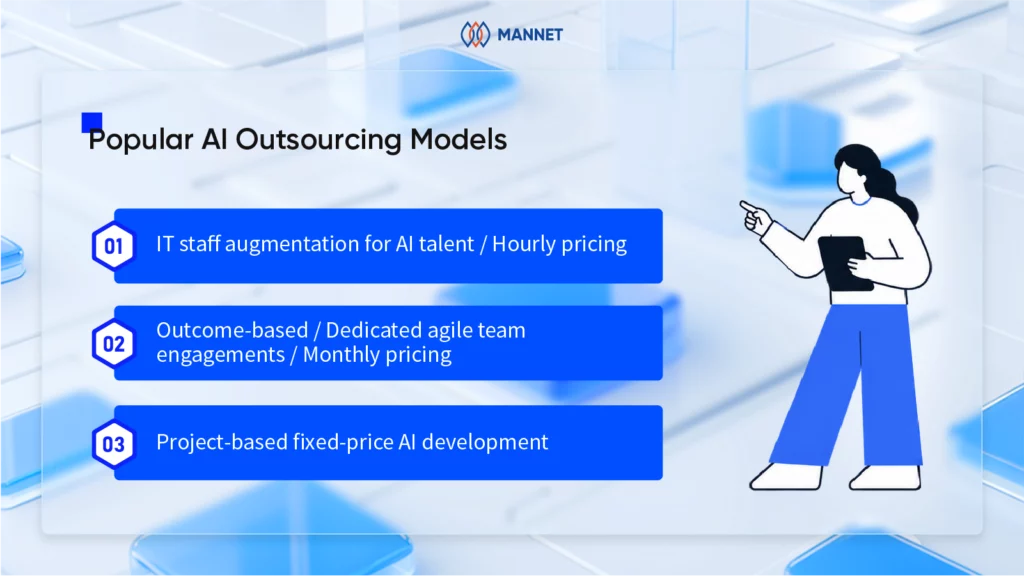
Pricing model summary (table)
| Pricing model | Best suited for | Pricing basis | Advantages | Considerations |
| IT staff augmentation | Extending an existing engineering team while retaining full delivery control | Hourly or monthly rate per engineer | Fast deployment (1-3 weeks); full client control; scale up or down on demand; IP and knowledge stay in-house | Client carries project management and delivery governance overhead |
| Outcome-based dedicated team | Ongoing product roadmaps needing delivery accountability without internal PM capacity | Monthly team fee, including governance layer | Committed sprint deliverables; reduced client PM burden; sprint and monthly reporting included | 20-30% premium over raw staffing rates; typically 6-month minimum |
| Project-based fixed price | Clearly scoped, well-documented deliverables with stable requirements | Lump sum per project or milestone | Budget certainty; vendor absorbs execution risk | Change orders are frequent and costly in AI work; limited flexibility once signed |
IT staff augmentation for AI talent / Hourly pricing
Staff augmentation charges an hourly or monthly rate per engineer, with external talent working as an extension of your existing team. Your organisation retains control over priorities, architecture, workflows, and delivery, while the provider supplies the specialised capability you need.
This model works best when the gap is AI talent capacity. For example, an organisation may have a defined product roadmap and engineering team but need to add an ML engineer, data engineer, or LLM specialist without making a long-term hire.
2025-2026 Vietnam AI talent rate benchmarks
Pricing varies primarily by specialisation and seniority, with AI/ML and GenAI roles typically commanding a premium over general development because of their more specialised skill requirements.
| Role | Junior / Entry | Mid-Level | Senior / Specialist |
| Full-stack / general developer | $18-30/hr | $30-50/hr | $50-70/hr |
| Data engineer | $20-35/hr | $35-60/hr | $60-85/hr |
| AI / ML engineer | $25-40/hr | $45-70/hr | $70-90/hr |
| GenAI / LLM engineer | $35-50/hr | $60-85/hr | $85-110/hr |
| QA / automation engineer | $18-28/hr | $28-40/hr | $40-55/hr |
| Tech lead / solution architect | $35-50/hr | $50-75/hr | $75-110/hr |
Sources: Kyanon Digital (2026), Tinasoft (2026). Rates reflect managed-delivery benchmarks, not local salary data.
When comparing rates, look beyond the headline number. Three factors usually explain the gap between quotations:
- Skill scarcity: A general developer and an LLM engineer operate in very different talent markets.
- Level of ownership: Senior specialists may contribute to architecture, technical decisions, and complex problem-solving (apart from simply executing assigned tasks).
- What’s included in the rate: Provider pricing may cover recruitment, screening, onboarding, account management, replacement, and other delivery overheads, making it different from an employee’s salary.
This is why the lowest hourly rate is not necessarily the lowest total cost. A cheaper engineer who requires more onboarding or technical supervision can cost more over the life of an engagement than a higher-rate specialist who becomes productive faster.
The trade-off is equally important: staff augmentation provides capability, not project ownership. Your organisation remains responsible for managing priorities, coordinating the work, and owning delivery outcomes. In return, you gain the flexibility to adjust team capacity or specialist skills as AI requirements evolve.
Best fit: organisations with established technical leadership that need targeted AI expertise or flexible capacity while retaining direct control over how the work is delivered.
Outcome-based / Dedicated agile team engagements / Monthly pricing
Outcome-based pricing packages a dedicated agile team into a fixed monthly engagement, with the commercial focus shifting from hours consumed to agreed sprint outcomes. Alongside engineers, the provider typically supplies delivery management, sprint planning, QA coordination, and reporting, creating a managed delivery layer around the technical team.
For AI projects with evolving requirements, this model can provide a middle ground between hiring individual specialists and outsourcing the entire project: the client retains strategic direction and backlog priorities, while the provider takes greater responsibility for organising the team and executing each sprint.
| Team size | Typical composition | Monthly cost range |
| Starter (3 people) | 2 developers + 1 QA | $10,000- 17,000 |
| Core (5 people) | 3 developers + 1 QA + 1 tech lead / Scrum Master | $ 15,000- 28,000 |
| Standard (7 people) | 4–5 developers + 1-2 QA + tech lead + Scrum Master | $ 24,000- 42,000 |
| Growth (10 people) | 6 developers + 2 QA + tech lead + Scrum Master + BA | $ 38,000- 65,000 |
| Scale (15+ people) | Multi-squad structure with dedicated governance | $60,000- 100,000+ |
Sources: Kyanon Digital (2026); Tinasoft (2026) and SotaTek (2026). Rates are indicative managed-team benchmarks and vary by role mix, seniority, scope, and delivery requirements.
What are you paying for beyond engineering hours?
The monthly premium is primarily tied to the delivery layer around the engineers:
- Team coordination: Sprint planning, task allocation, ceremonies, and progress tracking.
- Quality governance: QA planning, review processes, and release readiness.
- Delivery visibility: Structured reporting against backlog, sprint goals, and agreed outcomes.
- Scalability: A structured team that can expand or adjust as the product roadmap changes.
This means the right comparison is not simply monthly team cost vs. staff augmentation rates. A dedicated agile team also absorbs part of the coordination workload that would otherwise sit with the client. Kyanon, for example, positions its dedicated agile model around committed sprint outcomes and reduced management overhead through provider-led governance.
Best fit: organisations that have product direction and technical requirements defined, but want a provider to take greater responsibility for team orchestration and sprint-level execution without handing over the entire project.
Project-based fixed-price AI development
Fixed-price AI development sets a lump-sum fee for a defined scope, with payment tied to agreed milestones or deliverables. The vendor takes on more execution risk, while the client gains greater budget predictability. This model is most suitable when the requirements, acceptance criteria, and expected outputs can be defined with reasonable certainty.
| Project type | Typical duration | Cost range |
| AI/ML proof of concept or prototype | Weeks to 3 months | Under $20,000 |
| AI feature integration into an existing product | 3-6 months | $50,000-180,000 |
| Data pipeline + BI / analytics layer | 3-7 months | $60,000-180,000 |
| Enterprise AI platform (pipelines, MLOps, governance) | 6-18 months | $150,000-400,000+ |
| Legacy modernisation with AI components | 8-18 months | $150,000-500,000+ |
Sources: Kyanon Digital (2026) and Tinasoft (2026). Ranges are indicative and vary by scope, complexity, integration requirements, and delivery team.
The trade-off is certainty versus flexibility. Fixed pricing can protect the budget, but changes in scope typically require change requests or contract adjustments.
For AI projects, buyers should pay particular attention to:
- Scope definition: Are deliverables and acceptance criteria measurable?
- Technical uncertainty: How much is known about data, model performance, and integration requirements?
- Change policy: What happens when requirements evolve?
- Post-launch costs: Are testing, deployment, monitoring, and maintenance included?
Best fit: defined AI features, prototypes, integrations, or implementation projects where budget predictability matters more than maximum flexibility.
Key takeaways
- Staff augmentation fits teams with technical leadership in place that need specialised AI talent quickly while retaining day-to-day control and knowledge in-house.
- Dedicated agile teams fit ongoing AI roadmaps where team continuity and delivery accountability matter alongside flexibility.
- Fixed-price projects fit clearly defined, stable scopes where budget predictability matters more than flexibility when requirements evolve.
Key Factors Influencing AI Outsourcing Cost
Once the engagement model is chosen, the final cost depends on what is being built, who is building it, and how much delivery complexity the engagement carries. The eight factors below can materially shift an AI outsourcing budget, from the expertise required and project maturity to data readiness, team structure, governance, location, and compliance.
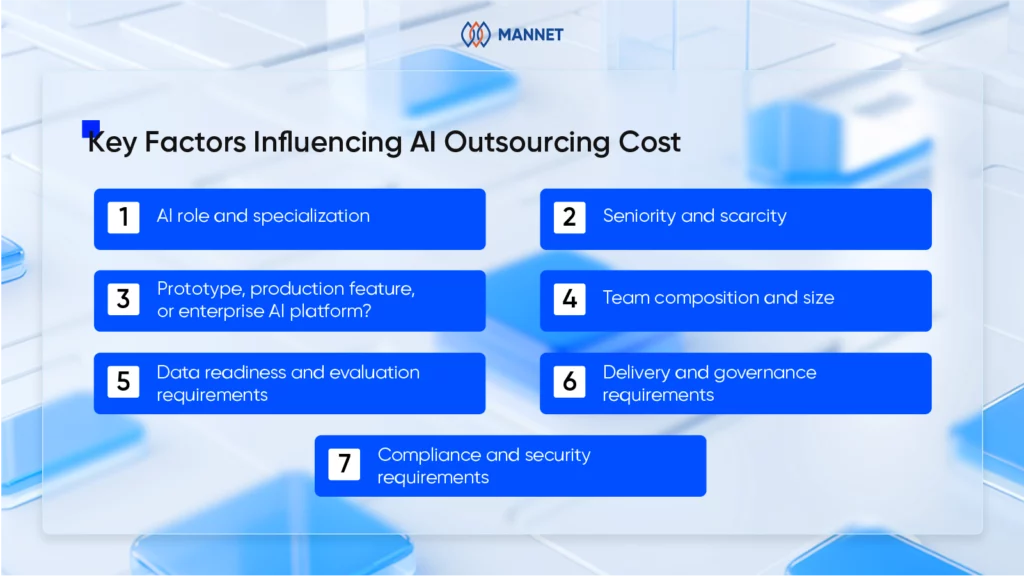
Understanding these variables helps TA and procurement teams separate a genuine rate difference from a difference in scope, capability, or delivery responsibility.
AI role and specialization
A general software engineer and a GenAI/LLM specialist may sit on the same project but operate in very different talent markets. In Vietnam, available benchmarks indicate 10-15% for ML engineering, 15-20% for computer vision, and 20-25% for NLP/LLM development over baseline developer rates.
| Specialisation | Indicative premium | Why it costs more |
| Generative AI / LLM | +20-25% | Strong demand and limited production-level talent |
| Computer vision | +15-20% | Specialised expertise across imaging, detection, and visual AI |
| ML engineering | +10-15% | Deeper modelling and production engineering requirements |
| MLOps / production AI | Premium varies | Combines ML, cloud, deployment, monitoring, and production operations |
Source: SmartDev (2025); SecondTalent’s developer rate analysis. Premiums are indicative and should not be treated as fixed market rates.
Takeaway
Apart from the job title, compare vendors by capability and seniority to understand what the quoted rate actually represents. A higher rate may reflect a narrower skill set, production experience, or responsibility for taking AI systems beyond experimentation into deployment.
Seniority and scarcity
Seniority and talent availability are key drivers of AI outsourcing rates. Tinasoft (2026) estimates that AI/ML specialists command roughly a 40-60% premium over general software development rates at equivalent seniority. At the same time, Vietnam-based AI talent remains cost-competitive against major Western markets, with senior AI engineers typically priced substantially below equivalent US, UK, or Australian talent.
The premium reflects more than years of experience. Production-level AI expertise is a narrower talent segment: designing models is only one part of the role; deploying, evaluating, monitoring, optimising, and maintaining AI systems requires additional engineering depth. Vietnam’s 2026 salary benchmarks similarly show a significant progression from junior to senior and lead AI engineering profiles, reflecting differences in technical ownership and production responsibility.
Takeaway
For TA and procurement teams, this makes seniority alone an incomplete pricing benchmark. When evaluating an outsourcing quotation, assess the capability behind the rate:
- Production experience: Has the specialist deployed and maintained AI systems in production?
- Technical depth: Does the profile cover the specific stack required, such as GenAI/LLM, MLOps, computer vision, or ML infrastructure?
- Level of responsibility: Is the role focused on implementation, or does it include architecture and technical decision-making?
- Talent availability: How specialised is the profile, and how difficult would it be to source or replace?
The practical implication is straightforward: a higher rate can be justified when it buys deeper expertise, greater technical ownership, or access to a scarcer talent segment. Vendor comparisons should therefore evaluate the capability delivered at a given rate, not the hourly figure in isolation.
Prototype, production feature, or enterprise AI platform?
The same AI use case can carry very different budgets depending on how close it needs to get to production. A prototype is primarily designed to validate feasibility. Once that system needs to support real users, the scope expands into evaluation, integration, monitoring, reliability, security, and ongoing cost control. At enterprise scale, data pipelines, MLOps, governance, and multiple system integrations add another layer of complexity.
That is why project maturity often matters more to the final budget than the AI model itself. Current 2026 benchmarks place projects from sub-$20,000 prototypes to $150,000-$400,000+ enterprise AI platforms, reflecting the increasing engineering and operational requirements at each stage.
Takeaway
For TA and procurement teams, the important distinction is what the vendor considers “production-ready.” A quotation should make clear whether it covers:
- Evaluation: performance benchmarks, test datasets, and acceptance criteria
- Integration: APIs, existing systems, workflows, and data pipelines
- Reliability: monitoring, error handling, fallback or human-review paths
- Operations: deployment, MLOps, maintenance, and usage-related costs
- Enterprise requirements: security, compliance, scalability, and governance
A lower initial quote can therefore reflect a narrower delivery scope rather than a more cost-efficient solution. The most useful comparison is to align vendors on the same definition of “done” before comparing the numbers.
Team composition and size
Team size affects the economics of AI outsourcing, but composition determines where the budget goes. A larger team can spread onboarding, tooling, management, and delivery overhead across more people, potentially reducing the blended cost per engineer. But adding headcount does not automatically improve cost efficiency if the team is heavily weighted toward senior or highly specialised roles.
A five-person team could comprise one tech lead, two mid-level engineers, one data engineer, and one QA specialist, or five senior AI/ML specialists. The headcount is identical, but the cost structure can be materially different. In practice, role mix, seniority, and delivery responsibility matter as much as team size when assessing a monthly engagement.
Takeaway
For TA and procurement teams, the more useful benchmark is therefore cost against the capability mix required for delivery, rather than cost per head alone:
- Specialist-heavy teams command higher rates but may be necessary for complex AI architecture, model development, or MLOps.
- Balanced teams combine senior oversight with mid-level execution and QA, creating a different cost profile for ongoing delivery.
- Lean teams reduce monthly spend but may leave more technical coordination and delivery responsibility with the client.
A lower blended rate is not automatically more efficient if the team lacks the senior coverage or specialist expertise required by the scope. Conversely, a higher rate may be justified when the team structure provides capabilities that would otherwise require additional hiring or management overhead.
Data readiness and evaluation requirements
Data readiness can materially change the economics of an AI engagement before model development even begins. Cleaning fragmented data, resolving inconsistencies, building pipelines, and creating labelled or representative datasets can add substantial engineering effort to the original scope.
IBM found that only 29% of technology leaders strongly agreed that their enterprise data met the quality, accessibility, and security standards needed to efficiently scale generative AI.
The evaluation layer creates another cost dimension. A production AI system needs more than a model that performs well in a demonstration. Teams may need representative test datasets, performance benchmarks, acceptance thresholds, edge-case testing, and ongoing evaluation to determine whether model changes improve or degrade results. Gartner reports that 63% of organisations surveyed either lack or are unsure whether they have the data-management practices needed for AI, highlighting how often data readiness remains unresolved at the start of an AI initiative.
Takeaway
For TA, procurement, and business stakeholders evaluating an AI proposal, the key is to establish what data and evaluation work is included in the quoted scope:
- Data preparation: cleaning, labelling, transformation, and pipeline development
- Evaluation framework: test datasets, metrics, acceptance criteria, and edge cases
- Data ownership: which activities remain with the client and which are handled by the provider
- Post-deployment evaluation: monitoring, re-evaluation, and maintenance as data or models change
If these assumptions are left undefined, vendors may be pricing different levels of data readiness and quality assurance under the same project brief. Making them explicit before comparing proposals gives procurement teams a more meaningful view of the actual delivery cost.
Delivery and governance requirements
The delivery model affects cost because it determines how much coordination and accountability the client is buying alongside engineering capacity. Hourly staff augmentation may offer a lower headline rate, but the client typically retains responsibility for task management, prioritisation, technical coordination, and day-to-day delivery. A managed or dedicated team can incorporate sprint planning, technical oversight, QA, reporting, and delivery management into the engagement.
This creates an important distinction in AI outsourcing: the quoted rate may cover either engineering capacity or a broader delivery function. Two proposals with similar team profiles can therefore produce different total costs depending on where management responsibility sits.
For example:
- Staff augmentation: lower delivery overhead in the vendor fee, but more coordination remains with the client.
- Dedicated agile team: higher provider involvement, with governance, QA, and delivery coordination built into the engagement.
- Project-based delivery: greater vendor accountability for defined outcomes, with execution risk reflected in the commercial model.
For TA and procurement, the relevant comparison is therefore not the hourly or monthly rate in isolation, but the amount of delivery responsibility included in that rate. A lower quote can shift management effort back to the internal team, while a higher quote may incorporate functions that would otherwise require additional PM, QA, or technical leadership capacity.
Before comparing proposals, clarify who owns prioritisation, sprint management, QA, reporting, technical decisions, and delivery risk. This makes the underlying cost structure much easier to compare on a like-for-like basis.
Location and talent market
Location can influence AI outsourcing rates, but its impact depends on the talent profile being sourced. Ho Chi Minh City remains Vietnam’s largest technology market and typically commands the highest engineering rates, while Hanoi offers a similarly deep talent base and Da Nang provides a lower-cost alternative. For specialised AI roles, however, talent availability and expertise can matter more than the city itself.
| Market | Cost positioning | Talent profile / consideration |
| Ho Chi Minh City | Highest among major hubs | Largest concentration of technology and outsourcing employers; strong availability of specialised engineering talent |
| Hanoi | Close to HCMC | Strong enterprise, R&D, university, and technology ecosystem |
| Da Nang | Typically lower | More cost-efficient market, with a smaller pool of senior and specialised AI talent |
Recent 2026 benchmarks put median permanent software-engineer salaries at approximately, according to PayMetric Labs:
- VND 43.6M/month in HCMC
- VND 41.55M in Hanoi
- VND 34.1M in Da Nang
SmartDev estimates Da Nang development rates at around 20-25% below HCMC for comparable talent. These figures should be treated as directional benchmarks rather than fixed AI outsourcing rates.
Takeaway
For TA and procurement teams, location is therefore best evaluated alongside specialisation, seniority, availability, and delivery requirements. A lower-cost market may offer an attractive headline rate, but limited access to specialised AI talent can affect sourcing time, team composition, or the premium required for scarce profiles.
The practical benchmark is not simply cost by city, but the combination of rate, talent availability, and capability fit for the required scope.
Compliance and security requirements
Security and compliance requirements can influence AI outsourcing cost before any engineering work begins. Projects involving personal, financial, healthcare, or other regulated data may require stronger access controls, auditability, data-processing agreements, security assessments, and specific certifications. For Vietnam-based engagements, the Law on Personal Data Protection and Decree 356/2025/NĐ-CP have been in force since January 1, 2026, adding a more defined regulatory framework for personal-data processing and cross-border transfers.
The commercial impact is often indirect. Compliance requirements can narrow the pool of qualified vendors and add work around security documentation, audits, data handling, access management, and contractual controls. Certifications such as ISO 27001 or SOC 2 can therefore function as vendor qualification criteria rather than simple procurement checkboxes, particularly for enterprise and regulated-industry engagements.
| Requirement | Potential cost implication |
| Security certification | May narrow the vendor pool and require certified security processes |
| Data-processing requirements | Adds contractual, documentation, and data-handling obligations |
| Access & audit controls | Requires logging, permissions, monitoring, and evidence trails |
| Cross-border data processing | May introduce additional assessment and governance requirements |
| Industry-specific compliance | Can require additional controls, certifications, or security reviews |
For TA and procurement teams, compliance should be treated as a vendor qualification criterion as well as a cost consideration. Security certifications, data-processing terms, audit requirements, and data residency should be established during vendor evaluation, before commercial proposals are compared. This helps prevent a low headline rate from becoming a higher total cost once additional controls or contractual requirements are introduced.
Comparing vendors on the same security, privacy, and governance requirements provides a more meaningful view of commercial value and reduces the risk of selecting a lower-cost proposal that does not meet the organisation’s operational or regulatory requirements.
In-house Hiring vs. AI Staff Augmentation vs. Full Project Outsourcing
Beyond pricing models sits a broader resourcing decision: build permanent AI capability in-house, add specialised capacity through staff augmentation, or transfer delivery responsibility to an external provider. The three models differ not only in cost, but also in who manages the work, who carries delivery responsibility, how quickly capacity can be added, and where knowledge remains after the engagement.
Cost and control comparison
| Factor | In-house hiring | AI staff augmentation | Full project outsourcing |
| What you are buying | Permanent AI capability | Specialist capacity | A defined project outcome |
| Cost structure | Salary + benefits + recruitment + employment overhead | Hourly/monthly rate per specialist | Fixed project fee or milestone-based pricing |
| Upfront investment | Highest – hiring, onboarding, infrastructure, and potentially local entity setup | Low–moderate – sourcing and onboarding are typically handled by the provider | Low internal hiring investment; project budget can still be substantial |
| Time to first capacity | Slowest – typically weeks to months for specialised hiring | Fast – often days to weeks once requirements are confirmed | Moderate – discovery, scoping, team mobilisation, and kickoff are required |
| Day-to-day control | Full | High – client directs priorities, workflows, and tools | Lower – vendor manages delivery against agreed scope |
| Delivery accountability | Internal team | Client | Vendor, against agreed deliverables / SOW |
| Management burden | Highest – hiring, performance, retention, and team management remain internal | Moderate – client manages augmented engineers | Lower – vendor manages delivery, QA, and coordination |
| Flexibility to scale | Low-moderate – constrained by hiring and employment commitments | High – capacity can be added or reduced relatively quickly | Moderate – changes typically require scope or commercial adjustments |
| Knowledge retention | Highest – capability and domain knowledge remain permanently in-house | High – engineers work within the client’s systems, processes, and documentation | Depends on contract and knowledge-transfer provisions |
| IP & data control | Direct and internal | Typically client-controlled, subject to contract | Contract-dependent; ownership and access should be defined in the SOW |
| Compliance responsibility | Primarily internal | Shared between client and provider | More delivery responsibility sits with the provider, while client obligations remain |
| Best fit | Long-term, business-critical AI capability | Evolving roadmaps and specialised skill gaps | Defined outcomes where delivery ownership can sit externally |
Sources: 2026 comparisons from Global IT Vision, Lifted, DigiWorks, and current Vietnam hiring benchmarks. Actual cost, timeline, IP ownership, and compliance responsibilities depend on the contract, jurisdiction, role mix, and project scope.
When to choose staff augmentation
Staff augmentation is most suitable when the organisation already has the leadership and delivery structure to manage AI work internally, but needs additional specialist capacity. The model keeps priorities, architecture, workflows, and day-to-day coordination with the client while the provider supplies the required talent.
It tends to fit when:
- The AI roadmap is ongoing and likely to evolve, making flexible capacity more valuable than a fixed delivery scope.
- Internal technical leadership can direct priorities, review work, and manage dependencies.
- The organisation needs specialised capabilities quickly without committing to permanent headcount.
- Product knowledge, IP, and working practices need to remain closely integrated with the internal team.
- Engineering capacity may need to scale with roadmap demand.
The key requirement is management capacity on the client side. Augmentation adds capability, but the organisation continues to own the operating system around that capability.
When to choose full project outsourcing
Full project outsourcing becomes more appropriate when the organisation wants the provider to take responsibility for coordinating and delivering a defined outcome. The vendor typically manages the delivery team, planning, execution, quality processes, and project risks within an agreed scope, while the client retains business ownership and acceptance responsibility.
It tends to fit when:
- The scope and deliverables are sufficiently defined to establish clear acceptance criteria.
- Internal technical leadership is limited or unavailable to manage day-to-day engineering.
- The organisation wants to reduce internal delivery and coordination overhead.
- The initiative is a discrete project rather than an ongoing extension of the product engineering function.
- The commercial model can accommodate change control if requirements evolve.
The critical procurement question is therefore not simply “How much does the project cost?” but “Which delivery responsibilities are included in that price?”
Hybrid model in practice
Once the delivery model is selected, vendor evaluation should move beyond rate cards. The objective is to verify that the provider can deliver the capability, security controls, and continuity represented in the proposal. Current 2026 vendor-diligence frameworks recommend validating evidence such as certifications, data-handling practices, production references, and contractual protections rather than relying on vendor claims alone.
| Due-diligence area | What to verify | Potential red flag |
| Technical capability | Role-specific assessment, architecture discussion, relevant AI/ML experience | Evaluation based primarily on CVs |
| Production track record | Verifiable references for comparable live production systems | Pilots or demos presented as production deployments |
| Security & compliance | Current ISO 27001 / SOC 2 or relevant equivalent evidence; DPA and security controls | Certifications or controls cannot be independently verified |
| Data governance | Data location, access controls, retention, subprocessors, model-training terms | Unclear use or retention of client data |
| Delivery governance | Named delivery owner, reporting cadence, escalation and change-control process | Responsibility remains ambiguous after contract signature |
| Scalability | Documented process for adding, replacing, or reallocating specialists | “We can scale” without defined capacity or SLA |
| Continuity & knowledge transfer | Documentation, replacement process, exit and handover provisions | Critical knowledge concentrated in one or two individuals |
| Commercial resilience | Transparent assumptions, rate structure, change-order mechanism | Low headline price with major scope exclusions |
The final comparison should bring these dimensions back to the commercial model: rate, capability, delivery responsibility, risk allocation, and internal management effort. The lowest quoted rate is not necessarily the lowest total cost if the organisation must absorb substantial coordination, technical leadership, or remediation work outside the contract.
Verdict
If AI is becoming central to your product roadmap, staff augmentation delivers better long-term economics and control than repeatedly outsourcing discrete projects to different vendors. Each new vendor relationship restarts onboarding, re-establishes context, and leaves institutional knowledge outside your organisation.
Full project outsourcing remains the correct call for bounded, well-specified work where you genuinely lack capacity to direct delivery. In-house hiring becomes competitive once headcount justifies dedicated local HR and recruitment infrastructure, typically past 15-20 engineers.
Companies without a Vietnam legal entity can access the same talent pool without entity-setup delays through EOR services, generally the fastest route from hiring decision to a productive engineer on the ground.
Hidden Costs and Budget Planning for AI Outsourcing
The quoted development rate is only one component of an AI outsourcing budget. Discovery, data preparation, infrastructure, security, specialist ramp-up, and post-launch continuity can all introduce additional costs depending on the engagement scope. These expenses are not necessarily hidden by the provider; they are often simply outside the engineering rate itself.
Seven cost areas deserve particular attention when pressure-testing an AI outsourcing proposal:
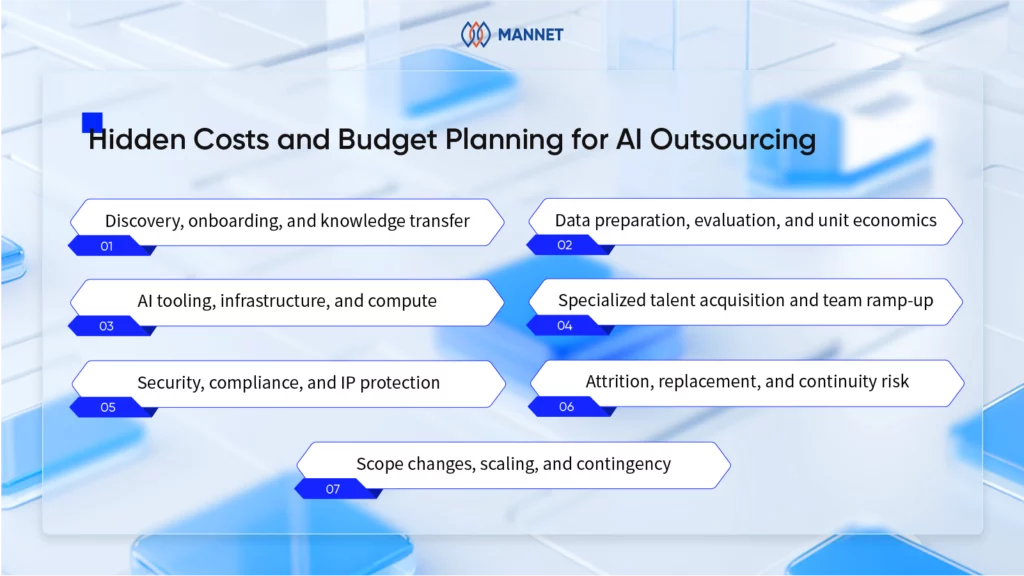
1. Discovery, onboarding and knowledge transfer
Initial discovery, architecture alignment, documentation review, environment setup, and knowledge transfer consume delivery capacity before feature development begins. The quality of this phase can also affect downstream rework and delivery efficiency.
2. Data preparation, evaluation, and unit economics
Data cleaning, labelling, evaluation-set development, retrieval infrastructure, and modelling cost per request can become significant parts of an AI engagement. These activities determine whether a prototype can operate reliably and economically at production scale.
3. AI tooling, infrastructure and compute
The development quote may not include cloud environments, GPU compute, model/API usage, vector databases, storage, monitoring, or production inference. Unlike a one-time engineering fee, many of these costs continue to scale with usage after deployment.
4. Specialized talent acquisition and team ramp-up
Scarce AI specialists can affect both the time and cost required to assemble the right delivery team. Additional senior expertise may also be required during architecture, productionisation, or complex integration phases.
5. Security, compliance and IP protection
Security reviews, data-processing requirements, access controls, auditability, IP provisions, and regulatory requirements can introduce additional delivery and governance work—particularly for enterprise and regulated-industry projects.
6. Attrition, replacement and continuity risk
Team changes can create replacement, onboarding, knowledge-transfer, and productivity costs that are not visible in the original rate. Contractual replacement terms and structured documentation can reduce the financial impact of delivery disruption.
7. Scope changes, scaling and contingency
AI requirements can evolve as evaluation results, data constraints, or production usage reveal new requirements. A defensible budget should therefore distinguish the initial scope, expected scaling costs, and contingency for material changes instead of treating the quoted project price as the complete TCO.
Takeaway
Compare the quoted engineering cost with the full cost of getting the AI system from discovery to production and keeping it reliable after launch. The seven cost categories above provide the starting point for that assessment.
How to Build an AI Outsourcing Budget
A credible AI outsourcing budget requires a clear view of delivery costs, operating expenses, and budget exposure across the engagement lifecycle. The planning process should progressively translate the required business capability into scope, team capacity, duration, operating costs, and contingency. This gives TA, procurement, technology, and finance stakeholders a consistent basis for evaluating vendor proposals and managing cost exposure throughout the engagement.
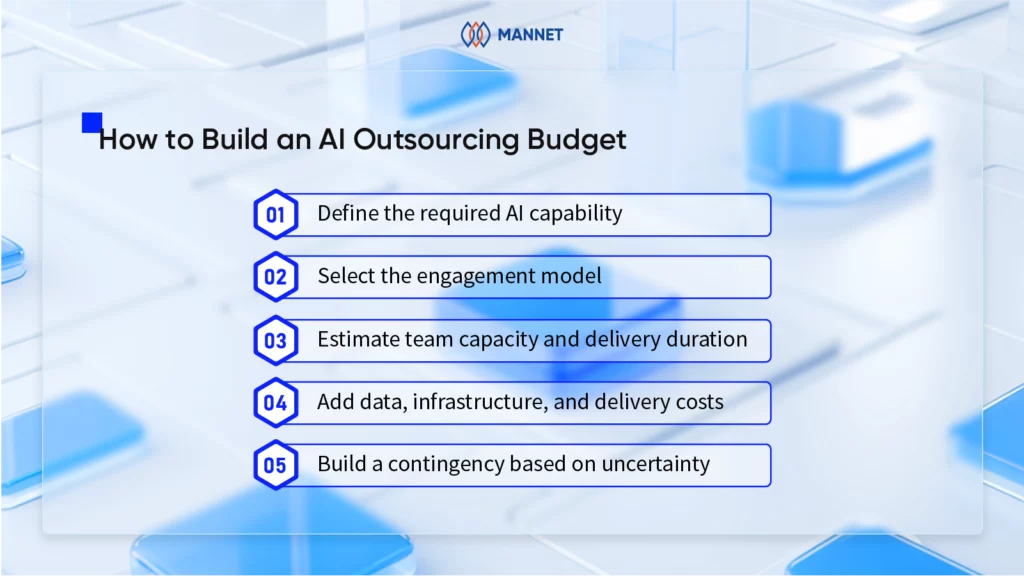
1. Define the required AI capability
Budget planning should begin with the business outcome and required level of production readiness.
“Reduce support-ticket volume by 30%” represents a different investment profile from “build a chatbot.” The initial scope should establish whether the engagement covers:
- Prototype / POC: technical feasibility and initial validation
- Production feature: deployment within an existing product or workflow
- Enterprise AI platform: integration, evaluation, monitoring, governance, and ongoing operations
Current 2026 benchmarks illustrate the scale difference: focused AI prototypes can fall below $20,000, while enterprise AI platforms can reach $150,000–400,000+, depending on complexity and production requirements.
2. Select the engagement model
The commercial model should reflect scope stability, internal delivery capacity, and the level of delivery responsibility retained by the organisation.
| Operating condition | Typical engagement model |
| Evolving roadmap + internal technical leadership | Staff augmentation |
| Continuous delivery + limited internal delivery capacity | Dedicated team |
| Defined scope + measurable acceptance criteria | Project-based outsourcing |
The choice affects the allocation of management effort, delivery accountability, change risk, and commercial exposure. This makes the engagement model an important input to the budget itself.
3. Estimate team capacity and delivery duration
The budget should be modelled around the minimum effective team required for the agreed scope, with capacity adjusted as delivery requirements become clearer.
For planning purposes, current Vietnam benchmarks place a five-person dedicated team at approximately $ 15,000- $ 25,000 per month, with the final rate influenced by seniority, role composition, AI specialisation, and delivery structure.
A practical baseline is:
Blended monthly team cost × expected delivery duration
The estimate should then be tested against:
- Seniority and role mix
- Technical leadership and QA coverage
- Data engineering requirements
- Productionisation and deployment workload
- Ramp-up and scale-up requirements
- Client-side dependencies and approval cycles
Duration is a major budget variable. A lower monthly rate can still produce a higher project cost when the delivery period extends.
4. Add data, infrastructure, and delivery costs
The delivery team represents one part of the AI budget. Production engagements can also generate costs across data, infrastructure, model consumption, tooling, security, integration, and ongoing operations.
A 2026 enterprise AI budgeting framework from StackAI, for example, separates implementation services, infrastructure and platform, security and governance, change management, and ongoing operations as distinct cost categories. IBM similarly recommends connecting AI spend across cloud, tokens, applications, suppliers, and business units to establish a complete view of TCO.
| Cost category | Budget consideration |
| Discovery & onboarding | Architecture alignment, environment setup, documentation, knowledge transfer |
| Data & evaluation | Preparation, labelling, testing, benchmarking, ongoing evaluation |
| Infrastructure & compute | Cloud, GPU, storage, inference, and production environments |
| AI tooling | Model/API usage, observability, vector databases, development tools |
| Security & compliance | Assessments, access controls, documentation, audits, regulatory requirements |
| Integration & deployment | Connecting AI capabilities to existing systems and production workflows |
These categories should be modelled separately where possible because their cost behaviour differs. Some are one-time investments, some scale with usage, and others become recurring operating expenses after launch. Oliver Wyman’s 2026 analysis similarly highlights the shift toward a hybrid AI cost structure combining fixed subscriptions with variable usage-based spending.
5. Build a contingency based on uncertainty
Contingency should correspond to the areas of uncertainty within the business case.
A higher reserve may be appropriate when:
- Data quality has not been fully validated
- The AI use case remains technically unproven
- Acceptance criteria are still evolving
- Production usage is difficult to forecast
- The engagement uses a fixed-price commercial structure
- External dependencies may affect the delivery timeline
A validated use case with established architecture, clear acceptance criteria, and stable data allows for a tighter budget range.
For finance and procurement stakeholders, separating the base delivery budget from the risk reserve provides greater visibility into the assumptions behind the approved investment.
6. Example: Estimating a 6-month AI team budget
Consider a five-person team delivering a production AI feature: 1 tech lead, 2 AI/ML engineers, 1 data engineer, and 1 QA engineer.
| Budget item | Planning assumption | Illustrative cost |
| Core delivery team | ~$22,000/month × 6 months | $132,000 |
| Discovery & onboarding | One-time allocation | $5,000 |
| AI tooling & compute | ~$750/month × 6 months | $4,500 |
| Security & compliance setup | One-time allocation | $5,000 |
| Subtotal | $146,500 | |
| Contingency | 10% of subtotal | $14,650 |
| Illustrative 6-month budget | ≈ $161,000 |
Illustrative planning scenario based on the benchmark ranges discussed above. Actual costs vary by seniority mix, technology stack, data readiness, infrastructure requirements, security requirements, and delivery scope.
The $161,000 figure represents one planning scenario. Its greater value lies in showing how the budget is constructed: delivery capacity, operating costs, and risk reserve are modelled as separate components.
For perspective: the same five-person team hired in Silicon Valley would exceed this total in base salary alone within approximately two months.
A practical budgeting framework
For internal planning and vendor comparison, the model can be expressed as:
Total AI outsourcing budget = Delivery cost + Data & evaluation + Infrastructure & tooling + Security/compliance + Contingency
Each vendor proposal can then be assessed against four commercial questions:
- What is included in the quoted rate?
- Which costs scale with usage, team size, or project duration?
- Which responsibilities remain with the client?
- What are the commercial implications of changes to scope, timeline, or capacity?
This structure gives TA, procurement, technology, and finance teams a common basis for comparing proposals, identifying budget exposure, and establishing clearer commercial assumptions before an AI engagement begins. McKinsey’s 2026 research similarly highlights cost attribution, visibility into AI consumption, and financial accountability as important capabilities as enterprise AI spending scales.
How to Evaluate an AI Outsourcing Pricing Proposal
A competitive AI outsourcing proposal should make the commercial assumptions behind the price easy to evaluate. Comparing the headline hourly or monthly rate alone can conceal differences in team composition, delivery scope, infrastructure costs, risk allocation, and contractual obligations. Gartner’s 2026 sourcing guidance highlights the need to compare AI pricing models and metrics systematically, while its procurement guidance recommends separating bundled licensing, services, and AI costs to improve financial visibility.
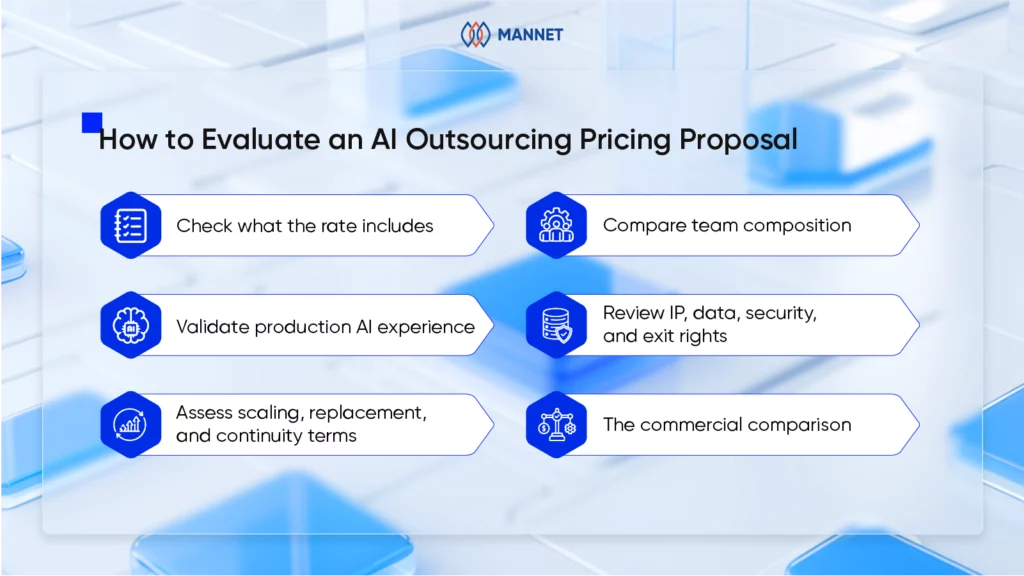
Check what the rate includes
Start by converting the rate card into a clear scope-of-cost matrix. Confirm whether the proposal includes:
- AI tooling, model/API usage, and development environments
- Data preparation and evaluation activities
- Architecture, deployment, and integration
- Sprint planning, QA, reporting, and delivery management
- Security and compliance activities
- Post-launch support and maintenance
This is particularly important when vendors bundle professional services, licensing, and AI-related costs into a single commercial line. Unbundling these components creates a more meaningful basis for proposal comparison and budget planning.
Compare team composition
The same monthly budget can represent materially different delivery capacity. Request the proposed role mix, seniority, allocation, and responsibilities for each team member.
| Proposal dimension | What to compare |
| Role mix | AI/ML, data engineering, QA, DevOps/MLOps, tech leadership |
| Seniority | Junior, mid-level, senior, specialist, lead |
| Allocation | Full-time vs. part-time involvement |
| Leadership coverage | Tech lead, architect, delivery lead |
| Specialisation | GenAI/LLM, computer vision, MLOps, NLP, etc. |
A five-person team with broad mid-level coverage can have a very different capability profile from a smaller team built around senior AI specialists and technical leadership, even when the monthly commercial value is similar.
Validate production AI experience
Production experience provides a more relevant capability signal than prototype volume alone. Ask for evidence of comparable systems that have moved beyond experimentation into live environments, including the role the provider played in architecture, deployment, monitoring, and ongoing optimisation.
Useful validation points include:
- Comparable AI use cases and technical architecture
- Production deployment history
- Scale and user volume where disclosure is possible
- Evaluation and monitoring approach
- Experience handling model failures, drift, or performance degradation
- Verifiable client references
This distinction matters because production AI introduces operational requirements around evaluation, monitoring, resilience, security, and ongoing model management. Deloitte’s AI governance framework similarly identifies performance validation, monitoring, third-party risk, and audit-ready evidence as important controls across the AI lifecycle.
Review IP, data, security, and exit rights
The commercial proposal should be assessed together with the contractual rights attached to the engagement. Confirm:
| Area | Questions to resolve |
| IP ownership | Who owns newly developed code, models, prompts, documentation, and other project outputs? |
| Data rights | Where is client data stored and processed? Who can access it? |
| Model training | Can client data, prompts, or outputs be used to train or improve third-party models? |
| Security | What certifications, controls, audits, and incident procedures apply? |
| Subprocessors | Which third parties have access to data or infrastructure? |
| Exit & portability | How are data, code, documentation, credentials, and other assets returned at termination? |
These terms can materially affect long-term commercial exposure. Deloitte recommends addressing IP ownership, data governance, security, and contractual protections in GenAI supplier arrangements, while Gartner’s 2026 guidance specifically highlights IP/data ownership and data extraction and deletion rights as important exit considerations.
Assess scaling, replacement, and continuity terms
The commercial model should remain workable as the engagement changes. Before signing, establish the terms governing team expansion, reduction, replacement, and knowledge transfer.
| Commercial point | What to clarify |
| Scaling up | Lead time, available capacity, and applicable rate changes |
| Scaling down | Notice period and minimum commitment |
| Replacement | Replacement timeline and conditions for role substitution |
| Key-person dependency | Process for replacing critical specialists |
| Knowledge transfer | Documentation and handover obligations |
| Continuity | Coverage during leave, attrition, or transition periods |
For a 12-month engagement, these terms can have a meaningful effect on total cost and delivery continuity. Deloitte’s outsourcing guidance also identifies key personnel retention and exit/disentanglement provisions as important elements of the sourcing contract.
The commercial comparison
After these checks, evaluate proposals across five comparable dimensions:
Rate → Scope → Capability → Risk allocation → Contract terms
The objective is to establish whether each proposal is pricing the same delivery requirement under comparable assumptions. A lower headline rate can represent a different team mix, fewer included services, greater client-side management effort, or additional costs outside the quoted scope.
For TA and procurement teams, the most useful output is therefore a normalised comparison of total expected cost and delivery responsibility, with assumptions documented before commercial negotiations begin.
FAQ About AI Outsourcing Pricing
1. How much does AI outsourcing cost in 2026?
AI outsourcing costs vary significantly by engagement model, role mix, seniority, project scope, and production requirements. Current Vietnam benchmarks provide the following planning ranges:
- Staff augmentation: approximately $20-110/hour, depending on role and seniority. AI/ML and GenAI/LLM specialists sit toward the upper end of the range.
- Dedicated teams: approximately $10,000-100,000+/month, depending on team size and delivery structure. A five-person team typically falls around $15,000-25,000/month in current Vietnam benchmarks.
- Fixed-price projects: from under $20,000 for focused prototypes to $150,000-400,000+ for enterprise AI platforms, depending on integration, data, infrastructure, and governance requirements.
These figures should be treated as indicative market benchmarks. A comparable team can produce materially different project costs depending on scope maturity, seniority mix, data readiness, and delivery responsibility.
2. What’s the real difference between staff augmentation and project-based AI outsourcing pricing?
The two models allocate capacity, delivery responsibility, and commercial risk differently.
With staff augmentation, the organisation pays for engineering capacity while retaining control over priorities, architecture, and day-to-day delivery. It is generally suited to evolving roadmaps where internal technical leadership is already established.
With project-based outsourcing, the vendor prices a defined scope and assumes greater responsibility for delivery against agreed milestones and acceptance criteria. This model is better suited to projects with stable requirements and clearly measurable outputs. Fixed-price models are commonly positioned for well-defined projects with clear deliverables and timelines.
3. Why do AI specialists cost 40-60% more than general developers?
The premium reflects both specialised delivery requirements and talent-market scarcity.
Production AI work can require capabilities across model development, data engineering, evaluation, deployment, inference optimisation, monitoring, and AI-specific cost management. These requirements extend beyond conventional application development.
Current Vietnam benchmarks put AI/ML specialists around $45-65/hour, compared with approximately $25-40/hour for general development, with higher rates applying to senior and scarce specialisations.
The relevant comparison for procurement is therefore the capability and seniority included in the rate, alongside the scope of responsibility attached to each role.
4. Is it cheaper to build an AI team in-house or use staff augmentation?
The answer depends on headcount requirements, hiring horizon, entity structure, and the amount of internal infrastructure already in place.
Staff augmentation can reduce the fixed overhead associated with local recruitment, employment administration, and maintaining a permanent specialist bench. It also allows organisations to access specialised AI capability without committing immediately to long-term headcount.
In-house hiring can become more relevant when an organisation has sustained demand for a larger local team, requires direct employment relationships, and has the HR, recruitment, compliance, and management infrastructure to support that workforce.
For organisations entering Vietnam without an established local setup, an EOR-supported hiring model can provide another route between direct entity establishment and project outsourcing.
5. Do I need a Vietnamese legal entity to hire AI engineers there?
A Vietnamese entity is not always required. An Employer of Record (EOR) can employ local personnel on behalf of an overseas organisation while handling local employment administration, payroll, and compliance. SmartDev, for example, describes EOR as a model for entering a new market without establishing a local legal entity.
The appropriate structure depends on headcount, employment duration, control requirements, tax and labour obligations, and the organisation’s longer-term market strategy.
For shorter-term or variable AI capacity requirements, staff augmentation can provide another route to accessing Vietnam-based engineering talent without establishing a permanent local workforce.
6. How do I evaluate whether an AI outsourcing pricing proposal is fair?
Start with commercial comparability, then assess technical capability and contractual exposure.
Five areas should be reviewed:
- Rate coverage: What engineering, QA, delivery management, tooling, infrastructure, and support are included?
- Team composition: Which roles, seniority levels, allocation, and AI specialisations are actually proposed?
- Production experience: Can the vendor demonstrate comparable AI systems operating in production?
- IP, data, and security: How are ownership, data processing, model-training rights, security controls, and exit obligations defined?
- Scaling and continuity: What terms apply when the team needs to expand, contract, or replace key specialists?
The objective is to compare proposals on a like-for-like basis across total expected cost, delivery capability, and commercial responsibility. A headline hourly rate provides only one part of that comparison.
For a deeper evaluation framework, see our guide on how to choose the right AI outsourcing company, or review our guide to AI outsourcing companies in Vietnam.
Pricing AI Outsourcing as a Strategic Decision
AI outsourcing pricing is ultimately about how an organisation chooses to acquire, scale, and govern AI capability. The rate attached to an engineer, team, or project is only one part of that equation. The larger consideration is how effectively the commercial model aligns talent, delivery capacity, risk, and long-term business requirements.
As AI moves from experimentation into production, pricing discipline becomes part of AI strategy. Organisations that can connect vendor cost with capability, usage, delivery outcomes, and future scalability are better positioned to make informed sourcing decisions as requirements evolve.
For companies building AI capability in Vietnam, ManNet provides IT staff augmentation and recruitment services, supported by EOR, RPO, and HR consulting capabilities. The focus is on giving international organisations a practical path to access Vietnam’s technology talent while building workforce capacity around their specific operating model.
The objective is simple: build the AI capability the business needs, with a commercial structure that can scale with it.