

Knowing how to choose an AI outsourcing company has become a strategic priority as organizations accelerate AI adoption. According to McKinsey, 88% of organizations have adopted AI, yet only about one-third have successfully scaled it beyond the pilot stage. One of the biggest reasons is selecting the wrong delivery partner – many vendors claim AI expertise. Still, far fewer possess the technical depth required to build, deploy, and support production-ready AI systems.
This guide provides a practical framework for how to choose an AI outsourcing company, covering the evaluation criteria, technical capabilities, security and governance practices, and engagement models that matter most when assessing potential partners. Whether an enterprise is launching its first AI initiative or expanding an existing AI capability, these best practices can help reduce delivery risk and improve long-term project outcomes.
Let’s dive in!
How to Choose the Right AI Outsourcing Company
Selecting an AI outsourcing partner is fundamentally different from choosing a traditional software development vendor. The success of an AI initiative depends not only on engineering execution but also on data quality, model performance, deployment maturity, and the ability to improve AI systems after launch continuously.
Rather than evaluating vendors based solely on hourly rates or company size, enterprises should assess whether a partner can support the full AI lifecycle—from data preparation and model development to deployment, monitoring, and long-term optimization.
Looking for an overview of AI outsourcing models, costs, and delivery approaches? Read our complete guide to AI Outsourcing before comparing providers.
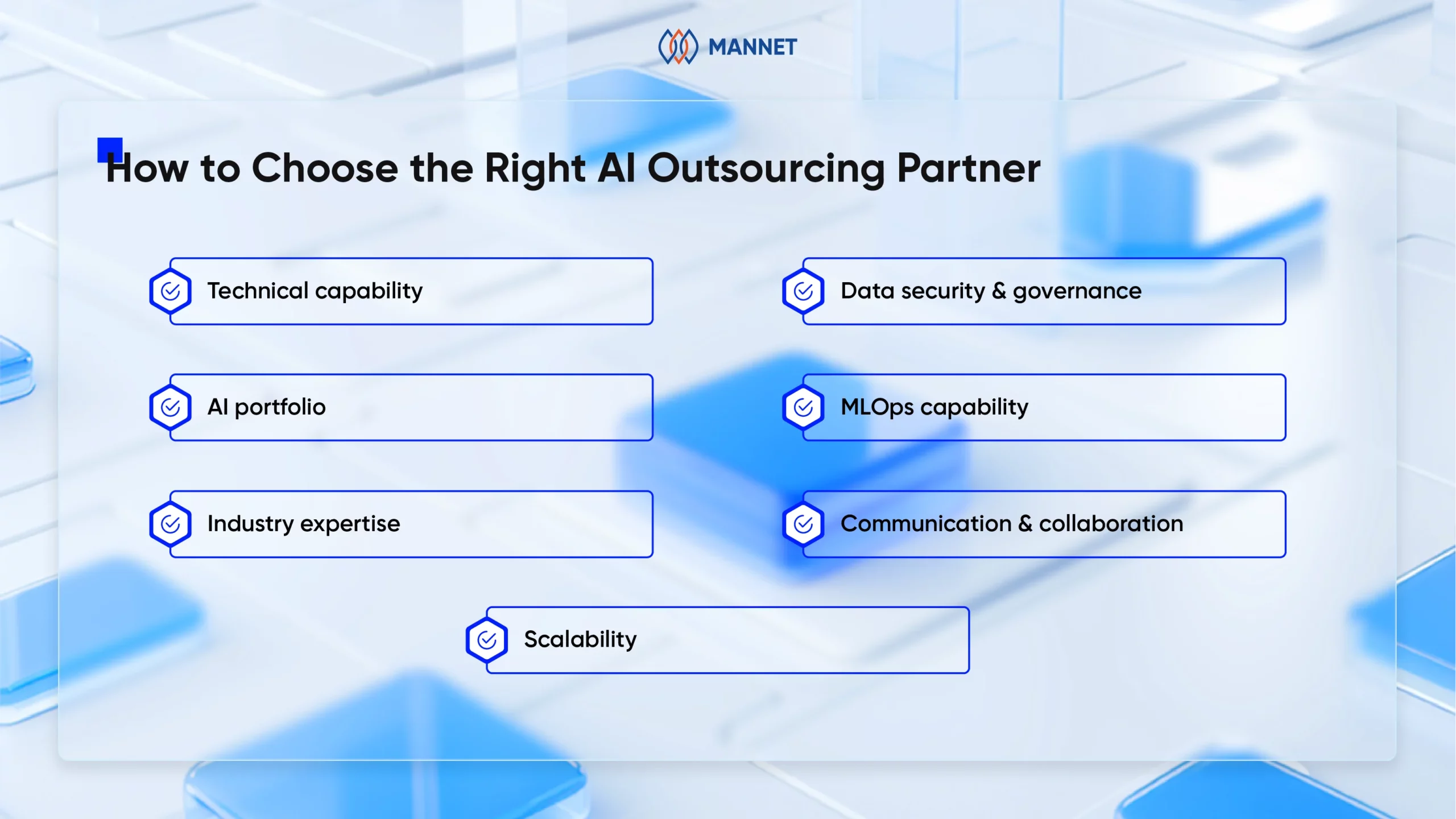
The following framework highlights the six areas that matter most when evaluating an AI outsourcing partner.
Technical capability
Technical expertise is the foundation of every successful AI outsourcing engagement. While many software companies now advertise AI services, relatively few possess hands-on experience building production-grade AI systems.
When assessing technical capability, look beyond programming languages or framework logos. Instead, evaluate whether the partner has demonstrated expertise across the modern AI technology stack, including:
- Machine Learning and Deep Learning
- Generative AI and Large Language Models (LLMs)
- Retrieval-Augmented Generation (RAG)
- AI Agents and workflow automation
- Computer Vision
- Natural Language Processing (NLP)
- Data Engineering
- MLOps and model deployment
- Cloud AI platforms (AWS, Azure, Google Cloud)
Questions to ask
- Has the company deployed AI systems into production?
- Can the engineering team explain architectural decisions and model trade-offs?
- Does the team include specialists rather than generalist software engineers?
Red flags
- AI expertise limited to chatbot demos or proofs of concept.
- No evidence of production deployments.
- Heavy reliance on third-party APIs without proprietary engineering capability.
AI portfolio
An AI portfolio provides one of the clearest indicators of a partner’s delivery capability. Technical presentations and service pages can describe what a company offers; completed AI projects demonstrate how that expertise performs under real business conditions.
The strongest portfolios consistently show three characteristics: production deployment, business relevance, and measurable outcomes. When reviewing an AI outsourcing company’s portfolio, look beyond the number of projects completed. Instead, evaluate the complexity of the use cases, the maturity of the solutions, and the business impact achieved.
What to evaluate
When reviewing case studies, consider the following questions:
- Has the company deployed AI solutions into production environments?
- Does the portfolio include projects across multiple AI domains, such as Generative AI, LLMs, computer vision, NLP, predictive analytics, or intelligent automation?
- Are the business objectives, technical approach, and measurable outcomes clearly explained?
- Does the company demonstrate experience maintaining and optimizing AI systems after deployment?
A portfolio should explain the business problem, the AI architecture, and the operational impact with equal clarity.
Evaluation checklist
| Evaluation Area | What to Look For |
| Production experience | AI solutions deployed in live business environments with ongoing operational support. |
| Breadth of AI expertise | Experience across multiple AI disciplines, including Generative AI, machine learning, NLP, computer vision, MLOps, and AI automation. |
| Industry relevance | Case studies addressing business challenges similar to those faced by your organization. |
| Business outcomes | Quantifiable improvements such as higher accuracy, shorter processing time, increased productivity, or lower operating costs. |
| Technical credibility | Clear documentation of the solution architecture, technology stack, deployment approach, and integration strategy. |
| Client validation | Public case studies, customer testimonials, or reference projects demonstrating successful delivery. |
Red flags
The following signals often indicate limited AI delivery maturity:
- Case studies focused exclusively on prototype applications or internal demonstrations.
- Marketing materials describing AI capabilities without explaining implementation details.
- No measurable business outcomes or customer references.
- Limited evidence of post-deployment support, model monitoring, or continuous improvement.
Recommended practice
Ask vendors to walk through one production AI project from end to end, including the business problem, data pipeline, model selection, deployment architecture, post-launch monitoring, and measurable business results. A capable AI partner should be able to explain not only what was built, but also why specific technical decisions were made and how the solution created business value.
Industry expertise
AI systems are built around business processes, operational workflows, and domain-specific data. The same machine learning techniques can produce very different results depending on the industry’s regulations, terminology, data quality, and decision-making requirements.
A partner with relevant industry experience typically reaches production faster because less time is spent understanding business logic, defining data requirements, and validating model outputs. Familiarity with industry-specific regulations and operational constraints also reduces implementation risk throughout the project lifecycle.
What to evaluate
Industry expertise should be demonstrated through practical delivery experience rather than a list of sectors on a company’s website. During vendor evaluation, consider whether the partner can demonstrate:
- Experience solving AI challenges similar to those faced by the organization.
- Familiarity with industry-specific data structures, workflows, and terminology.
- Knowledge of regulatory or compliance requirements relevant to the industry.
- Case studies demonstrating measurable business outcomes in comparable operating environments.
The objective is not to find a partner that has worked with identical companies, but one that understands the operational context in which AI will be deployed.
Examples of industry-specific AI expertise
| Industry | Examples of AI applications |
| Financial services & insurance | Fraud detection, credit risk modeling, intelligent document processing, claims automation |
| Healthcare & life sciences | Clinical documentation, medical imaging, patient support, revenue cycle optimization |
| Manufacturing | Predictive maintenance, visual quality inspection, production planning, demand forecasting |
| Retail & E-commerce | Recommendation engines, customer segmentation, demand forecasting, conversational AI |
| Logistics & supply chain | Route optimization, inventory forecasting, warehouse automation, supply chain analytics |
| SaaS & technology | AI copilots, intelligent search, support automation, product analytics |
Questions to ask during vendor evaluation
- Which AI projects has the company delivered within the same or adjacent industries?
- How did industry-specific requirements influence the AI solution design?
- What business KPIs were used to measure project success?
- Which compliance, security, or governance standards were addressed during implementation?
Red flags
Industry expertise may be limited if a vendor:
- Presents generic AI capabilities without industry-specific case studies.
- Cannot explain how business workflows influenced model design or deployment decisions.
- Has little experience working with regulated environments where governance, security, or compliance play a critical role.
- Focuses primarily on technical implementation while overlooking business adoption and operational integration.
Recommended practice
Industry expertise becomes increasingly important as AI initiatives move beyond experimentation. Projects involving proprietary data, customer-facing applications, or regulated environments often require engineering teams to work closely with business stakeholders, compliance teams, and domain specialists. Selecting a partner with experience in similar operating environments can significantly shorten the learning curve and improve the likelihood of successful deployment.
Data security & governance
AI projects often require access to an organization’s most valuable assets – customer information, proprietary datasets, internal documents, source code, and business processes. As AI models become increasingly integrated into core operations, data security and governance should be evaluated as strategic capabilities rather than compliance checklists.
An experienced AI outsourcing partner should demonstrate a structured approach to protecting data throughout the entire delivery lifecycle, from data access and model development to deployment and ongoing operations.
What to evaluate
Security practices should extend beyond signed NDAs. During vendor evaluation, consider whether the partner has established policies and technical controls covering:
- Information security management (e.g., ISO 27001)
- Compliance with applicable regulations such as GDPR, HIPAA, or industry-specific standards
- Role-based access control (RBAC) and least-privilege access
- Data encryption in transit and at rest
- Secure development and deployment practices
- Audit logging and activity monitoring
- Intellectual property (IP) ownership and confidentiality agreements
For organizations developing AI with proprietary data, governance around model training data, prompts, generated outputs, and source code ownership should also be clearly defined before project delivery begins.
Questions to ask during vendor evaluation
- Which security certifications and compliance standards does the company maintain?
- How is customer data stored, accessed, and protected throughout the project?
- Who owns the AI models, source code, prompts, and training data after delivery?
- How are access permissions managed for distributed engineering teams?
- What incident response procedures are in place in the event of a security breach?
Red flags
Security risks often become apparent long before implementation begins. Warning signs include:
- No recognized information security certifications or documented security policies.
- Unclear ownership of intellectual property, AI models, or project deliverables.
- Limited visibility into access controls or data handling procedures.
- Inability to explain how confidential data is isolated across different client projects.
- Security documentation provided only after contract negotiations have started.
Recommended practice
For enterprise AI initiatives involving sensitive customer information or proprietary business data, request a security review early in the vendor selection process. Reviewing governance policies, security certifications, access control procedures, and contractual ownership terms before technical discussions helps identify potential risks while evaluation options remain open.
MLOps capability
Building an accurate AI model is only one stage of a successful AI initiative. Long-term business value depends on how well AI systems perform after deployment. As data evolves and user behavior changes, model accuracy can gradually decline without continuous monitoring, retraining, and operational governance.
An AI outsourcing partner should demonstrate capabilities that extend beyond model development to include the processes, infrastructure, and engineering practices required to deploy, monitor, and continuously improve AI systems in production.
What to evaluate
A mature MLOps capability should support the entire AI lifecycle, from deployment through continuous improvement. Key areas to evaluate include:
- Automated model deployment and version control
- CI/CD pipelines for machine learning workflows
- Model monitoring and performance tracking
- Data and model drift detection
- Automated retraining pipelines
- Rollback and recovery procedures
- Integration with cloud platforms and existing DevOps environments
These capabilities help guarantee AI models remain accurate, reliable, and maintainable as business requirements, user behavior, and underlying data evolve.
Questions to ask during vendor evaluation
- How are AI models deployed, updated, and versioned in production?
- Which tools and processes support model monitoring and lifecycle management?
- How does the team detect and respond to model or data drift?
- What process governs model retraining, validation, and release?
- How are new model versions tested before production deployment?
Red flags
Limited MLOps maturity often becomes apparent when a provider:
- Focuses primarily on model development without explaining post-deployment operations.
- Has no documented process for monitoring model performance over time.
- Relies heavily on manual deployment and update workflows.
- Cannot explain how models are retrained, versioned, or rolled back if performance deteriorates.
Recommended practice
Ask shortlisted vendors to explain how an AI model is managed six to twelve months after deployment. A mature partner should be able to describe the complete operational lifecycle, from deployment and monitoring to drift detection, retraining, and continuous optimization. This conversation often reveals more about delivery maturity than a technical architecture diagram alone.
Communication & collaboration
Even the strongest AI engineering team can struggle without structured collaboration. AI projects typically involve multiple stakeholders, including engineering, data, product, compliance, and business teams – making communication a critical factor in delivery quality and project velocity.
An effective AI outsourcing partner should establish clear communication processes, consistent reporting, and transparent project governance from the beginning of the engagement. This enables faster decision-making, reduces misunderstandings, and keeps development aligned with evolving business priorities.
What to evaluate
A well-defined collaboration model should include:
- Dedicated project managers or technical leads responsible for day-to-day coordination.
- Regular sprint planning, stand-ups, and review meetings to maintain delivery transparency.
- Clear reporting on progress, risks, and milestones, supported by project management tools.
- Documentation standards covering technical decisions, architecture, APIs, and deployment processes.
- Working-hour overlap that enables timely communication across time zones.
- Strong English communication skills, particularly for customer-facing engineers and technical leads.
These practices help ensure external engineers operate as an integrated extension of the internal team rather than a separate delivery unit.
Questions to ask during vendor evaluation
- How are project updates, risks, and delivery milestones communicated?
- Who serves as the primary technical and project management contact?
- Which collaboration tools are used for project management, documentation, and communication?
- How are technical decisions documented and shared across teams?
- What level of time-zone overlap can be provided for ongoing collaboration?
Red flags
Communication challenges often emerge early in an engagement. Common warning signs include:
- No clearly assigned project manager or technical lead.
- Irregular reporting or limited visibility into project progress.
- Heavy reliance on informal communication with little documentation.
- Slow response times during the evaluation process.
- Difficulty explaining technical concepts in a clear and structured manner.
Recommended practice
Pay close attention to the vendor evaluation process itself. The responsiveness, clarity of communication, quality of technical discussions, and consistency of follow-up during vendor selection often reflect how the team will collaborate once the project begins. A well-managed evaluation process is frequently a strong indicator of delivery discipline.
Scalability
AI initiatives rarely remain the same from start to finish. A project may begin with a proof of concept, expand into production deployment, and eventually require a larger multidisciplinary team to support ongoing development, monitoring, and optimization. An outsourcing partner should be able to scale alongside these changing requirements without disrupting delivery.
Scalability extends beyond increasing team size. It also includes the ability to add specialized expertise, adapt engagement models, and support different stages of the AI lifecycle as business priorities evolve.
What to evaluate
An AI outsourcing partner should demonstrate the ability to scale across both people and delivery models, including:
- Rapid team expansion as project scope or delivery timelines increase.
- Access to specialized AI talent, such as ML engineers, data engineers, MLOps specialists, AI architects, and AI QA engineers.
- Flexible engagement models, including IT Staff Augmentation, Dedicated Teams, Recruitment (RPO), and Employer of Record (EOR).
- Support for long-term collaboration, from initial discovery through production support and continuous improvement.
- The ability to scale across multiple projects, business units, or geographic regions when required.
A partner with flexible delivery capabilities enables organizations to respond more effectively to changing priorities while avoiding the delays and costs associated with repeated hiring cycles.
Questions to ask during vendor evaluation
- How quickly can additional AI engineers or specialists be onboarded?
- Which AI roles can be provided as project requirements evolve?
- Can the engagement model change as the project moves from pilot to production?
- What processes support knowledge transfer and onboarding as the team grows?
- Has the company successfully scaled AI teams for similar enterprise engagements?
Red flags
Scalability limitations often become visible when a provider:
- Has a narrow talent pool with limited AI specialization.
- Depends heavily on subcontractors to increase delivery capacity.
- Offers only a single engagement model regardless of business needs.
- Cannot provide a clear plan for scaling teams while maintaining delivery quality and knowledge continuity.
Recommended practice
Discuss the next phase of the project, not just the current scope. Ask prospective partners how they would support a scenario in which a three-person AI team expands to ten specialists, or a successful pilot evolves into a multi-year production program. The quality of that scaling strategy often reveals whether the partner is prepared for long-term collaboration rather than short-term project delivery.
Before making a final decision
Selecting an AI outsourcing partner is a long-term engineering decision, not simply a procurement exercise. The strongest candidates consistently demonstrate technical expertise, production AI experience, domain knowledge, security maturity, operational excellence, and the ability to scale alongside evolving business needs.
A structured evaluation framework helps enterprises compare providers against the criteria that have the greatest impact on delivery success, reducing the likelihood of costly rework, implementation delays, or vendor lock-in.
For organizations evaluating providers in Vietnam, our guide to the Top AI Outsourcing Companies in Vietnam compares leading vendors across AI capabilities, delivery models, industry expertise, enterprise readiness, and engagement strengths, helping technology leaders identify the most suitable partner for their AI strategy.
Structuring the Engagement for Success
Selecting a capable AI outsourcing partner establishes the foundation, but consistent delivery comes from a well-defined engagement model. Enterprise AI projects involve evolving business requirements, multiple stakeholder groups, and continuous technical refinement. A structured delivery approach provides the governance needed to maintain alignment, manage risk, and support predictable execution from initial discovery through long-term operations.
Although every AI initiative follows its own roadmap, successful engagements generally progress through three phases: validating the opportunity, building a production-ready solution, and enabling sustainable operations after deployment.
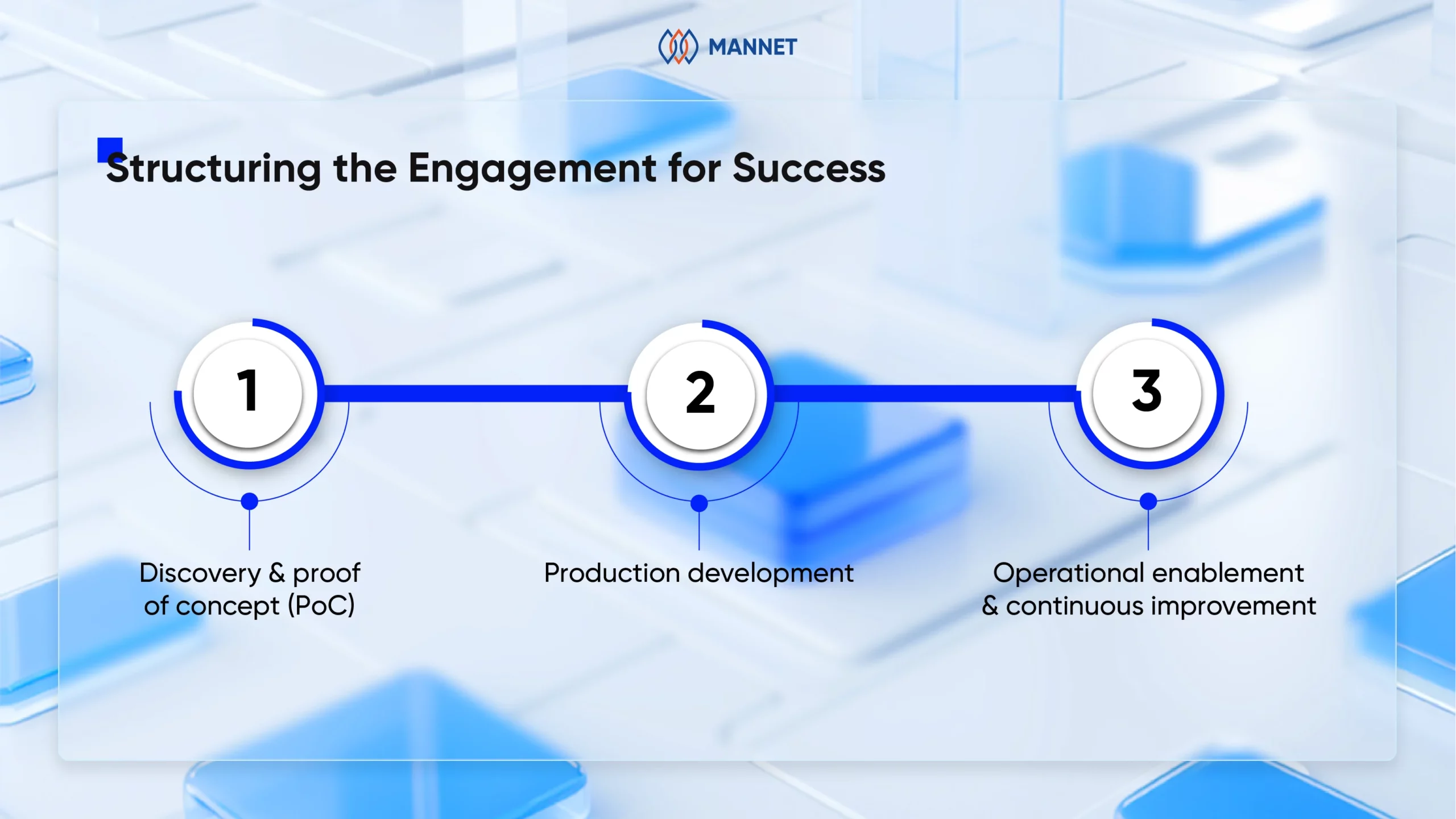
Phase 1. Discovery & proof of concept (PoC)
The Discovery phase establishes technical feasibility and business alignment before significant engineering resources are committed. This stage enables both parties to develop a shared understanding of the business challenge, the available data, the success criteria, and the delivery approach.
Typical activities include:
- Defining business objectives and measurable success metrics.
- Assessing data availability, quality, and readiness.
- Identifying technical constraints and integration requirements.
- Selecting an appropriate AI architecture and technology stack.
- Developing a focused Proof of Concept (PoC) to validate key assumptions.
A successful PoC demonstrates whether the proposed solution can achieve the intended business outcome while providing the confidence required to move into production development.
Success indicators
- Business objectives and KPIs are clearly defined.
- Data quality supports reliable model development.
- Technical feasibility has been validated through the PoC.
- Stakeholders align on the implementation roadmap and investment priorities.
Recommended practice
Establish measurable evaluation criteria before PoC development begins. Clear success metrics help teams determine whether the initiative is ready for production, requires additional refinement, or should be redirected toward a different approach.
Phase 2. Production development
Following successful validation, the engagement shifts toward engineering a secure, scalable, and production-ready AI solution. The emphasis expands from model performance to operational reliability, system integration, governance, and user adoption.
This phase typically includes:
- Developing production-grade AI models.
- Building scalable data pipelines.
- Integrating AI capabilities into existing applications and enterprise platforms.
- Implementing MLOps pipelines for deployment, monitoring, and model lifecycle management.
- Conducting quality assurance, performance testing, and security validation.
- Optimizing system performance prior to production release.
Successful delivery depends on close collaboration between AI engineers, software developers, data engineers, MLOps specialists, QA engineers, product owners, and business stakeholders. Well-defined governance and communication processes help maintain alignment throughout iterative development.
Success indicators
- AI solutions are successfully deployed into production environments.
- Performance, scalability, and security requirements are achieved.
- Monitoring and governance processes support ongoing operations.
- Business teams begin realizing measurable operational or commercial value.
Practical tips
Clearly define ownership across engineering, product, and business teams before development accelerates. Well-established decision-making responsibilities reduce delivery delays, simplify change management, and improve collaboration throughout the project lifecycle.
Phase 3. Operational enablement & continuous improvement
Once an AI solution is deployed, the focus shifts toward operational excellence, long-term maintainability, and continuous improvement. As business requirements evolve and new data becomes available, AI systems require ongoing monitoring, optimization, and governance to sustain performance over time.
This phase combines knowledge transfer, operational readiness, and AI lifecycle management, enabling internal teams to confidently manage the solution while maintaining the flexibility to scale future initiatives.
Typical activities include:
- Preparing comprehensive technical and operational documentation.
- Conducting architecture walkthroughs and knowledge-sharing sessions.
- Establishing monitoring, alerting, and incident response procedures.
- Supporting model performance monitoring, drift detection, and retraining strategies.
- Defining long-term ownership, governance, and support responsibilities.
- Planning future enhancements, feature expansion, or team scaling as business needs evolve.
Whether an organization continues working with its outsourcing partner or gradually transitions ownership to internal teams, a structured operational model helps preserve engineering knowledge, reduce delivery risk, and support continuous business value.
Success indicators
- Internal teams understand the solution architecture, operational workflows, and deployment processes.
- Documentation is complete, current, and accessible.
- Monitoring and governance processes support reliable day-to-day operations.
- Ownership and support responsibilities are clearly defined across all stakeholders.
- AI systems continue to evolve through regular optimization, retraining, and incremental enhancements.
Recommended practice
Plan operational readiness from the beginning of the engagement. Incorporating documentation, knowledge sharing, and collaborative engineering practices throughout the project creates a smoother transition to long-term operations while reducing dependency on individual team members.
Best Practices for Effective AI Outsourcing Engagement and Management
Successful AI outsourcing extends beyond selecting the right partner and establishing a well-structured engagement model. Long-term outcomes are shaped by how internal and external teams collaborate throughout the delivery lifecycle. Organizations that consistently achieve successful AI implementations typically adopt operating practices that encourage transparency, shared ownership, and continuous alignment between business objectives and technical execution.
The following practices have become common among enterprises that successfully scale AI initiatives from pilot projects into production environments.
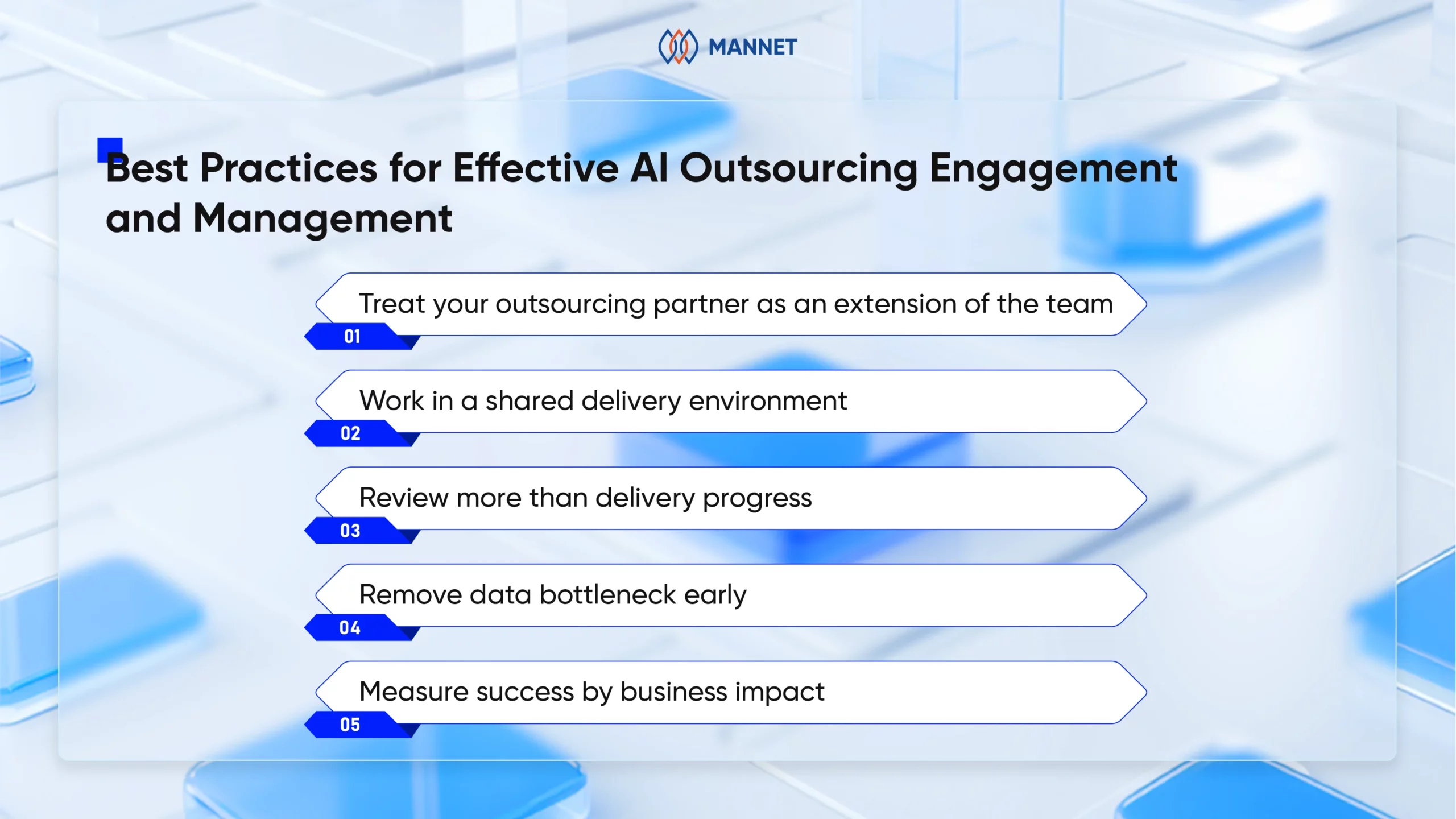
Treat your outsourcing partner as an extension of the team
The strongest AI outsourcing engagements operate as one integrated engineering organization with shared objectives, transparent communication, and collective ownership of delivery outcomes. External AI specialists should contribute to engineering discussions alongside internal teams instead of working as an isolated delivery function.
Embedding outsourced engineers into everyday workflows accelerates knowledge sharing, shortens feedback loops, and enables faster decision-making as business priorities evolve.
Teams that work as a unified organization typically achieve:
- Faster engineering decisions through direct collaboration.
- Greater knowledge sharing across internal and external teams.
- Higher code quality through shared technical reviews.
- Better continuity as projects scale or requirements change.
Recommended practices
- Include outsourced engineers in sprint planning, backlog refinement, and retrospectives.
- Invite them to architecture reviews and technical design discussions.
- Define shared engineering goals and delivery KPIs across both teams.
- Establish regular feedback sessions between internal leaders and external engineers.
Work in a shared delivery environment
Fragmented collaboration introduces unnecessary friction throughout the delivery lifecycle. Separate project management systems, documentation repositories, or communication channels often reduce visibility and slow decision-making.
A shared delivery environment creates a single source of truth for everyone involved, allowing engineering teams to collaborate more efficiently while maintaining transparency across the project.
A shared environment typically includes:
- Project management(Jira, Azure DevOps, Linear)
- Documentation(Confluence, Notion)
- Source code repositories(GitHub, GitLab, Bitbucket)
- Communication platforms(Slack, Microsoft Teams)
- CI/CD pipelines and monitoring dashboards
Recommended practices
- Use the same collaboration tools across internal and outsourced teams.
- Maintain a single documentation repository for technical decisions.
- Grant appropriate repository and dashboard access from the beginning of the engagement.
- Standardize engineering workflows, coding guidelines, and release processes.
Review more than delivery progress
Sprint velocity and milestone completion provide useful delivery signals, but they represent only one dimension of an AI project’s health. Effective governance also evaluates technical performance, operational readiness, and business outcomes.
Executive reviews should regularly assess:
- Model performance(accuracy, latency, drift)
- Data quality and availability
- Infrastructure stability
- Security and compliance
- User adoption and stakeholder feedback
- Business KPIs and ROI
This broader perspective enables leadership teams to identify emerging risks early while ensuring technical execution remains aligned with business priorities.
Recommended practices
- Schedule monthly governance reviews alongside sprint ceremonies.
- Review business KPIs together with engineering metrics.
- Track technical risks before they affect delivery timelines.
- Adjust priorities based on evolving business objectives.
Remove data bottlenecks early
Many AI initiatives slow down long before model development begins. Data availability, quality, governance, and system integration frequently determine delivery speed more than algorithm selection.
Preparing data early helps engineering teams focus on solution development while reducing downstream delays.
Key areas to validate include:
- Data availability
- Data quality and consistency
- Data ownership
- Privacy and compliance requirements
- Integration complexity
Recommended practices
- Complete a structured data readiness assessment during Discovery.
- Resolve data ownership questions before development begins.
- Define governance and access policies early.
- Prioritize production-quality datasets for model training.
Measure success by business impact
The value of AI outsourcing is ultimately measured through business outcomes. Technical excellence creates lasting impact when it contributes to operational efficiency, customer experience, revenue growth, or strategic decision-making.
Organizations should monitor a balanced set of technical and business indicators, including:
- Productivity improvements
- Cost reduction
- Revenue growth
- Customer satisfaction
- Operational efficiency
- Return on investment (ROI)
Aligning engineering metrics with business KPIs provides a clearer picture of long-term performance and helps guide future AI investment decisions.
Recommended practices
- Define business KPIs before development begins.
- Review business and engineering metrics together throughout the engagement.
- Measure adoption alongside model performance.
- Use outcomes to inform future AI roadmap decisions.
How to Measure ROI of AI Development Outsourcing
AI outsourcing delivers value across multiple dimensions, many of which extend beyond engineering productivity. While reduced development costs and faster hiring are common objectives, executive teams increasingly evaluate AI investments based on their contribution to business performance, operational efficiency, and long-term organizational capability.
Establishing ROI metrics before an engagement begins provides a common framework for business leaders, product owners, and engineering teams. It also enables organizations to measure progress consistently throughout the AI lifecycle instead of relying on delivery milestones alone.
A practical ROI framework typically combines five complementary perspectives.
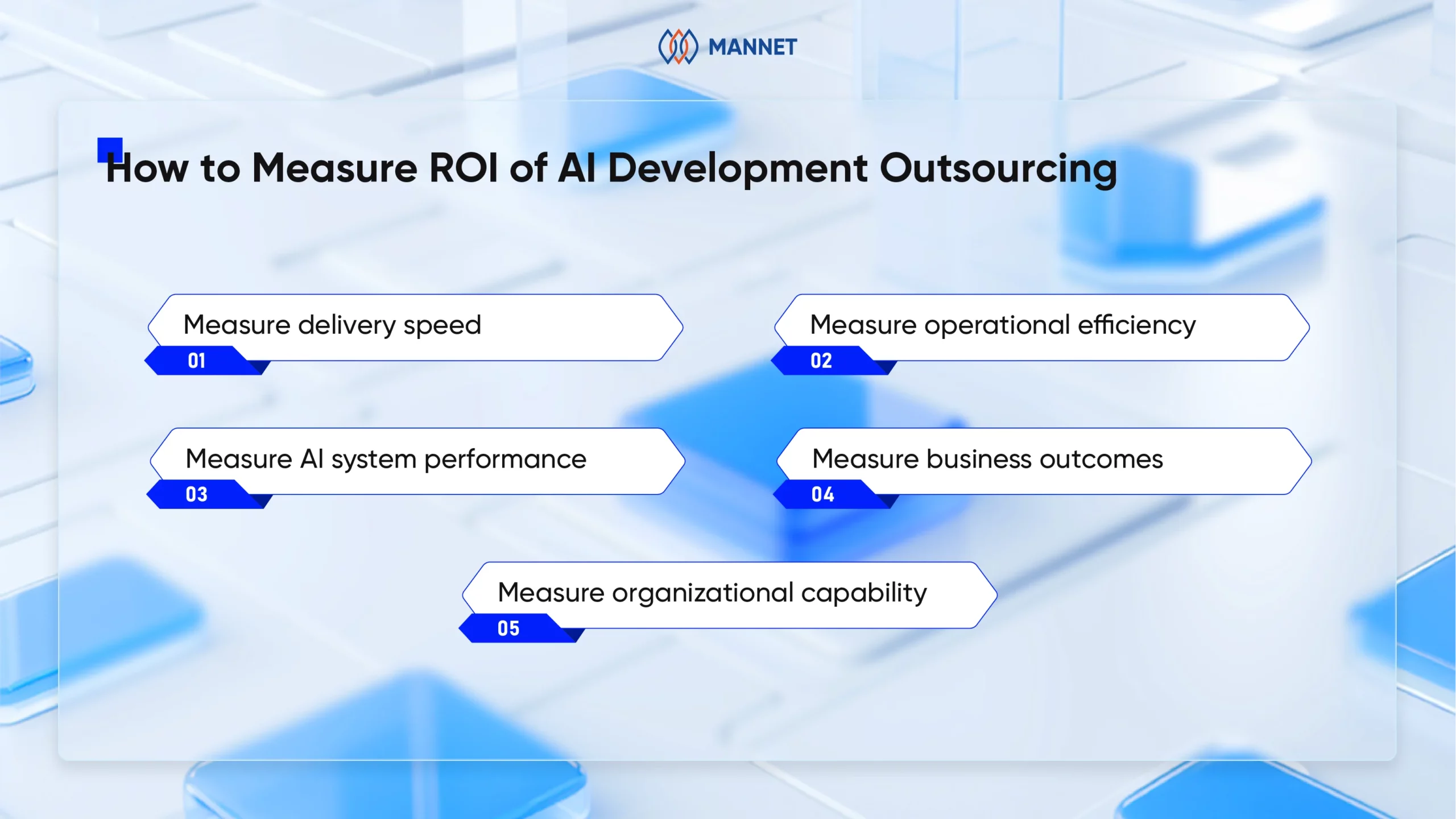
Measure delivery speed
One of the most immediate benefits of AI outsourcing is accelerating access to specialized expertise. Instead of spending months recruiting scarce AI talent, organizations can rapidly expand engineering capacity and begin development sooner.
Key metrics include:
- Time-to-hirefor AI specialists.
- Time-to-project kickoff after resource approval.
- Time-to-Proof of Concept (PoC).
- Time-to-production deployment.
- Release frequency for new AI capabilities.
Reducing delivery timelines enables organizations to validate ideas earlier, respond to market opportunities faster, and shorten the path from concept to business value.
Recommended practice
Benchmark project timelines before outsourcing begins and compare actual delivery performance against historical in-house projects wherever possible.
Measure operational efficiency
Many AI initiatives focus on improving internal processes by automating repetitive work, streamlining operations, or supporting employees with intelligent decision-making.
Typical performance indicators include:
- Hours saved through automation.
- Reduction in manual processing time.
- Productivity improvements across business teams.
- Lower operating costs.
- Faster turnaround times for critical workflows.
These metrics help quantify efficiency gains while providing a clear baseline for future optimization initiatives.
Recommended practice
Measure operational performance before implementation to establish a reliable baseline. Comparing pre- and post-deployment metrics provides a more accurate view of AI’s contribution to business operations.
Measure AI system performance
Business value depends on AI systems performing reliably in production. Measuring technical performance helps ensure models continue meeting quality expectations as data, user behavior, and business requirements evolve.
Organizations commonly monitor:
- Prediction accuracy.
- Precision and recall.
- Inference latency.
- Model drift.
- System availability and uptime.
- Production incident rates.
These engineering metrics provide early signals when models require retraining, optimization, or infrastructure improvements.
Recommended practice
Review technical KPIs alongside business metrics instead of evaluating them independently. Strong model performance should translate into measurable business outcomes over time.
Measure business outcomes
AI initiatives ultimately support broader organizational goals. Measuring commercial and operational impact helps determine whether the investment contributes to strategic priorities.
Depending on the use case, organizations may track:
- Revenue growth.
- Customer satisfaction (CSAT or NPS).
- Conversion rate improvements.
- Reduced fraud losses or operational risk.
- Customer retention.
- Faster service delivery.
- Employee satisfaction and adoption.
Business metrics provide the strongest evidence of long-term ROI and support future investment decisions across the AI portfolio.
Recommended practice
Define business KPIs during project planning and align them with executive reporting cycles so stakeholders can monitor value creation throughout the engagement.
Measure organizational capability
Successful AI outsourcing strengthens an organization’s ability to deliver future AI initiatives more efficiently. Beyond project-specific outcomes, many enterprises evaluate how outsourcing contributes to long-term capability building.
Useful indicators include:
- Time required to launch subsequent AI initiatives.
- Scalability of engineering capacity.
- Growth in internal AI knowledge and technical maturity.
- Effectiveness of knowledge transfer.
- Ability to expand AI adoption across additional business functions.
Organizations that build reusable capabilities often achieve greater long-term returns than those measuring individual projects in isolation.
Recommended practice
Include capability-building objectives within the engagement plan, such as documentation standards, technical workshops, and structured knowledge transfer, to strengthen internal AI maturity over time.
A practical AI outsourcing ROI scorecard
Tracking a balanced combination of technical, operational, and business KPIs provides a more comprehensive view of AI outsourcing performance than relying on cost savings alone.
| ROI dimension | Representative KPIs |
| Delivery speed | Time-to-hire, Time-to-PoC, Time-to-production, Release frequency |
| Operational efficiency | Productivity gains, Hours saved, Cost reduction, Cycle time improvement |
| AI system performance | Accuracy, Precision, Recall, Latency, Model drift, Uptime |
| Business outcomes | Revenue growth, Conversion rate, Customer satisfaction, Risk reduction |
| Organizational capability | Knowledge transfer, Team scalability, AI adoption, Internal capability growth |
Organizations should select KPIs that reflect the objectives of each AI initiative rather than applying a single measurement framework across every project. For example, a customer service chatbot may prioritize resolution time and customer satisfaction, while a predictive maintenance solution may focus on equipment uptime and maintenance cost reduction.
Common Mistakes to Avoid when Choosing an AI Outsourcing Company
Choosing an AI outsourcing partner involves more than comparing technical capabilities or hourly rates. Many unsuccessful engagements can be traced back to decisions made before development even begins, during vendor selection, project planning, and governance design.
The following mistakes appear consistently across AI outsourcing engagements and often lead to longer delivery timelines, higher costs, and lower business value. Recognizing these risks early enables organizations to establish stronger partnerships and improve delivery outcomes from the outset.
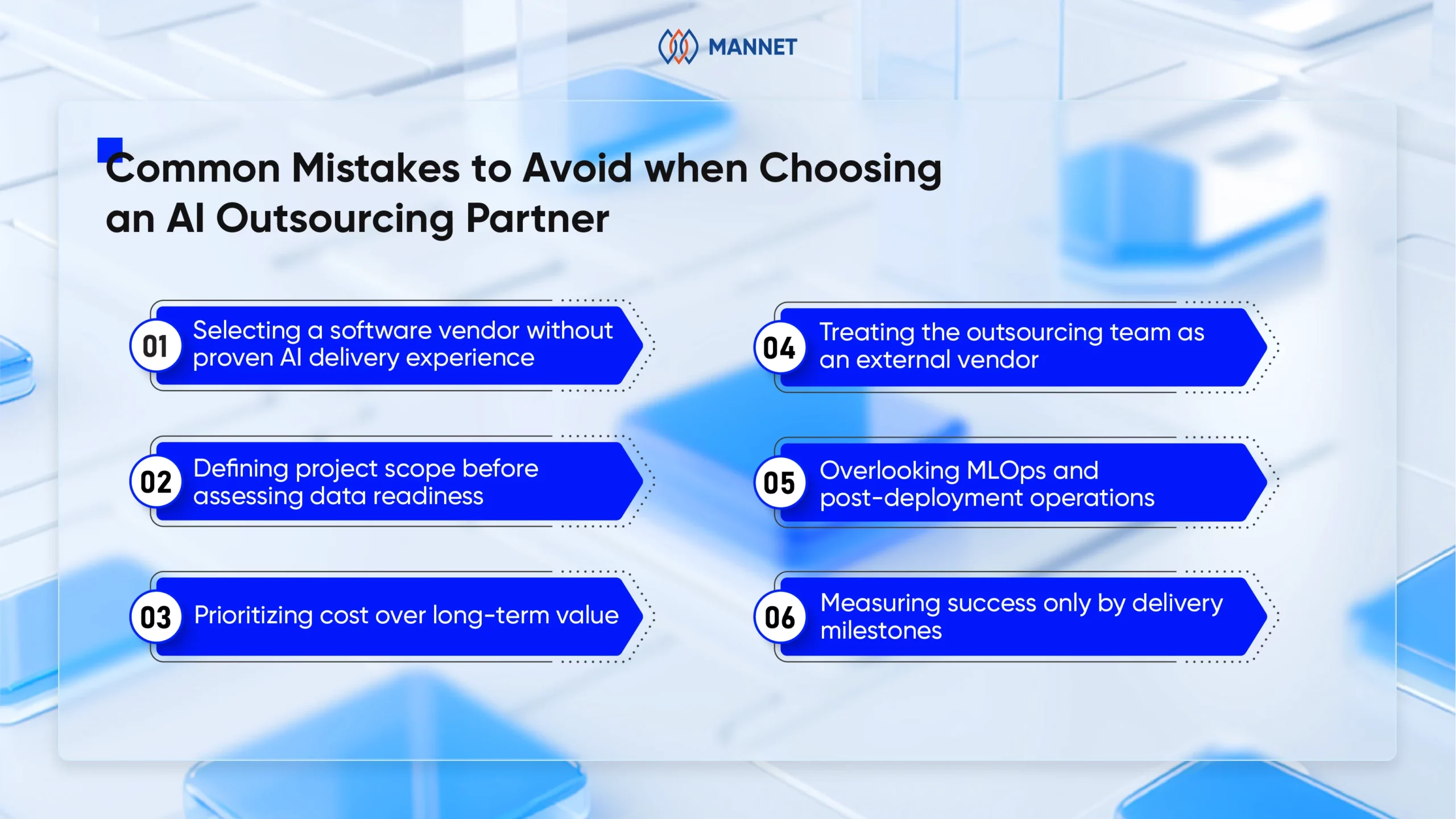
Selecting a software vendor without proven AI delivery experience
Many software development companies now promote AI services, yet production AI requires capabilities that extend well beyond traditional application engineering. Expertise in machine learning, data engineering, MLOps, LLM deployment, and AI governance plays a significant role in determining whether an AI initiative successfully reaches production.
Potential impact
- Longer experimentation cycles.
- Technical rework during production.
- Limited scalability.
- Higher implementation risk.
How to avoid it
Evaluate evidence of production AI delivery, including deployed AI systems, engineering case studies, MLOps practices, and the technical backgrounds of delivery teams. A strong portfolio should demonstrate measurable business outcomes rather than prototype demonstrations alone.
Defining project scope before assessing data readiness
Organizations often invest significant effort into defining AI features while overlooking the condition of the underlying data. Data quality, accessibility, governance, and integration requirements frequently determine project timelines and model performance.
Potential impact
- Delayed project delivery.
- Reduced model accuracy.
- Increased engineering effort.
- Higher implementation costs.
How to avoid it
Include a structured data readiness assessment during Discovery. Confirm data availability, ownership, governance requirements, and integration complexity before committing to development timelines.
Prioritizing cost over long-term value
Lower hourly rates rarely translate into lower total project costs. Engineering quality, delivery efficiency, communication effectiveness, and operational maturity have a much greater influence on overall project success.
Potential impact
- Higher maintenance costs.
- Frequent rework.
- Extended delivery schedules.
- Lower return on investment.
How to avoid it
Evaluate providers using a balanced scorecard covering technical expertise, delivery maturity, communication, security, scalability, and long-term business value rather than pricing alone.
Treating the outsourcing team as an external vendor
AI initiatives depend on close collaboration between engineering, product, data, and business stakeholders. Limited communication and isolated delivery models often slow decision-making and reduce knowledge sharing.
Potential impact
- Misaligned priorities.
- Slower issue resolution.
- Reduced engineering productivity.
- Knowledge silos.
How to avoid it
Embed external engineers into existing engineering workflows, planning sessions, architecture discussions, and governance meetings to create a unified delivery organization.
Overlooking MLOps and post-deployment operations
Production deployment represents an important milestone, but long-term value depends on maintaining model performance after release. Monitoring, retraining, governance, and operational support should be planned from the beginning of the engagement.
Potential impact
- Declining model performance.
- Undetected model drift.
- Increased operational risk.
- Reduced business value over time.
How to avoid it
Assess the provider’s MLOps capabilities, including monitoring, automated deployment, model versioning, retraining workflows, and operational support processes before the engagement begins.
Measuring success only by delivery milestones
Completing development on schedule does not necessarily indicate project success. Executive teams ultimately evaluate AI initiatives based on measurable business outcomes.
Potential impact
- Limited executive visibility.
- Difficulty demonstrating ROI.
- Misaligned investment priorities.
- Reduced stakeholder confidence.
How to avoid it
Define business KPIs alongside technical metrics during project planning and review both throughout the engagement. Delivery progress, model performance, operational efficiency, and commercial outcomes should all contribute to project evaluation.
When to Outsource AI Development
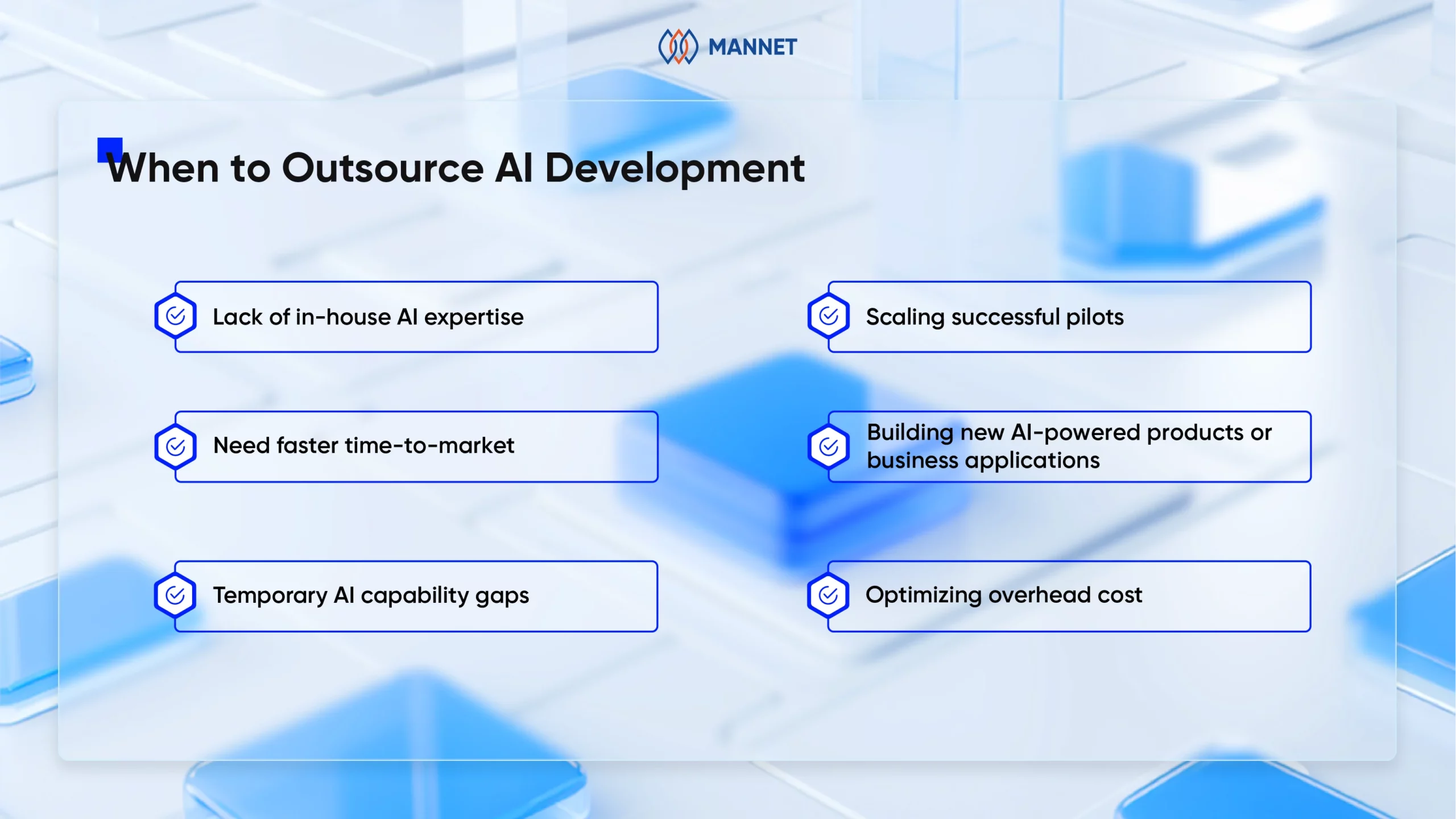
AI outsourcing is most effective when it addresses a clearly defined business challenge rather than serving as a default resourcing strategy. While every organization’s AI roadmap is different, certain situations consistently benefit from external expertise, whether the priority is accelerating delivery, accessing specialized skills, or scaling successful initiatives.
Understanding these scenarios helps leadership teams determine when outsourcing can strengthen internal capabilities and create greater business value throughout the AI lifecycle.
Lack of in-house AI expertise
Many organizations have mature software engineering teams but limited experience delivering production AI systems. Machine learning, Generative AI, MLOps, data engineering, and AI governance require specialized knowledge that differs significantly from traditional software development.
Developing these capabilities internally often involves substantial investment in recruitment, training, and experimentation. For organizations launching new AI initiatives, this learning curve can delay delivery and increase implementation risk.
AI outsourcing enables companies to supplement existing engineering teams with experienced specialists who bring established technical practices, production experience, and domain knowledge from previous AI implementations.
AI outsourcing is particularly valuable when projects require expertise in:
- Machine Learning and Deep Learning
- Generative AI and Large Language Models (LLMs)
- Retrieval-Augmented Generation (RAG)
- Data Engineering and Feature Engineering
- MLOps and AI infrastructure
- AI governance and model monitoring
Need faster time-to-market
For many organizations, the timing of an AI initiative is closely tied to business opportunity. Delays in assembling the right engineering team can postpone product launches, slow digital transformation programs, or allow competitors to establish an early advantage.
Recruiting experienced AI professionals often takes several months, particularly for senior or niche roles. AI outsourcing shortens this timeline by providing immediate access to engineering capacity that is already familiar with modern AI frameworks, cloud platforms, and production delivery practices.
Organizations commonly outsource AI development to accelerate:
- Proof of Concept (PoC) delivery
- Minimum Viable Product (MVP) development
- Production AI implementation
- AI feature releases within existing products
- Enterprise AI transformation initiatives
When speed is a strategic priority, reducing team ramp-up time can be just as valuable as accelerating software development itself.
Temporary AI capability gaps
AI talent requirements often fluctuate throughout a project’s lifecycle. A team may need additional expertise during data preparation, model training, cloud deployment, or production rollout without requiring those resources permanently.
Rather than expanding long-term headcount for short-term demand, many organizations augment their internal teams with external AI specialists during critical delivery phases.
Typical situations include:
- Supporting a high-priority product release
- Implementing new AI technologies
- Addressing short-term resource constraints
- Providing specialist expertise for a specific workstream
- Backfilling difficult-to-fill AI engineering roles
This flexible approach enables organizations to respond to changing project demands while maintaining strategic ownership of products, architecture, and technology decisions.
Scaling successful pilots
Proofs of Concept demonstrate technical feasibility, but enterprise adoption introduces an entirely different set of engineering challenges. Moving from a successful pilot to a production environment often requires stronger capabilities in infrastructure, security, monitoring, governance, integration, and operational support.
Many organizations discover that the team responsible for building a PoC does not necessarily possess the experience required to operate AI systems reliably at scale.
External AI engineering teams can help accelerate this transition by supporting:
- Production-grade MLOps implementation
- Cloud infrastructure and deployment automation
- Enterprise system integration
- Model monitoring and lifecycle management
- Performance optimization and scalability
For organizations seeking to expand AI beyond experimentation, outsourcing can help bridge the gap between technical validation and sustainable production deployment.
Building new AI-powered products or business applications
AI is increasingly becoming a core component of digital products and enterprise software rather than a standalone innovation initiative. Whether developing AI copilots, intelligent document processing platforms, recommendation engines, or industry-specific business applications, organizations often need multidisciplinary expertise that extends beyond software engineering.
Successful AI product development typically combines expertise in machine learning, backend engineering, cloud infrastructure, data engineering, MLOps, user experience, and domain knowledge.
AI outsourcing allows organizations to assemble these capabilities more efficiently while allowing internal product teams to focus on roadmap execution, customer insights, and strategic product decisions.
Common examples include:
- AI copilots and virtual assistants
- Knowledge management and enterprise search platforms
- Document intelligence solutions
- Predictive analytics applications
- Recommendation and personalization engines
- Industry-specific AI software products
Optimizing overhead cost
Building an internal AI capability involves significantly more than hiring engineers. Recruitment, onboarding, technical training, infrastructure, management overhead, employee retention, and workforce planning all contribute to the total cost of ownership.
For organizations with evolving AI roadmaps, maintaining a permanently sized AI team may not always represent the most efficient use of resources. Outsourcing provides greater flexibility by allowing engineering capacity to scale alongside business demand while reducing fixed operational commitments.
Organizations frequently adopt outsourcing to:
- Reduce recruitment and onboarding costs
- Scale engineering teams according to project demand
- Access specialized expertise without permanent hiring
- Improve resource utilization across multiple initiatives
- Increase budget predictability for AI programs
Evaluating AI investment through the lens of total cost of ownership (TCO) rather than salary alone provides a more accurate picture of long-term financial impact.
Key takeaway
The decision to outsource AI development should align with an organization’s business objectives, technical maturity, and delivery priorities. Companies often realize the greatest value when outsourcing provides capabilities that are difficult to build internally within the required timeframe, supports the transition from experimentation to production, or enables AI initiatives to scale without slowing broader business objectives.
As AI adoption continues to expand across industries, the most successful organizations increasingly combine internal strategic ownership with specialized external expertise, creating delivery models that balance speed, flexibility, and long-term capability building.
The Alternate Playbook: Retaining In-House Strategic Control with ManNet
For enterprises that prefer to retain full ownership of their proprietary codebases, core intellectual property (IP), and system architecture rather than offloading the entire execution lifecycle to a closed external vendor, project-based outsourcing may not be the optimal path.
ManNet’s specialized IT Staff Augmentation Services provide a highly flexible alternative. Instead of relinquishing control of the product roadmap, organizations can strategically inject the exact engineering resources required at each stage of the AI lifecycle:
- Stuck on Stage 1 & 2? Inject a senior Data Scientist or Big Data Consultant through ManNet’s IT Recruitment Services and Executive Search solutions to audit corporate data landscapes, organize legacy structures, and build clean pipelines.
- Ready for Stage 3? Instantly scale up the internal squad by choosing to hire AI & Machine Learning engineers from ManNet’s premium talent pool to code, train, and validate neural networks.
- Prepping for Stage 4 & 5? Deploy specialized MLOps Engineers to build automated deployment pipelines and real-time monitoring infrastructure directly inside the organization’s native cloud environment using agile IT staff augmentation
- Expanding Global Teams in Vietnam?Leverage ManNet’s Employer of Record (EOR) services and Build-Operate-Transfer (BOT) support to seamlessly manage local payroll, labor compliance, and offshore subsidiary setup under a unified provider.
Through this hybrid talent strategy, organizations secure elite Vietnamese technical velocity, optimize engineering budgets, and accelerate development speed while maintaining 100% internal control over their strategic technical assets.
How ManNet Approaches AI Talent Sourcing for AI-Driven Organizations
Most enterprise tech buyers evaluating AI outsourcing in Vietnam focus on three core metrics: specialized technical skill, deployment speed, and financial risk mitigation.
Unlike traditional software development vendors competing for broad project budgets, ManNet operates as a pure talent architecture layer. The company’s core mission is to inject the precise engineering resources needed to accelerate development, whether those professionals operate within an in-house corporate team or alongside an external vendor.
Talent deployment velocity
Traditional recruitment cycles for specialized tech roles in Southeast Asia often exceed 45 days. ManNet compresses this pipeline via strict Service Level Agreements (SLAs):
- 4 Working Hours: Completion of comprehensive technical requirements analysis.
- 3-5 Business Days: Delivery of a curated, pre-vetted specialist shortlist.
- 7 Calendar Days: Deployment of a complete, cross-functional engineering team.
This velocity advantage directly prevents roadmaps from stalling and eliminates the heavy opportunity costs associated with vacant engineering seats.
Full-stack AI engineering bench
Deploying production-grade artificial intelligence requires a multi-disciplinary tech squad. ManNet provides instant access to a vetted network of 10,000+ IT professionals, allowing organizations to seamlessly:
- Hire machine learning engineers to architect and train complex neural networks.
- Deploy Data Engineers to clean raw databases and build secure pipelines.
- Embed MLOps Specialists to manage containerization, scaling, and real-time drift telemetry.
- Integrate QA Automation Engineers to validate system outputs before live deployment.
Flexible managed staffing models
ManNet offers agile engagement structures designed to scale smoothly alongside an organization’s specific technical maturity curve:
- IT recruitment & direct hire: Tailored for companies looking to permanently fill local technical roles without building an in-house recruitment pipeline from scratch.
- IT staff augmentation: Ideal for tech leaders needing to rapidly inject engineering capacity into specific sprints without increasing fixed headcount overhead.
- EOR & BOT subsidiary setup: A comprehensive, integrated blueprint covering local payroll, legal compliance, and operational setup for global enterprises building permanent offshore development centers in Vietnam.
Algorithmic vetting & risk mitigation
To protect software roadmaps from early candidate attrition and slow hiring cycles, ManNet provides a dual-layer safety net:
- Passive candidate sourcing: Utilizing AI-powered ATS infrastructure to mine GitHub and LinkedIn data, capturing high-performing passive talent unavailable on standard job boards.
- 60-day performance guarantee: Providing a complimentary candidate replacement or a 50% fee deduction if an embedded engineer fails to meet organizational performance standards within the first two months.
FAQs About Choosing an AI Outsourcing Company
1. How long does it typically take to onboard an AI outsourcing team?
The onboarding timeline depends on the engagement model, project complexity, and required skill sets. For AI staff augmentation, experienced engineers can often join an existing team within a few weeks. Larger dedicated teams or project-based engagements may require additional time for discovery, technical alignment, and knowledge transfer before development begins.
2. What roles are typically included in an AI outsourcing team?
AI outsourcing teams vary by project, but they commonly include AI/ML Engineers, Data Engineers, MLOps Engineers, Backend Engineers, Cloud Engineers, QA Engineers, and Technical Project Managers. Enterprise initiatives may also involve Solution Architects, Data Scientists, AI Consultants, or Domain Experts depending on business requirements.
3. Can an AI outsourcing partner work with an existing in-house engineering team?
Yes. Many organizations adopt a hybrid delivery model where internal teams retain ownership of product strategy, architecture, and business priorities while external AI specialists contribute technical expertise and additional engineering capacity. This collaborative approach often accelerates delivery while preserving strategic control.
4. How can companies protect intellectual property (IP) when outsourcing AI development?
Protecting IP starts with clear contractual agreements covering ownership, confidentiality, and data governance. Organizations should also evaluate a partner’s security certifications, access controls, secure development practices, and compliance processes to ensure sensitive data, proprietary models, and source code remain protected throughout the engagement.
5. What engagement model is best for AI outsourcing projects?
The most suitable model depends on business objectives, internal capabilities, and project scope. AI staff augmentation is often ideal for extending existing engineering teams, dedicated development teams support long-term product development, while project-based outsourcing works well for clearly defined AI initiatives with fixed deliverables. Many organizations combine these models as their AI strategy evolves.
Final Verdict: Choosing the Right AI Outsourcing Company in Vietnam
There is no one-size-fits-all model for AI outsourcing in Vietnam. The optimal strategic choice depends entirely on how much ownership an organization requires over its technical infrastructure, product roadmap, and core intellectual property (IP).
The ManNet distinction: Why retain control?
For fast-moving tech organizations that refuse to lock themselves into rigid external vendor contracts or give up absolute ownership of their codebases, standard project-based outsourcing introduces unnecessary risks.
ManNet offers the ultimate hybrid approach. By separating execution capacity from headcount overhead, the company enables organizations to keep their core strategy in-house while instantly scaling up engineering velocity. Whether a business needs to hire machine learning engineers for a single project milestone, leverage flexible IT staff augmentation services for rapid development sprints, or utilize compliant Employer of Record (EOR) models to build a permanent tech hub in Vietnam, ManNet handles the operational heavy lifting under one roof.