

Hiring top tech talent in 2026 is no longer a sourcing challenge but a competition for speed, precision, and candidate engagement. Research shows that roughly 70% of the global workforce consists of passive candidates who are not actively applying for jobs (LinkedIn), meaning the best engineers, cloud specialists, and technology leaders are often beyond the reach of traditional job postings.
To compete in this market, organizations need recruitment strategies that go beyond posting vacancies and waiting for applications. In this guide, we explore 15 proven recruitment strategies that help IT leaders and talent acquisition teams attract stronger candidates, reduce hiring delays, and build high-performing tech teams at scale.
Let’s dive in!
1. Execute a Precision Technical Skills Gap Audit
Many hiring initiatives fail before sourcing even begins due to unclear role requirements.
Before launching recruitment efforts, organizations should assess their current technical capabilities against business priorities and product roadmap goals. A structured skills gap audit helps hiring teams identify exactly which capabilities are missing, where they are needed, and how they should be acquired.
Recommended actions
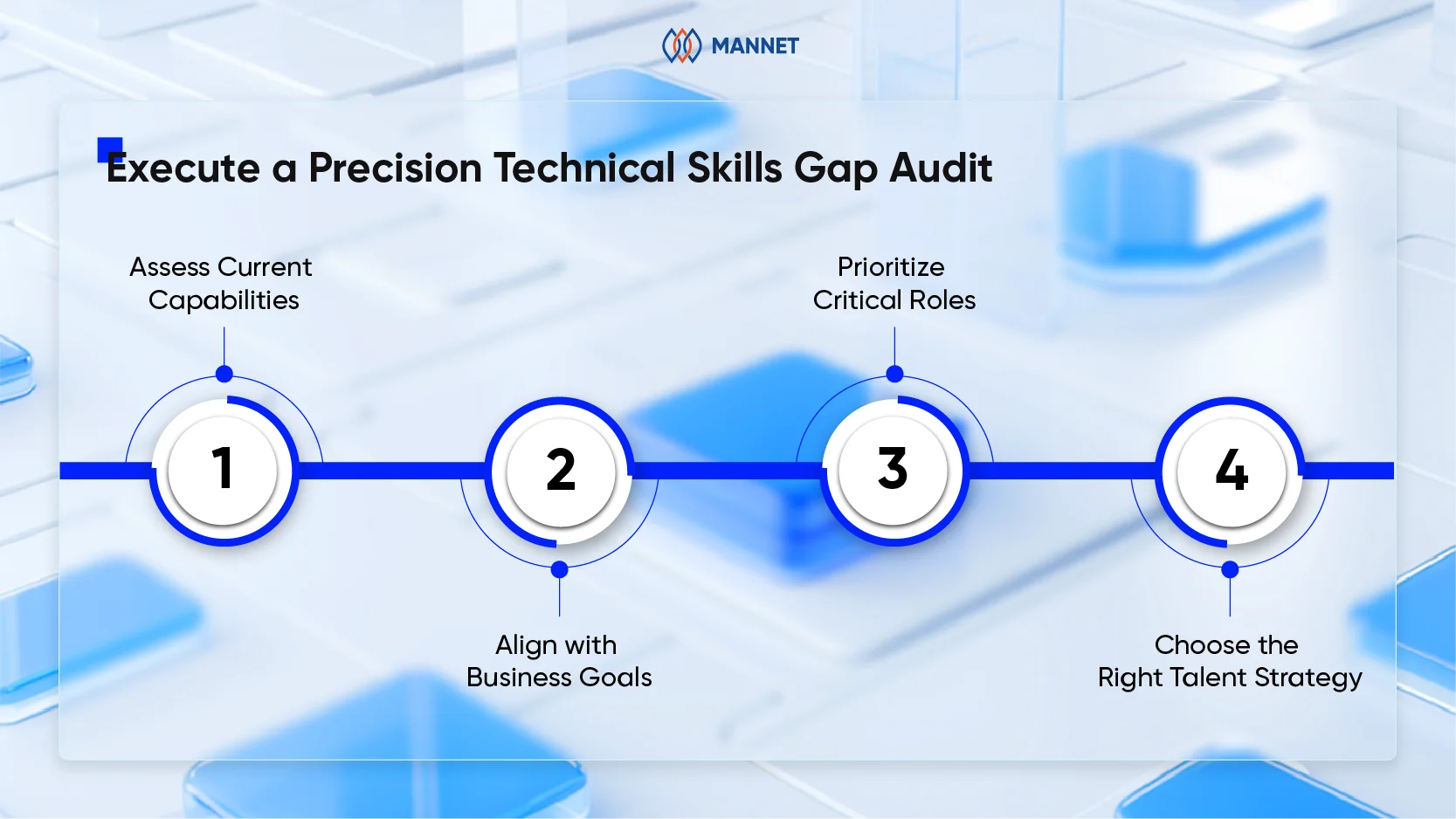
- Assess engineering capabilities across teams, projects, and critical technology domains.
- Align hiring priorities with 6-18 month business and product objectives.
- Categorize roles by business impact, distinguishing critical leadership positions from scale-supporting roles.
- Determine whether gaps should be addressed through permanent hiring, internal mobility, upskilling, or external talent augmentation.
Why it matters
Without a clear understanding of existing capabilities and future talent requirements, recruitment quickly becomes reactive. Recruiters spend valuable time refining role definitions, hiring managers struggle to align expectations, and candidate pipelines become filled with profiles that do not match business needs.
A well-executed skills gap audit creates a stronger hiring strategy from the outset, helping organizations prioritize investments, improve hiring accuracy, and build teams that support long-term growth rather than short-term headcount targets.
For companies entering new markets or expanding operations internationally, structured HR consultation and workforce planning can help ensure hiring decisions reflect local talent availability, compensation benchmarks, and regulatory considerations from the beginning.
2. Architect Proactive Talent Pipelines
One of the biggest mistakes in technology hiring is treating recruitment as a reactive process.
By the time a critical role is approved, the strongest candidates are often already engaged elsewhere. Organizations that consistently hire top talent build relationships before demand arises, creating a pipeline of qualified professionals who are already familiar with the company, its technology environment, and its growth ambitions.
Implementation framework
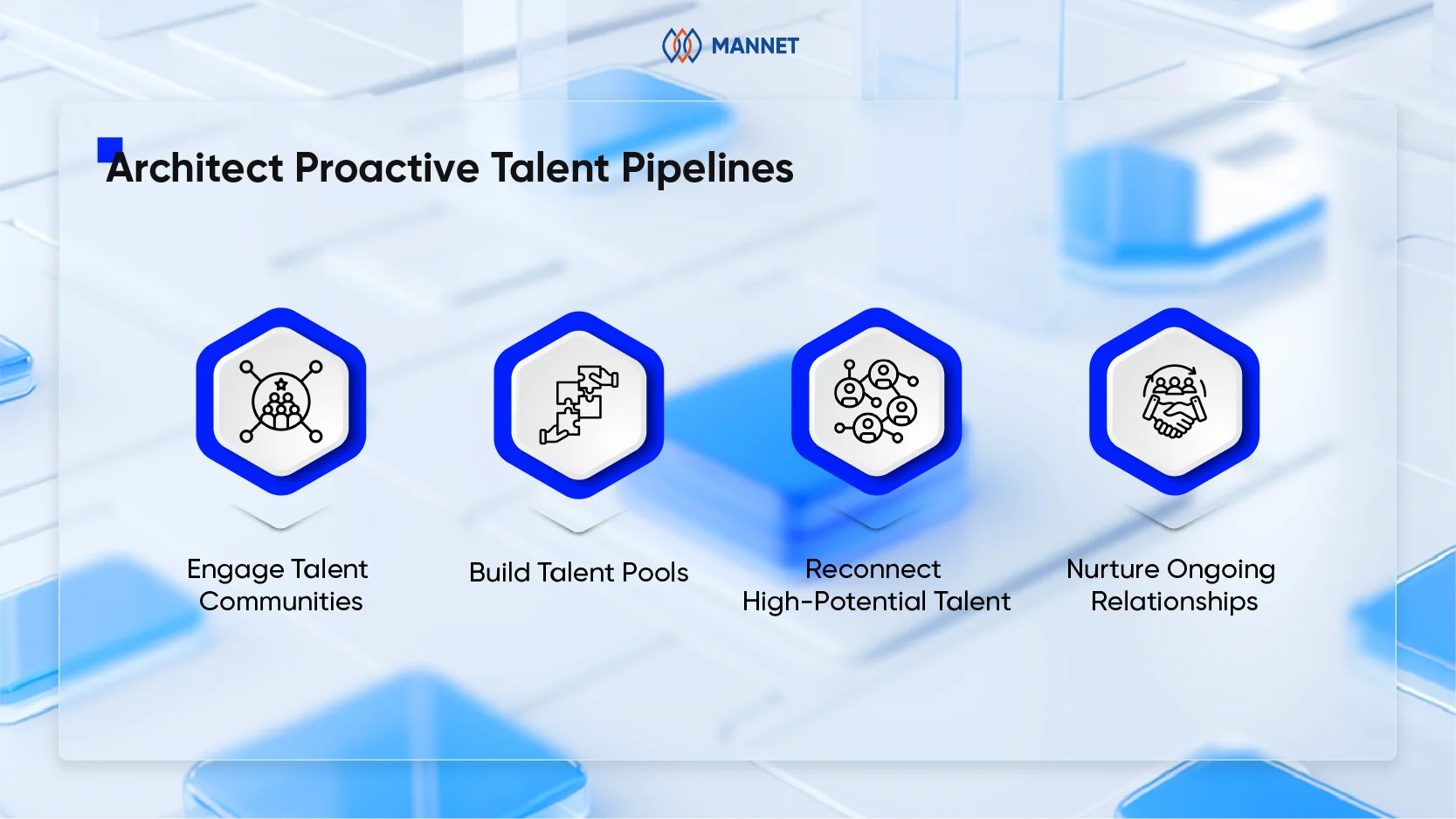
- Engage technical communities through engineering events, webinars, open-source initiatives, and industry partnerships.
- Maintain a structured talent database segmented by technology stack, seniority level, and hiring readiness.
- Reconnect with high-potential candidates from previous hiring cycles who may be a fit for future opportunities.
- Create talent communities where prospective candidates can stay informed about company updates, technical projects, and upcoming roles.
Why it matters
Reactive hiring often forces organizations into lengthy sourcing cycles, increased recruitment costs, and greater competition for a limited pool of qualified talent. In contrast, proactive talent pipelines shorten time-to-hire and improve candidate quality by ensuring relationships are already established before a hiring need emerges.
When a critical position opens, whether a Cloud Architect, AI Engineer, or Engineering Manager, the goal should not be to start searching. It should be to activate a network that has already been built.
For companies scaling across multiple locations or specialized technology domains, partnering with an experienced IT recruitment provider can help establish and maintain these talent pipelines more efficiently and at greater scale.
3. Engineer Precise, Outcome-Based Job Descriptions
A job description is often the first interaction a candidate has with your organization. For technical professionals, it can strongly influence whether they apply, explore further, or move on.
Yet many companies continue to rely on generic templates packed with lengthy requirement lists, vague expectations, and corporate buzzwords. Instead of attracting qualified talent, these job descriptions often discourage the very candidates they are designed to reach.
Best practices for high-performing job descriptions
- Use clear, standardized job titles that reflect how candidates actually search for roles.
- Distinguish essential skills from preferred qualifications to avoid unnecessarily shrinking the talent pool.
- Clearly communicate the technologies, tools, and working environment candidates can expect.
- Focus on measurable outcomes and expectations for the first 90 to 180 days rather than listing responsibilities alone.
- Keep formatting concise, scannable, and mobile-friendly to improve the candidate experience.
Why it matters
The strongest candidates evaluate opportunities as carefully as employers evaluate candidates. A well-crafted job description helps them quickly understand the role, assess fit, and envision their potential impact within the organization.
Beyond improving application quality, optimized job descriptions also increase visibility across job boards and search engines. By incorporating relevant role-specific keywords and candidate-friendly language, organizations can expand their reach and attract more qualified talent without increasing recruitment spend.
4. Build a Strong Engineering Employer Brand
In competitive technology markets, attracting top talent requires more than offering competitive compensation. Candidates increasingly evaluate employers long before they enter a hiring process, researching company culture, technical challenges, leadership credibility, and employee experiences before deciding whether to engage.
For experienced engineers in particular, an employer brand is most effective when it reflects the realities of the engineering organization, apart from the broader corporate brand.
Implementation framework
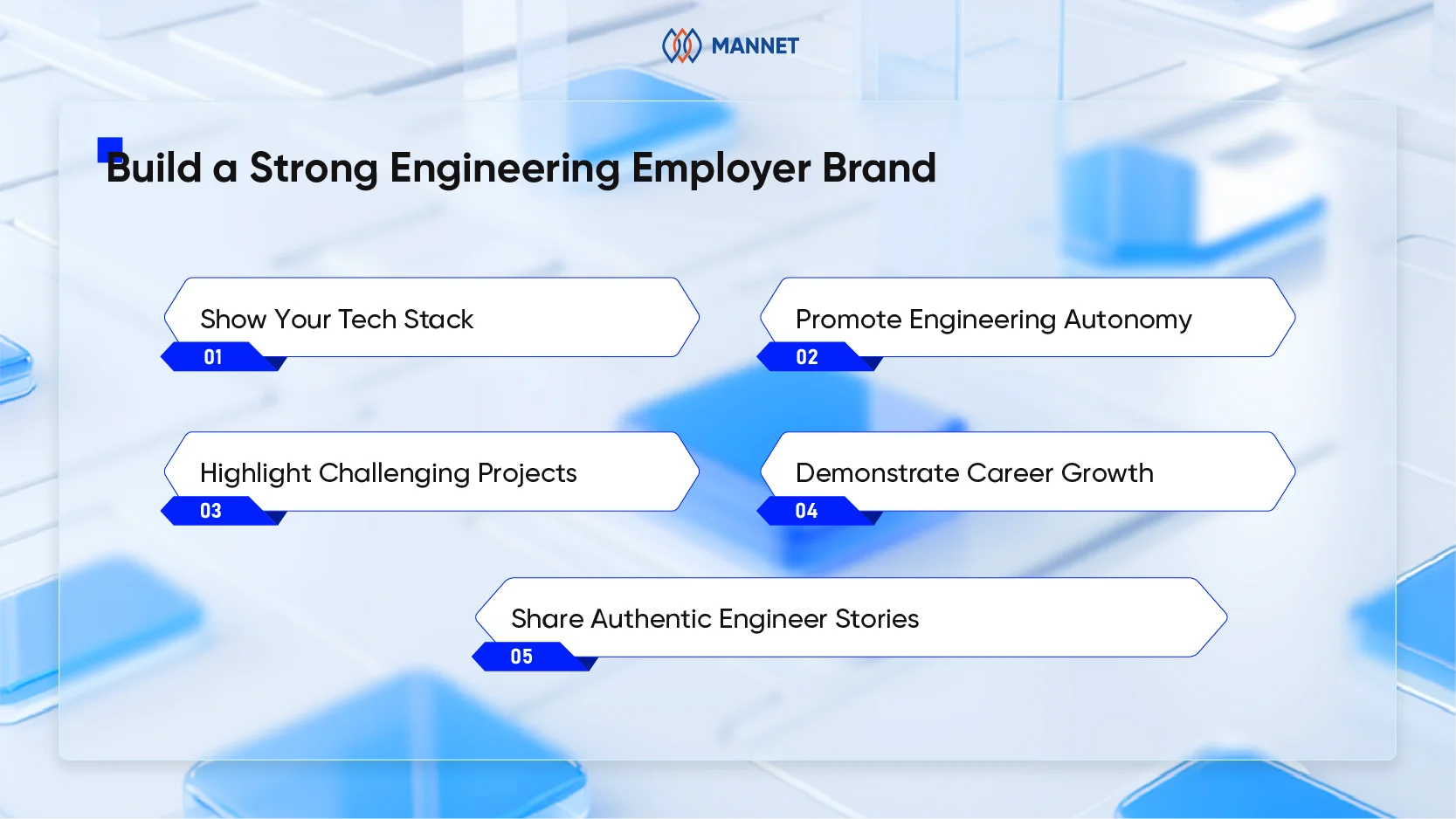
- Clearly communicate your technology stack, engineering practices, and approach to software development.
- Highlight opportunities for technical ownership, innovation, and decision-making autonomy.
- Showcase challenging projects, modern technologies, and the business impact of engineering work.
- Demonstrate career growth opportunities through mentorship, learning programs, and leadership pathways.
- Feature authentic stories from engineers, architects, and technical leaders across the organization.
Why it matters
The strongest candidates are evaluating your company just as carefully as you are evaluating them. Before responding to outreach or submitting an application, they often seek evidence that the organization provides meaningful technical challenges, a supportive engineering culture, and opportunities for long-term growth.
Organizations that invest in a credible engineering employer brand are better positioned to attract passive candidates, improve candidate engagement, and strengthen hiring outcomes over time. Content created by engineering leaders, technical case studies, and employee success stories can be particularly effective because they provide the authenticity and transparency that experienced professionals value.
Ultimately, employer branding is not a marketing exercise but a strategic recruitment asset that influences who enters your talent pipeline and how quickly critical roles can be filled.
5. Deploy a Multi-Channel Talent Sourcing Strategy
Relying on a single sourcing channel is no longer enough to compete for top technology talent.
Today’s candidates discover opportunities across a wide range of platforms, from professional networks and technical communities to social media and specialized job boards. Organizations that consistently attract high-quality talent adopt a multi-channel sourcing strategy that reaches candidates where they already spend their time.
| Channel | Best used for |
| Senior roles, management, structured InMail campaigns | |
| GitHub / Stack Overflow profiles | Specialized engineering talent; verify skills before first contact |
| Facebook & Instagram | Employer brand storytelling, broader reach, and younger talent |
| Niche tech communities (Slack, Discord, local dev forums) | Highly specialized, community-embedded technical profiles |
| Job boards (Indeed, tech-specific platforms) | Volume sourcing; optimize listings for discoverability |
Key actions
- Use professional networks such as LinkedIn to engage experienced professionals and leadership-level candidates.
- Leverage technical platforms and developer communities to identify candidates with specialized skills and relevant project experience.
- Invest in employer branding across social media channels to increase visibility and strengthen candidate engagement.
- Participate in industry groups, technical forums, and community events to build relationships with passive talent.
- Optimize job advertisements for both job board visibility and search engine discoverability.
Why it matters
Different talent segments engage with different channels. While some candidates actively search job boards, many experienced professionals are more likely to respond through professional networks, technical communities, or referrals from trusted peers.
A diversified sourcing strategy expands access to talent pools that traditional recruiting methods often miss. It also reduces dependency on any single channel, improving recruitment resilience and helping organizations adapt to changing candidate behaviors.
The most effective organizations combine long-term employer brand building with targeted sourcing efforts. Together, these approaches increase visibility, strengthen candidate trust, and create a more sustainable pipeline of qualified technology talent.
6. Proactively Engage Passive Tech Talent
70% of the global tech workforce isn’t browsing job boards. The engineers you most want to hire are already delivering value somewhere else. (LinkedIn’s Global Talent Trends)
The professionals capable of the highest business impact are rarely applying. They must be systematically identified, intelligently approached, and carefully converted.
Sourcing framework:
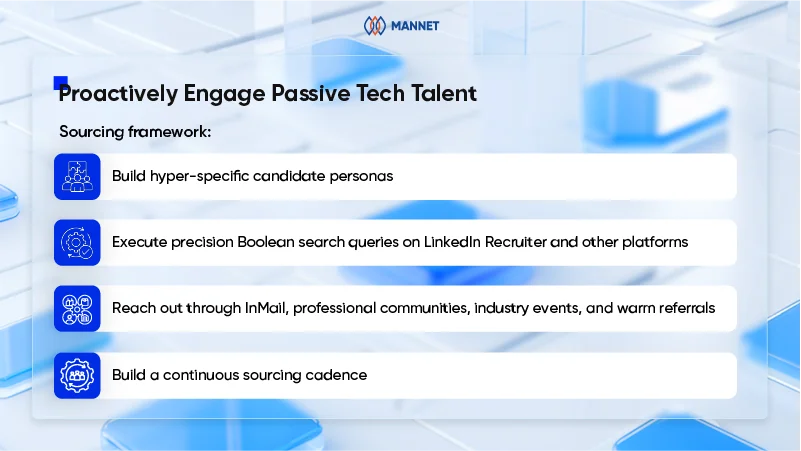
- Build hyper-specific candidate personas: primary tech stack, career trajectory, compensation drivers, and typical pain points in their current role
- Execute precision Boolean search queries on LinkedIn Recruiter and other platforms to intercept profiles before they become active candidates
- Reach out through InMail, professional communities, industry events, and warm referrals– cold outreach works when it’s relevant and respectful
- Build a continuous sourcing cadence– don’t source only when roles go live; build relationships in advance
What to say when you reach out:
- Reference their specific background; make the connection between their trajectory and the opportunity explicit
- Respect brevity – senior engineers receive a lot of outreach; get to the point quickly
- Frame the role as a natural next step, not a generic pitch
- Make the next step obvious and low-friction
When internal sourcing teams hit capacity limits or lack local network depth, particularly in markets like Vietnam, specialized partners like ManNet’s IT Recruitment provide immediate, confidential access to pre-vetted local engineering pools.
7. Build a High-Performing Employee Referral Program
Your employees can be one of your most effective talent acquisition channels, especially in technology hiring.
Referred candidates often move through hiring processes faster, integrate into teams more smoothly, and demonstrate stronger long-term retention. Existing employees understand both the technical requirements of a role and the realities of working within the organization, making them uniquely positioned to identify strong-fit candidates.
How to strengthen your referral program
- Offer meaningful incentives: Align referral rewards with role seniority, business impact, and hiring difficulty.
- Reduce friction: Make the referral process simple, intuitive, and easy to complete.
- Maintain visibility: Keep employees informed throughout the hiring process to encourage ongoing participation.
- Recognize contributors: Celebrate successful referrals through internal communications and recognition programs.
- Encourage team involvement: Create opportunities for candidates to connect with future teammates through informal conversations and team introductions.
Pro tip
Referral programs rarely succeed on incentives alone. Regular reminders, success stories, and periodic recognition initiatives help keep referrals top of mind and sustain participation over time.
8. Institutionalize Skills-Based Tech Hiring
Hire for capability, not credentials.
In technology hiring, academic background and years of experience do not always predict job performance. Many of today’s strongest engineers have built their expertise through hands-on projects, open-source contributions, bootcamps, certifications, or non-traditional career paths.
Organizations that prioritize demonstrated skills over formal credentials can access a broader talent pool and identify high-potential candidates who may be overlooked by traditional screening methods.
How to implement skills-based hiring
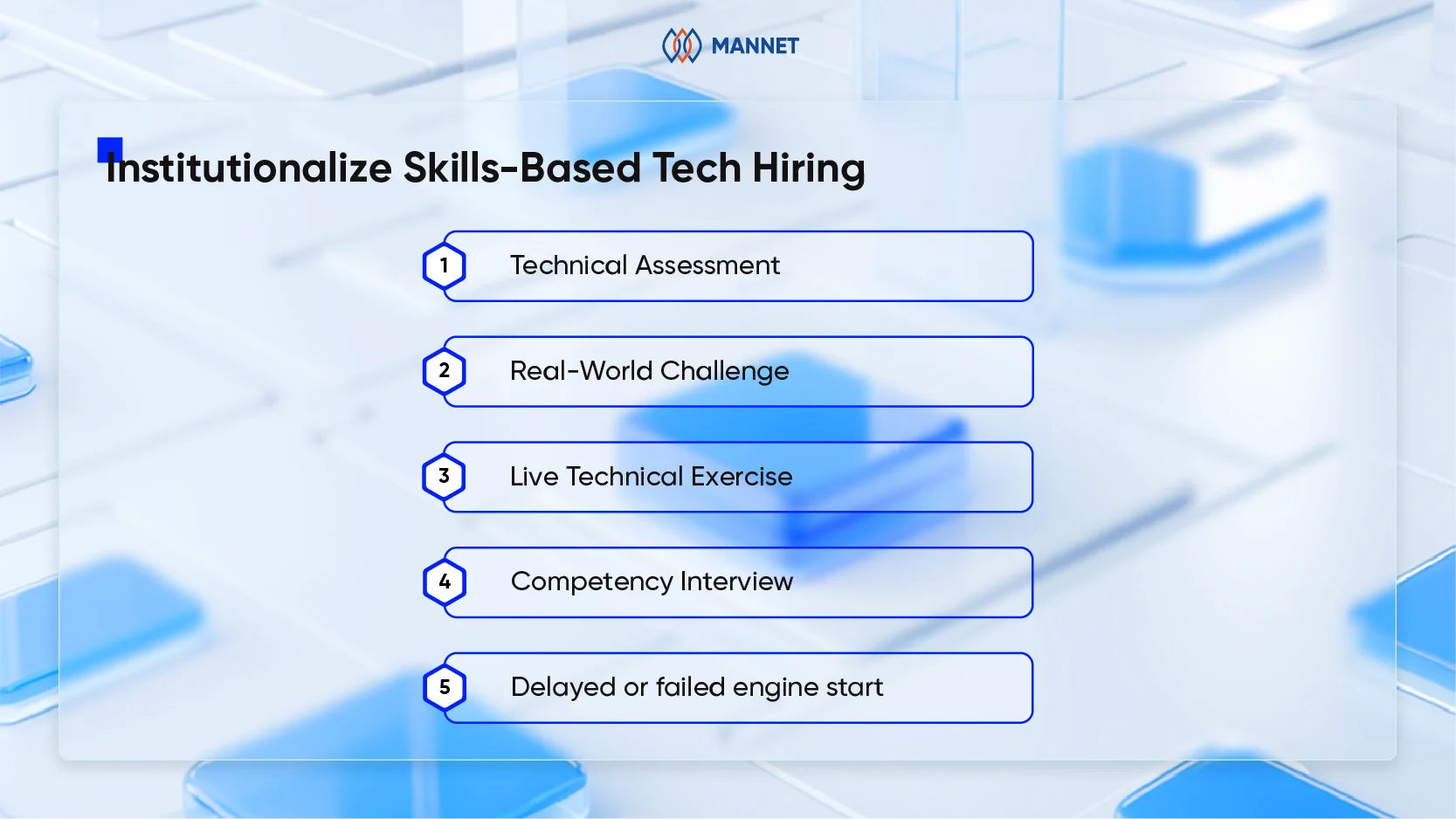
- Use technical assessments to evaluate role-specific skills consistently across candidates.
- Incorporate practical coding challenges or take-home assignments that reflect real-world work.
- Include live problem-solving exercises to assess collaboration, communication, and technical thinking.
- Structure interviews around competencies and measurable past achievements rather than credentials alone.
- Adopt standardized evaluation criteria to improve consistency and reduce bias in hiring decisions.
Pro tip
Start by reviewing your job descriptions. Prioritize the skills, outcomes, and capabilities required for success in the role, while removing unnecessary degree requirements or rigid experience thresholds. This simple change can significantly expand access to qualified technology talent.
9. Unlock Workforce Elasticity Through IT Staff Augmentation
Not every hiring need requires a permanent employee.
As technology projects become more dynamic, organizations need workforce strategies that balance long-term capability building with the flexibility to scale resources up or down as business demands change. Relying exclusively on permanent hiring can create delays when project timelines move faster than recruitment cycles.
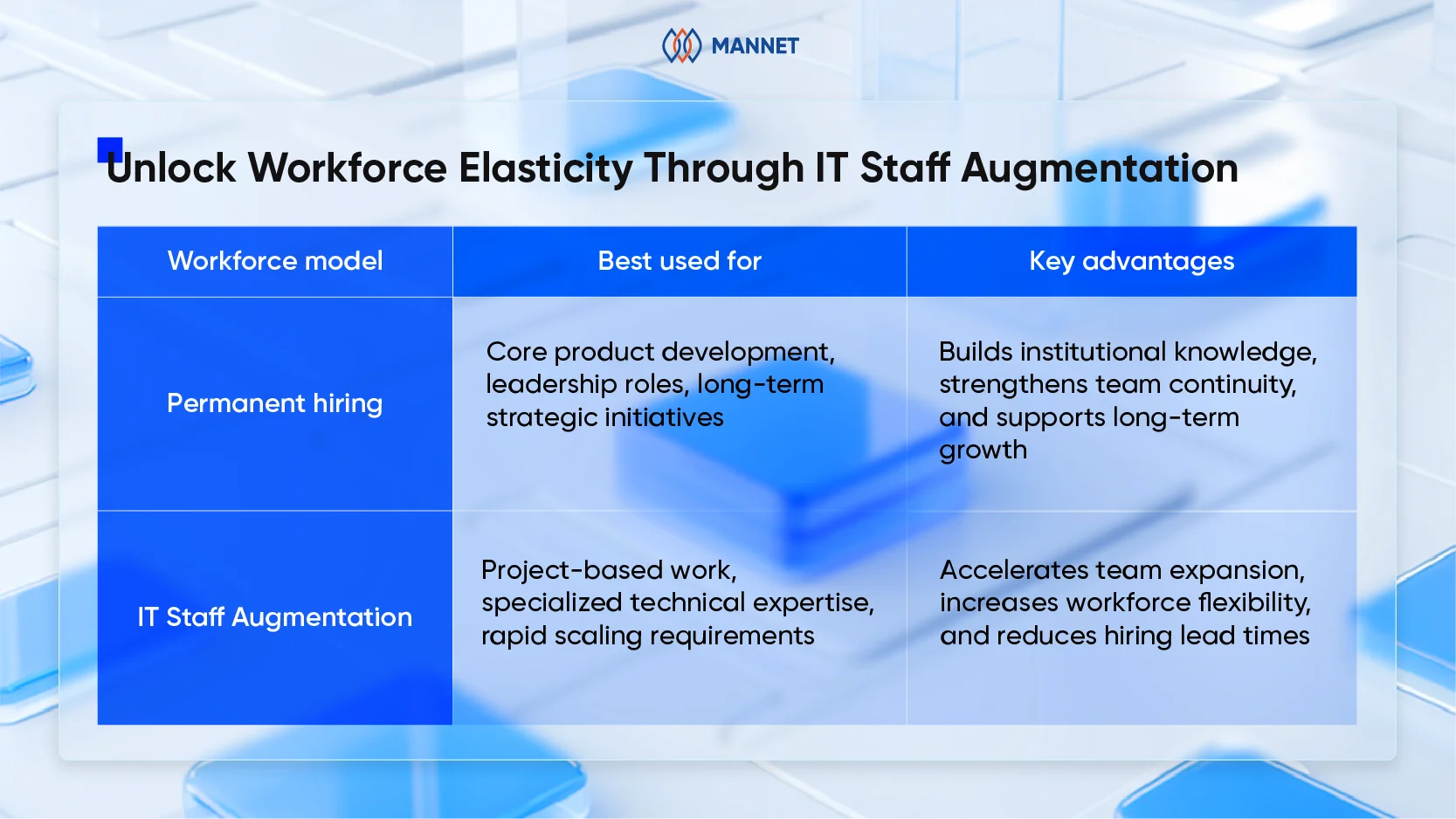
When augmentation wins over permanent hiring:
- Projects require niche expertise in areas such as AI, Data Engineering, Cloud, Cybersecurity, or emerging technologies.
- Delivery timelines cannot accommodate traditional hiring cycles.
- Additional capacity is needed while permanent recruitment is still in progress.
- Organizations want to scale engineering resources quickly without committing to long-term headcount expansion.
IT Staff Augmentation bypasses traditional recruitment drag, eliminates overhead costs tied to permanent local payroll, and allows teams to scale up or down in direct response to real-time development cycles. For organizations actively scaling engineering capacity – including hiring software developers or QA engineers – augmentation provides a structural speed advantage that permanent-only hiring cannot match.
10. Augment Sourcing with AI and Predictive Analytics
AI-powered recruitment tools are now standard in high-performing talent acquisition functions. Organizations deploying them thoughtfully gain measurable edges in sourcing speed, screening accuracy, and candidate engagement. Those treating AI as a replacement for recruiter judgment tend to get the tradeoffs backwards.
High-ROI AI allocations in tech recruiting:
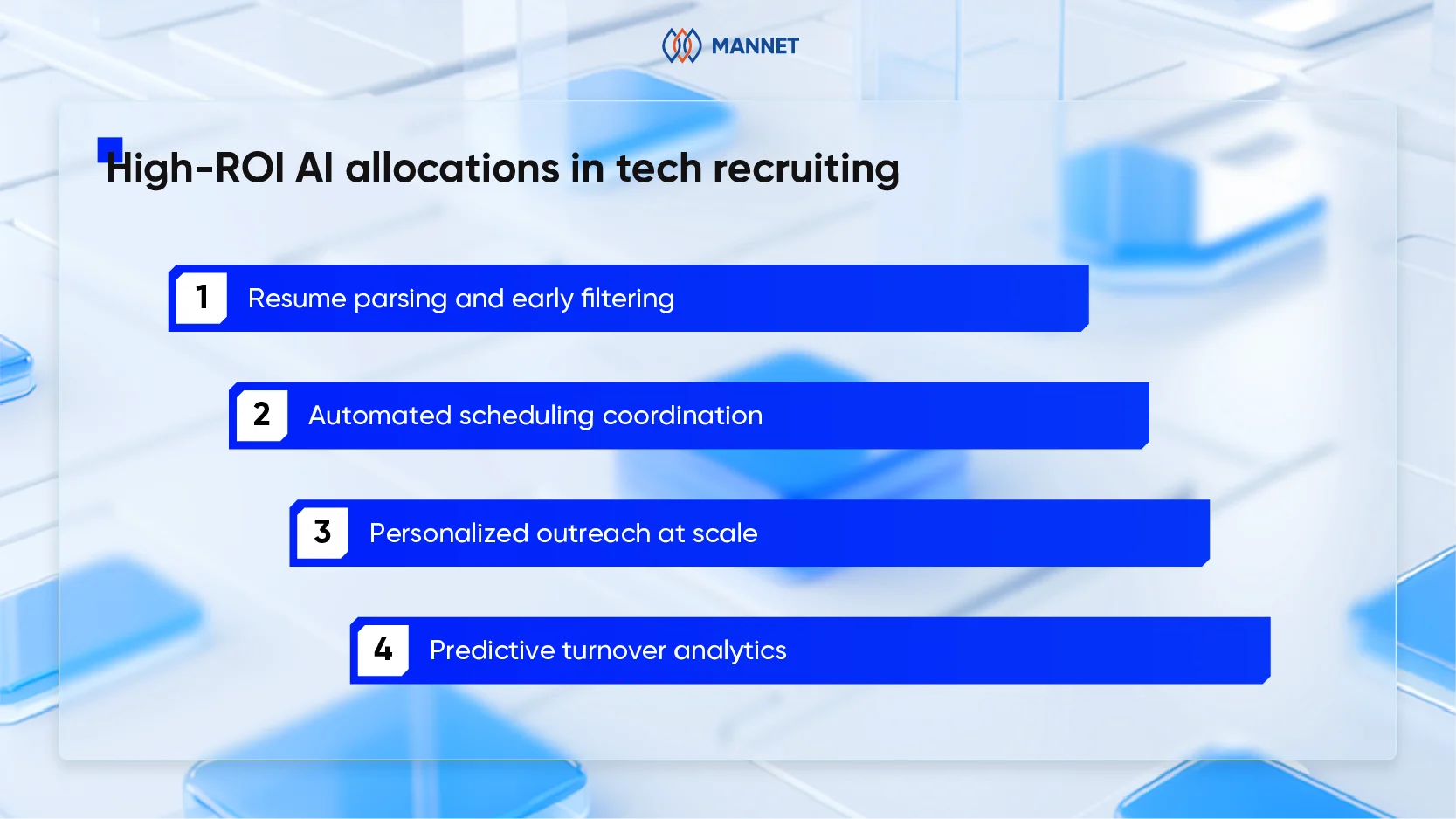
- Resume parsing and early filtering: surface matching profiles faster; reduce unconscious bias at initial stages
- Automated scheduling coordination: eliminate back-and-forth calendar management entirely
- Personalized outreach at scale: maintain a human tone across high-volume candidate communications
- Predictive turnover analytics: identify early signals of flight risk among current high-performers before a gap opens
According to SHRM’s 2025 data, 51% of organizations already use AI in recruitment, most commonly for JD generation (66%) and resume screening (44%).
The enterprise TA dashboard – metrics every team must be tracking:
- Time-to-Fill
- Time-to-Hire
- Source-of-Hire ROI
- Offer Acceptance Rate
- Quality-of-Hire
- First-Year Retention
Each metric tells a different story. Time-to-fill reveals pipeline depth. Offer acceptance rate signals EVP strength. First-year retention is the ultimate verdict on whether the entire process is working. For a deeper breakdown of how these connect, ManNet’s Recruitment Funnel Playbook maps each KPI to its corresponding funnel stage.
11. Refine the Candidate Experience Into a Brand Asset
Every interaction in your hiring process, from the job listing to the final debrief, shapes how candidates perceive your organization. For senior tech talent with multiple offers on the table, a poor experience doesn’t just cost you a hire. It costs you referrals, online reputation, and future pipeline quality.
The data is unambiguous:
- 66%of tech professionals say a positive, transparent interview loop directly influenced their decision to sign an offer
- 26%have actively walked away from disorganized or opaque evaluation processes
- Leading friction points: unclear communication, inconsistent timelines, and interviews with no structured evaluation criteria
Actionable fixes that move the needle immediately:
- Simplify the apply flow: audit your own application process end-to-end; every unnecessary step increases drop-off
- Set communication SLAs: candidates should never be left in silence; establish explicit follow-up windows at each stage
- Structure your technical interview loop: candidates should know what’s being assessed and why; interviewers should evaluate against consistent rubrics
- Deliver timely feedback: even a brief, respectful rejection sent promptly leaves a lasting positive impression
- Survey candidates post-process: rejected and hired; the signal from both groups is invaluable for continuous improvement
Candidates who don’t receive an offer but walk away feeling respected are more likely to reapply, refer colleagues, and speak positively about your organization. Every touchpoint is a branding moment.
12. Re-Engage Historical Pipelines and Corporate Alumni
Your talent database is one of the most underutilized assets in recruitment.
Many organizations invest significant time and resources in building candidate pipelines, only to restart sourcing from scratch whenever a new vacancy opens. In reality, past candidates who were once strong contenders may now have new skills, different career goals, or greater openness to new opportunities.
Re-engaging historical talent pipelines
- Tag and categorize high-potential candidates within your ATS, particularly those who progressed to later interview stages.
- Review previous finalist and runner-up candidates before launching external sourcing campaigns.
- Personalize outreach by referencing prior interactions and clearly explaining why the new opportunity may be relevant.
- Maintain periodic communication with promising candidates to keep relationships active over time.
Activating alumni networks
Former employees can also be a valuable source of future talent. Many organizations have successfully rehired “boomerang employees” who return with additional skills, broader industry experience, and a deeper understanding of the business.
To maintain strong alumni relationships:
- Create alumni communities through LinkedIn groups, newsletters, or professional networking channels.
- Share company updates, career opportunities, and industry insights with former employees.
- Invest in positive offboarding experiences that leave the door open for future collaboration.
- Host occasional alumni events to strengthen long-term engagement and professional connections.
13. Diversify Sourcing Channels and Build Strategic Campus Partnerships
Over-reliance on a single sourcing channel is a single point of failure in your talent supply chain.
High-performing talent acquisition functions run multiple channels simultaneously – continuously measuring performance and reallocating effort toward what converts.
Sourcing channels:
| Channel | Strength | Best for |
| Professional reach, InMail | Senior roles, passive outreach | |
| Job boards (Indeed, tech-specific) | Volume | Mid-level, active candidates |
| Employee referrals | Highest quality-of-hire | All levels |
| GitHub / Stack Overflow | Technical signal | Specialized engineering |
| Campus partnerships | Early pipeline | Entry-level, graduate hires |
| Staff augmentation partners | Speed + pre-vetting | Urgent, niche, or scaled tech hiring |
Elevating campus recruitment beyond transactional career fairs:
- Sponsor deep technical research or capstone projects at universities with relevant CS/IT programs
- Embed senior engineers as guest lecturers to build genuine brand equity among students before they enter the open market
- Create structured internship-to-permanent pathways that convert top emerging talent before competitors see them
- Build a dedicated graduate landing page showcasing growth trajectories, mentorship, and technical culture
For organizations scaling engineering capacity rapidly – including permanent hires, contract resources, and dedicated offshore teams – IT Staff Augmentation provides the channel agility to meet demand without depending on any single sourcing stream.
14. Standardize the Recruiter-Hiring Manager Partnership
Misalignment between TA and hiring managers is one of the primary drivers of hiring drag and candidate drop-off.
When these two parties are out of sync, the consequences cascade: unclear briefs lead to wasted sourcing cycles, slow feedback windows lose candidates to faster-moving competitors, and inconsistent evaluation criteria produce unpredictable hiring outcomes.
The partnership charter – ground rules that eliminate friction:
- Mandate a formal kick-off alignment sync before any role goes live: lock down the non-negotiables, define what “great” looks like, and document it
- Set explicit SLA windows: hiring managers must submit interview feedback within 24-48 hours; candidates are evaluating you on this timeline too
- Establish a weekly data review cadence: track active roles, funnel metrics, and market feedback; adjust sourcing parameters when compensation or availability drifts from initial projections
- Share market intelligence openly: if the role spec is unrealistic or below-market compensation is causing offer declines, surface this in week one, not week six
- Recognize joint wins: when a hire works out, acknowledge it as shared ownership; this builds the partnership’s credibility and sustains the collaboration over time
When this relationship is optimized, everything downstream becomes more efficient: briefs are sharper, screening is more targeted, offers move faster, and hiring decisions carry genuine confidence.
15. Merge Onboarding Into the Full Talent Acquisition Lifecycle
The recruitment process concludes when the employee successfully integrates and delivers outcomes.
Research shows 86% of new hires determine their long-term commitment within the first six months. A structurally weak onboarding experience doesn’t just risk early attrition, it actively destroys the ROI of every sourcing hour, interviewer hour, and offer negotiation that preceded it.
The pre-onboarding phase (offer acceptance → Day 1):
- Send proactive, personalized welcome communications immediately after signing
- Provision equipment, system access, and tool credentials before the first day – eliminate the “nothing works on Day 1” experience entirely
- Share a structured first-week agenda so new hires arrive with clarity, not anxiety
The 30/60/90-day success roadmap:
- Set graduated, measurable milestones– what does success look like at each stage? Define it explicitly, not generically
- Schedule regular manager check-ins(not ad hoc) to surface concerns before they become flight risks
- Implement a peer buddy framework– pair new hires with an internal mentor to accelerate cultural integration and reduce the overwhelm of a new environment
For organizations operating distributed teams or engaging talent through IT Staff Augmentation or IT Recruitment Services, onboarding complexity multiplies across time zones, legal frameworks, and engagement models. Qualifying a consistent, genuinely integrative experience – regardless of location – requires deliberate design, not improvisation.
Summary: Turning Recruitment Strategy into Hiring Results
The gap between knowing these strategies and executing them consistently is where most organizations lose ground. Organizations that consistently attract and retain top technology talent tend to share four characteristics:
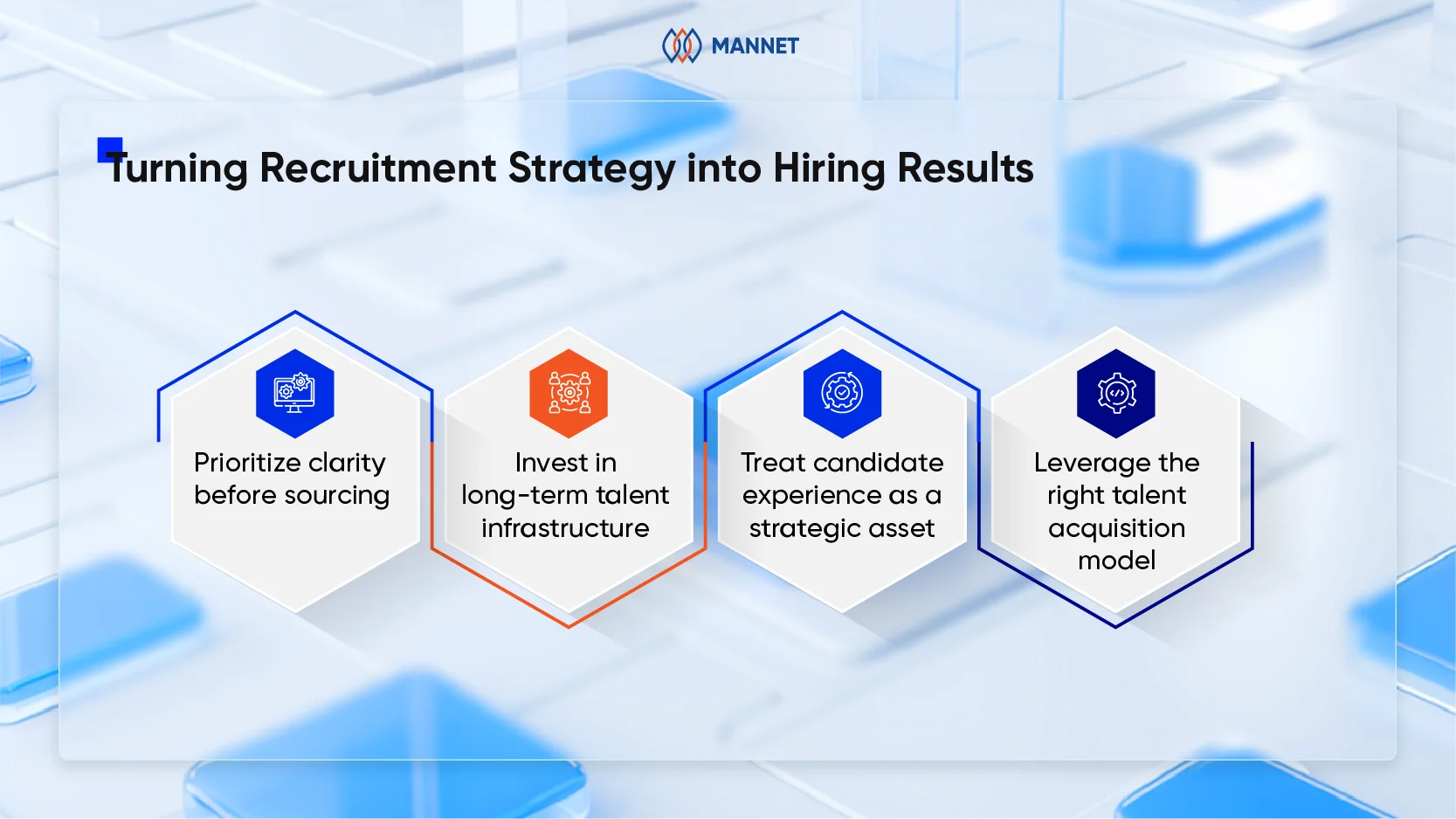
Prioritize clarity before sourcing
Define hiring needs, success criteria, and skill requirements before launching recruitment efforts. Clear hiring objectives lead to stronger candidate pipelines and better hiring outcomes.
Invest in long-term talent infrastructure
Talent pipelines, employer branding, referral programs, and skills-based hiring frameworks require time to build, but they deliver compounding value over time.
Treat candidate experience as a strategic asset
Every interaction shapes how candidates perceive your organization. Transparency, responsiveness, and professionalism can significantly influence hiring success and employer reputation.
Leverage the right talent acquisition model
Not every hiring challenge should be solved the same way. Depending on business needs, organizations may benefit from a combination of direct hiring, staff augmentation, workforce consulting, and recruitment outsourcing strategies.
In specialized markets – particularly IT talent in emerging hubs like Vietnam – the most valuable hiring decision is often recognizing when internal sourcing capacity has reached its ceiling. Whether the need is targeted direct placement through IT Recruitment Services, immediate scale through IT Staff Augmentation, or foundational infrastructure through HR Consultation & Set-up, the right external partnership compresses timelines that would otherwise take years to build internally.
Frequently Asked Questions about Recruitment Strategies
What are the most effective recruitment strategies for hiring tech talent in 2026?
The most effective recruitment strategies include skills-based hiring, proactive talent pipeline development, employee referral programs, employer branding, multi-channel sourcing, AI-assisted recruitment, and structured candidate experience management. Organizations that combine multiple strategies typically achieve better hiring outcomes than those relying solely on job postings.
How can companies attract passive technology candidates?
Attracting passive candidates requires proactive sourcing, personalized outreach, strong employer branding, and consistent engagement through professional communities, industry events, and talent networks. Building relationships before a role becomes available is often more effective than recruiting only when vacancies arise.
What is the difference between IT recruitment and IT staff augmentation?
IT recruitment focuses on hiring permanent employees for long-term organizational needs, while IT staff augmentation provides access to external technical talent for project-based or short-term capacity requirements. Many organizations use both approaches as part of a broader workforce strategy.
How can organizations reduce time-to-hire for technical roles?
Companies can shorten hiring timelines by maintaining active talent pipelines, leveraging employee referrals, simplifying interview processes, re-engaging previous candidates, and using recruitment technology to automate administrative tasks such as sourcing and scheduling.
When should a company consider Recruitment Process Outsourcing (RPO)?
RPO is often a good fit when organizations need to scale hiring quickly, improve recruitment efficiency, access specialized sourcing expertise, or build a more structured recruitment function without significantly expanding internal talent acquisition teams.
Final Verdict
Technology recruitment has become a strategic business function rather than a purely operational HR activity. As competition for skilled talent continues to intensify, organizations that rely on reactive hiring approaches will increasingly struggle to meet growth objectives.
The most successful companies build recruitment capabilities that scale with the business: developing strong employer brands, nurturing talent communities, engaging passive candidates, embracing skills-based hiring, and continuously optimizing their hiring processes through data and technology.
While no single strategy guarantees hiring success, the organizations that consistently apply these principles are better positioned to attract, hire, and retain the talent needed to drive innovation and long-term growth.
For organizations looking to strengthen their technology hiring capabilities, exploring specialized solutions such as ManNet’s IT Recruitment Services, IT Staff Augmentation, and Recruitment Process Outsourcing (RPO) can provide additional flexibility and access to highly competitive talent markets.